
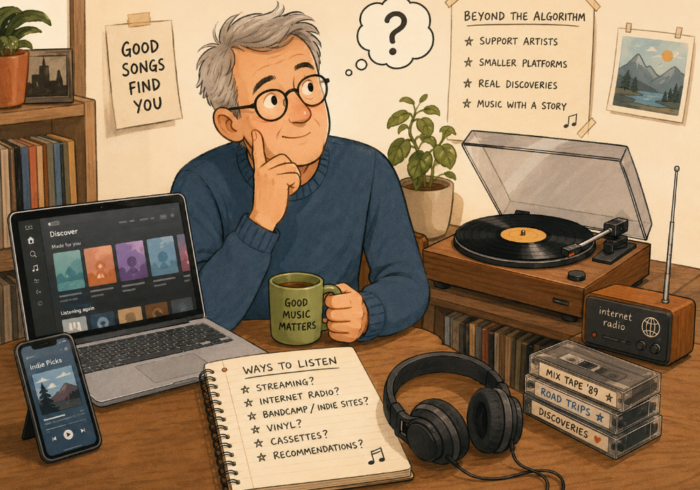
I have written before on Just Me about my doubts concerning music streaming. Not because streaming is inherently bad. Having almost every piece of recorded music available within seconds is still quite remarkable. But I increasingly wonder whether unlimited access has also made listening a little too easy, too passive and too dependent on algorithms.
That is probably why I keep looking for other ways to listen to music. Sometimes that means trying new services and apps. Sometimes it means internet radio. And sometimes I simply go backwards and put on a vinyl record or even a cassette. Less convenient perhaps, but also a very different way of listening.
So I was immediately interested when I came across an essay by Amaya Lim on Pigeons & Planes about possible alternative futures for music streaming. Rather than proposing one giant Spotify replacement, the article points to a surprisingly diverse collection of smaller services, communities and even dedicated hardware. See here for the article: https://www.pigeonsandplanes.com/read/alternative-futures-of-music-streaming-essay.
Cantilever: streaming with an editor
One of the most interesting examples is Cantilever (https://www.cantilever-music.com/). You could roughly describe it as a Mubi for music. Instead of offering millions of tracks and letting an algorithm decide what you should hear next, Cantilever presents a much smaller, rotating catalogue selected by humans. The service works directly with independent labels and combines music with editorial context. The idea is that music should be in the foreground again, rather than becoming background noise generated by an endless recommendation system.
I like that idea. Unlimited choice sounds wonderful, but it can also mean that choosing becomes meaningless.
tone: deliberately algorithm-free
Then there is tone, a streaming service being developed by the non-profit organisation sone. It describes itself as artist-built, customisable, AI-free and algorithm-free. You can find it here: https://tone.audio/.
tone was still in an invite-only alpha phase when this article was posted to Just Me, so this is very much an experiment rather than a finished Spotify competitor. But the underlying idea is interesting: create a streaming platform around the needs of artists and listeners rather than around recommendation algorithms and advertising.
Both tone and Cantilever are also experimenting with user-centric payments. In simple terms, your subscription money is distributed according to what you listen to instead of disappearing into one enormous pool based on everybody’s streams.
Mirlo: buy the music again
Mirlo takes another route altogether. It is an open-source platform where artists can sell music directly. See here: https://mirlo.space/. That may sound almost old-fashioned. And perhaps that is exactly the point.
Instead of paying every month for temporary access to an enormous catalogue, you can actually buy music again. That creates a much more direct relationship between musician and listener and also means that your music collection can once again become something you actually own.
Subvert: a cooperative Bandcamp alternative
A similar idea sits behind Subvert. The project presents itself as an alternative to Bandcamp (https://bandcamp.com/), but with an important difference: it is collectively owned and governed by artists, labels and listeners. See here: https://www.subvert.fm/.
Fans can become members and participate in decisions about the platform. Artists started creating pages before the public launch in May 2026. In other words, this is not simply another online shop for music. It is also an experiment in what happens when the people using a platform have some actual influence over how it develops.
turntable: music as a social space
The author of the Pigeons & Planes article is herself building turntable. It started as a way to analyse and visualise playlists, but gradually evolved into something that combines several ideas: a music community, a discovery service, a library-unification tool and a place for sharing curated music. You can apply here: https://turntable.fyi/auth/application.
The description I particularly like is wonderfully simple: a place online just for music. That sounds almost trivial. But compare it with today’s giant platforms, which increasingly want to become your destination for music, podcasts, audiobooks, video, advertising, social features and whatever comes next. A small place that is simply about music suddenly sounds rather refreshing.
Evenings.FM: rethinking internet radio
Evenings.FM (https://evenings.fm/) immediately caught my attention because of my interest in internet radio. It combines software with a hardware device called Sol. Sol can broadcast live audio so that, in principle, almost any location can become a radio station. The Evenings website then provides the infrastructure for scheduling, archiving and streaming those broadcasts.
More importantly, the whole thing revolves around human curation: radio stations select hosts, hosts select artists and music, and listeners discover things through people rather than through behavioural profiling. That is much closer to the way I like discovering music anyway: somebody plays something unexpected and I think, what on earth is this?
Sleevenote: making digital music physical again
Perhaps the strangest—and therefore one of the more interesting—ideas in the article is Sleevenote (https://sleevenote.com/). This is not another streaming platform at all. It is a dedicated digital music player with a square touchscreen designed to put album artwork back at the centre of the experience. Think of something somewhere between an old iPod and a digital record sleeve.
As far as I can tell (I haven’t tried Sleevnote yet) the idea would probably work particularly well together with services such as Bandcamp, Mirlo or Subvert. You buy music, put it on your own player and deliberately listen to albums again instead of endlessly skipping through an unlimited catalogue.
And yes, that sounds suspiciously like reinventing the Walkman. Which may not be such a bad thing.
Maybe there shouldn’t be one Spotify replacement
The most interesting conclusion from all these projects is that as far as I can tell none of them really wants to become the new Spotify. Streaming has conditioned us to expect one enormous service containing everything. But music did not work that way in the past. We had record shops, radio stations, magazines, mixtapes, friends recommending obscure bands, concerts, record collections and people lending each other albums. It was fragmented. Sometimes inconvenient. And often much more interesting.
Services such as Cantilever, tone, Mirlo, Subvert, turntable and Evenings seem to be experimenting with precisely that idea: not replacing one giant music ecosystem with another giant music ecosystem, but creating lots of smaller ones. And perhaps I will simply combine them with vinyl, cassettes and internet radio. That sounds considerably more fun than pressing Discover Weekly and hoping for the best.