How Did I Miss Radio Browser?

I am a big fan of internet radio. There is something wonderful about finding a station you have never heard before and suddenly discovering music that is completely new to you. And unlike many streaming services, internet radio still has that element of surprise. You don’t really know what is coming next.

Most of the stations I listen to were discovered more or less by accident. SomaFM (https://somafm.com), for example, was one of those discoveries. It is an independent, listener-supported internet radio network with more than 30 channels, many of them focused on music that sits comfortably outside the mainstream.

My favourite station, however, came to me in an even more traditional way: I first heard it on FM radio while in France. It is Radio Pays de Gueret, a local community station broadcasting from the relatively small city of Guéret on 96.5 FM. Its music programming is wonderfully unpredictable. You might hear some old jazz, followed by metal, then a French chanson, some hip-hop and perhaps Caribbean music. On paper, that sounds like a recipe for complete musical chaos. Yet somehow it works. There is a certain logic to the lack of logic, which is probably one of the reasons I keep listening. You can them here: https://www.radiopaysdegueret.fr.

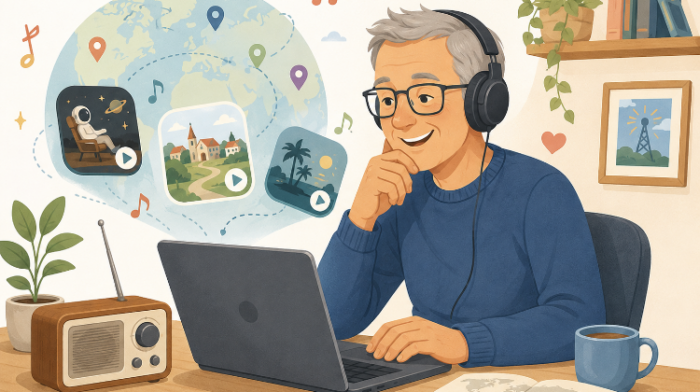
Given how much I like internet radio, I was therefore slightly surprised to discover that I had never heard of Radio Browser (https://www.radio-browser.info/). Radio Browser is basically a community-driven directory of internet radio stations. It is free and provides an open API that is used by all kinds of radio apps, websites and other projects. You can simply search for stations on the website itself, but there is also a list of applications and services that use its database.

And that is where it becomes dangerous. At least if, like me, you enjoy disappearing down little internet rabbit holes. I have already spent quite a bit of time browsing through the stations, apps and projects listed there, and every time I look I seem to find something new and interesting. A new player, an unusual station from somewhere on the other side of the world, or simply another way of exploring radio.

That, for me, is still one of the nicest things about internet radio. It is not necessarily about finding exactly the music you already know you like. It is about hearing something you didn’t know existed.

How a Red Sony Walkman Brought My Cassette Collection Back to Life

There is something strangely magical about pressing play on a cassette player. It is not the easiest way to listen to music. The sound quality is not perfect, the tape can wear out, and sometimes you have to rewind before you can hear a favourite song again. Yet, for many music lovers, that is exactly the charm.

While the world has moved almost completely towards streaming, a growing number of people are rediscovering physical music formats. Vinyl has already made its impressive comeback, but another, more unexpected format is also attracting attention: the cassette tape.

Websites and blogs dedicated to cassette collections, such as Hails & Ales or in The Netherlands where I live Platomania, show that there is still a passionate community around this small plastic box with magnetic tape inside. These collectors are not simply looking for the best possible audio quality. They are looking for a connection with music.

And that connection is something I completely understand.

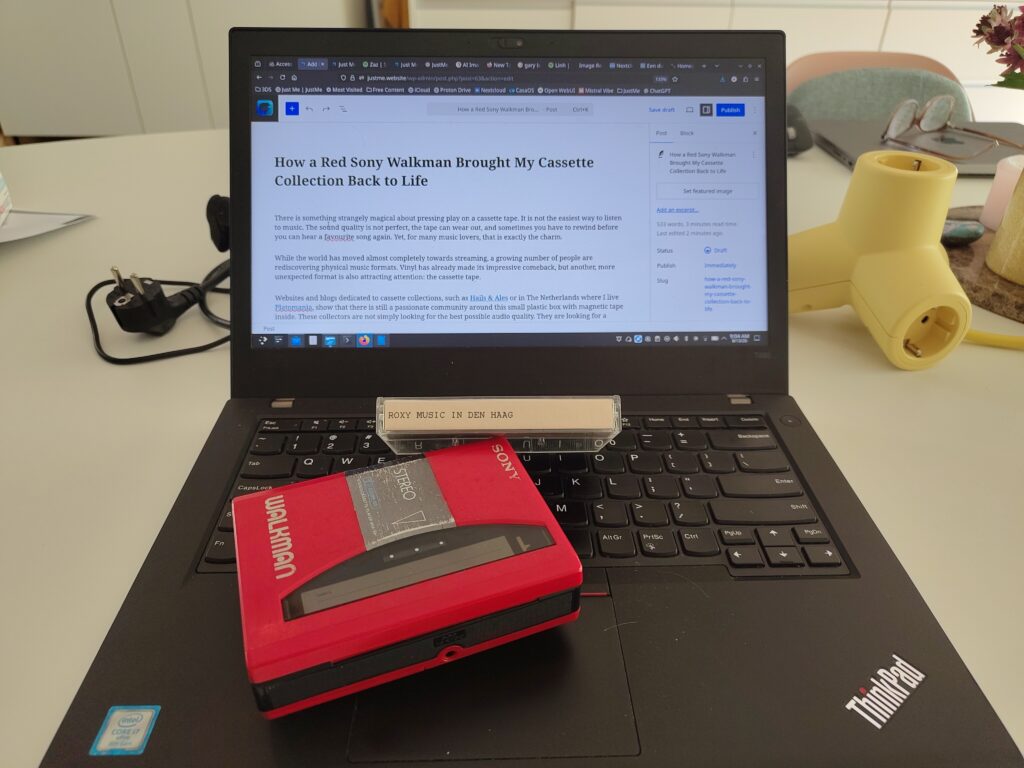
Earlier this year, I bought a bright red second-hand (third-hand or maybe even seventeenth-hand?) Sony Walkman. It was not a practical purchase. In fact, from a purely technical perspective, it makes little sense. I have access to millions of songs through streaming services. I have high-quality digital files at home. I can listen to music anywhere, anytime.

But I bought that Walkman for one specific reason: a cassette recording I have been keeping for years. It is a recording of a Roxy Music concert in The Hague. A fantastic performance by a band that was always about atmosphere, detail and musicianship. When I put that cassette into the Walkman and press play, something remarkable happens. The music itself is already special, but then there is the mechanical sound of the Walkman: the tiny motor running, the subtle noises from the tape mechanism, the feeling that the music is physically moving through the device. That combination creates a completely different atmosphere.

The little imperfections become part of the experience. The slight hiss, the mechanical sounds, the fact that this is not a perfectly clean digital stream — they all add something human. It feels less like playing a file and more like opening a small time capsule.

Of course, my new Walkman did not arrive quickly. Earlier this year, The Netherlands experienced a period with unusually heavy snowfall, and deliveries were delayed. For a while, I was wondering when my little red music machine would finally arrive. But when it finally appeared, the wait was completely worth it.

That is why I enjoy following websites and communities that focus on cassette music. They understand that listening to music is not only about convenience or technical perfection. It is also about memories, stories and rituals.

At home, I still have a small collection of cassettes. Some are old recordings that have been with me for decades. Others are newer releases that show that the format is not just a nostalgic curiosity. Among them are tapes from the Dutch band Alquin, a group that played an important role in the Dutch progressive rock scene. And I also have a much newer cassette release from Cigarettes After Sex, proving that even modern artists see value in this old-fashioned medium.

The Little Jump That Was Supposed to Be There (But Wasn’t)

In an earlier post, Why I Still Return to CDs, Vinyl and the Imperfect Sound of Music, I wrote about why I keep returning to physical music. Streaming is wonderfully convenient, of course, but CDs and vinyl offer something else. They carry traces of use. They can age. They can become associated with particular rooms, particular people and particular periods of your life. And sometimes even their defects become part of the music.

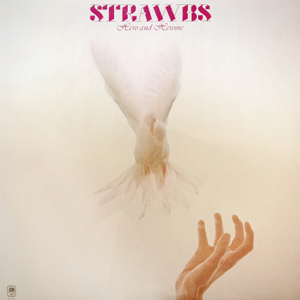
I was reminded of that recently by an album I loved when I was much, much younger: Hero and Heroine by the English band The Strawbs. At the time, I played that record a lot. The opening song especially was exactly to my taste. I knew it well, probably far better than I realised. But there was something unusual about my copy of the record. Somewhere near the beginning of that first song, there was a small piece of damage in the groove. Because of that little scratch the needle always made a little jump.

Photo: Wikipedia

At least, that is how I remember it. It was not dramatic. The record did not get stuck in an endless loop, nor did the stylus suddenly skate across half the song. It was just a tiny interruption. A fraction of a second in which something was missing or shifted. And after hearing it often enough, that little jump stopped being damage. It became part of the song.

I did not consciously think about it that way. I never sat there analysing the timing of the skip or wondering exactly which note disappeared. It simply became embedded in my memory of the music. The song, as far as I was concerned, contained that tiny stumble.

The version in your head

Years passed. Many years, in fact. At some point I more or less forgot about The Strawbs and Hero and Heroine. Other music appeared, formats changed, CDs replaced vinyl for everyday listening and eventually streaming made almost everything instantly available.

Then, many years later, I rediscovered The Strawbs. I still remember exactly where I was: in a fashion store, waiting for my two daughters to finally decide which clothes they were going to buy. I was listening to music on Spotify when, all of a sudden, the algorithm mysteriously decided to recommend The Strawbs.

Finding the band and the album again felt like finding a small piece of my own past. I was genuinely eager to hear it. There is something fascinating about returning to music you loved when you were young. You are not only listening to the recording. You are also listening for yourself.

The recording Spotify played for me sounded fine. Better than fine, probably. The digital version was clean. There was no surface noise, no worn groove and certainly no damaged section of vinyl.

But there was also no little jump.

And that was the problem. Because the correct version of the song didn’t sound right.

When an imperfection becomes information

It is a strange thing when you think about it. From a purely technical perspective, the modern version was obviously superior. It reproduced the recording as it was intended to be heard. Nothing was missing. Nothing had been damaged. The playback mechanism was not introducing an error. Yet my brain disagreed. Somewhere over all those repeated plays decades earlier, I had stopped hearing the skip as an error. My memory had absorbed it into the structure of the song. The damaged record had effectively created my own private edition of Hero and Heroine. Nobody in the studio had intended that tiny interruption. The musicians had not played it. The producer had not mixed it. It was not on the master tape. But it was on my record.

Music is also memory

Perhaps this tells us something about the way we actually experience music. We tend to talk about recordings as though there is one definitive version. There is a master recording, and every playback system is supposed to reproduce it as accurately as possible. But listeners do not experience master recordings. We experience moments. We hear a particular song through a particular loudspeaker in a particular room. We hear it in a car, on headphones, at a party or late at night when everyone else is asleep.

It is a bit like that delicious bottle of wine you discover during a holiday in the south of France. You enjoy it so much that you buy a few bottles to take home. But when you open one back home, somehow it does not taste quite the same. The Mediterranean atmosphere was an important part of what made that wine so special: the warmth of the sun, the surroundings, the food, perhaps even the mood you were in. Take all of that away, and although the wine itself has not changed, the experience has.

Why I Still Return to CDs, Vinyl and the Imperfect Sound of Music

For many people, music has become something almost invisible. It is everywhere, all the time. A few taps on a smartphone are enough to summon almost any song ever recorded. Streaming services have made music more accessible than any generation before us could have imagined. Yet something has changed along the way: the relationship between listener and music.

An interesting reflection on this comes from an article on Pigeons & Planes called “The Lost Joy of Music Piracy: What.CD, Oink, and the Banalities of Streaming”, written by Eden DaSilva. The article looks back at the strange and fascinating world of early online music communities such as Oink and What.CD, and explores how those platforms created a different kind of relationship with music. You can read Eden DaSilva’s original article on Pigeons & Planes.

The title may sound surprising. After all, music piracy is usually discussed in terms of lost revenue, copyright violations and damage to artists. But DaSilva’s article focuses on something else: the passion, curiosity and discovery that existed in some of these online communities. These were not simply places where people downloaded files. They were often communities of music enthusiasts who searched for rare recordings, discussed albums in detail and treated music collections almost like digital record stores or personal archives.

And that idea made me think about my own relationship with music.

Convenience is not the same as connection

Streaming is incredibly convenient. I use it myself. Being able to discover new artists, explore unfamiliar genres and instantly find a song that has just crossed my mind is something I would not want to lose.

There is also something wonderful about discovering music completely by accident. One warm summer evening, I was walking through an old town in France when I heard music drifting out of an open window somewhere above the street. I stopped, took out my phone and opened Shazam. Within seconds it identified the artist as Linh, a French singer I had never heard of before. You can find her here on Spotify.

I started listening to more of her music and was immediately drawn to her wonderful voice and songs that seem to contain an enormous amount of attention to small musical details. And, as so often happens with music, one discovery led to another. Through Linh I started exploring other French artists and eventually found singers such as Zaz on Spotify, whose distinctive voice and mixture of French chanson, pop and jazz opened yet another musical door. That is perhaps one of the nicest things about modern digital music: sometimes all it takes is an open window, a summer evening and Shazam to send you down a completely new musical path.

But convenience is not the same as connection. Sometimes I deliberately move away from streaming and return to music that I actually own. I still have a collection of CDs, and rather than letting them disappear into a cupboard somewhere, I have made them available through my own media server using Jellyfin and Plex. (I can never decide which option is perfect for me).

Using these apps, those albums become part of my personal digital library again. They are not just something I temporarily access through a subscription service. They are my collection, selected over decades, containing memories and associations. There is something satisfying about opening that library and seeing albums that I chose myself. There is a story behind many of them: where I bought them, when I discovered the artist, which period of my life they are connected to.

It is a very different experience from opening a streaming service and being presented with a seemingly endless collection of playlists and recommendations selected by an algorithm.

Hunting for little gems

The same feeling applies even more strongly to vinyl. Whenever I visit vintage stores, I keep an eye open for old records. These are not necessarily expensive collector’s items. In fact, the most interesting discoveries are often the unexpected ones: forgotten albums sitting quietly between hundreds of others, waiting for someone to notice them.

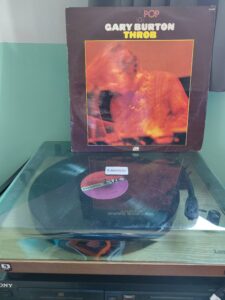
During a visit this summer to the old town of Perpignan in southern France, I walked into a small record store and found exactly such a treasure: Gary Burton’s Throb, a jazz album originally released in 1969. It was not an album I had specifically gone looking for. It was simply one of those discoveries that happen when you browse through physical records instead of typing an artist or album title into a search box.

Back home, I put the record on the turntable. And it sounded incredible.

Or is it the noise?

Of course, a modern digital version streamed in high quality might technically offer cleaner sound. The background noise would be gone. There would be no tiny clicks, no occasional crackle and none of the small imperfections caused by decades of playing and handling a physical record. But perhaps those imperfections are part of the magic. Maybe Throb doesn’t sound incredible despite those little noises. Maybe it sounds incredible partly because of them.

There is something about putting an old record on a turntable and hearing that brief crackle before the music starts. It immediately changes the experience. You know that you are listening to a physical object. A groove cut into a piece of vinyl more than half a century ago is mechanically producing the music that fills the room. Technically, that shouldn’t make the music better. Emotionally, it just might.

A vinyl record is not simply an audio file. It is a physical object that has travelled through time. Its small noises tell a story. They remind you that music is not only about technical perfection. It is also (mostly?) about atmosphere, emotion, memory and the experience of listening.

Perhaps that is why an old jazz record can still feel so alive. The tiny sounds between the notes create a sense of presence. They make you aware that this is not simply another recording being delivered by a digital service. Or an AI tool. It is a performance captured in another era and brought back to life in your own room.

When everything is available

None of this means that streaming is somehow bad. Quite the opposite. Streaming has opened the door to an unimaginable amount of music. Someone discovering jazz today can move from Miles Davis to Charles Mingus, Gary Burton, Keith Jarrett or hundreds of obscure artists within minutes. A teenager can explore music recorded decades before they were born without having to spend a fortune buying records. That is an extraordinary achievement.

But perhaps there is a paradox hidden inside that abundance. When everything is available instantly, individual pieces of music can start to feel less valuable. Discovery becomes effortless. Algorithms suggest what we might like. Playlists replace albums. Songs are skipped after twenty seconds. Music increasingly becomes something running in the background while we work, travel or scroll through our phones. There is always another song waiting. And another.

DaSilva’s article about the old piracy communities is interesting precisely because it reminds us that digital music did not always work like this. Finding music could require effort. People searched, collected, compared different versions and shared discoveries with others. Strangely enough, having less convenient access to music could sometimes create a stronger relationship with it.

Why I Started Just Me

As a journalist, there are many subjects I write about professionally. Technology is an obvious one. So are cloud computing, data centers, cybersecurity, AI and industrial technology. But there are also many subjects that fascinate me personally and that do not always fit neatly into one of the websites, magazines or other platforms I write for.

That is one of the reasons I started Just Me. I wanted a place where I could simply write about the things I find interesting. And there are quite a few of those.

Technology, but not only technology

Technology will certainly be an important part of this blog. I have always been interested in new technologies and in the way they change the world around us. AI is an obvious example, but I am just as interested in developments around open source software, European technology and the growing discussion about digital sovereignty and autonomy.

I find it fascinating to look beyond the individual product or announcement and ask what a development actually means. Who controls the technology we use? Where is our data stored? How dependent have we become on a relatively small number of technology companies? And what alternatives are emerging?

Sustainability is another subject that regularly catches my attention. Particularly when it intersects with technology. Energy, data centers, renewable power, more efficient computing and smarter use of resources are all subjects I expect to return to regularly. European companies are actually at the forefront of developments like these.

Looking a little further away

I have been fascinated by spaceflight for as long as I can remember. And right now, space is becoming particularly interesting again. New launch companies, satellites, lunar missions, reusable rockets, space-based infrastructure and an increasingly important European space industry are creating an enormous number of stories worth following.

Space technology is also becoming much more closely connected to everyday life on Earth. Satellites help us understand climate change, monitor agriculture, improve communications and respond to natural disasters. At the same time, ideas that sounded highly futuristic only a few years ago are gradually becoming serious engineering projects. That makes space exactly the sort of subject I enjoy writing about.

Building my own knowledge system

Another recurring subject will probably be personal knowledge management. I read a lot. I save articles. I make notes. I bookmark websites. I collect ideas for future stories. And, like many people who do this, I am constantly trying to find better ways to organise all that information. That has led me to tools and concepts such as digital notebooks, knowledge graphs, linked notes, RSS, self-hosted services and personal archives. At the moment, I’m using Capacities.io for this. It has quite a steep learning curve, but I have to say: it really works for me!

I am interested not only in the tools themselves, but also in the underlying question: how do you build a useful collection of knowledge without simply creating an enormous digital pile that you never look at again?

Music, blogs and the small internet

Then there is music. I enjoy streaming, but I also like CDs, vinyl records and even cassettes. There is something interesting about the different ways in which we discover, collect and listen to music. Sometimes the technology becomes part of the experience: the crackle of vinyl, the mechanical sound of a cassette player or simply rediscovering an album you had forgotten about for decades.

The same is true for blogs on the indyweb. I have become increasingly interested in personal websites and independent blogs. In a web dominated by enormous platforms, algorithms and automatically generated content, there is something refreshing about discovering a small website maintained by one person who simply writes about things he or she cares about. One post might be about software development. The next about a record they bought. Another about a walk through a city, a book they read or a strange technical problem they finally managed to solve.

There does not always have to be a content strategy behind it. Sometimes somebody simply has something interesting to say.

A place for curiosity

That is roughly what I want Just Me to be. Not a tightly defined technology publication. Not a personal diary either. And certainly not a blog that tries to stay within one carefully selected niche. It is simply a place where I can follow my curiosity. One day that may result in a story about European technology or digital autonomy. Another day it might be about a spacecraft, a useful open source application, a personal knowledge management experiment, an interesting blog I discovered or an old record that suddenly sounds wonderful again.

There is plenty to write about. And that is exactly what I intend to do.