
For many people, music has become something almost invisible. It is everywhere, all the time. A few taps on a smartphone are enough to summon almost any song ever recorded. Streaming services have made music more accessible than any generation before us could have imagined. Yet something has changed along the way: the relationship between listener and music.
An interesting reflection on this comes from an article on Pigeons & Planes called “The Lost Joy of Music Piracy: What.CD, Oink, and the Banalities of Streaming”, written by Eden DaSilva. The article looks back at the strange and fascinating world of early online music communities such as Oink and What.CD, and explores how those platforms created a different kind of relationship with music. You can read Eden DaSilva’s original article on Pigeons & Planes.
The title may sound surprising. After all, music piracy is usually discussed in terms of lost revenue, copyright violations and damage to artists. But DaSilva’s article focuses on something else: the passion, curiosity and discovery that existed in some of these online communities. These were not simply places where people downloaded files. They were often communities of music enthusiasts who searched for rare recordings, discussed albums in detail and treated music collections almost like digital record stores or personal archives.
And that idea made me think about my own relationship with music.
Convenience is not the same as connection
Streaming is incredibly convenient. I use it myself. Being able to discover new artists, explore unfamiliar genres and instantly find a song that has just crossed my mind is something I would not want to lose.
There is also something wonderful about discovering music completely by accident. One warm summer evening, I was walking through an old town in France when I heard music drifting out of an open window somewhere above the street. I stopped, took out my phone and opened Shazam. Within seconds it identified the artist as Linh, a French singer I had never heard of before. You can find her here on Spotify.
I started listening to more of her music and was immediately drawn to her wonderful voice and songs that seem to contain an enormous amount of attention to small musical details. And, as so often happens with music, one discovery led to another. Through Linh I started exploring other French artists and eventually found singers such as Zaz on Spotify, whose distinctive voice and mixture of French chanson, pop and jazz opened yet another musical door. That is perhaps one of the nicest things about modern digital music: sometimes all it takes is an open window, a summer evening and Shazam to send you down a completely new musical path.
But convenience is not the same as connection. Sometimes I deliberately move away from streaming and return to music that I actually own. I still have a collection of CDs, and rather than letting them disappear into a cupboard somewhere, I have made them available through my own media server using Jellyfin and Plex. (I can never decide which option is perfect for me).
Using these apps, those albums become part of my personal digital library again. They are not just something I temporarily access through a subscription service. They are my collection, selected over decades, containing memories and associations. There is something satisfying about opening that library and seeing albums that I chose myself. There is a story behind many of them: where I bought them, when I discovered the artist, which period of my life they are connected to.
It is a very different experience from opening a streaming service and being presented with a seemingly endless collection of playlists and recommendations selected by an algorithm.
Hunting for little gems
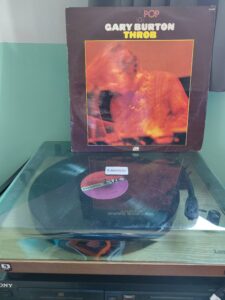
The same feeling applies even more strongly to vinyl. Whenever I visit vintage stores, I keep an eye open for old records. These are not necessarily expensive collector’s items. In fact, the most interesting discoveries are often the unexpected ones: forgotten albums sitting quietly between hundreds of others, waiting for someone to notice them.
During a visit this summer to the old town of Perpignan in southern France, I walked into a small record store and found exactly such a treasure: Gary Burton’s Throb, a jazz album originally released in 1969. It was not an album I had specifically gone looking for. It was simply one of those discoveries that happen when you browse through physical records instead of typing an artist or album title into a search box.
Back home, I put the record on the turntable. And it sounded incredible.
Or is it the noise?
Of course, a modern digital version streamed in high quality might technically offer cleaner sound. The background noise would be gone. There would be no tiny clicks, no occasional crackle and none of the small imperfections caused by decades of playing and handling a physical record. But perhaps those imperfections are part of the magic. Maybe Throb doesn’t sound incredible despite those little noises. Maybe it sounds incredible partly because of them.
There is something about putting an old record on a turntable and hearing that brief crackle before the music starts. It immediately changes the experience. You know that you are listening to a physical object. A groove cut into a piece of vinyl more than half a century ago is mechanically producing the music that fills the room. Technically, that shouldn’t make the music better. Emotionally, it just might.
A vinyl record is not simply an audio file. It is a physical object that has travelled through time. Its small noises tell a story. They remind you that music is not only about technical perfection. It is also (mostly?) about atmosphere, emotion, memory and the experience of listening.
Perhaps that is why an old jazz record can still feel so alive. The tiny sounds between the notes create a sense of presence. They make you aware that this is not simply another recording being delivered by a digital service. Or an AI tool. It is a performance captured in another era and brought back to life in your own room.
When everything is available
None of this means that streaming is somehow bad. Quite the opposite. Streaming has opened the door to an unimaginable amount of music. Someone discovering jazz today can move from Miles Davis to Charles Mingus, Gary Burton, Keith Jarrett or hundreds of obscure artists within minutes. A teenager can explore music recorded decades before they were born without having to spend a fortune buying records. That is an extraordinary achievement.
But perhaps there is a paradox hidden inside that abundance. When everything is available instantly, individual pieces of music can start to feel less valuable. Discovery becomes effortless. Algorithms suggest what we might like. Playlists replace albums. Songs are skipped after twenty seconds. Music increasingly becomes something running in the background while we work, travel or scroll through our phones. There is always another song waiting. And another.
DaSilva’s article about the old piracy communities is interesting precisely because it reminds us that digital music did not always work like this. Finding music could require effort. People searched, collected, compared different versions and shared discoveries with others. Strangely enough, having less convenient access to music could sometimes create a stronger relationship with it.