
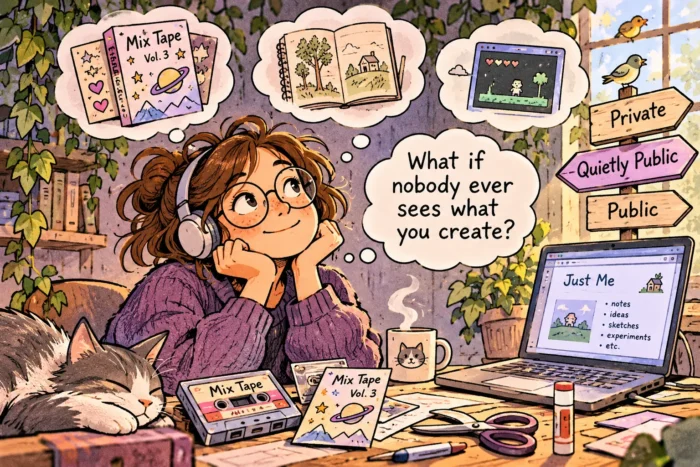
I have a small confession. I’ve developed a fascination with things people make that nobody else is supposed to see. Not secret government documents or mysterious hidden treasures. Nothing that exciting.
I’m talking about drawings tucked away in notebooks. Songs recorded on laptops and never played to anyone. Little stories saved in folders with names like “ideas”, “old stuff” or, my personal favourite, “final version 7 REALLY FINAL”.
And homemade cassette covers. Oh, I love those.
Back when people made mixtapes, some of them would spend ages designing the little paper inserts that slipped into cassette cases. They’re called J-cards, because of the way the folded paper fits inside the case.
People drew on them, cut pictures from magazines, experimented with lettering and squeezed tiny tracklists into whatever space remained. Sometimes the result looked almost professional. Sometimes it looked like somebody had attacked a piece of paper with scissors, glue and enormous enthusiasm.
Which, come to think of it, is exactly what happened.
Some of those little creations were gifts. Others simply accompanied tapes made for their creators’ own enjoyment. No audience, no gallery, no followers. Just a piece of paper that made a cassette feel a little more special.
And now I’m wondering something.
When did making something become so closely connected to showing it to other people?
Wait. Do I have to post this?
Imagine spending a Sunday afternoon making something.
A drawing, perhaps. Or a little piece of music. Maybe you’ve written a poem, although you would rather die than let anyone read it.
You enjoy yourself. You experiment. You make mistakes. You start again. And eventually you finish. Lovely.
But then comes the question. Are you going to share it?
And if you do, should you take a nice photograph first? Perhaps arrange everything on a wooden table, preferably near a window. Add a cup of coffee. Maybe a plant.
There should definitely be a plant.
Then you need a caption. Something natural and spontaneous, which you will probably rewrite six times.
Suddenly your relaxing Sunday afternoon has acquired a marketing department.
How did that happen?
Of course, there’s nothing wrong with sharing something you’ve made. I rather like the idea of showing somebody a drawing and hearing them say, “Oh, that’s wonderful!”
Even if the drawing is objectively a terrible representation of a horse.
But I wonder whether knowing that somebody might see our work changes the way we make it.
Would you still draw the same horse if you knew it would remain in your notebook forever?
Would you make a stranger song?
Write a sillier poem?
Use more purple?
I hope you’d use more purple.
Meet the quietly public people
While looking into this, I came across an idea by artist and writer Carolyn Yoo that made me stop scrolling.
She calls it Quietly Public.
In her essay Go Quietly Public on the Internet (https://cyoo.substack.com/p/quietly-public-on-the-internet), Carolyn suggests that people don’t have to choose between hiding everything they create and turning themselves into constantly visible online personalities.
There is another possibility.
You can make a small place for yourself on the internet. A personal website, perhaps. Or a digital garden where you collect your thoughts, experiments, sketches and unfinished ideas.
You can share things there without constantly announcing that you’ve shared them.
People might visit. They might find something interesting. They might leave a message, or wander off somewhere else.
And that’s fine.
I like this idea rather a lot.
It reminds me of a little shop tucked away in a side street. The owner has arranged everything exactly as they like it. There’s a slightly odd collection of books near the entrance, postcards pinned to the wall and perhaps a sleepy cat occupying the best chair.
The door is open.
But nobody is standing outside shouting at passing strangers to come in.
You can visit if you want to.
And if nobody comes today, the shop is still a perfectly nice place to spend the afternoon.
A website can be a little room of your own
I went looking for more of Carolyn’s writing and found another essay, When Sharing Becomes the Creative Work (https://cyoo.substack.com/p/when-sharing-becomes-the-creative)
In it, she describes how documenting a creative hobby can become an activity in itself.
People start drawing, journaling, taking photographs or making things by hand. But then they also begin recording the process so it can be shared online.
At some point, the presentation may start taking as much attention as the activity itself.
That’s a curious little trap, isn’t it?
You take up journaling because you want some time away from screens. Then you spend an hour filming your journal for people watching on screens.
I am not judging. I can see why someone would enjoy sharing beautiful notebook pages.
But the thought made me smile.
Carolyn’s alternative isn’t to disappear from the internet. She talks about personal websites and digital gardens as places where people can share their work at their own pace.
I think there’s something wonderfully gentle about that.
A website doesn’t have to be a business card. It doesn’t have to demonstrate your expertise, attract customers or convince the world that you’re doing something terribly important.
It can simply be somewhere you put things.
A drawing you made yesterday. A photograph of an interesting cloud. Three paragraphs about a book you haven’t finished.
Perhaps nobody will visit for a week.
Nothing terrible happens.
The cloud is still there.
But what about the things we never share?
There’s one part of this I keep coming back to.
Even the quietly public people are still sharing something.
Somewhere, someone can find their work.
But what about the things that never leave a notebook, a cassette case or a computer folder?
I don’t mean unfinished projects that people are embarrassed about. I mean things that were never intended for an audience in the first place.
An imaginary world somebody has been drawing maps of since childhood.
A collection of photographs of the same tree, taken every morning for ten years.
A little tune someone plays on the piano when they’re home alone.
Nobody has asked to see these things. Nobody is waiting for them. They might never receive a single compliment.
And yet somebody keeps making them.
Isn’t that lovely?
Actually, I should be careful. I’m assuming these people even think of what they do as creating.
Perhaps the person photographing that tree isn’t making an art project. Perhaps they just like the tree.
Maybe that’s even better.
Not everything needs a title.
Or a purpose.
Or a carefully considered explanation of what it says about the human condition.
Although here I am, trying to give it one.
Oops.
Maybe the door can stay slightly open
I don’t think the answer is to keep everything private.
That would be rather sad too.
Some of my favourite corners of the internet exist because somebody decided to share an unlikely obsession with complete strangers.
A collection of old cassette sleeves. A website about abandoned railway stations. A diary of someone’s experiments with an unusual programming language.
Things that probably started with one person thinking, “Well, I find this interesting.”
And then another person came along and said, “Oh! Me too!”
That’s a lovely thing the internet can do.
But I like Carolyn’s suggestion that we can choose how visible we want to be.
Perhaps some things belong in a drawer.
Others belong on a little personal website, where strangers can discover them by accident.
And some deserve to be shown to the whole world.
We don’t have to make the same choice every time.
I keep thinking about those old J-cards. All the cutting, drawing, folding and trying to fit impossibly long song titles onto a tiny piece of paper.
Some were made for someone special. Some accompanied tapes that may have been played hundreds of times. Others probably disappeared into boxes, cupboards and forgotten collections.
I wonder how many of those little pieces of artwork still exist.
I wonder whether their makers remember making them.
And I wonder whether they would smile if they found one today.
Not because it was particularly good.
Not because anybody else thought it was beautiful.
But because, for one afternoon, making it was a wonderful way to spend their time.
Which brings me back to my original question.
What if nobody ever sees what you create?
Well.
Maybe you had a lovely afternoon anyway.
And maybe that’s enough.
A Quietly Public website
And then something rather funny occurred to me: I’m writing this on a quietly public website.
Just Me doesn’t have a marketing campaign. Nobody sends out newsletters announcing every new post. There’s no elaborate plan to attract more followers. Things get written because we find them interesting, and then they’re simply left here for anyone who happens to wander in.
Including this little story of mine.
Which means I could spend an afternoon wondering why people create things without worrying about an audience, publish my thoughts about it, and then happily disappear into another internet rabbit hole.
If somebody reads this, lovely.
If nobody does, I still had fun writing it.
Although I must admit, I rather like the idea of somebody stumbling upon this page three years from now and thinking, “Oh, that’s interesting.”
Hello, future stranger.
I hope you’re having a nice day.