
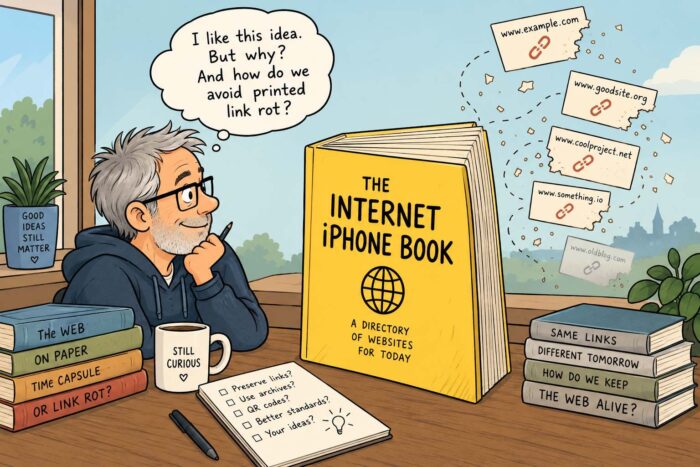
A few days ago I came across an article about a rather unusual book. It is a big yellow book full of websites. A kind of printed directory of the internet. The author describes it as an “Internet Phone Book” — a physical snapshot of a digital world that changes every second. They are working on version 2 now as well. (https://internetphonebook.net/).
A book full of website links? I have to admit: I like the idea. But I am not entirely sure why. Maybe it is the same reason I still like vinyl records, printed books and old computer magazines. There is something satisfying about information that exists as a physical object. Something you can put on a shelf, pick up years later and browse without needing an account, an app or a subscription.
But then I read a term that surprised me: printed link rot. I had never heard that expression before. And it immediately connected with something I wrote about recently: digital link rot (https://justme.website/content-creation/the-web-has-a-memory-problem/). In other words: the slow decay of the web. Websites disappear. Companies shut down. Platforms change their rules. Domains expire. Articles move. The links that once connected the internet together slowly stop working.
In that previous post, I looked at some strategies to reduce the problem. Using permanent URLs. Keeping your own archives. Avoiding unnecessary dependence on platforms that may disappear. But printed link rot? That is a completely different challenge.
A printed book full of website addresses is already frozen the moment it is published. The links do not change inside the book, but the internet behind those links does. A website that works today may lead to nothing five years from now. And unlike a digital page, you cannot simply update a printed book with a new URL. That makes printed link rot a strangely sad idea. A book that tries to preserve the internet could eventually become a record of things that no longer exist.
But maybe that is also part of the charm. After all, old books, magazines and newspapers are full of references to companies, people and places that disappeared long ago. We accept that as part of – well – history. Maybe an internet book will work the same way. Not only as a practical guide, but as a time capsule.
Still, I wonder: How do we prevent printed link rot? Can we create better ways to connect physical publications with a changing digital world? Should books like this include archives, QR codes, alternative references or some kind of long-term preservation system? I don’t have the answer. But maybe that is exactly why this idea is interesting. The internet was built to connect information forever. Yet keeping those connections alive turns out to be much harder than we expected.
Perhaps the real question is not only how we preserve websites. It is also how we preserve the paths that lead to them.