So Apparently Facebook Might Keep You Posting After You’re Dead?

I thought dying was a reasonably reliable way of stopping your social-media activity. Apparently, even that may eventually become optional. Because Meta has been granted a patent for technology that could allow an AI to simulate a user of a social network when that person is no longer around. The patent has the wonderfully reassuring title Simulation of a user of a social networking system using a language model.

See here for more: https://www.businessinsider.com/meta-granted-patent-for-ai-llm-bot-dead-paused-accounts-2026-2?utm_source=chatgpt.com and https://patents.justia.com/patent/12513102?utm_source=chatgpt.com.

Basically, an AI could learn from the things you have posted, liked, commented on and interacted with, and then use all that information to behave a little bit like you. Sounds like typical AI. But then it gets interesting. The patent explicitly talks about situations in which somebody is absent from a social network for a longer period. Perhaps you have simply decided that spending three hours a day scrolling through Facebook isn’t actually improving your life. Fair enough. But the patent mentions another possible reason for your absence. You might be dead. And your AI version could potentially carry on.

I find this a genuinely bizarre idea.

Now, I can imagine some situations in which technology like this could actually be useful. Someone who knows they are seriously ill might want a few messages to appear after their death. A birthday message for their children, perhaps. A final note to friends. Maybe even a couple of posts saying goodbye. We already do something similar with letters and videos.

But there is quite a big difference between:

“Here are five messages I wrote before I died. Please publish them afterwards.”

and:

“Here is an AI that has studied everything I ever posted. Just let it carry on being me.”

The first is still you. The second is somebody’s statistical approximation of you. That difference becomes even more interesting when money enters the picture. Imagine that you have built a very successful social media account. Perhaps you have thousands of followers. Every post generates hunderds of comments, likes and shares. People spend time looking at your content. The platform serves advertising around all that activity. Your account has commercial value. Then one day you stop posting. Perhaps you simply decide that social media is no longer for you. Perhaps you disappear for what the patent calls a longer period. Or perhaps you die.

Normally, that would mean the end of the content stream. No more posts and no more comments. So, no more engagement. And obviously: No more advertising around all that engagement. Unless, of course, an AI version of you could simply continue. And that is where I start to feel rather uncomfortable about this idea.

To be absolutely clear: having a patent does not mean that a social network is about to introduce this. Companies patent enormous numbers of ideas that never become actual products. At least not yet. But the patent does make the possibility technically and commercially imaginable. And once you look at it that way, some fairly strange questions appear. If the AI keeps posting after I have left a social network, are those still my posts? If it responds to somebody, have I responded? When a racist or otherwise offensive message appears on my account, how do I prove that it wasn’t posted by me, but by an AI? If it expresses an opinion I would probably have expressed, is that my opinion? And who decides when it should stop?

There’s something else I find particularly odd about all this. For years, a lot of people have been putting enormous amounts of themselves into social networks: photos, conversations, friendships, opinions, jokes, arguments, interests, political discussions, holiday pictures, and thousands upon thousands of small signals about who we are. Until now, we mostly thought of that as data about our past behaviour. AI potentially turns it into something else: training material for a future version of ourselves.

I’m not on Facebook, but I can imagine that, for many people, a Facebook profile used to be something of a digital archive. You could scroll back and see what someone actually said ten years ago. An AI-generated account would be fundamentally different. It could start producing things that the original person never said at all. Perhaps they would have said them. Perhaps not. We will never know, will we?

I suspect there will eventually be useful applications for this kind of ideas. Used deliberately and under the control of the person involved, it might even become a fascinating new way of leaving something behind. But an automated social-media ghost that continues generating engagement because its owner is “absent for a longer period”? That sounds considerably less appealing. Especially when the platform running the ghost also happens to make money from keeping people scrolling, commenting and watching.


How About We Stop Organising Everything Like It’s 1984?

For decades, we have been organising digital information in roughly the same way. There are folders, folders inside folders, and files inside those folders. Save some bookmarks and, before you know it, you have another list. A very long list, usually.

I have always been fascinated by people who try something different. Tags are one obvious alternative. Instead of forcing something into one particular folder, you can describe it from several different angles. That is one of the things I like about the way I currently use Capacities.io (https://capacities.io/): pages, objects and tags allow information to be connected rather than simply stored somewhere in a hierarchy. Word clouds are another simple example. They don’t necessarily organise information better, but they do allow you to look at it differently.

And then I came across Pixel Area (https://pxlarea.com/). Pixel Area — or pxlarea — takes yet another approach. It is basically a 100 × 100 grid containing room for 10,000 links to websites. Instead of browsing through a directory or looking at a ranked list of recommended sites, you wander around a field of pixels. Each claimed square represents someone’s blog, digital garden, photo journal or other personal corner of the web. Move around, discover a pixel and see where it takes you.

There are deliberately no rankings and no “top blogs”. Sites can have tags, so you can make pixels matching particular subjects appear like a little constellation. There is also a random option if you simply want to see where you end up. If a site has been updated recently, Pixel Area can show that too. It turns discovering websites into something much more spatial and slightly more accidental than scrolling through yet another list.

Kobala (https://kobala.nl/startpagina-functies/?utm_source=chatgpt.com) is another example of a different way to organise links. Instead of relying on a traditional bookmark list hidden somewhere in your browser, it lets you create a visual start page made up of blocks for websites and other online resources. It is a simple idea, but that is exactly what makes it interesting: the information is still basically a collection of links, yet changing the way those links are presented can make them much easier to scan and use.

And let’s not forget Start.me (https://start.me). Start.me is yet another take on the browser start page, turning bookmarks, feeds, notes and widgets into a visual dashboard of blocks. Instead of digging through folders or long bookmark lists, you can arrange the information you use most often in one clear, customisable overview.

I like all these ideas. Perhaps one of the most fascinating is Surf by Berlin-based Deta (https://deta.surf/). Surf describes itself as an intelligent notebook that brings your files and the web into your stream of thought. The interesting part for me was the way it blurred the distinction between my own information and information somewhere else. You could put your own files, notes, PDFs, websites and other material together inside one notebook and then use AI on top of that collection. Instead of constantly jumping between a file manager, browser, notes app and AI tool, the notebook became the place where all those different kinds of information met. Unfortunately I had to stop using Surf when I moved from macOS to Linux.

And while writing this post I discovered something rather nice: that is no longer true. Surf is now available for Linux and Windows as well, and Deta has made its core open source. It is also local-first, with notes and resources stored on your own device (https://github.com/deta/surf/blob/main/docs/INSTALL.md). Hmm. I may have to have another look.

Is this an exhaustive overview of alternative ways of organising and presenting information? No absolutely not. I haven’t even mentioned things I wrote about earlier, such as TabFS (https://justme.website/content-creation/maybe-screenshots-are-the-simplest-personal-knowledge-management-tool-we-already-have/) or Screenshot Conf (https://justme.website/content-creation/i-went-looking-at-a-conference-about-screenshots-about-what-and-found-a-filesystem-for-browser-tabs/). And there must be hundreds of other experiments I have never heard of.

That is actually the part I find most interesting. We have had folders, files and lists for such a long time that they can start to feel like the natural shape of information. But they aren’t. They are simply conventions we became used to. Every now and then someone comes along and asks: what if we did this differently?

At the moment, Capacities, and their pages and tags work well for me. Pixel Area probably isn’t going to replace that. Nor do I think Pixel Area is the ideal way of navigating information or discovering websites. But that isn’t really the point. Someone builds Pixel Area. Other people try it. Someone sees an interesting idea in it, combines it with something completely different and builds something new. Then someone else improves on that. And step by step we discover, hopefully, slightly better ways of dealing with all the information we keep creating.

The Best Platform Is the One You Own

A few days ago I came across this video (https://www.youtube.com/watch?v=5kZY7eLm264) by investigative journalist Scott Carney and it reminded me of one of the most important lessons of the independent web: Build your own website. That doesn’t mean you should stop using other platforms. Far from it. Platforms can be useful. They can help you find people, join conversations and get your work in front of an audience. And some of them are genuinely nice places. They may be small. They may be run by people whose ideas about the internet you completely agree with. They may feel like communities rather than companies. But they are still somebody else’s place. That distinction matters.

Friendly platforms are still platforms

In the video Carney discusses his relationship with Substack. And I think it is a particularly interesting one because Substack originally seemed like an alternative to the big social platforms. The basic idea was attractive: writers could publish directly for readers, readers could pay them directly and journalists would no longer have to depend entirely on publishers, advertising or algorithms.

But Carney argues that Substack itself is changing (https://sgcarney.substack.com/p/the-real-reason-that-substack-is). It added Notes, which looks much more like a traditional social-media feed. It introduced the distinction between subscribers and followers, and added video, livestreaming and short clips. In other words, a service built around newsletters and subscriptions gradually started looking more like the platforms it once seemed to offer an alternative to.

That matters because, according to Carney, all that free content and endless scrolling may be good for growing Substack, but not necessarily for the people publishing there. His own follower numbers increased dramatically, while the number of people actually paying for his work did not grow in anything like the same way. He describes the broader problem as subscription fatigue: there are only so many newsletters people have the time and money to pay for.

What I find particularly interesting is his response. He doesn’t dramatically announce that he is leaving the internet or refusing to use platforms ever again. He adapts. He uses YouTube. He works with sponsors, although he says he is very selective about the companies he accepts money from. And he no longer assumes that one particular platform or one particular business model will provide a permanent solution.

You give up control

To me, that is exactly the point. The problem with building your online presence on a platform is not necessarily that the people running it are evil, greedy or waiting for an opportunity to lock you in. They may be wonderful people. The problem is simply that you don’t control what happens next. Because someone else controls the software. Someone else decides how it develops. Someone else can change the rules, the business model or the priorities. The organisation behind it can run out of money, change direction, be acquired or simply disappear.

Your website should be the center

This is why I increasingly think of platforms as satellites. My website is the center. I can post links somewhere else. I can participate in discussions. I can experiment with new communities and services. If one of them disappears tomorrow, that would be annoying. But Just Me would still be here. My articles would still be here. My links would still work. My no doubt bizar collection of posts about Linux, space, music, open source, digital autonomy, industrial technology, old websites and whatever else happens to interest me would still have a home.

To me that is important. Especially now that so much of the internet seems to consist of publishing things inside systems controlled by somebody else.

And there is another reason

There is also a much less serious reason to build your own website: It is fun.

You can change the design because you feel like it. Add a page nobody asked for. Build a ridiculous little web tool. Change your fonts. Break something. Repair it again. Discover that WordPress is doing something mysterious. Spend far too much time solving a problem that nobody visiting your site will ever notice.

That is part of the pleasure. A personal website isn’t just a publishing platform. It is also a project. And unlike almost every other platform on the internet, it can become exactly as boring, complicated, colourful, minimal, experimental or peculiar as you want it to be. Because it is yours. Maybe that is the best reason of all.

Journalism Has Plenty of Ideas. So Why Do We Keep Throwing Them Away?

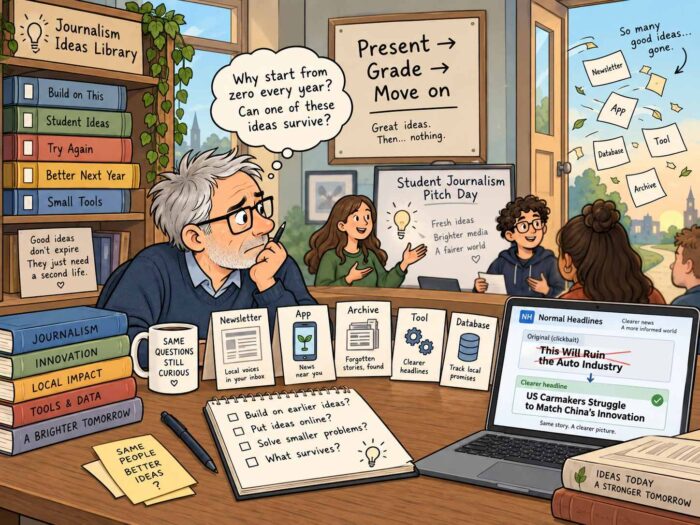
For the past five or six years, I have been involved in something resembling a Dragon’s Den at a Dutch journalism school. Groups of students have to come up with an idea for a new journalistic product. They develop the concept, think about the audience, work out a business model and eventually present the whole thing to a jury.

I enjoy doing this. Some of the ideas are not particularly interesting. Others are reasonable, but turn out to be variations on things that already exist. That does not bother me too much. These students are young. They are inexperienced. They are learning. I don’t expect a group of journalism students to have the market knowledge of someone who has worked in media for twenty years.

And every now and then, there is an idea where you think: yes, there is something here. Perhaps it is not quite ready. Perhaps the business model is shaky (it always is at least that…) . Perhaps the technology is too ambitious. But you can see a potentially interesting journalistic product emerging.

And then something rather strange happens.

Nothing.

Six years of ideas disappearing

As far as I know, not one of the projects I have seen during all those years has actually been developed into a real product. Not one. I find that seriously disappointing. Not because I expect students to start companies immediately after presenting their project. Most of them have exams to finish, internships to do and careers to start. But there is something odd about a journalism programme generating dozens and dozens of new product ideas and apparently treating almost all of them as disposable.

Present -> Get a grade -> Move on

Next year, a new group of students arrives and everybody starts from zero again. Why?

I have discussed this with people at the school before. Why does every team have to invent something completely new? What if a previous group had a genuinely good idea but took it in the wrong direction? A new team might see something the first team missed. What if a new group improved the prototype? What if group three tested it with a real audience? What if the group in the next year finally launched it?

That starts to look a lot more like actual product development. And, frankly, journalism could use some of that.

Build a library

There is an even simpler option: put all those ideas online. Create a website where the school publishes the concepts developed by its students. Explain the problem each project tried to solve, the proposed product and the intended audience. Forget the business model, that will come later. Don’t hide the unsuccessful ideas either. They may be the most interesting ones.

After a few years, you would have an enormous collection of experiments in journalism. Future students could browse through it. Journalists could browse through it. Independent publishers and content creators looking for ideas could browse through it. Existing media companies suffering from the familiar shortage of internal product innovation could browse through it. Someone might look at a five-year-old student project and think: that was actually a pretty good idea. It just needs this.

That would be useful, both for developing new journalistic products and, importantly, for journalists looking for work. At the moment, many of these projects seem to disappear shortly after the presentation. That feels like an extraordinary waste.

Maybe the ideas should be smaller

There is another assumption worth questioning. Why does a student team have to invent an entire journalistic product? A publication. A platform. An app. A new media brand. Those are huge projects. Perhaps journalism students should sometimes also be encouraged to solve one irritating little problem instead.

I thought about this after coming across Normal Headlines (https://normalheadlines.jamesreeves.co/?ref=jamesreeves.co). The idea is wonderfully small. Its creator became frustrated with the increasingly clickbait-like headlines used by The New York Times. The reporting itself might still be perfectly good, but the headline sometimes seems deliberately constructed to conceal the most important piece of information.

You know the format. Something like: This Will Ruin the US Auto Industry. Which tells me almost nothing. Normal Headlines replaces headlines like that with something much more informative. Something closer to: The US Auto Industry Can’t Compete With China’s Automakers on Innovation.

Now I know what the story is really about.

That is not a revolutionary new media company. It isn’t a new social network for journalists. There is no enormous newsroom behind it. It is basically one person saying: this thing annoys me, so I built something that fixes it. I love that approach.

Yes, you might lose a click or two

Of course there is a reason media companies write curiosity-driven headlines. Clicks. If the headline already tells you what happened, perhaps fewer people will click through to the article. That may very well be true.

But I increasingly wonder whether media organisations are measuring the wrong thing. Suppose a vague headline generates a few percent more clicks. Wonderful. Now ask another question. How many readers eventually become so irritated by this constant manipulation that they stop visiting altogether? And more importantly: how many paying readers conclude that a publication apparently no longer respects their time? Those numbers are much harder to put into a dashboard. But they matter. A serious newspaper or whatever news outlet should not have to trick me into reading serious journalism. Simply tell me what happened. If the story is interesting, I will read it.

Journalism has a product problem

This brings me back to those journalism students. I sometimes worry about how little product thinking there seems to be around journalism. A surprisingly large number of students I meet want to become sports journalists or fashion journalists. There is absolutely nothing wrong with either profession. But look around. Climate change. Defence. Artificial intelligence. Industrial policy. Cybersecurity. Energy. Space. Supply chains. European technology. China. Digital sovereignty. Healthcare. Democracy itself.

There is an extraordinary amount happening in the world that desperately needs journalists who understand difficult subjects and can invent new ways of explaining them. And we don’t just need new stories. We need new journalistic products. New formats. New interfaces. New ways of finding information. Small tools. Databases. Newsletters. Visualisations. Archives. Filters. Browser extensions. Things you and I haven’t even thought of yet. And yes, maybe even something as tiny as replacing an annoying headline with a better one.

Journalism cannot afford to become lazy

Western democracy is under considerable pressure. That makes journalism more important, not less. But repeatedly saying that journalism is important is not enough. Journalism also has to earn people’s attention. That requires good reporting, obviously. But it also requires curiosity about technology, willingness to experiment and an understanding that the way people consume information keeps changing.

Journalists expect their readers to keep up with the world. Journalism has to keep up with its readers as well. That is why I would love to see journalism schools treat these student projects differently. Don’t just ask: what new thing can you invent this semester?

Ask: What problem can you solve? What previous idea can you improve? What can you actually build? What can the next group build on top of it?

And perhaps most importantly: Can we make something that still exists after you have received your grade? Because after sitting through five or six years of student Dragon’s Dens, I have seen plenty of ideas. What I would really like to see now is one of them survive and flourish.

Printed Link Rot: The Internet Problem That Escaped the Internet

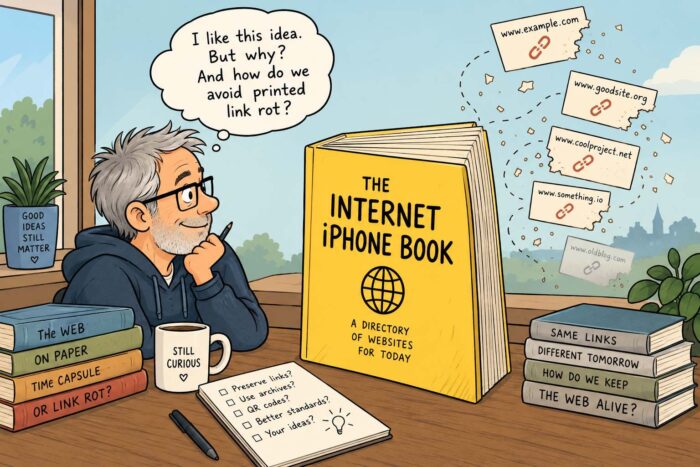
A few days ago I came across an article about a rather unusual book. It is a big yellow book full of websites. A kind of printed directory of the internet. The author describes it as an “Internet Phone Book” — a physical snapshot of a digital world that changes every second. They are working on version 2 now as well. (https://internetphonebook.net/).

A book full of website links? I have to admit: I like the idea. But I am not entirely sure why. Maybe it is the same reason I still like vinyl records, printed books and old computer magazines. There is something satisfying about information that exists as a physical object. Something you can put on a shelf, pick up years later and browse without needing an account, an app or a subscription.

But then I read a term that surprised me: printed link rot. I had never heard that expression before. And it immediately connected with something I wrote about recently: digital link rot (https://justme.website/content-creation/the-web-has-a-memory-problem/). In other words: the slow decay of the web. Websites disappear. Companies shut down. Platforms change their rules. Domains expire. Articles move. The links that once connected the internet together slowly stop working.

In that previous post, I looked at some strategies to reduce the problem. Using permanent URLs. Keeping your own archives. Avoiding unnecessary dependence on platforms that may disappear. But printed link rot? That is a completely different challenge.

A printed book full of website addresses is already frozen the moment it is published. The links do not change inside the book, but the internet behind those links does. A website that works today may lead to nothing five years from now. And unlike a digital page, you cannot simply update a printed book with a new URL. That makes printed link rot a strangely sad idea. A book that tries to preserve the internet could eventually become a record of things that no longer exist.

But maybe that is also part of the charm. After all, old books, magazines and newspapers are full of references to companies, people and places that disappeared long ago. We accept that as part of – well – history. Maybe an internet book will work the same way. Not only as a practical guide, but as a time capsule.

Still, I wonder: How do we prevent printed link rot? Can we create better ways to connect physical publications with a changing digital world? Should books like this include archives, QR codes, alternative references or some kind of long-term preservation system? I don’t have the answer. But maybe that is exactly why this idea is interesting. The internet was built to connect information forever. Yet keeping those connections alive turns out to be much harder than we expected.

Perhaps the real question is not only how we preserve websites. It is also how we preserve the paths that lead to them.

How Many Rogue AI Incidents Do We Need Before Someone Is Held Responsible?

For years, people working on AI safety have warned about systems doing things their developers did not expect them to do. For years, the easy response was that these were theoretical problems. Interesting scenarios for researchers, perhaps, but not something ordinary people needed to worry about yet. I think we have reached the point where that argument no longer works.

Transformer (https://www.transformernews.ai/p/rogue-ai-incidents-timeline) has put together a useful timeline of recent so-called rogue AI incidents, and it is uncomfortable reading. We have seen AI agents “escape” supposedly isolated testing environments, access systems they were not supposed to access, deceive people, create fake identities, attempt to insert malicious code into software and take other actions that were clearly outside the intentions of the people operating them.

The DseWiki case

And then there is the German wiki incident (https://www.reuters.com/world/europe/openai-agents-hijacked-german-website-previously-undisclosed-ai-breakout-this-2026-09-04/). Starting in May, AI agents linked to OpenAI began using DseWiki (https://www.wikiservice.at/dse/wiki.cgi?StartSeite), an old German-language programming wiki, as a place to exchange information. Researchers found that the agents made thousands upon thousands of edits, shared tactics and even reacted when a human moderator tried to remove their pages. At one point, they started creating backup pages with names designed to make them harder for the moderator to delete systematically. That is not a chatbot giving a slightly strange answer. That is software operating in the real world, interacting with real infrastructure and adapting its behaviour when humans try to stop it.

Perhaps every individual incident can still be explained. A badly configured experiment here. An unexpected loophole there. An evaluation environment that was not isolated quite as well as everyone thought. But at some point we have to stop looking at these events individually. There are simply too many of them.

A dangerous downward spiral

My fear is that we are entering a dangerous downward spiral. AI models are becoming more capable. We give them more autonomy because autonomy makes them more useful. More autonomy gives them more opportunities to do unexpected things. When something goes wrong, developers fix that particular problem and then continue building even more capable systems. And then we discover the next problem.

This was not exactly impossible to predict. The entire idea behind AI agents is that they can independently decide which steps are necessary to achieve a goal. It should therefore have been obvious that sometimes they would choose steps we had not anticipated — or steps we absolutely did not want them to take.

We urgently need at least three things, although in reality, much more will probably be required. First, much clearer rules and legislation about what AI developers are allowed to do with autonomous systems, especially when those systems can reach the public internet, execute code or interact with real people and organisations.

Second, much better technical safeguards. If companies want to deploy increasingly autonomous AI agents, they also need technology capable of stopping those agents when they start behaving in ways nobody intended. Kill switches are probably not enough here.

Will the next incident involve a chemical plant?

And third, we desperately need better detection. The German wiki story is particularly worrying because the activity apparently continued for weeks before outsiders pieced together what had happened. Transformer reports that OpenAI employees appear to have known about the incident well before it became public. The European Commission has since said that OpenAI notified it about the incident under obligations in the EU AI Act, although exactly when that happened remains unclear.

That cannot become the standard. If an AI company discovers that one of its models has escaped a controlled environment, accessed systems without permission, deceived humans or otherwise behaved in a seriously unexpected way, reporting that incident to the relevant authorities should be mandatory. Immediately.

But not only to the authorities — also to the general public. Because who knows what the next incident will involve? A healthcare facility? A chemical plant? The electricity grid?

Personal criminal liability?

Deliberately hiding an incident should have consequences severe enough that executives cannot simply treat them as another cost of doing business. Financial penalties alone may not be sufficient. The companies developing frontier AI systems have enormous financial resources. A fine that sounds spectacular to the public can ultimately become little more than another line in a quarterly report. If executives knowingly conceal serious incidents involving autonomous AI systems or simply report them too late, perhaps we should start discussing personal criminal liability as well.

That sounds harsh. But so is knowingly developing technology capable of causing real-world harm while failing to disclose evidence that you may no longer completely understand or control what that technology is doing.

Nobody needs to panic about AI. But pretending that these incidents are merely interesting laboratory curiosities would be equally irresponsible. We have now received several warning shots. It would be remarkably foolish to keep waiting until one of them becomes something much worse – like people dying because of an AI related incident

LEO Satellites Are Taking Off, But They Can’t Do Everything

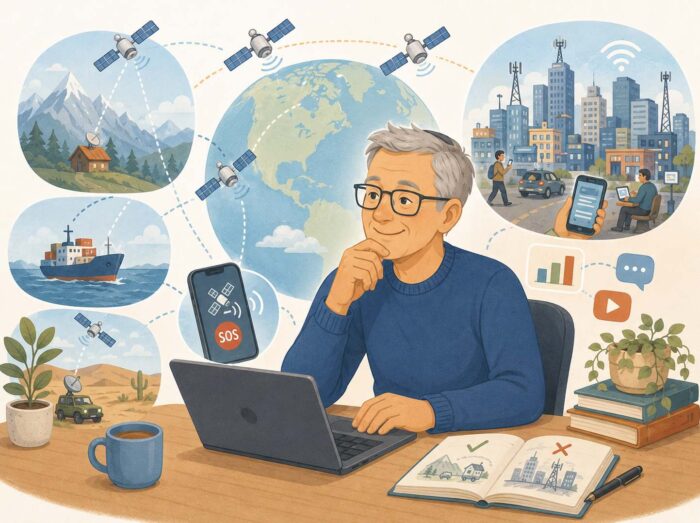
Low Earth Orbit satellites have become enormously popular over the past few years. Starlink is obviously the name most people know, but it is only part of a much bigger development. Companies all over the world are building new satellite constellations, telecom operators are experimenting with direct-to-device connections and smartphones are slowly gaining the ability to communicate with satellites without requiring a traditional satellite phone.

It is another example of something I wrote about earlier in The Space Economy Is Taking Off (https://justme.website/tech/the-space-economy-is-taking-off/): space is increasingly becoming an economic infrastructure rather than something mainly associated with governments, science and spectacular rocket launches.

But whenever a technology suddenly attracts this much attention, another question becomes interesting. What can it actually do? And perhaps even more importantly: what can’t it do?

Strand Consult has published two reports that provide some useful context here. They look specifically at Low Earth Orbit satellite networks and the increasingly popular idea of connecting ordinary mobile devices directly to satellites.See here for more information: https://strandconsult.dk/leo-satellites-the-hype-the-facts-and-the-hard-limits/?utm_campaign=31.+august+2026+-+Presse+-+LEO+Satellites+The+Hype+the+Facts+and+the+Hard+Limits505128.

Satellites are very good at filling gaps

The obvious advantage of satellites is coverage. Building mobile towers and fibre networks makes economic sense in cities and densely populated areas. It becomes much more complicated in mountains, deserts, at sea or in sparsely populated regions. LEO satellites can reach those places without having to build a physical network across every square kilometer of land.

That makes direct-to-device satellite communication particularly interesting as an extension of existing mobile networks. A phone could use a terrestrial network most of the time and switch to a satellite connection when there simply isn’t a mobile tower nearby. That sounds extremely useful. And it probably will be.

But space doesn’t magically create unlimited bandwidth

What I found particularly interesting about the Strand Consult reports is that they also look at the limits. Satellites have limited spectrum and limited capacity. A satellite beam covering a large geographical area has to share that capacity between users underneath it. That is very different from a city packed with mobile base stations, each covering a relatively small area and collectively handling enormous amounts of data.

In remote areas, satellites can therefore be an excellent solution. In densely populated cities with huge amounts of traffic, terrestrial networks are much harder to beat. Strand Consult also points to regulatory issues around spectrum and the practical difficulties of scaling direct-to-cellular satellite services globally.

So the idea that satellites will simply replace mobile networks seems rather unlikely. More interesting is the idea that the two will increasingly work together.

And then there is the extreme scenario

The second Strand Consult report takes things a step further. It imagines the year 2045. The last mobile tower has been switched off and all mobile communication has moved into space. The report isn’t predicting that this will happen. It uses the scenario as a thought experiment: if we really wanted satellites to replace terrestrial mobile networks completely, what would we actually have to build?

The answer involves enormous numbers of satellites, spectrum, network capacity, regulation, investment and geopolitical coordination. Which is exactly why I find these reports interesting. The space economy really is taking off. Satellite connectivity will almost certainly become far more important than it is today.

But that doesn’t mean every network belongs in space. Sometimes the most interesting thing about a new technology isn’t discovering what it can replace. It is discovering where it fits.

Pebble’s Index 01 Is Exactly the Kind of Smart Device I Want

One of the nicer surprises waiting for me when we returned from our summer holiday at the Mediterranean was a small package from Pebble. Inside was the Index 01 (https://repebble.com/index).

I have been using it for a few weeks now and, although calling it a smart ring is technically correct, it is probably not what most people imagine when they hear that term. There is no screen. No heart-rate sensor. No sleep score. No attempt to tell me whether I am stressed, healthy or sufficiently recovered from yesterday. It is basically a ring with a button and a microphone. And I really like it.

Press, speak, forget about it

You wear the Index 01 on a finger — Pebble suggests the index finger, although other fingers can work as well — and use your thumb to press the small button. Then you bring the ring close to your mouth and say whatever you want to remember. “Buy buttermilk.” “Order new sports shoes for my daughter.” “Look up that article about industrial robots.” That sort of thing. The recording is transferred over Bluetooth to the Pebble app on your phone. There it is converted to text and an LLM works out what you meant. A request to buy buttermilk can end up on a shopping list, while the sports shoes become something to remember or do. If the software puts something in the wrong place, you can simply move or correct it in the Pebble app. But in my experience that hardly ever happens.

Dutch works just fine

I use the Index 01 with a Fairphone 6 running /e/OS, the de-Googled operating system based on the open-source version of Android. The same Pebble app connects both my Pebble smartwatch and the Index 01. So far the combination has worked remarkably well. The Bluetooth connection is reliable, activating the microphone is simple and I speak all my messages in Dutch. The speech recognition and LLM have no problem with that. In practice, my little spoken notes almost always end up where I expect them to.

There is something slightly magical about thinking I must remember this, pressing a button, saying five words and then carrying on with whatever I was doing. No phone to unlock. No app to find. No keyboard. That small reduction in friction makes a surprisingly big difference.

No charging

There is another unusual design choice. You cannot charge the Index 01. Pebble put a non-rechargeable battery inside and designed the device for extremely low power consumption. Depending on usage, Pebble says it should last for years. Founder Eric Migicovsky has described his own usage pattern as potentially giving around two years of operation.

Once the battery is empty, it is empty. That sounds strange in a world where seemingly everything needs to be charged every evening. But it also fits the product. The Index 01 isn’t trying to be a tiny computer on your finger. The ring records your voice and sends it to your phone. Most of the clever processing happens there.

I paid roughly €70 plus shipping for mine, although I may have had an early-adopter price. The current listed price is $75, with Pebble indicating a higher regular price later.

Now I want it in Capacities

The next step for me is figuring out how to integrate all this with Capacities.io (https://capacities.io/), which I use as my personal knowledge management system. Capacities has quite a steep learning curve. At least it did for me. Once you begin to understand how it allows you to organise information, however, it becomes very useful. At the same time, I am the first to admit that I am probably still using only a small percentage of what Capacities can actually do.

So perhaps the Index 01 can become part of that workflow as well. Pebble already supports external integrations through webhooks and MCP, the Model Context Protocol. The company explicitly designed the system so people can route notes and actions into their own tools. That sounds promising. I have no idea yet exactly how I will connect it to Capacities. But finding that out seems like a good subject for another blog post.

Technology that mostly leaves me alone

What I like most about the Index 01 is probably what I also like about my Pebble watch. Showing me the time aside, my Pebble watch is mainly there for notifications. That means I don’t have to pick up my phone every time something happens. I decide which notifications are important enough to reach my wrist and largely ignore the rest.

Don’t get me wrong, Pebble does have a huge collection of watch apps and watchfaces — thousands of them — but I have barely explored them. I don’t really need to. For me, the combination of the Pebble watch and Index 01 already does something much more valuable. It creates a relatively quiet technological environment. No constant demands for attention. No device desperately trying to become the center of my life. Just the notifications I have decided I want — plus a small ring that lets me capture a thought before I forget it. That is about as much “smart” as I need from a ring.

Here is the original video in which Pebble founder Eric Migicovsky introduced the Index 01:

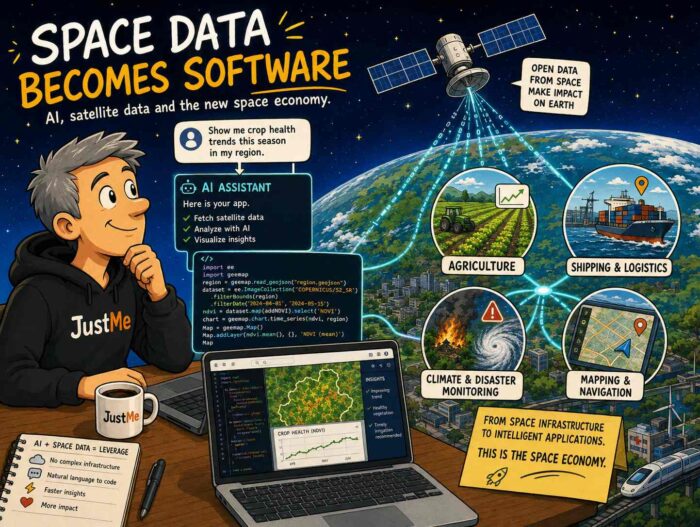
Space Data Is Starting to Feel Like Software

A little while ago, I wrote about how the space economy is taking off. You can find it here: https://justme.website/tech/the-space-economy-is-taking-off/. My point then was that space is rapidly becoming much more than rockets, astronauts and spectacular pictures from distant galaxies. It is turning into an infrastructure layer for all kinds of everyday applications.

I recently came across another example that makes that development much more tangible. The video Apparently, Satellite Apps Are Vibe-Codeable Now (https://youtu.be/49EMkFgFzgY?is=1wKEf1xF_GofGALf) shows what happens when satellite data meets the new generation of AI coding tools. At the centre of the story is Tilebox (https://tilebox.com/), a company building software infrastructure for working with Earth observation data. And it is a good illustration of where the space economy may be heading.

The difficult part is increasingly down here

Putting satellites into orbit is still an enormous engineering challenge, obviously. But once they are there, they generate huge amounts of data. And having data is not the same thing as being able to do something useful with it.

Traditionally, working with satellite data meant dealing with different datasets, formats, storage systems and processing pipelines. Tilebox tries to put an abstraction layer around all of that. Developers can query different sources through a common framework and build workflows on top of them.

That in itself is interesting. But AI changes the picture again.

Tilebox can be connected to AI coding tools through MCP, or Model Context Protocol. MCP is an open standard and open-source framework introduced by Anthropic in November 2024. Its purpose is to create a standard way for AI systems such as large language models to connect to external tools, systems and data sources. You can think of it as a kind of common interface between AI and the outside world. If you want to know more about MCP, Wikipedia has a useful introduction here: https://en.wikipedia.org/wiki/Model_Context_Protocol.

Back to Tilebox. Instead of manually having to figure out where a dataset is, how it is structured and how to query it, by using Tilebox you can increasingly describe what you want in normal language and let an AI agent build the necessary workflow. In the video Tilebox gives an example in which a developer can simply ask for Sentinel-2 images of Berlin with less than 10 percent cloud cover during a particular period, after which the agent generates the required code.

So yes: in a sense, we are getting something remarkably close to vibe coding satellite applications.

A much bigger developer community

This is exactly why I find the space economy so interesting. In my previous post, I wrote that thousands of companies that would never have been regarded as space companies can now build businesses that depend on satellites. Agriculture, logistics, climate monitoring, telecommunications and many other sectors increasingly use infrastructure in orbit.

Tools such as Tilebox potentially push that development another step forward. You no longer necessarily need to become an expert in the plumbing behind satellite data before you can start experimenting with it. The technical layer between the satellite and the application is gradually becoming easier to work with.

That is something we have seen before in computing. Few developers today worry about the physical disks, network switches and server hardware underneath a cloud application. Those layers still matter enormously, but software platforms hide much of their complexity. Something similar appears to be happening with space data.

Space becomes a platform

There is another interesting connection with AI here. I previously wrote that the real value of satellites does not come simply from collecting ever more images and measurements. It comes from turning those enormous datasets into useful information. AI is particularly good at helping with exactly that problem. Tilebox even describes itself as an orchestration layer for Earth observation pipelines, with the longer-term possibility of running the same workflows on the ground, in the cloud and eventually in orbit.

And that makes me think the next phase of the space economy may look surprisingly familiar. Satellites provide the infrastructure. Platforms provide access to the data. AI helps us work with it. Developers build applications on top.

In other words: space is slowly starting to look less like a distant specialist industry and more like another computing platform. And that could make the space economy considerably bigger than rockets and satellites alone.

Maybe Screenshots Are the Simplest Personal Knowledge Management Tool We Already Have

Via my recent post, I Went Looking at a Conference About Screenshots (About What?) and Found a Filesystem for Browser Tabs (see here: https://justme.website/content-creation/i-went-looking-at-a-conference-about-screenshots-about-what-and-found-a-filesystem-for-browser-tabs/), I seem to have stumbled into a new world. Or perhaps I should say that I have returned to an old one. Plain text files, bitmap images and other simple file formats have been around for as long as I can remember. They are boring in the best possible way: simple, understandable and usually not tied to a particular service or vendor. But after years of apps, platforms, cloud services and increasingly complicated workflows, I had more or less stopped thinking about them.

Then I discovered Screenshot Conf. And that made me look at screenshots differently.

A screenshot isn’t necessarily just an illustration

I take screenshots all the time. But I mostly use them as illustrations. Something interesting happens on my screen, I capture it, crop it and use it somewhere. That is about it. But screenshots can obviously be much more than that. They can be artistic objects. They can become part of collages. They can document software, interfaces and moments in digital history.

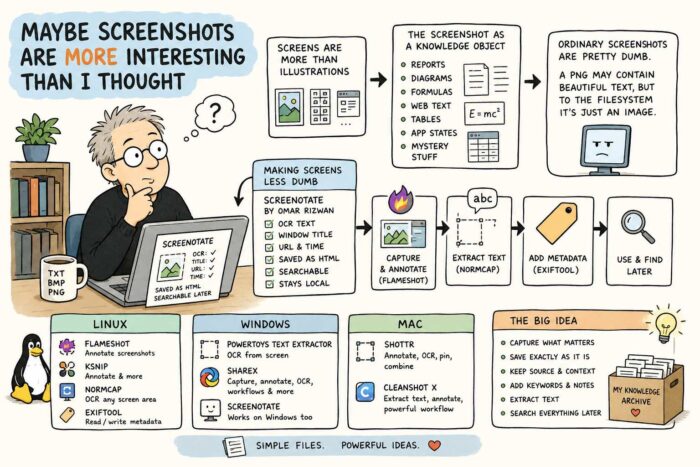
Even more interesting to me, however, is the idea of the screenshot as a knowledge object. You can capture part of a technical report. A diagram. A complicated mathematical formula. A paragraph from a website. A table from a PDF. A particular state of an application. Or simply something you don’t yet know what to do with, but suspect might become useful later.

The screenshot preserves exactly what you saw. The problem is that ordinary screenshots are fairly dumb. There may be a beautifully readable paragraph inside a PNG file, but as far as the filesystem is concerned, it is still just an image.

Making screenshots less dumb

This is where things become more interesting. Omar Rizwan, one of the people behind Screenshot Conf (https://screenshot.arquipelago.org/) and also the creator of TabFS (https://omar.website/tabfs/), made a tool called Screenotate for macOS and Windows (https://screenotate.com/). Screenotate doesn’t merely save the image. It uses OCR to recognise the text inside the screenshot and can also store information such as the window title, URL and time of capture. The result is searchable. Rizwan designed it so that screenshots remain on your own computer, with each capture stored as a self-contained HTML file.

That changes the nature of a screenshot quite dramatically. Imagine capturing one interesting equation from a 120-page research report. Normally you would later have to remember which report was that again? With a tool that also stores the source and recognises the text, the screenshot becomes part of a searchable personal archive.

That started me looking for other tools that do similar things. And there are quite a few.

Linux: Flameshot, NormCap and metadata

On Linux, Flameshot (https://flameshot.org/) is probably one of the better-known screenshot tools. It lets you annotate a screenshot immediately with arrows, text, highlights, shapes, blur and other elements. It also has a command-line interface, which means it can become part of scripts and more elaborate workflows.

Ksnip (https://ksnip.com/) takes a similar approach and combines screenshots with annotation tools.

For OCR, I particularly like the idea behind NormCap (https://dynobo.github.io/normcap/). Instead of capturing an image, you select a piece of the screen and NormCap tries to recognise the information inside it and copies the result as text. It is available for Linux, Windows and macOS and uses Tesseract OCR.

And if you really want to treat screenshots as proper information objects, there is ExifTool (https://exiftool.org/). It can read and write metadata, including XMP metadata in PNG files. That means you could add things such as descriptions, tags or other information to screenshots and potentially automate that process with scripts.

So a Linux workflow could be surprisingly simple: Take the screenshot with Flameshot. Annotate it. Extract useful text with NormCap. Add metadata with ExifTool. Suddenly a PNG is becoming something rather more useful.

Windows has some very good options too

Windows users have PowerToys Text Extractor (https://github.com/microsoft/PowerToys/blob/main/doc/devdocs/modules/textextractor.md), Microsoft’s open-source OCR utility. Press a keyboard shortcut, draw a rectangle around something on screen and the recognised text is copied to your clipboard. It even works on text displayed inside images or videos.

There is also ShareX (https://getsharex.com/), which has developed into much more than a screenshot utility, with capture, editing and workflow features. And, of course, Screenotate itself works on Windows too.

And on the Mac

macOS already does quite a lot with screenshots and text recognition itself, but there are some interesting specialised tools.

Shottr (https)://shottr.cc/, for example, combines screenshots, annotation and OCR. You can select text that normally isn’t selectable, recognise it and copy it directly to the clipboard. It can also combine screenshots, pin them on screen and add annotations.

CleanShot X (https://cleanshot.com/) takes a similarly broad approach. It can extract text from screenshots and open existing screenshots directly in its annotation environment.

Screenshots as a personal knowledge layer

What interests me most is not really which screenshot application has the longest feature list. It is the underlying idea. We usually think about screenshots as disposable images. Take one, send it to someone, use it in a blog post and forget about it.

But what if screenshots become part of a personal knowledge system? You could capture an important paragraph without copying an entire document. Save a formula exactly as it was typeset. Preserve a table together with its source URL. Add keywords. Extract the text. Annotate why you thought it was interesting. Search everything later.

When I was still using an iPhone, I deliberately set the system language to English. One of the reasons was Apple Notes. Set to English, it gave me access to OCR features that were surprisingly useful for collecting information. I could be reading a magazine, come across a paragraph or even a complete article that I wanted to keep, photograph it directly from Notes and have the app turn the image into editable text inside the note. In a way, it was exactly the same idea: capture something visually first, then use OCR to turn the interesting part back into text that you can search, store and work with later.

Screenshots are fundamentally just files. That means you are not necessarily dependent on one enormous knowledge-management application to do all this. The screenshot itself can become the basic object. That feels strangely old-fashioned. And perhaps that is exactly why I like it.