
There is something slightly ironic about reading a blog post about the disappearance of personal websites (see here: https://widdershins.verja.net/the-old-personal-web-is-going-quiet/). Especially when you are reading it on a personal website.
But that is exactly what happened when I came across The Old Personal Web Is Going Quiet on Widdershins. The author asks an interesting question: are personal websites and blogs slowly disappearing as their owners get older, lose interest, move to social media or simply stop paying for their hosting?
There are some numbers to support at least part of that idea. Pew Research looked at web pages archived between 2013 and 2023 and found that about a quarter were no longer accessible by October 2023. The older the page, the greater the chance that it had disappeared. Of pages that existed in 2013, roughly 38 percent were gone ten years later.
Those are impressive numbers. But I am not entirely convinced they tell us very much about the state of the personal web.
A missing page is not necessarily a dead website
There is an important distinction here. These figures are about web pages in general. They include all kinds of pages, including pages on corporate websites, news sites and probably enormous numbers of URLs that were never intended to remain online forever.
Websites are redesigned. CMS systems change. Companies disappear. Products are discontinued. News sites reorganise their archives. URLs change. Pages without permanent links vanish. As the Widdershins article itself points out, most of the missing pages were actually from websites that were still online. A disappearing page therefore isn’t necessarily evidence of a disappearing website, let alone a disappearing personal blog.
The personal web feels surprisingly alive
My own impression is actually rather different. I spend quite a lot of time wandering around the less corporate corners of the web. And perhaps that gives me a distorted view, but the personal web seems remarkably lively to me.
There are blogs about programming, Linux, photography, books, retrocomputing, science, writing, electronics, personal knowledge management and dozens of subjects that are almost impossible to categorise.
Some people publish every day. Others write something once every three months. Some websites look as if they were designed last week. Others proudly look as if CSS was still considered an exciting new technology.
I like that. These sites aren’t optimised by a social-media algorithm. Nobody is desperately trying to keep you scrolling. Often there isn’t even an advertising banner. It is simply someone saying: I found this interesting, so I wrote something about it. That is pretty much my definition of the personal web.
But there may be an age problem
There is, however, one part of the Widdershins article that I find more worrying: age.
Pew found that in 2006 more than half of the bloggers it surveyed were younger than 30. Those people are now, of course, roughly twenty years older. Meanwhile, blogging among teenagers and young adults already declined sharply between 2006 and 2009 as social networks became more important. More importantly, there doesn’t appear to be much recent research telling us who is maintaining personal websites today.
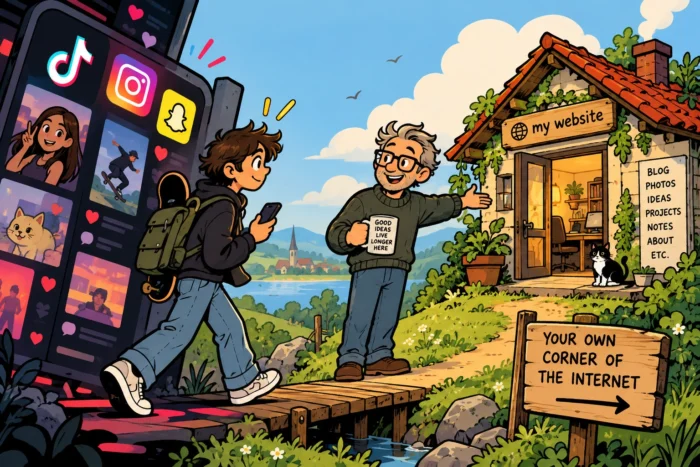
So perhaps the problem isn’t that the personal web is dying. Perhaps the people maintaining it are simply getting older. And if that is true, we should probably spend less time worrying about whether blogs are disappearing and more time showing younger people how much fun having your own little corner of the internet can be. A place where you decide what to publish. Where you decide what it looks like. Where there is no algorithm deciding whether twelve people or twelve thousand people will see what you made. Where your old posts don’t disappear into an endless timeline after three days. And where you can experiment, write, draw, code, photograph or simply collect things that interest you.
So how do we tell them?
That brings us to the slightly bizarre part. If we want to convince teenagers and twenty-somethings to build personal websites instead of putting everything on giant social platforms, we probably have to go where they are. TikTok. Instagram. Snapchat.
Perhaps the best way to save the independent personal web is to make TikTok videos explaining why people should spend less time on TikTok. There is something wonderfully absurd about that. But it might just work.