
I have been working at the intersection of journalism, AI and websites for quite some time now. I like all three, but I particularly enjoy combining them. And one thing keeps bothering me. Journalism — or at least the kind of journalism I know best — isn’t exactly overflowing with innovation. Newsrooms do what newsrooms have always done. They find stories, write articles and publish them. Of course, the tools have changed enormously. We have websites, newsletters, social media, analytics and now AI. But the basic process? Not so much.
There is another thing that has puzzled me for years. I live in the Netherlands and work mainly as an IT journalist. When I look at the sources used by Dutch IT media, they are overwhelmingly Dutch or English-language sources. Which is slightly strange when you think about it. Apparently, interesting things in IT happen in the Netherlands, the US and the UK. Perhaps occasionally somewhere else — provided somebody writes about them in English. That cannot possibly be true.
There is a world outside the English-language web
Interesting technology companies exist in Poland. Researchers publish interesting work in Japan. Startups emerge in South Korea. German companies develop new industrial technology. There are cybersecurity incidents in France, infrastructure projects in Scandinavia and interesting IT developments in Brazil, Italy, Spain, Croatia and dozens of other countries. Local journalists write about all of this. We just don’t read most of it.
There is another problem with relying so heavily on English-language sources. IT journalists unintentionally amplify the already enormous marketing power of predominantly American technology companies. These companies have large PR departments, communicate in English and are extremely good at getting their stories into the international technology press.
If journalists mainly watch that part of the information landscape, it shouldn’t surprise us that those same companies dominate the news. So I decided to build something.
IT news from 23+ language areas
The result is a proof of concept: AroundTheITWorld.news (https://www.aroundtheitworld.news). It is an IT news website, but not quite in the traditional sense. Instead of concentrating on a handful of familiar English-language sources, it watches technology websites across more than 23 language areas. Twice a day, a script checks sources scattered around the world. Korea to Croatia. Brazil to the Benelux. Japan to Poland. Germany to Denmark. Australia to Thailand and Hongkong.
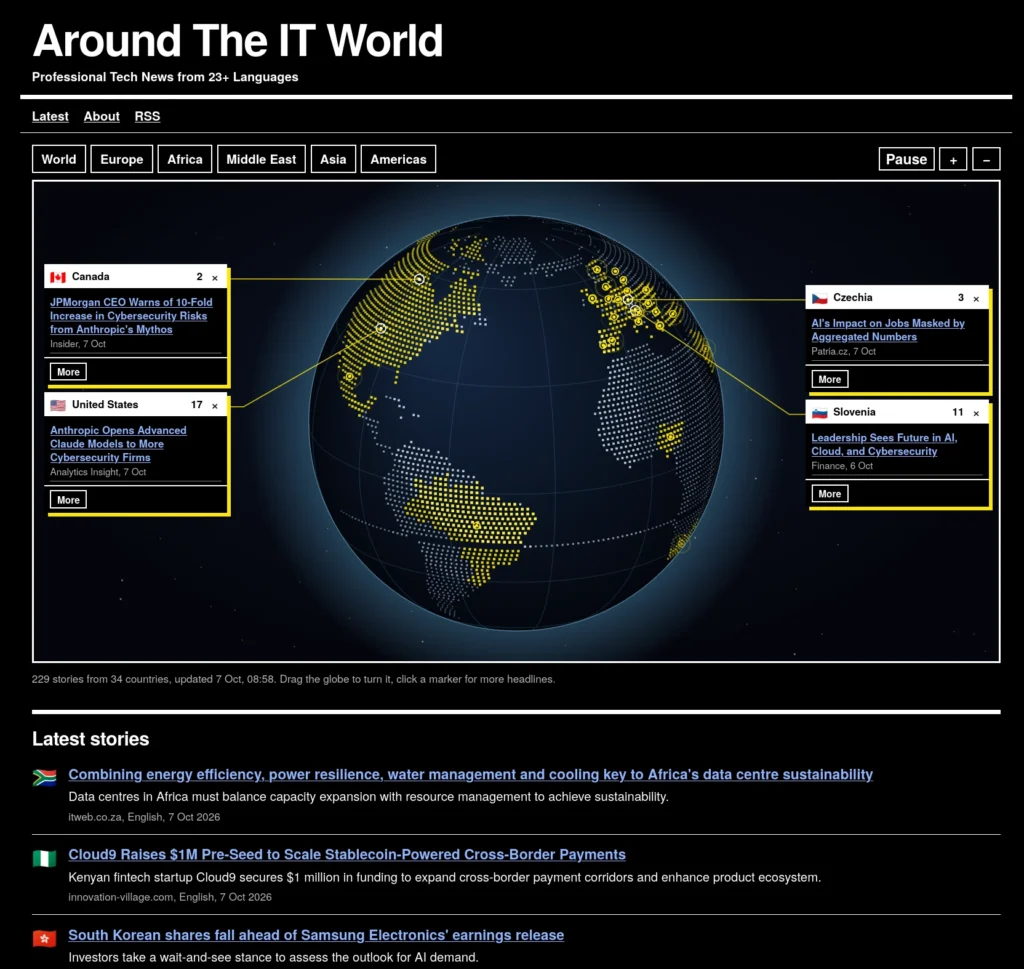
The script looks for new and potentially interesting stories. When it finds one, a locally hosted LLM turns the source material into a short English-language news item and includes a link to the original article. Actually, I use two LLMs. One handles Western languages, while another deals with Asian languages. Both LLMs run on a server in my home office. The resulting articles are automatically published on a website built with the Hugo static site generator. The whole thing costs me about €30 a year.
There is no editor sitting there copying and pasting stories into a CMS. The entire process runs automatically. I have written before about using this approach to create fully automated niche news websites. But AroundTheITWorld.news has a slightly different purpose. I built it because I want journalists — including myself — to look further than the English-language information bubble.
And then Croatia beat everyone
Almost immediately, the site demonstrated why this can be useful. AroundTheITWorld.news had only been live for a few minutes when a story appeared about Schneider Electric acquiring PTC. That is not some obscure local story. It is major international technology news that quickly travelled around the world. But the first report I encountered about it through my new system came from…Croatia. An IT publication in Croatia had picked it up.
I loved that. Not because Croatia somehow “beat” the rest of the world. That isn’t the point. The interesting part was that my little experiment had immediately surfaced a source I almost certainly would never have checked myself. Nice work by that Croatian journalist! And exactly the kind of thing I hoped this project would uncover.
Journalism experiment meets technical experiment
For me, AroundTheITWorld.news combines two ideas I keep coming back to.
The first is journalistic innovation. It doesn’t always have to involve enormous projects, expensive platforms or some grand reinvention of journalism. Sometimes innovation can simply mean changing the way we look for information. What happens if, instead of following 30 familiar websites every morning, you let software monitor hundreds of sources across more than 20 languages? Suddenly your information horizon becomes much wider.
The second part is technical experimentation. AroundTheITWorld.news is a fully automated website. Scripts collect the information, LLMs process it, Hugo (https://gohugo.io/) builds the pages and the resulting news service keeps running without somebody continuously operating it.
And, perhaps more importantly, I actually use it. Every morning I take a look. Usually I return several times during the day. Not because I have to maintain the site. Simply because I am curious. What is happening in the global IT world? What is happening today in Poland? What did a Japanese IT publication notice? Is there an interesting cybersecurity story in France? What are German technology journalists writing about? Did somebody in Brazil spot something that hasn’t reached the English-language technology press yet? That has become a surprisingly enjoyable routine.
Then the AI had an idea
There is one more part of this project that I rather like. The website was built through vibe coding. The first version was extremely simple: basically a textual website with a list of news stories and links. Which was fine. In fact, I quite liked it.
Then the AI tool I use to build these kinds of websites and news services made a suggestion. A list of stories was clear and functional, it said, but since the whole idea was about global news, why not make that visible? Why not show where the stories come from on a globe? I hadn’t asked for that. But it was a good idea. So we built it.
And that is what you now see on AroundTheITWorld.news: stories appearing around the world, geographically rather than just chronologically. In a funny way, that small visual change made the original idea much clearer. The IT world isn’t a list of English-language websites. It is a very large place full of people researching, building, experimenting, investing, failing, succeeding — and writing about it. Sometimes in English. Often not. Maybe we should start reading more of the latter.