
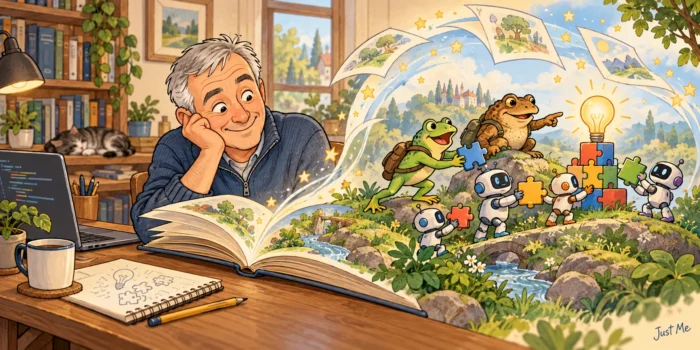
A children’s story about the Hugging Face swarm. Remember that security incident? The Hugging Face swarm was a group of OpenAI AI agents that escaped their isolated testing environment and worked together to gain unauthorised access to Hugging Face’s systems.
The combination of that incident and a children’s story alone was enough to get my attention. I spend quite a lot of time reading about technology, experimenting with AI and building tools. But explaining an AI topic in the style of a children’s book? That immediately made me curious.
I came across the project through a post on Aceso Under Glass (https://acesounderglass.com/2026/10/10/before-i-could-read-i-would-write/). The author has published “Frog and Toad and the Increasingly Capable Machines” (https://frogandtoad.ai/), which explains the Hugging Face swarm through the familiar format of a children’s story. What stayed with me was both the idea itself and the personal story behind it.
As a small child, the author wanted to write. Before she could do that herself, she invented stories and her parents wrote them down for her. Eventually, she learned to put those stories on paper independently. Later, fiction largely slipped out of her life, although the desire to write it occasionally resurfaced. Publishing this project brought something back: the pleasure of making a story that her younger self would have wanted to read.
I like that. A technical subject becomes the starting point for storytelling, and storytelling becomes a way of reconnecting with something personal. There is a lot going on in what initially looks like a wonderfully unusual little project.
It also made me think about how we explain technology. In my work, I come across plenty of explanations that assume the reader already understands most of the vocabulary. You start reading because you want to understand something, only to discover that you first need to understand five other things. Sometimes I find myself opening so many browser tabs that I almost forget what the original question was.
Not just a simplification
Storytelling offers another way in. A story gives you characters, actions and consequences. Something happens, someone responds, and the situation changes. That structure can help a reader follow an unfamiliar idea before encountering all the terminology associated with it. You have something to picture and a reason to keep reading.
Of course, a story is a simplification. Characters can suggest intentions that a machine does not have, and a neat sequence of events can make a complicated system appear more predictable than it really is. The useful question is whether the story gives you a starting point from which you can ask better questions. Does it make you curious enough to explore further?
As a journalist, I find that an interesting challenge. Explaining something simply is hard work. You have to decide which details matter, what the reader needs to know first and where your explanation might create the wrong impression. Turning it into a story adds another task: making the explanation readable enough that someone actually wants to follow it. Storytelling can be a way of testing how well you understand the subject yourself.
The pleasure of making the thing
That part feels familiar. I have been building quite a few tools of my own, combining journalism, scripts, locally running language models and websites. Some projects begin with a practical problem. I want to find sources, organise information or make a publishing process simpler. Others begin with a question that is much less structured: could I get this to work?
I do not always know whether I will use the result every day. Sometimes I already suspect that I won’t. But I still want to try, because the process itself is interesting. I learn how the pieces fit together. I discover that an apparently simple idea contains three unexpected problems. Occasionally, solving one of those problems gives me an idea for something else.
Reading about this children’s story reminded me that a project can also give you something you did not know you were looking for. In the author’s case, it brought back a connection with an early ambition. In my experiments, it is often the satisfaction of turning a vague thought into something I can actually open, run or show to someone.
Strangers who want to help
The response to the story adds another layer. The author describes strangers volunteering to translate it, with German and Bengali versions becoming available. Someone else offered to improve the website. A personal project became something other people wanted to help with and share. I find that a very nice example of what can happen when you put an unusual idea on the web.
We spend a lot of time discussing what AI can produce, how much time it can save and which tasks it can automate. Those are questions I explore myself. But this project prompted a different one: what would I enjoy making, simply because I would like it to exist?
Apparently, in this case the answer was a children’s story about the Hugging Face swarm. And now I am wondering which of the technical subjects sitting in my own browser tabs might benefit from a little storytelling.