
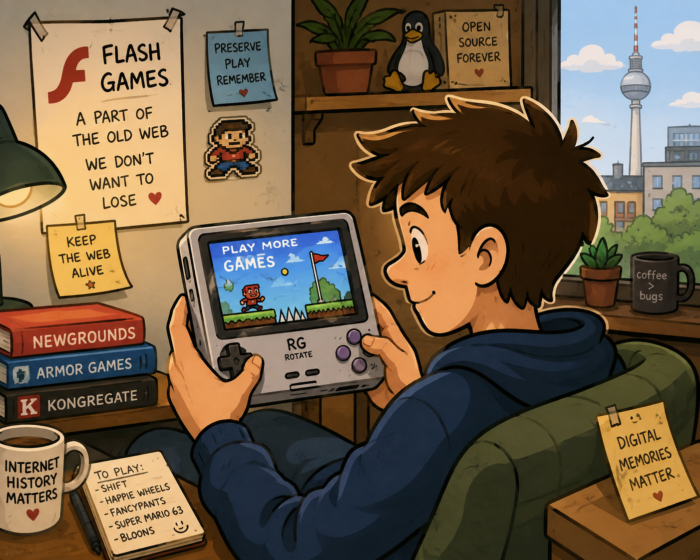
The internet has a memory problem. Every year, countless websites, games, animations and creative projects disappear because the technology they were built on becomes outdated. One obvious example is the world of Flash games: a huge part of early internet culture that almost vanished when Adobe Flash reached the end of its life. That is why projects focused on preservation are so interesting. They are not only about technology, but also about keeping digital history alive.
Recently I read an interview by Gardiner Bryant with NaviVani about Swiff, a project that aims to bring Flash games back to modern Android devices. You can read the original interview here: https://gardinerbryant.com/inside-swiff-an-interview-with-navivani/
I know Gardiner personally: I met him last year during the Nextcloud Community Conference in Berlin. Besides his work around Linux, open source and digital freedom, he has a talent for finding people and projects that represent the creative side of technology.
Swiff is a great example of that creativity. The project focuses on making classic Flash experiences accessible again on modern hardware. For many people, Flash games were their first introduction to interactive entertainment on the web. They were often small, experimental and sometimes wonderfully strange. Unlike today’s highly polished games, many Flash creations had a very personal character because almost anyone could build and publish something.
In the interview, NaviVani – a young Mexican developer – explains her own connection with Flash games and why preserving this part of internet history matters. The challenge is not simply running old software. Flash was designed for a completely different technological environment, and modern platforms require new approaches. Swiff is therefore not just about running old games; it is about creating a bridge between the creative internet of the past and today’s mobile devices.
Another interesting aspect of the conversation is the role of retro hardware. The project connects with the growing community around handheld gaming devices, where people are rediscovering older games and experimenting with new ways to play them. It shows how modern hardware can become a window into digital history. NaviVani herself is particularly charmed by the Anbernic RG Rotate.
The project itself is openly available through GitHub, where users can find the latest releases of Swiff and explore its development: https://github.com/NaviVani-dev/Swiff/releases
What I find especially interesting about projects like Swiff is that they challenge the idea that technology should always move forward and leave everything behind. Innovation is not only about creating something new; sometimes it is about preserving what already exists. The digital world has produced an enormous cultural heritage, but much of it is fragile because it depends on specific software, formats and platforms. Swiff represents a broader movement: people taking responsibility for preserving parts of the internet that would otherwise disappear. It is a reminder that open technology, experimentation and communities can play an important role in protecting our digital memories.
For anyone interested in open source, retro gaming or the history of the web, Gardiner’s interview with NaviVani is a fascinating read.