I Don’t Play These Games, But I Am Glad That Places Like This Exist

I recently watched a documentary called Grimdark (https://youtu.be/QTj8WXC_KgM?is=dNlEF1aXZhyQJDLx) about a world I know very little about. It is the world of tabletop games in which people gather around large tables, move miniature warriors and monsters across carefully constructed landscapes, roll dice, discuss strategies and occasionally spend a very long time deciding what a tiny plastic soldier should do next.

And to be honest, I find it fascinating. Not because I play these games myself. I don’t. And after watching the documentary, I didn’t suddenly feel an irresistible urge to start building an army of miniature warriors either. But I do understand the attraction a little better. Because there is much more going on here than simply playing a game.

People build their own armies. They paint tiny figures, sometimes in extraordinary detail. They construct buildings, ruins, forests and entire landscapes. They develop strategies, learn complicated sets of rules and then bring everything together on a table to play against — or sometimes alongside — other people. It is gaming, certainly. But it is also model building, painting, collecting, storytelling and socialising all rolled into one slightly unusual hobby.

And there is another reason why the documentary caught my attention. There is a place like this in my own hometown. Every now and then, I go there with my youngest daughter. Like I said, we don’t play these games ourselves and, so far at least, neither of us feels any particular need to start. We mostly look around. People arrive carrying boxes containing armies they have assembled and often painted themselves. Then they spend hours playing out battles that, to an outsider like me, can look impressively complicated.

But what I notice most is how much fun everyone is having. People talk about their figures. They admire what someone else has built or painted. They discuss the game. They laugh. They concentrate intensely on what is happening on the table. And they spend time with other people who understand exactly why all of this is so interesting.

I like that. We tend to talk a lot about communities on the internet. Social networks, forums and all the other digital places where people with similar interests find each other. Those communities can be valuable. But there is something rather nice about an actual physical place where people can do the same thing. A place you can walk into carrying a box full of tiny warriors and find other people who immediately understand why you have spent many evenings carefully painting them. You don’t have to explain yourself. You can just start playing.

Perhaps that is what I liked most about the documentary. And perhaps it is also why I enjoy occasionally visiting the place in my hometown with my daughter. Neither of us belongs to this particular world. We are visitors. Curious outsiders looking at something other people are deeply enthusiastic about. Sometimes that is enough. You don’t have to share someone else’s hobby to appreciate it. I’m glad places like this exist.
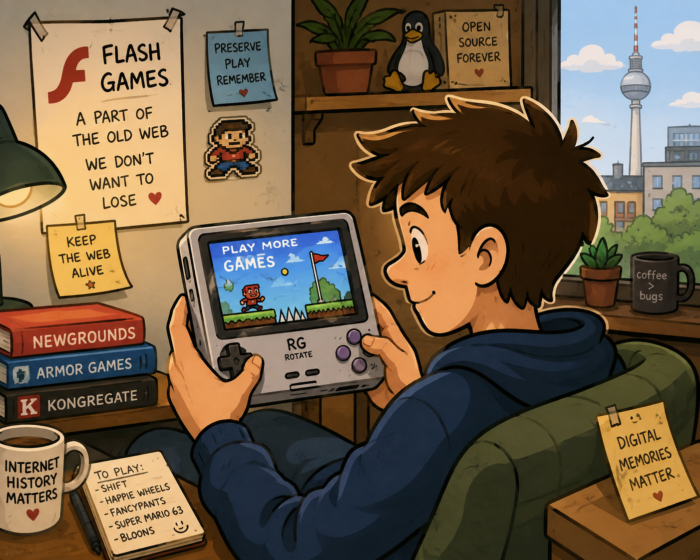
The Unexpected Comeback of Flash Games

The internet has a memory problem. Every year, countless websites, games, animations and creative projects disappear because the technology they were built on becomes outdated. One obvious example is the world of Flash games: a huge part of early internet culture that almost vanished when Adobe Flash reached the end of its life. That is why projects focused on preservation are so interesting. They are not only about technology, but also about keeping digital history alive.

Recently I read an interview by Gardiner Bryant with NaviVani about Swiff, a project that aims to bring Flash games back to modern Android devices. You can read the original interview here: https://gardinerbryant.com/inside-swiff-an-interview-with-navivani/

I know Gardiner personally: I met him last year during the Nextcloud Community Conference in Berlin. Besides his work around Linux, open source and digital freedom, he has a talent for finding people and projects that represent the creative side of technology.

Swiff is a great example of that creativity. The project focuses on making classic Flash experiences accessible again on modern hardware. For many people, Flash games were their first introduction to interactive entertainment on the web. They were often small, experimental and sometimes wonderfully strange. Unlike today’s highly polished games, many Flash creations had a very personal character because almost anyone could build and publish something.

In the interview, NaviVani – a young Mexican developer – explains her own connection with Flash games and why preserving this part of internet history matters. The challenge is not simply running old software. Flash was designed for a completely different technological environment, and modern platforms require new approaches. Swiff is therefore not just about running old games; it is about creating a bridge between the creative internet of the past and today’s mobile devices.

Another interesting aspect of the conversation is the role of retro hardware. The project connects with the growing community around handheld gaming devices, where people are rediscovering older games and experimenting with new ways to play them. It shows how modern hardware can become a window into digital history. NaviVani herself is particularly charmed by the Anbernic RG Rotate.

The project itself is openly available through GitHub, where users can find the latest releases of Swiff and explore its development: https://github.com/NaviVani-dev/Swiff/releases

What I find especially interesting about projects like Swiff is that they challenge the idea that technology should always move forward and leave everything behind. Innovation is not only about creating something new; sometimes it is about preserving what already exists. The digital world has produced an enormous cultural heritage, but much of it is fragile because it depends on specific software, formats and platforms. Swiff represents a broader movement: people taking responsibility for preserving parts of the internet that would otherwise disappear. It is a reminder that open technology, experimentation and communities can play an important role in protecting our digital memories.

For anyone interested in open source, retro gaming or the history of the web, Gardiner’s interview with NaviVani is a fascinating read.