
When I wrote about Blaugust a few weeks ago (https://justme.website/uncategorized/youre-not-just-publishing-posts-youre-building-a-habit-for-your-readers/), I thought I had discovered one of those wonderfully strange corners of the internet that still exist outside the big platforms. A place where people simply decide: let’s write more. No algorithm. No engagement hacks. No content calendar created by an AI marketing tool. Just people with their own websites, sharing ideas, stories and experiments.
Blaugust turned out to be exactly that. A yearly blogging challenge where participants try to publish throughout August, sometimes every day, sometimes with a more relaxed goal. It has become a small festival of personal publishing, especially popular in IndieWeb circles.
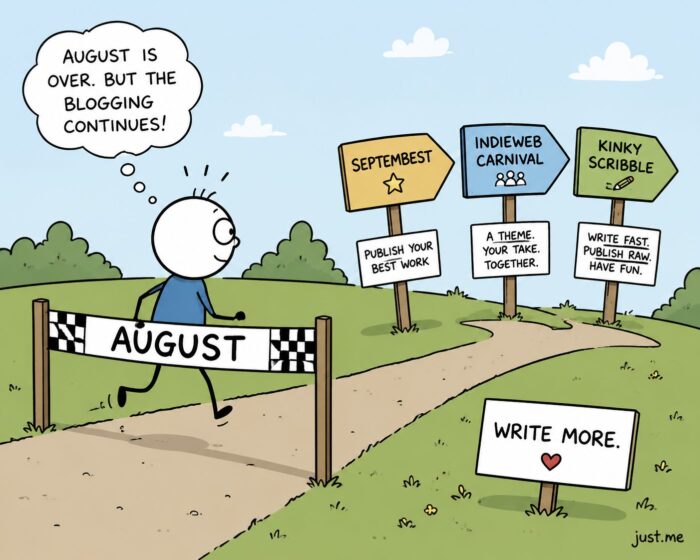
But apparently I was too quick to think that August was the end of the story. Because September has its own collection of writing challenges. The internet is full of people who refuse to stop writing.
SeptemBest: a September for better blogging
One of the challenges that caught my attention is SeptemBest (https://robertbirming.com/septembest-blog-challenge/). The idea is simple: use September as a month to publish your best work. It is less about producing something every single day and more about creating, sharing and discovering interesting blog posts. Some participants use it as a continuation of the energy they built up during Blaugust. Writing challenges are often described as productivity exercises. A way to force yourself to create more. But I think the better description is: they create momentum.
Publish something every day during Blogtober
And if September isn’t enough, there is always October. I discovered Blogtober (https://tantek.com/2025/303/t1/october-blogging-challenges), which is wonderfully straightforward: publish something on your blog every day in October. Thirty-one days, thirty-one posts. There is no big organisation behind it and no complicated set of rules. It is simply another of those traditions that has emerged among bloggers who apparently need very little encouragement to make writing unnecessarily difficult for themselves.
I like this idea because it reflects something that has always been special about blogs. A blog post is not just a piece of content. It is a conversation (sorry, that word sounds a bit too Big Tech-like…). The big platforms tried to turn publishing into a competition for attention. IndieWeb-style projects often go in the opposite direction. They encourage curiosity, personal perspectives and connections between independent websites. The result is slower. But maybe also more interesting.
Kinky Scribble: embracing imperfect writing
There are also more unusual challenges. The Kinky Scribble Challenge (https://ellelargesse.com/2026/08/30/sks/) for example, focuses on writing quickly and publishing with minimal editing. The idea is closer to a small, quick & dirty brain dump than writing a highly polished essay. Write something, share it, and move on. That might sound strange in a world where everyone is encouraged to polish everything endlessly. But there is something valuable about unfinished, imperfect work. Many interesting blogs started because someone simply wrote down an idea before it was completely formed. Sometimes the first version is where the interesting thinking happens.
Maybe Pink Floyd Were Kinky Scribblers Too
The Kinky Scribble Challenge also made me think of something completely different: Pink Floyd. A new live album has just been released, Live from the Los Angeles Sports Arena, April 26th, 1975. And what makes this recording particularly interesting is that Pink Floyd were playing songs that, in a way, weren’t finished yet.
The band was between The Dark Side of the Moon and Wish You Were Here. The former had been released two years earlier and had turned Pink Floyd into one of the biggest bands in the world. Wish You Were Here, however, wouldn’t appear until September 1975, so six months later. That didn’t stop them from playing much of it in Los Angeles in April.
Even more remarkable: they also played early versions of material that would eventually end up on Animals. That album wouldn’t be released until January 1977, almost two years later. In other words, the audience wasn’t simply listening to Pink Floyd performing its catalogue. They were listening to the band working on its future catalogue.
And that is where I see the connection with Kinky Scribble. The idea behind Kinky Scribble is to stop treating publishing as the final stage of a perfectly polished piece of work. Write something. Don’t spend forever editing it. Put it out there. See what happens. Continue working. Pink Floyd did something surprisingly similar on stage. Songs weren’t necessarily written, recorded, polished and then performed. Some developed while the band was playing them. Early versions were often a very rough work-in-progress. They changed, grew and were gradually polished until they became the versions we now know from albums like Wish You Were Here and Animals.
I like that idea. We have become accustomed to thinking that publishing means something is finished. A blog post should be polished before you press Publish. An album should be finished before anyone hears the songs. But perhaps publishing can also be part of the creative process. Write it. Play it. Put it in front of people. And then keep working on it.
Somehow it also reminds me of the Building in Public trend. But that is for another time.
The return of the personal web
What I find fascinating about these challenges is not the challenges themselves. It is what they say about the state of the web. For years we were told that blogging was disappearing. Social media would replace personal websites. Newsletters would replace blogs. Video would replace text.
And yet here we are. People are still building small websites. They are still writing about technology, books, music, games, politics, everyday life and completely random observations. Why? Maybe it is because a personal website offers something that platforms cannot provide: A place that feels like your own.