
Blogs are strange things. They are personal, sometimes deeply personal, collections of thoughts, experiences, ideas and observations. Unlike a printed diary that can disappear into a drawer, a blog lives somewhere on the internet. It can remain accessible for years, even decades, long after the person who wrote it has stopped adding new stories.
This raises an interesting question: what happens to the digital stories we leave behind?
That is exactly the topic explored by Michael Harley in his thoughtful blog post about the future of our online writings and the question of digital legacy. It is a fascinating reflection on what happens to the content we create once we are no longer actively maintaining it.
For many bloggers, writing is not just about publishing information. A blog is often a digital extension of ourselves. It contains memories, opinions, lessons learned, discoveries, frustrations and moments of inspiration. In many ways, it is comparable to the letters, notebooks and diaries that previous generations left behind. The difference is that digital content can potentially survive forever — but only if someone takes care of it.
Harley’s article made me think about my own blog.. Here I publish articles, observations and personal stories there. Some are about technology, digital sovereignty, open source and the future of IT. Others are much more personal reflections about music, travel, creativity and the small moments that make life interesting. But what happens with all that content in ten, twenty or fifty years?
A Periodic ePub Version of My Content
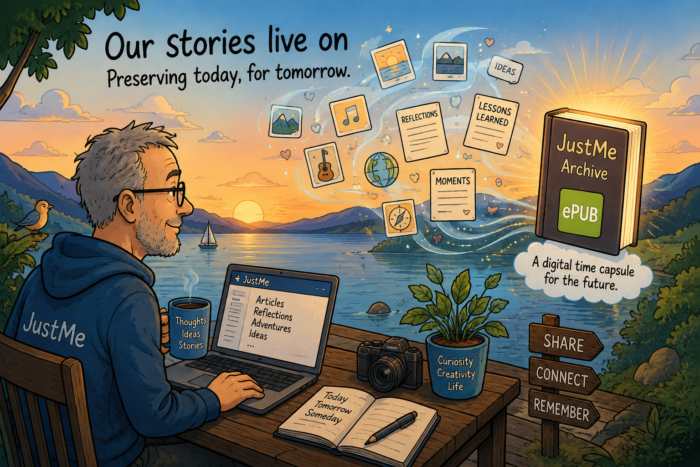
One idea that particularly appeals to me is creating a periodic ePub version of the content published on JustMe. Perhaps every month, every quarter or once a year, the latest articles could be collected into a digital book. An ePub is a simple but powerful format: it can be stored, copied, read on different devices and preserved much more easily than a constantly changing website.
Such a digital “JustMe Archive” would create a kind of time capsule. It would not only preserve the texts themselves, but also capture a specific moment in time. Reading old blog posts often reveals more than just the subject being discussed. It shows how people thought about technology, society and the world around them at that particular moment.
Of course, no digital archive is completely future-proof. Websites disappear, platforms change, domains expire and file formats become outdated. Preserving digital content requires some attention. But perhaps that is exactly the point: our digital memories need the same care that previous generations gave to photo albums, letters and physical documents.
The question of digital legacy is becoming increasingly relevant. Many of us have created a substantial online presence, whether through blogs, social media, photographs or other digital projects. Yet we rarely think about what happens to these creations when we are no longer around.
A blog is more than a collection of web pages. It is a record of curiosity, creativity and human experience. Creating regular ePub archives could be a simple way to ensure that this record does not disappear.After all, perhaps the most valuable thing we leave behind is not the technology we used to create our stories, but the stories themselves.