
Whenever I buy second-hand vinyl records or cassette tapes these days, something funny happens at the checkout. The person behind the counter often asks whether I’ve checked that the record or cassette inside the case is actually the one I’m buying. The first time someone asked me that, I thought it was a slightly strange question. Surely, if the sleeve says it’s a David Bowie album, there should be a David Bowie record inside? But apparently, things aren’t always that simple. And the more I think about it, the more I like the idea that second-hand music comes with a certain amount of uncertainty.
I’ve been buying vinyl and cassettes again for the past few years. Not because I think they always sound better than digital music (although they often do), or because I have anything against streaming. I simply enjoy browsing through old records and tapes. Picking something up, looking at the artwork, reading the track listing, perhaps recognising an album I haven’t thought about in decades.
The wrong record
But what if the music inside isn’t what the cover promises?
It turns out that buying the wrong record in the right sleeve is a surprisingly common experience. And people have some wonderful stories about it. There’s a discussion on Reddit called The wrong sleeve! Please tell me about the record you got accidentally (https://www.reddit.com/r/vinyl/comments/1vb9zbh/the_wrong_sleeve_please_tell_me_about_the_record/), where people share their discoveries.
Someone bought what was supposed to be an Ella Fitzgerald album and ended up with the soundtrack to Mary Poppins. Another expected Sinéad O’Connor but discovered Tom Waits instead. Someone else found an early Possessed record inside a sleeve belonging to the German thrash metal band Destruction.
I can imagine the disappointment. You’ve finally found that album you’ve been looking for, you get home, put it on the turntable and… wait a minute. That’s not right. But I can also imagine the opposite reaction. Perhaps the unexpected record turns out to be something you’ve never heard before. Something you wouldn’t normally have bought. And perhaps you end up loving it.
Of course, there are limits to how much fun this is. If you’ve paid serious money for a particular record, finding something completely different inside is hardly a pleasant surprise. Especially when you’re buying a rare pressing.
There’s another complication, too. Sometimes the album is correct, but the pressing isn’t. The sleeve might belong to an original release while the record inside is a much later reissue. For serious collectors, that distinction matters enormously. Sound Matters has an interesting article about precisely this problem, called Right Cover, Wrong Record: The Perils of Buying Used Vinyl (https://www.yoursoundmatters.com/right-cover-wrong-record-perils-buying-used-vinyl/).
So yes, I understand why second-hand record shops ask customers to check the contents before paying. Still, I can’t help thinking there’s something rather charming about the whole phenomenon.
Someone else’s music collection
A second-hand record has already lived a life before it reaches you. Someone bought it, took it home, listened to it, perhaps played it hundreds of times or perhaps only once. It might have accompanied parties, romantic evenings, lonely Sundays or long afternoons doing absolutely nothing. And then, eventually, someone decided to sell it. Sometimes you can see little traces of that history. A name written on the sleeve. A price sticker from a shop that closed thirty years ago. A handwritten note. Perhaps a record that has clearly been played far more often on one side than the other.
Cassettes can be even more interesting. On Reddit, I found a story from someone who discovered a collection of cassette tapes in a thrift store. They had belonged to a man who had died. The buyer took around 42 tapes home and started listening. Gradually, an unknown person began to emerge from the recordings. There was jazz, music from different periods of his life, and even romantic mixtapes that apparently had never been given to their intended recipient. The story is here: https://www.reddit.com/r/cassetteculture/comments/1epz4w1/.
I find that fascinating. Imagine learning something about a complete stranger simply by listening to the tapes he or she left behind. It’s almost like finding someone’s diary, except that the entries consist of music. And it makes me wonder how many similar collections are sitting in boxes in thrift stores, attics and garages.
Music that doesn’t exist on Spotify
There’s another aspect of second-hand music that I hadn’t really considered before. We tend to assume that almost everything ever recorded is now available somewhere online. And admittedly, the amount of music on streaming services is enormous.
But there’s a whole world of music that never made it onto those platforms. Think of local bands that released a few hundred cassettes in the 1980s. Small independent labels that disappeared decades ago. Demo tapes recorded by musicians who never released an album. Or recordings sold at concerts and distributed among friends. Some of that music may never have been digitised at all. Which means that the cassette you find in a second-hand shop could be one of the few surviving copies of a recording.
I came across a blog called Thrift Store Tape Culture & The Mystery Artist (https://raybrazen.blogspot.com/2018/02/thrift-store-tape-culture-mystery-artist.html), about collecting and exploring mysterious tapes found in thrift stores. That is interesting, because the collector doesn’t necessarily know what he’s buying. The tape itself is the starting point for an investigation. Who recorded this? When? Where did it come from? Was it ever commercially released? Is there any information about the artist? Suddenly, buying second-hand music becomes a kind of amateur archaeology. And occasionally, the person who finds an old tape may be the first person in years to listen to what’s on it.
Digging through crates
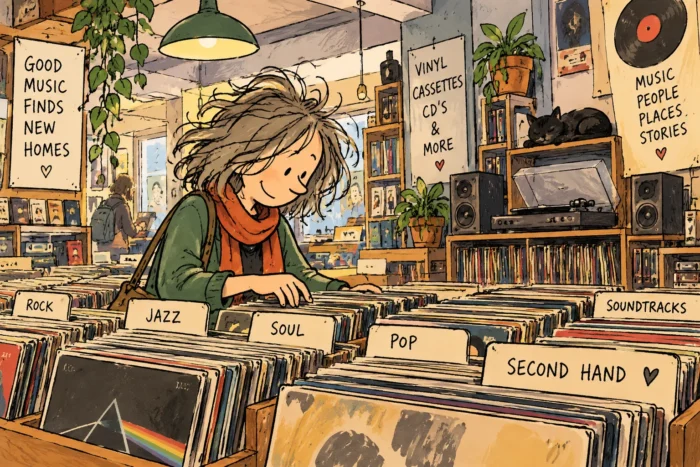
There’s a term for searching through boxes and shelves of old records: crate digging. It’s closely associated with DJs, hip-hop producers and serious record collectors, but I think it describes something that many ordinary second-hand music buyers enjoy. You enter a shop without a particular album in mind. You start browsing. Perhaps you recognise an artist. Perhaps a sleeve catches your eye. Or you find something so strange that you simply have to know what it sounds like. The interesting thing is that you’re not searching for something you already know you want. You’re allowing yourself to discover something unexpected.
There’s a surprisingly technical side to this world, too. Experienced collectors know how to identify different pressings of the same album by examining details that most people would never notice. For example, the tiny letters and numbers etched into the runout groove of a vinyl record can reveal information about the pressing. Discogs has extensive documentation about these markings (https://support.discogs.com/hc/en-us/articles/360005054893-Database-Guidelines-5-Barcodes-Identifiers). I rather like the idea of people investigating a record almost as if it were an archaeological object. Not just asking what music is on it, but where it was manufactured, which version it is and how it ended up in their hands.
The pleasure of not knowing
What strikes me about all this is how different it is from the way we usually discover music today. Streaming services are very good at helping us find things. We can search for an artist, an album, a song title or a genre. Recommendation systems suggest music based on what we’ve listened to before. And that’s incredibly convenient. But browsing through second-hand records works differently. You don’t know what’s going to be in the next box. You don’t know whether you’ll find anything interesting. You might spend half an hour looking through records and leave empty-handed. Or you might discover an album by an artist you’ve never heard of, released by a label that no longer exists, with a sleeve that looks as though someone designed it at their kitchen table.