
Some people are turning the simple act of discovering personal websites into something surprisingly playful. A great example of that, is a website called Pixel Area (https://pxlarea.com/). At first glance, it looks like a colourful collection of tiny squares. Nothing particularly sophisticated. But click on one of those squares and you might find yourself visiting somebody’s personal website, a little blog, an unusual creative project, or a corner of the internet you didn’t even know existed.
The idea is simple. Instead of presenting websites as a list of links, Pixel Area gives them a physical location on a digital grid. Each website occupies its own little piece of space. Somehow, that changes the experience. You’re no longer browsing a directory in the traditional sense. You’re wandering around a place, looking for something interesting. A colour catches your attention, you click, and suddenly you’re somewhere else.
It reminded me of something I’ve been thinking about quite a lot lately: perhaps the personal web doesn’t just need more websites. Perhaps it also needs more interesting ways for people to find one another.
Remember when finding a website was an adventure?
There was a time when discovering websites felt rather different from how it does today. You might follow a link from somebody’s homepage, stumble across a webring, or explore a collection of bookmarks maintained by someone whose interests happened to overlap with yours. Sometimes you’d end up somewhere completely unexpected.
Of course, there were directories too. Yahoo famously started as one, as did Startpagina (https://www.startpagina.nl/) in my own part of the world. Countless smaller directories appeared throughout the early web. There was often something rather personal about many of them. Somebody had taken the trouble to collect websites, organise them, and recommend them to other people.
Today’s search engines are enormously more capable. Yet they have also made discovering the web feel strangely functional. You type a question, receive an answer or a collection of results, and hopefully find what you need.
That works very well when you already know what you’re looking for. But what if you don’t? What if you simply want to see what other people are making? That’s where projects like Pixel Area become interesting.
Websites as places you can visit
Pixel Area isn’t the only project experimenting with the idea of giving websites a sense of place. Take Somnolescent Districts (https://somnolescent.net/index2.html), for example. This project connects a collection of personal websites through the idea of fictional districts. Instead of treating each website as an isolated destination, it places them within an imaginary community.
I like that idea. It suggests that a personal website can be more than an individual publishing platform. It can also be somebody’s little house in a much larger neighbourhood. The neighbourhood doesn’t have to exist in the physical world. Its geography can be entirely imaginary.
Another interesting experiment is Base31 (https://www.base31.org/), which presents websites through an interactive network of connected branches. Rather than scrolling through rows of names, visitors explore a visual structure. Websites become nodes in something that resembles a map.
Neither approach necessarily makes finding a particular website faster. But that’s not really the point. They make exploration itself part of the experience. I wonder whether that’s something we’ve gradually lost as the web has become more efficient.
Sometimes the best destination is a surprise
Other projects take a different approach. Instead of building a visual world, they bring back the element of chance. Cloudhiker (https://cloudhiker.net/) is one example. It encourages visitors to discover websites beyond the usual large platforms, including unusual, independent and creative corners of the internet. You don’t necessarily arrive with a particular question. You arrive because you’re curious.
Then there’s IndieBlog.page (https://indieblog.page/), which does something I find particularly appealing. Instead of sending you to a random personal homepage, it sends you to a random blog post. A homepage tells you who someone is, or at least how they choose to present themselves. A blog post tells you what they were thinking about at a particular moment. Perhaps somebody has written about repairing an old camera. Or about some British railway stations. Perhaps they’ve documented a walk through their hometown, explained why they stopped using a particular app, or shared photographs of a collection of objects that most people would probably throw away.
You don’t know until you click. And because you’re arriving at an actual article, you immediately have something to read. If you enjoy it, you might become curious about the person who wrote it. And before you know it, you’re exploring the rest of their website. That’s a rather interesting reversal of how we usually discover people online.
The people behind the websites
Not every interesting directory needs a playful map or a random button. Some projects make the people behind the websites more visible. PersonalWebsites.org (https://personalwebsites.org/) presents a large collection of personal websites, including visual previews and information about their creators. It feels a little like walking through a gallery of people’s online homes.
Meanwhile, Blogroll.blog (https://blogroll.blog/) introduces another dimension: geography. You can discover personal blogs through cities and countries. That is interesting because the personal web is often discussed as though it were a largely English-speaking phenomenon. Of course it isn’t. People are maintaining personal websites in Japan, Germany, France, Brazil, South Korea, the Netherlands and countless other places. They may write about entirely different subjects, use different publishing tools, and have different ideas about what a personal website should look like. A geographically organised blog directory makes some of that diversity easier to explore.
Then there’s Ye Olde Blogroll (https://blogroll.org/), which takes a more traditional approach: a human-curated collection of independent blogs. And Weirdnet (https://directory.weirdnet.org/), which feels like opening the door to a vast cabinet of internet curiosities, full of unusual websites, creative projects, niche interests and subcultures.
These projects are quite different from Pixel Area. But they share something important. They make choices about what deserves attention without simply reproducing the ranking systems of the major platforms.
Those tiny buttons are making a comeback, too
Another discovery is Netdir (https://netdir.org/), a webring built around those small 88×31-pixel buttons. If you remember the early personal web, you’ll probably recognise them immediately. They were everywhere. Little animated or static badges announcing which browser someone preferred, which software they used, which communities they belonged to, or simply something they found amusing. Netdir uses these buttons as part of a network of personal websites. You can move from one participating website to another, or jump to a random destination.
What I particularly like is that the navigation doesn’t have to live exclusively on a central directory. The participating websites can become part of the discovery system themselves. That’s a different philosophy from a platform where everyone publishes inside the same environment. Here, people keep their own websites while creating connections between them.
A pixel doesn’t care how many followers you have
There’s another aspect of Pixel Area that I keep returning to. On a grid of tiny squares, a website belonging to someone with five readers can occupy the same amount of space as a website belonging to someone with fifty thousand. That doesn’t mean every website receives the same attention, of course. Position, colour and visual appeal will influence what people click. But at least the interface doesn’t begin by asking who is most popular. It begins with a collection of places. And visitors decide where to go.
I find that a refreshing idea in an online world where visibility is so often determined by engagement statistics, recommendation systems and advertising budgets. It also raises an interesting question. What would happen if we stopped designing discovery tools primarily to help people find the most relevant or popular content, and started designing some of them simply to encourage curiosity? Perhaps the results would be less predictable. But perhaps that would be a good thing.
Could a blogroll become something entirely different?
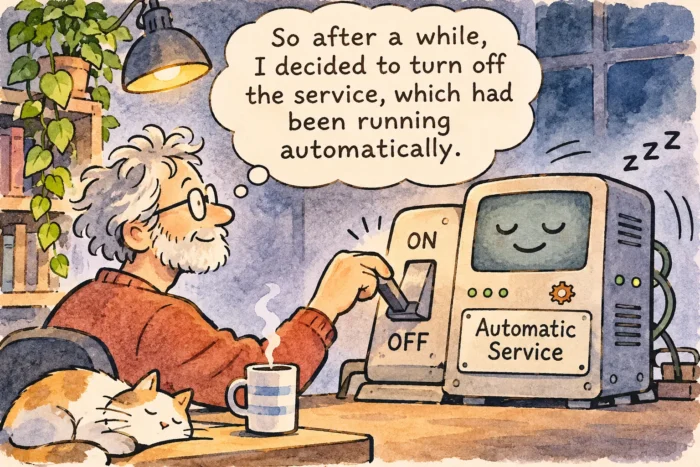
I’ve been experimenting with a feature on Just Me called Just Me Wanderer. It introduces visitors to other independent websites. I like the underlying idea, but I’ve also been wondering whether sending people to random websites is enough. So after a while, I decided to turn off the service, which had been running automatically.
Perhaps the missing ingredient is a little more context. Imagine a visual collection of personal websites that resembles a bookshelf, a small town, a garden or even a night sky. Each website has its own place. But instead of merely displaying its name, the interface might show something interesting that its owner has recently published. You could browse the little world, notice an intriguing article, read a short description, and decide whether to visit. The website would still be the destination. The article would be the invitation. It wouldn’t have to be an algorithmic recommendation engine. Nor would it need to rank people according to popularity. It could simply be a playful way of introducing people to one another’s work. And perhaps visitors could eventually contribute their own discoveries, making the collection grow organically.
The web needs more doors
I don’t think any of these experiments will replace search engines. Nor should they. They solve a different problem. Search engines are useful when you know what you want to find. Directories, blogrolls, webrings and these strange little visual experiments are useful when you want to discover something you didn’t know you were looking for.
They also remind us that the web doesn’t have to look like a feed, a search results page or a collection of identical profile cards. It can look like a map. A neighbourhood. A bookshelf. A collection of tiny pixel buttons. Or something nobody has thought of yet.
And maybe that’s what makes this small movement so interesting. People aren’t just creating independent websites again. They’re also experimenting with new ways to connect them. I think I’ll spend some more time exploring these projects, particularly those emerging outside the English-speaking web. Because if there are already people turning directories into tiny digital worlds, I’m rather curious to see what else is out there.