
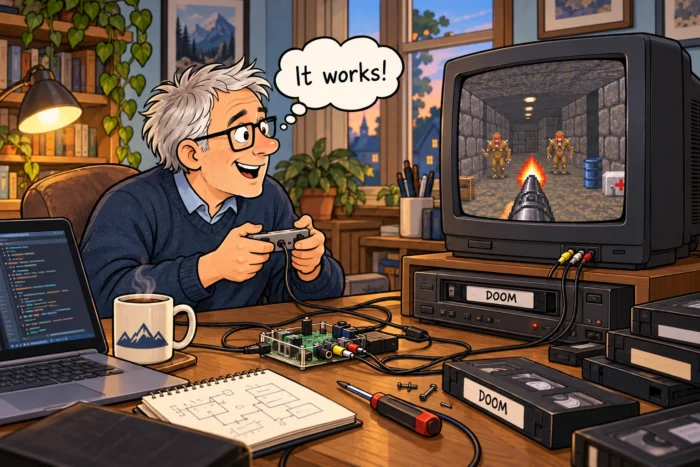
I tend to think of VHS tapes as things you watched. You put one into a video recorder, pressed play and hoped nobody had recorded something else over the film you wanted to see. Gaming belonged to another device under the television. At least, that was the arrangement I understood.
Then I came across this article on hackaday (https://hackaday.com/2026/10/05/porting-video-games-to-vhs/) about bringing video games to VHS. Which is certainly an unusual way to spend an evening gaming. Somewhere between finding the controller and remembering what the tracking button did.
The project is by a creator called Throaty Mumbo. After trying ActionMax, an older VHS gaming system with a light gun and footage that played the same way each time, he decided to build something more interactive. His setup uses a VHS tape containing both video streams and binary game data, with additional electronics decoding that information and processing controller input. The tape supplies the material; modern hardware makes interaction possible.
The demonstrations include Super Mario Bros. with video backgrounds, Night Trap and a version of Doom built around prerecorded footage and timed button presses. That last detail matters: this is a different interpretation of playing Doom, rather than the familiar game simply running inside a video recorder.
What caught my attention was the choice of medium. A tape moves forward through a sequence. A player, meanwhile, expects to make decisions, change direction and interfere with what happens next. Putting those two things together creates a rather interesting design problem. How much interaction can you build around something that keeps rolling?
I like coming across projects that start with a question like that. Most of us look at an old video recorder and see a device whose working life has ended. Someone else sees a collection of mechanisms, signals and possibilities, then wonders whether it could become part of a game system. I recognise a little of my own approach here. Some of my projects begin with something I want to try, even though I already know I am unlikely to use it in everyday life. I will happily spend time figuring it out anyway. Much of the fun is in experimenting, solving the little problems along the way and seeing whether I can actually get the thing to work. That moment when it finally does what I hoped it would do can be enough reason to have built it.
It also makes me think about how easily we accept the intended purpose of technology. A video recorder plays films. A browser displays websites. A text editor lets us write. Those descriptions are useful, but people keep finding ways to stretch them. Sometimes the result becomes a practical tool. Sometimes it becomes a wonderfully peculiar experiment involving Doom and a magnetic tape.
Would we replace a modern gaming system with this? I suspect the novelty would have to carry quite a lot of the experience. But I would certainly be curious to try it. There is something appealing about having to rethink a familiar activity because somebody has deliberately chosen an awkward piece of hardware.
And if the game goes badly, at least there is finally a plausible reason to say: perhaps I should rewind and try again.