Just Me Wanderer: An experiment in random discovery, unexpected blog posts, and the wonderful variety of the independent web

One of the things I love about the IndieWeb is that you never really know what you are going to find. One moment you’re reading about someone building a tiny computer in their garage. A few clicks later, you’re looking at photographs of abandoned railway stations in Japan. And before you know it, you’ve spent twenty minutes reading a detailed account of someone’s attempts to grow tomatoes on a balcony.

None of these subjects were on your mind when you started browsing. You weren’t searching for them. You probably didn’t even know you were interested in them. And yet, here you are.

I think that’s one of the most enjoyable things about the independent web. It is full of people writing about whatever interests them. Not necessarily because there’s an audience for it. Not because some algorithm has identified a trending topic. But simply because they have something they want to share. And the variety is enormous.

A web that doesn’t fit into categories

We tend to talk about the web as if it consists of a relatively small number of subjects. Technology, politics, entertainment, sports, travel, food, and so on. But spend some time exploring personal websites and you’ll discover that these categories barely scratch the surface. People write about restoring old radios, collecting unusual maps, learning forgotten programming languages, identifying birds, experimenting with homemade musical instruments, or documenting the history of a single street in their hometown. Some blogs are beautifully designed. Others look as if they haven’t changed since 1998. Some authors publish several times a day. Others return after three years with a new post about something completely unexpected.

There is no editorial calendar to satisfy. No need to optimize every headline for search engines. No requirement to build a personal brand. Of course, some independent bloggers do care about traffic and visibility. Nothing wrong with that either. But the beauty of the IndieWeb is that people can decide for themselves what their websites are for. I find that incredibly refreshing.

The problem with looking for things

There is, however, a small problem. How do you discover all this wonderful stuff?

RSS helps enormously. I use it all the time. And services that encourage serendipitous discovery can take you to websites you would probably never have found otherwise. But even then, there’s a limitation. You tend to follow people whose interests overlap with your own. And when you discover new websites, they often come through people you already follow. That’s not necessarily a bad thing. It just means that your little corner of the web can gradually become rather familiar.

Search engines don’t completely solve this problem either. They are excellent when you know what you’re looking for. But what if you have absolutely no idea what you want to find? How do you search for something you don’t know exists? You can’t, really.

Which brings me to a little experiment I’m starting here on Just Me.

What if we let randomness do the work?

I’ve been playing with a simple idea. What if I built a system that searches for a completely random blog post somewhere on the independent web, reads it, and publishes a short introduction to it here on Just Me? Not a recommendation based on my interests. Not a carefully curated selection of the best articles of the day. And certainly not another algorithm trying to predict what I might want to read. Just a random blog post. It could be about photography, knitting, astronomy, a programming experiment, a family holiday, or someone’s thoughts about a book they finished yesterday. I genuinely don’t care. In fact, that’s the whole point. I want to discover subjects I wouldn’t normally look for. And I want to show just how incredibly diverse the independent web really is.

So I decided to automate the process.

A little script, an LLM, and a WordPress blog

The technical setup is relatively straightforward. A script searches for a blog post on an independently published website. It retrieves the content and passes it to a large language model, which produces a very short English introduction explaining what the post is about. The system then publishes that introduction on Just Me, together with a link to the original article.

The idea is to publish two of these discoveries every day, one at 10 in the morning and another at 5 in the afternoon (Amsterdam time. I do not manually select the subjects. I don’t tell the LLM to prefer technology, open source, privacy, or any of the other subjects I usually write about. The whole idea is to get away from my own preferences.

Of course, completely random discovery is harder than it sounds. The script still needs a way to find websites, and the sources it uses will inevitably influence what it discovers. It also needs to avoid spam, duplicate posts, and content that isn’t suitable for republishing even as a short introduction. So this isn’t mathematically perfect randomness. But it is an attempt to remove my own interests from the selection process as much as possible.

And just to be clear: the LLM isn’t writing new versions of other people’s articles. It is simply creating a short introduction and pointing readers to the original author’s website. That’s important to me. I want people to visit these websites, not replace them with AI-generated summaries.

I’m curious about the results myself

Here’s another thing I like about this experiment. I have no idea what will appear on Just Me tomorrow. Or next week. I might discover a fascinating blog about medieval architecture. Or a website dedicated to old railway timetables. Or a personal account of someone’s attempt to repair a thirty-year-old coffee machine. Maybe some of these posts will be fascinating. Others might be completely uninteresting to me.

Actually, I hope some of them will be about subjects I have absolutely no interest in. Because the purpose isn’t to build a collection of articles I personally enjoy. It is to demonstrate how many different interests, hobbies, ideas, experiences, and opinions exist outside the relatively small part of the web most of us visit every day. And perhaps someone reading Just Me will discover a new blog they want to follow. If that happens, the experiment has already achieved something worthwhile.

Giving a little attention back to the independent web

There’s also a broader reason why I want to do this. So much of our online attention is concentrated on a handful of enormous platforms. Their algorithms decide which posts we see, which subjects become popular, and which creators receive attention. Meanwhile, there are countless independent websites publishing interesting things that most of us will never encounter. Not because the content isn’t good. Simply because we don’t know these websites exist.

I don’t expect my little experiment to change that in any meaningful way. Just Me isn’t exactly a gigantic traffic generator. But perhaps it can send a few visitors to a website they’ve never heard of. Perhaps someone will subscribe to a new RSS feed. Perhaps a blogger somewhere will notice that a complete stranger has linked to something they wrote.

And I particularly like the idea of using AI for something like this. Not to produce an endless stream of synthetic content, but to help people discover things written by other people. AI as a tool for discovery rather than a replacement for the original work. That seems like a rather nice use of the technology.

Let’s see where this takes us

So, over the coming weeks, you’ll notice some rather unusual posts appearing on Just Me. They’ll be short. They’ll link to their original sources. And they’ll cover whatever subjects the script happens to stumble upon. There won’t necessarily be any connection between them. One day might bring a post about astrophotography followed by one about homemade bread. The next day could be about a forgotten video game or an unusual species of mushroom. I won’t know in advance. And that’s precisely what makes this fun (I hope).

The posts will appear on the Just Me homepage, just like my regular blog posts. But, if everything works as planned, they will also be collected on a separate page called Just Me Wanderer. That way, anyone who enjoys a bit of random exploration can browse through all these unexpected discoveries in one place. Think of it as a little doorway to corners of the web you didn’t even know existed.


Please Rewind Before Playing Doom

I tend to think of VHS tapes as things you watched. You put one into a video recorder, pressed play and hoped nobody had recorded something else over the film you wanted to see. Gaming belonged to another device under the television. At least, that was the arrangement I understood.

Then I came across this article on hackaday (https://hackaday.com/2026/10/05/porting-video-games-to-vhs/) about bringing video games to VHS. Which is certainly an unusual way to spend an evening gaming. Somewhere between finding the controller and remembering what the tracking button did.

The project is by a creator called Throaty Mumbo. After trying ActionMax, an older VHS gaming system with a light gun and footage that played the same way each time, he decided to build something more interactive. His setup uses a VHS tape containing both video streams and binary game data, with additional electronics decoding that information and processing controller input. The tape supplies the material; modern hardware makes interaction possible.

The demonstrations include Super Mario Bros. with video backgrounds, Night Trap and a version of Doom built around prerecorded footage and timed button presses. That last detail matters: this is a different interpretation of playing Doom, rather than the familiar game simply running inside a video recorder.

What caught my attention was the choice of medium. A tape moves forward through a sequence. A player, meanwhile, expects to make decisions, change direction and interfere with what happens next. Putting those two things together creates a rather interesting design problem. How much interaction can you build around something that keeps rolling?

I like coming across projects that start with a question like that. Most of us look at an old video recorder and see a device whose working life has ended. Someone else sees a collection of mechanisms, signals and possibilities, then wonders whether it could become part of a game system. I recognise a little of my own approach here. Some of my projects begin with something I want to try, even though I already know I am unlikely to use it in everyday life. I will happily spend time figuring it out anyway. Much of the fun is in experimenting, solving the little problems along the way and seeing whether I can actually get the thing to work. That moment when it finally does what I hoped it would do can be enough reason to have built it.

It also makes me think about how easily we accept the intended purpose of technology. A video recorder plays films. A browser displays websites. A text editor lets us write. Those descriptions are useful, but people keep finding ways to stretch them. Sometimes the result becomes a practical tool. Sometimes it becomes a wonderfully peculiar experiment involving Doom and a magnetic tape.

Would we replace a modern gaming system with this? I suspect the novelty would have to carry quite a lot of the experience. But I would certainly be curious to try it. There is something appealing about having to rethink a familiar activity because somebody has deliberately chosen an awkward piece of hardware.

And if the game goes badly, at least there is finally a plausible reason to say: perhaps I should rewind and try again.

Who Looks at an E-Ink Display and Thinks: Birds

Every now and then I come across a project that makes me wonder: How did somebody even think of this? Fugleramme is one of those.

The idea sounds almost ridiculously specific. Put a microphone near your window. Listen to the birds outside. Use AI to recognise which species are making those sounds. Then show those birds on an e-ink display, using beautiful old natural-history illustrations. And yes, of course, run the whole thing on a Raspberry Pi.

That is Fugleramme. You can find it here: https://github.com/arnegiacomo/fugleramme

It uses BirdNET-Go to listen for and identify birds. Fugleramme then matches the detected species with illustrations and arranges them on an e-ink display. When the birds outside change, the picture changes as well. The AI runs locally, and the illustrations aren’t AI-generated either: the project contains more than 800 carefully prepared cut-outs representing over 400 species, based on actual historical natural-history plates.

The creator even has one running at his kitchen window in Bergen, Norway, displaying the birds that can currently be heard in his garden.

I sometimes think we spend too much time talking about technology in terms of productivity, efficiency and business cases. Raspberry Pis, local AI and e-ink displays apparently also allow us to build a picture frame that listens to birds.

Projects like this are one of the reasons I still enjoy wandering around personal websites. I am sometimes completely amazed by the creativity of people. Someone sees a microphone, a Raspberry Pi, an e-ink screen, some local AI software and a collection of nineteenth-century bird illustrations — and somehow connects all those dots. Would I have thought of Fugleramme myself? Absolutely not. Which is precisely why finding projects like this is so much fun.

Two New Journalism Ideas a Day, Courtesy of a Small Local LLM

I have been experimenting quite a bit lately with small tools, websites and AI projects. Not because I am trying to build the next big platform, but mostly because I enjoy finding out what is possible when you combine relatively simple technology with an idea.

One of those experiments is my little automated newsroom. I wrote about it earlier in “My laptop is running a tiny newsroom” (https://justme.website/content-creation/my-laptop-is-running-a-tiny-newsroom/). The basic idea is fairly straightforward. I built a setup that can create and maintain small, highly specialised news websites automatically. An open-source/open-weight LLM monitors a collection of sources about a particular niche subject. And I deliberately don’t limit those sources to English. They can be websites in Dutch, German, French, Swedish, Norwegian, Finnish, Italian or whatever language happens to be useful for that particular subject. The model decides which stories are new and relevant, writes a short news item based on a prompt I created, adds a link to the original source and publishes the result on a website.

At the moment, that newsroom is still very much a … well … internal operation. With “internal” meaning: it lives on my laptop. And yes, that includes the LLM. There are things I still want to improve, but as a proof of concept it works. I expect to be able to publish the first of these niche websites in a few weeks. So stay tuned.

Journalism could use more ideas

And once something like that works, an obvious question appears: what else could I do with this approach? I keep coming back to the world of journalism. There is certainly no shortage of journalism. But I think there is plenty of room for new ideas about how we do journalism. New tools. New services. New editorial products. New ways of presenting information. Small experiments that may never become businesses but could still turn into something useful. So I wondered whether I could use roughly the same LLM-plus-website approach to create a continuous stream of ideas for new journalistic products.

Once again, with a little vibe coding, building the first version wasn’t particularly difficult. I gave the LLM a fairly detailed description of what I wanted to achieve. In other words: my version of a product requirements document. I want ideas for new products, tools and services related to journalism and editorial work. For every idea, I want a short description explaining what it is and why it could be useful. And I want two of those ideas published every day. There was one additional requirement: I wanted to be able to add my own ideas as well. The result is Editorial-Ideas.com (https://editorial-ideas.com/).

This time, no WordPress

As with many of my proof-of-concept projects, the whole thing runs automatically. This time I didn’t use WordPress for the website itself. I decided to use a static site generator called Hugo (https://gohugo.io/). I will probably write another post about static site generators and Hugo at some point, because that turned out to be an interesting subject in itself.

Hugo runs on my little Slimbook Zero server (https://slimbook.com/en/zero), which I have mentioned here on Just Me before. It isn’t an enormously powerful server. Quite the opposite. But that is exactly why I like it. It has become the foundation for quite a few of my experiments.

Both the LLM and Hugo run locally on that machine. The LLM creates the ideas and content. Hugo turns that content into the actual website. A script then uploads the generated site via FTP to an external hosting provider. And that’s basically it.

Twice a day, the machine goes to work and a new idea appears on the website. I can also join the process myself. If I come across an interesting idea somewhere, or think of something myself, I can simply create a Markdown file and add it to the stream of ideas. So although the website is largely automated, I am not locked out of my own newsroom. Which seems useful.

But which LLM?

One part of this project turned out to be particularly interesting: choosing the LLM. Which model do you use for something like this? How large should it be? What can my little server actually handle? Is Llama better than Qwen for this? Would a Mistral model produce better ideas? How do I run these models locally? And how small can I go before the quality becomes noticeably worse?

Figuring that out was actually a significant part of the fun. I tried different models and sizes. And the conclusion was perhaps less exciting than I expected. For this particular project, it doesn’t matter that much. Mistral doesn’t magically write much better ideas than Qwen. Llama doesn’t suddenly transform the project either. There are differences between models, obviously, but they turned out to be much less important for this use case than choosing an appropriately sized model and giving it good instructions.

And “appropriately sized” in my case means relatively small. The model I eventually settled on is literally only a few gigabytes. That is partly dictated by the hardware. My little server has limits. A local LLM, even a relatively small one, can still make it work pretty hard. But here is the important part: I don’t care. The model only needs to do this twice a day. If generating an idea, writing the text and rebuilding the website takes a little longer, nothing happens. Nobody is sitting in front of Editorial-Ideas.com with a stopwatch waiting for the next idea to appear. There is absolutely no reason for this particular application to be lightning fast.

Maybe the small model is the right model

For me, that was another confirmation of something I have believed for some time: choose the LLM that fits the project. That sounds obvious, but the AI world has a strange fascination with the latest and greatest. Bigger models. More parameters. Bigger servers. More GPUs. More everything. And yes, putting an enormous model on a ridiculously powerful machine or cluster of machines looks impressive. But does your use case actually need it?

For this PoC, the answer is obviously no. A small local model running twice a day is perfectly capable of doing the job I need it to do. Using something dramatically bigger would mostly mean spending more money and consuming more computing resources without necessarily producing a significantly more useful website. For homelabs and small experiments in a business setting, that is important. You do not need to buy a ridiculously expensive new Mac Mini. Existing or older hardware will often work perfectly well.

I think the same considerations apply to professional AI projects within companies and government organisations. Start with the use case. What exactly are you trying to achieve? How good does the output need to be? How fast does it need to be? What hardware do you already have? What are your privacy or data requirements? I mean, we want Privacy by Design! And then choose a model. The latest and greatest isn’t automatically the best choice. Sometimes a model of a few gigabytes quietly running on a small server is all you need.

Anyway, here it is

The result of all this tinkering is Editorial-Ideas.com (https://editorial-ideas.com/). There are still a few small things I want to change. There probably always will be. That is part of running these kinds of projects. But the basic idea works. Twice a day, a new idea appears for a journalistic tool, service or product. Have a look. Maybe there is an idea there that makes you think: Hmm, I could do something with that. Maybe there isn’t. That’s fine too. But if you do find something interesting and decide to build on it, I hope it turns into something successful. More importantly, I hope it turns into something that is fun to work on. And if you actually start working on one of the ideas, do let me know. I would genuinely like to hear what happened to it.

Oh, and by the way: if you check the filename of the cartoon (editorial-ideas.png-shrunk.webp), you’ll notice the word “shrunk” in there. That’s because I’m still using my fully automated service to resize images in my Downloads directory. And that’s the beauty of automation: once it works, you can simply forget about it. It quietly does its job in the background without you having to think about it. You can read about this here: https://justme.website/content-creation/my-downloads-folder-now-resizes-photos-for-me/.

A (Hopefully) Useful Collection of Other People’s Collections

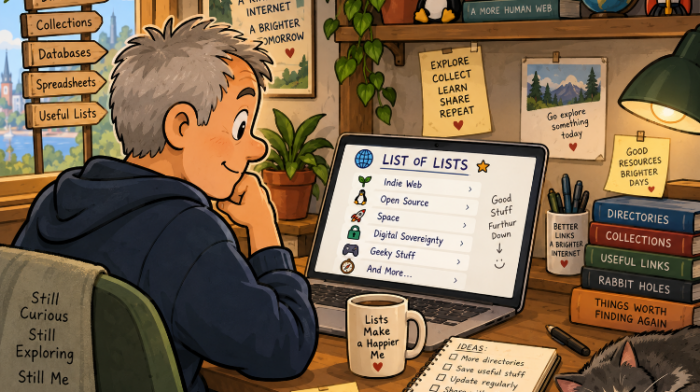
I have started a new page on Just Me for something I apparently cannot resist: lists. More precisely, it is a collection of links to directories, databases, spreadsheets, collections and other useful overviews I come across. Some are about technology, some about space, open source, the Indie Web or digital sovereignty. Others are simply wonderfully geeky.

You can find it here: https://justme.website/just-my-lists/

There is no grand plan behind it. If I find an overview that makes me think this is useful, I should remember this, it can go on the page. So yes, this is basically a list of lists. And, knowing myself, it will probably grow quite a lot over time.

You’re Not Just Publishing Posts. You’re Building a Habit for Your Readers

I only discovered Blaugust when August was almost over. Which is slightly unfortunate, because I like the idea.

Blaugust is one of those wonderfully IndieWeb-ish initiatives where people encourage each other to blog more. See for more here: https://tagn.wordpress.com/2026/07/21/. It originally started as a challenge to publish every day during August, although over the years it has become somewhat less strict. The idea now seems to be at least as much about participating, meeting other bloggers and keeping personal blogging alive.

Sebastian Malloy participated this year and wrote an interesting post about what the experience taught him (https://sebastianmalloy.bearblog.dev/what-blaugust-has-taught-me-about-my-blogging/). He managed 30 posts in 31 days, but discovered that producing something simply because today’s post still had to be produced wasn’t really for him. Some posts felt as if they existed mainly because there was a quota to meet. What he did enjoy was reading what everybody else had written.

I didn’t participate in Blaugust. There are several reasons for that. The most obvious one is that I already publish something on Just Me almost every day. So adding a challenge to make me write regularly would be slightly odd. The other reason is much simpler: I discovered Blaugust too late. Maybe next time.

There is a whole world of these things

What surprised me is that Blaugust isn’t some isolated event. There appears to be an entire world of challenges built around the simple idea of committing yourself to making things.

There is 100 Days To Offload, for example, where the challenge is to publish 100 posts on your personal blog within 365 days (https://100daystooffload.com/). And the rules explicitly say those posts don’t have to be long, profound or particularly polished. The important part is to write.

Then there is the IndieWeb Carnival (https://indieweb.org/IndieWeb_Carnival). Every month another blogger chooses a subject and other bloggers write their own posts about it. At the end of the month, the host collects the contributions. The IndieWeb wiki actually describes one of its purposes as motivating people to publish more on their personal websites and giving them inspiration for things to write about.

And there are many more. The DS106 Daily Create (https://daily.ds106.us/) offers small daily creative assignments involving photography, drawing, audio, video and writing. There are similar initiatives for musicians, pixel artists, zine makers and people building websites. There is even a site that collects these challenges.

And, of course, there is NaNoWriMo or National Novel Writing Month (https://nanowrimo2.com/), probably the best-known variation on the general idea: commit to creating something, set yourself a target and do it together with other people.

In other languages we see the same (more or less). In Germany there are quite of few challenges as well. See for example here https://judithpeters.de/50-blogparaden-im-sommer-2026/. I found fewer direct French-language blogging equivalents. There are plenty of French community writing challenges, though. For example, Scribonautes (https://scribonautes.fr/a-propos/) runs ongoing “défis d’écriture” where participants respond to community-created prompts and read and vote on each other’s work. It is closer to creative writing than personal blogging, but the community/regular-creation principle is very similar.

I find all this fascinating. Not necessarily because I need somebody to tell me to write another blog post. At the moment, I have rather the opposite problem. There are far more things I want to write about than I have time for. But these challenges provide something else. They are a very nice way to discover people. You follow links to participants, encounter blogs you have never seen before and suddenly end up reading about someone’s record collection, Linux setup, garden, travels, books or strange little hobby you didn’t know existed. That might actually be the most interesting part.

But what if you have nothing to say?

There is another side to all this. Sebastian Malloy’s experience also points to an obvious problem with publishing challenges: what happens when you simply have nothing you consider interesting enough to publish? I recently came across this post, Why People Quit Blogging (see here: https://unattributed.cc/2026/08/27/why-people-quit-blogging/), which looks at some of the reasons people eventually stop.

It certainly isn’t an exhaustive list, but I think the question itself is interesting. Starting a blog is easy. Continuing one for years is something else entirely. Perhaps you run out of subjects. Perhaps life changes. Perhaps writing starts feeling like an obligation. Or perhaps you begin wondering whether anybody is actually interested in what you have to say.

Challenges such as Blaugust, 100 Days To Offload and the IndieWeb Carnival can probably help with that. They provide a reason to sit down again. A subject. A small deadline. And, importantly, other people who are doing exactly the same thing.

Your readers notice when you disappear

But I think there is another reason to keep going that bloggers themselves may underestimate. What bloggers perhaps don’t always realise is that readers aren’t only interested in subjects. Over time, they also become interested in you. They want to know what you have discovered. What you are doing. What you think about something. Which book you are reading. Which piece of software you are experimenting with. Or why something completely ordinary suddenly caught your attention.

That creates a small social connection. It is very different from following a professional publication where another author can simply take over. A personal blog has a person attached to it. That person is part of the reason people return. And once you establish some kind of rhythm, people get used to that rhythm too. If it suddenly changes, I suspect some regular readers really do notice. Not necessarily in a dramatic way. Nobody will organise a search party because you haven’t published anything for four days. But perhaps there is a tiny moment of disappointment when they check your blog or their RSS reader and there is nothing new. Oh. You’re not here today.

I think that is rather nice. And perhaps that small relationship between writer and reader is something worth remembering whenever blogging starts to feel like talking into an empty room.

Why Thomson Reuters’ Own AI Model Is More Interesting Than It First Seems

Thomson Reuters has launched its own AI model, called Thomson, and I think the most interesting part of the story is not that yet another company has built an AI model. It is how they did it.

You can read the original press release here: https://www.thomsonreuters.com/en/press-releases/2026/august/thomson-reuters-leverages-its-world-class-data-assets-to-launch-its-own-frontier-model. I wrote about it here (text in Dutch): https://ai-visie.net/thomson-reuters-bouwt-eigen-frontier-ai-model/.

Thomson Reuters is not trying to beat OpenAI, Google or Anthropic by training a gigantic general-purpose model from scratch. Instead, it started with an existing open model and then trained and specialised it using its own data and expertise. The company reportedly invested around $40 million in talent and compute. That is still a serious amount of money, of course. But compared with the billions now being spent on the largest frontier models, it is almost modest.

The real advantage may be the data

Thomson Reuters has something most companies simply do not have: decades of highly structured, professionally maintained legal, tax and financial information. That may turn out to be much more valuable than simply having access to more GPUs.

For certain legal tasks, Thomson Reuters says its model can compete with, and in some cases outperform, much larger general-purpose frontier models. That makes sense. A specialised model does not need to be brilliant at everything. It needs to be exceptionally good at the tasks for which it was designed.

And that raises an interesting question. If Thomson Reuters can do this, why don’t more large companies simply build their own frontier models?

Because having lots of data is not enough

Many large organisations have enormous amounts of data. Banks have transactions. Manufacturers have huge amounts of product(ion) data. Telecom companies have network data. Healthcare organisations have huge collections of medical information.

But having data and having usable AI training data are two very different things. Corporate information is often scattered across thousands of systems, poorly structured, duplicated, lacking useful meta data, outdated or difficult to use because of privacy, intellectual property and compliance restrictions.

Then there is the technology itself. Training and maintaining a serious model still requires specialised AI engineers, infrastructure, evaluation methods, security expertise and a lot of compute. And once the model exists, you have to keep operating, testing and improving it.

So perhaps the interesting lesson from Thomson Reuters is not that every large organisation should now build its own model. It is that some organisations may have a very valuable combination: unique data, deep domain knowledge and enough resources to turn an existing open model into something that is better than a general-purpose AI system for their particular field.

Maybe “frontier” is becoming more specialised

I find that a particularly interesting development. Until now, we have tended to think of frontier AI as a race to build ever larger models. More parameters, more compute, bigger clusters. But perhaps there will also be another kind of frontier: not a model that knows everything, but one that knows one domain exceptionally well.

For companies sitting on decades of carefully curated specialist knowledge, that could make owning at least part of their AI stack increasingly attractive. And it may also change the AI discussion inside companies. The question may no longer simply be: which frontier model should we buy? It could increasingly become: What knowledge do we have that nobody else has, and can we turn that into our own AI advantage?

Your AI Tool May Be Using More of Your Data Than You Think

I use AI tools a lot. And like many people, I have gradually become accustomed to typing quite a lot of information into them: ideas, drafts, questions, pieces of text and sometimes work-related information. That makes a recent piece of research highlighted by Cybernews rather uncomfortable reading.

Here is the full article: https://cybernews.com/ai-news/ai-companies-lack-disclosures-on-data-training-and-retention/. The research comes from the Production AI Institute, which created an AI Data Use Index covering 63 AI products. It looked at what companies publicly disclose about the use of customer and user data: whether data can be reused for AI training, whether users can opt out, how long information is retained and whether humans may review it. Assuming the research has been carried out properly, I find the results pretty shocking.

So what exactly happens to our data?

The important point is not that all these AI companies are secretly feeding everything we type into their models. That is not what the research says. The problem is that in many cases it is surprisingly difficult for an ordinary user to determine exactly what happens to their data. According to the researchers, only a relatively small number of products clearly state that they use customer data for training, while others offer user-controlled settings or provide information that is spread across several privacy policies, help pages and product-specific terms.

That alone is worrying. With AI, we are no longer talking about entering a few search terms into a search engine. We increasingly paste complete documents, source code, meeting notes, business plans, customer information and personal questions into these systems. The more useful AI tools become, the more information we tend to give them.

One thing that becomes clear from the research is that there is no obvious industry standard for how AI companies deal with training data. Consumer ChatGPT, for example, can use conversations to improve models depending on the user’s Data Controls settings, while OpenAI says business workspace data is not used for model training by default. Perplexity has its own settings around AI data retention, while Cursor distinguishes between users who enable Privacy Mode and those who do not. Other services, including GitHub Copilot, Slack and Notion, again apply different policies.

Your data may still be stored

So the apparently simple question, does my AI tool train on my data?, often has no simple answer. It can depend on the product, the type of account you have, the subscription you pay for, your individual privacy settings and sometimes even the specific feature you are using.

That raises another question which I find even more interesting. In cases where an AI service has a setting that allows users to opt out of data being used for model training, what exactly does that opt-out mean? Does it apply immediately? Does it also cover previously stored conversations? What happens when you provide feedback on an answer? And does opting out of training also mean your information is no longer stored, reviewed for abuse prevention or shared with third-party service providers?

These are not the same things. The Production AI Institute’s research is primarily about transparency: it examines what companies publicly say about their data practices. It is not a technical audit that verifies what actually happens inside every company’s infrastructure. That means the research does not show that companies continue using data for AI training after users have opted out. But it also does not independently prove that every opt-out is implemented exactly as users might assume.

There is another distinction that deserves much more attention: not using your data for training is not the same as not storing your data. An AI provider may promise that prompts and responses are excluded from model training while still retaining them temporarily for security, abuse monitoring, troubleshooting or other operational purposes. Enterprise and API services often have separate rules again, with different retention periods and contractual protections.

For business users in particular, asking only whether an AI company trains on your data is therefore not enough. You also need to know what information is stored, for how long, where it is processed, who can access it, which third parties may receive it and whether deleting a conversation actually removes the underlying data. You should also know whether the privacy rules for a consumer account are different from those for a business or enterprise subscription.

For years, most of us have become used to clicking through privacy notices and terms of service without paying much attention. With AI, that habit is becoming considerably more risky. Both business users and private users probably need to become much more conscious about the services they use and the information they provide.

We need to pay more attention

Before using an AI tool for anything sensitive, it makes sense to check its privacy and data controls. Is model improvement enabled by default? Is there an opt-out? Does the opt-out apply to all data or only certain types of conversations? Are consumer and business accounts treated differently? And perhaps most importantly, what exactly does the company mean when it says it does not use your data for training?

I would like AI companies to make this much simpler. Every AI service should have one clearly visible page explaining in plain language what happens to everything you submit: whether it is used for training, whether that is opt-in or opt-out, how long data is retained, whether humans can review it, whether third parties receive it and whether you can permanently delete it.

That information should not require digging through five different policy documents. Because if this research is even broadly representative of the market, we have probably been paying far too little attention to a very basic question: What actually happens to our data after we press Enter?

How I Use AI to Give Just Me Its Own Illustration Style

When I started Just Me, I quickly realised that writing the articles was only part of the job. A blog also needs a visual identity. Not necessarily a complicated one, but something that makes the site feel consistent. For me, illustrations are an important part of that.

I could of course use stock photography. There is certainly enough of it available. But I find that stock images often look exactly like what they are: stock images. The same smiling people behind laptops, the same futuristic server rooms and the same glowing AI brains seem to appear everywhere. That is not really what I wanted for Just Me. So I started experimenting with AI-generated illustrations instead.

Finding a style instead of generating random images

The interesting part is that I don’t simply ask AI to create an image for every article. That would be easy, but it would also produce a fairly random collection of pictures. Instead, I use AI to create illustrations within a recognisable style.

Most Just Me illustrations are deliberately cartoon-like. They are fairly simple, friendly and colourful without becoming childish. They should support the article, not compete with it. Sometimes there is a person working behind a laptop. Sometimes it is a data center, a satellite, a cassette player or somebody struggling with a piece of software. The subjects can be completely different, but I try to make the illustrations feel as if they all belong to the same website. That consistency is important.

AI gradually learns what I mean by “Just Me style”

This is also where working with AI becomes interesting. Over time, I have developed a kind of shorthand. I can ask for an illustration “in Just Me style”, while also describing the subject of the article and the scene I have in mind. That doesn’t mean the AI magically understands a formal design manual. There isn’t one.

The style has developed through repetition. I generate an illustration, look at the result and adjust it. Perhaps the image is too realistic. Perhaps the person looks too young. Maybe the background is too busy or the whole thing has that slightly overproduced AI look that I try to avoid. Then I refine the instruction.

After doing that repeatedly, certain elements start returning. The drawing style, the level of detail, the way people are depicted and the overall atmosphere gradually become more consistent. In other words, I am not asking AI to invent a new visual style every time. I am using it to keep working within a visual direction that has already been established.

Sometimes the character is me

There is another small detail. In some illustrations, the person is supposed to represent me. That means I don’t want the standard AI-generated young tech worker with perfect hair sitting behind an impossibly clean laptop. I am somewhat older. I have grey hair. And my desk is probably not quite as perfectly organised either.

Once that character had appeared in a few illustrations, it became another recurring element of the visual language of Just Me. That is something I rather like. The blog is called Just Me, after all.

The AI does the drawing, but I still make the decisions

Using AI for illustrations doesn’t mean pressing a button and accepting whatever comes out. I still decide what I want the illustration to communicate. Should it be serious or slightly humorous? Should the technology itself be visible? Does the illustration need a person at all? What should be happening in the image? There are often several iterations before I use one. In that sense, AI is less of an automatic illustration machine and more of a tool that makes it possible for someone who isn’t an illustrator to develop a reasonably consistent visual identity. And that, for me, is the useful part.

Consistency matters more than perfection

I don’t think every illustration needs to be perfect. In fact, I probably prefer them not to be. Just Me isn’t meant to look like a carefully polished corporate publication. It is a personal website where I write about technology, digital autonomy, sustainability, space, music, personal knowledge management and whatever else catches my attention.

The illustrations should have the same feeling. They make the site more recognisable, add a little personality and help connect articles about very different subjects. AI simply gives me a practical way to create them.

And after generating enough of them, something interesting happens: what started as a few experiments gradually becomes a style of its own. Not because I designed an elaborate visual identity beforehand. Mostly because I kept saying: make it a little more like Just Me.