
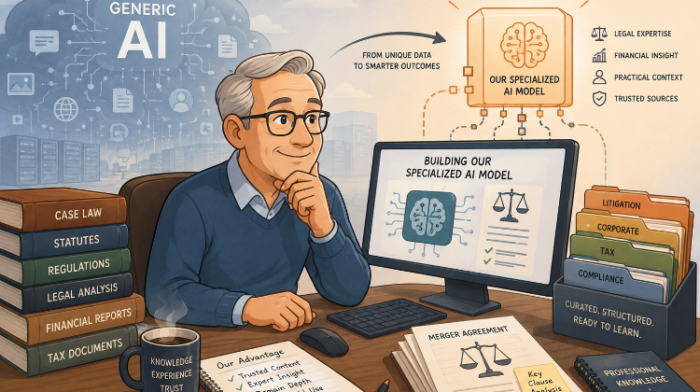
Thomson Reuters has launched its own AI model, called Thomson, and I think the most interesting part of the story is not that yet another company has built an AI model. It is how they did it.
You can read the original press release here: https://www.thomsonreuters.com/en/press-releases/2026/august/thomson-reuters-leverages-its-world-class-data-assets-to-launch-its-own-frontier-model. I wrote about it here (text in Dutch): https://ai-visie.net/thomson-reuters-bouwt-eigen-frontier-ai-model/.
Thomson Reuters is not trying to beat OpenAI, Google or Anthropic by training a gigantic general-purpose model from scratch. Instead, it started with an existing open model and then trained and specialised it using its own data and expertise. The company reportedly invested around $40 million in talent and compute. That is still a serious amount of money, of course. But compared with the billions now being spent on the largest frontier models, it is almost modest.
The real advantage may be the data
Thomson Reuters has something most companies simply do not have: decades of highly structured, professionally maintained legal, tax and financial information. That may turn out to be much more valuable than simply having access to more GPUs.
For certain legal tasks, Thomson Reuters says its model can compete with, and in some cases outperform, much larger general-purpose frontier models. That makes sense. A specialised model does not need to be brilliant at everything. It needs to be exceptionally good at the tasks for which it was designed.
And that raises an interesting question. If Thomson Reuters can do this, why don’t more large companies simply build their own frontier models?
Because having lots of data is not enough
Many large organisations have enormous amounts of data. Banks have transactions. Manufacturers have huge amounts of product(ion) data. Telecom companies have network data. Healthcare organisations have huge collections of medical information.
But having data and having usable AI training data are two very different things. Corporate information is often scattered across thousands of systems, poorly structured, duplicated, lacking useful meta data, outdated or difficult to use because of privacy, intellectual property and compliance restrictions.
Then there is the technology itself. Training and maintaining a serious model still requires specialised AI engineers, infrastructure, evaluation methods, security expertise and a lot of compute. And once the model exists, you have to keep operating, testing and improving it.
So perhaps the interesting lesson from Thomson Reuters is not that every large organisation should now build its own model. It is that some organisations may have a very valuable combination: unique data, deep domain knowledge and enough resources to turn an existing open model into something that is better than a general-purpose AI system for their particular field.
Maybe “frontier” is becoming more specialised
I find that a particularly interesting development. Until now, we have tended to think of frontier AI as a race to build ever larger models. More parameters, more compute, bigger clusters. But perhaps there will also be another kind of frontier: not a model that knows everything, but one that knows one domain exceptionally well.
For companies sitting on decades of carefully curated specialist knowledge, that could make owning at least part of their AI stack increasingly attractive. And it may also change the AI discussion inside companies. The question may no longer simply be: which frontier model should we buy? It could increasingly become: What knowledge do we have that nobody else has, and can we turn that into our own AI advantage?