
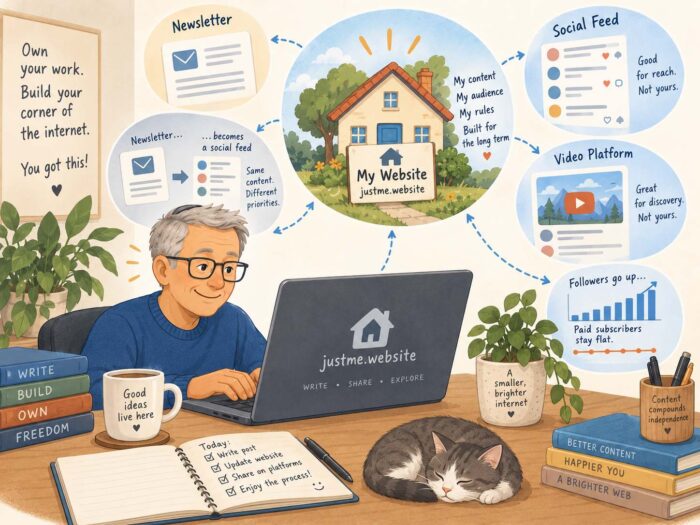
A few days ago I came across this video (https://www.youtube.com/watch?v=5kZY7eLm264) by investigative journalist Scott Carney and it reminded me of one of the most important lessons of the independent web: Build your own website. That doesn’t mean you should stop using other platforms. Far from it. Platforms can be useful. They can help you find people, join conversations and get your work in front of an audience. And some of them are genuinely nice places. They may be small. They may be run by people whose ideas about the internet you completely agree with. They may feel like communities rather than companies. But they are still somebody else’s place. That distinction matters.
Friendly platforms are still platforms
In the video Carney discusses his relationship with Substack. And I think it is a particularly interesting one because Substack originally seemed like an alternative to the big social platforms. The basic idea was attractive: writers could publish directly for readers, readers could pay them directly and journalists would no longer have to depend entirely on publishers, advertising or algorithms.
But Carney argues that Substack itself is changing (https://sgcarney.substack.com/p/the-real-reason-that-substack-is). It added Notes, which looks much more like a traditional social-media feed. It introduced the distinction between subscribers and followers, and added video, livestreaming and short clips. In other words, a service built around newsletters and subscriptions gradually started looking more like the platforms it once seemed to offer an alternative to.
That matters because, according to Carney, all that free content and endless scrolling may be good for growing Substack, but not necessarily for the people publishing there. His own follower numbers increased dramatically, while the number of people actually paying for his work did not grow in anything like the same way. He describes the broader problem as subscription fatigue: there are only so many newsletters people have the time and money to pay for.
What I find particularly interesting is his response. He doesn’t dramatically announce that he is leaving the internet or refusing to use platforms ever again. He adapts. He uses YouTube. He works with sponsors, although he says he is very selective about the companies he accepts money from. And he no longer assumes that one particular platform or one particular business model will provide a permanent solution.
You give up control
To me, that is exactly the point. The problem with building your online presence on a platform is not necessarily that the people running it are evil, greedy or waiting for an opportunity to lock you in. They may be wonderful people. The problem is simply that you don’t control what happens next. Because someone else controls the software. Someone else decides how it develops. Someone else can change the rules, the business model or the priorities. The organisation behind it can run out of money, change direction, be acquired or simply disappear.
Your website should be the center
This is why I increasingly think of platforms as satellites. My website is the center. I can post links somewhere else. I can participate in discussions. I can experiment with new communities and services. If one of them disappears tomorrow, that would be annoying. But Just Me would still be here. My articles would still be here. My links would still work. My no doubt bizar collection of posts about Linux, space, music, open source, digital autonomy, industrial technology, old websites and whatever else happens to interest me would still have a home.
To me that is important. Especially now that so much of the internet seems to consist of publishing things inside systems controlled by somebody else.
And there is another reason
There is also a much less serious reason to build your own website: It is fun.
You can change the design because you feel like it. Add a page nobody asked for. Build a ridiculous little web tool. Change your fonts. Break something. Repair it again. Discover that WordPress is doing something mysterious. Spend far too much time solving a problem that nobody visiting your site will ever notice.
That is part of the pleasure. A personal website isn’t just a publishing platform. It is also a project. And unlike almost every other platform on the internet, it can become exactly as boring, complicated, colourful, minimal, experimental or peculiar as you want it to be. Because it is yours. Maybe that is the best reason of all.