So Apparently Facebook Might Keep You Posting After You’re Dead?

I thought dying was a reasonably reliable way of stopping your social-media activity. Apparently, even that may eventually become optional. Because Meta has been granted a patent for technology that could allow an AI to simulate a user of a social network when that person is no longer around. The patent has the wonderfully reassuring title Simulation of a user of a social networking system using a language model.

See here for more: https://www.businessinsider.com/meta-granted-patent-for-ai-llm-bot-dead-paused-accounts-2026-2?utm_source=chatgpt.com and https://patents.justia.com/patent/12513102?utm_source=chatgpt.com.

Basically, an AI could learn from the things you have posted, liked, commented on and interacted with, and then use all that information to behave a little bit like you. Sounds like typical AI. But then it gets interesting. The patent explicitly talks about situations in which somebody is absent from a social network for a longer period. Perhaps you have simply decided that spending three hours a day scrolling through Facebook isn’t actually improving your life. Fair enough. But the patent mentions another possible reason for your absence. You might be dead. And your AI version could potentially carry on.

I find this a genuinely bizarre idea.

Now, I can imagine some situations in which technology like this could actually be useful. Someone who knows they are seriously ill might want a few messages to appear after their death. A birthday message for their children, perhaps. A final note to friends. Maybe even a couple of posts saying goodbye. We already do something similar with letters and videos.

But there is quite a big difference between:

“Here are five messages I wrote before I died. Please publish them afterwards.”

and:

“Here is an AI that has studied everything I ever posted. Just let it carry on being me.”

The first is still you. The second is somebody’s statistical approximation of you. That difference becomes even more interesting when money enters the picture. Imagine that you have built a very successful social media account. Perhaps you have thousands of followers. Every post generates hunderds of comments, likes and shares. People spend time looking at your content. The platform serves advertising around all that activity. Your account has commercial value. Then one day you stop posting. Perhaps you simply decide that social media is no longer for you. Perhaps you disappear for what the patent calls a longer period. Or perhaps you die.

Normally, that would mean the end of the content stream. No more posts and no more comments. So, no more engagement. And obviously: No more advertising around all that engagement. Unless, of course, an AI version of you could simply continue. And that is where I start to feel rather uncomfortable about this idea.

To be absolutely clear: having a patent does not mean that a social network is about to introduce this. Companies patent enormous numbers of ideas that never become actual products. At least not yet. But the patent does make the possibility technically and commercially imaginable. And once you look at it that way, some fairly strange questions appear. If the AI keeps posting after I have left a social network, are those still my posts? If it responds to somebody, have I responded? When a racist or otherwise offensive message appears on my account, how do I prove that it wasn’t posted by me, but by an AI? If it expresses an opinion I would probably have expressed, is that my opinion? And who decides when it should stop?

There’s something else I find particularly odd about all this. For years, a lot of people have been putting enormous amounts of themselves into social networks: photos, conversations, friendships, opinions, jokes, arguments, interests, political discussions, holiday pictures, and thousands upon thousands of small signals about who we are. Until now, we mostly thought of that as data about our past behaviour. AI potentially turns it into something else: training material for a future version of ourselves.

I’m not on Facebook, but I can imagine that, for many people, a Facebook profile used to be something of a digital archive. You could scroll back and see what someone actually said ten years ago. An AI-generated account would be fundamentally different. It could start producing things that the original person never said at all. Perhaps they would have said them. Perhaps not. We will never know, will we?

I suspect there will eventually be useful applications for this kind of ideas. Used deliberately and under the control of the person involved, it might even become a fascinating new way of leaving something behind. But an automated social-media ghost that continues generating engagement because its owner is “absent for a longer period”? That sounds considerably less appealing. Especially when the platform running the ghost also happens to make money from keeping people scrolling, commenting and watching.
The Best Platform Is the One You Own

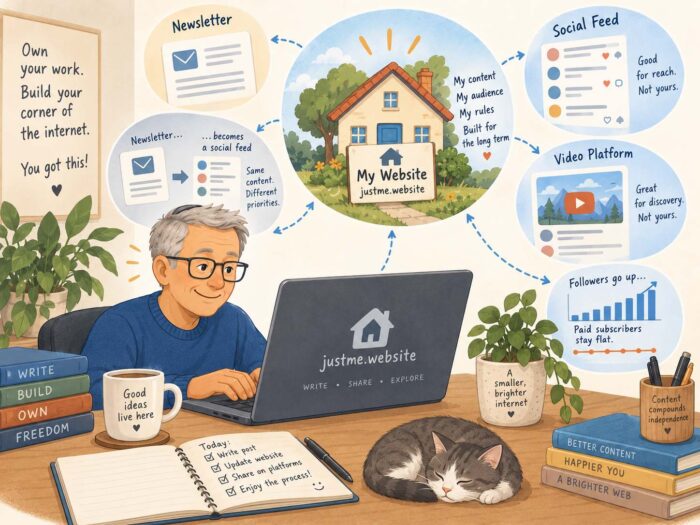
A few days ago I came across this video (https://www.youtube.com/watch?v=5kZY7eLm264) by investigative journalist Scott Carney and it reminded me of one of the most important lessons of the independent web: Build your own website. That doesn’t mean you should stop using other platforms. Far from it. Platforms can be useful. They can help you find people, join conversations and get your work in front of an audience. And some of them are genuinely nice places. They may be small. They may be run by people whose ideas about the internet you completely agree with. They may feel like communities rather than companies. But they are still somebody else’s place. That distinction matters.

Friendly platforms are still platforms

In the video Carney discusses his relationship with Substack. And I think it is a particularly interesting one because Substack originally seemed like an alternative to the big social platforms. The basic idea was attractive: writers could publish directly for readers, readers could pay them directly and journalists would no longer have to depend entirely on publishers, advertising or algorithms.

But Carney argues that Substack itself is changing (https://sgcarney.substack.com/p/the-real-reason-that-substack-is). It added Notes, which looks much more like a traditional social-media feed. It introduced the distinction between subscribers and followers, and added video, livestreaming and short clips. In other words, a service built around newsletters and subscriptions gradually started looking more like the platforms it once seemed to offer an alternative to.

That matters because, according to Carney, all that free content and endless scrolling may be good for growing Substack, but not necessarily for the people publishing there. His own follower numbers increased dramatically, while the number of people actually paying for his work did not grow in anything like the same way. He describes the broader problem as subscription fatigue: there are only so many newsletters people have the time and money to pay for.

What I find particularly interesting is his response. He doesn’t dramatically announce that he is leaving the internet or refusing to use platforms ever again. He adapts. He uses YouTube. He works with sponsors, although he says he is very selective about the companies he accepts money from. And he no longer assumes that one particular platform or one particular business model will provide a permanent solution.

You give up control

To me, that is exactly the point. The problem with building your online presence on a platform is not necessarily that the people running it are evil, greedy or waiting for an opportunity to lock you in. They may be wonderful people. The problem is simply that you don’t control what happens next. Because someone else controls the software. Someone else decides how it develops. Someone else can change the rules, the business model or the priorities. The organisation behind it can run out of money, change direction, be acquired or simply disappear.

Your website should be the center

This is why I increasingly think of platforms as satellites. My website is the center. I can post links somewhere else. I can participate in discussions. I can experiment with new communities and services. If one of them disappears tomorrow, that would be annoying. But Just Me would still be here. My articles would still be here. My links would still work. My no doubt bizar collection of posts about Linux, space, music, open source, digital autonomy, industrial technology, old websites and whatever else happens to interest me would still have a home.

To me that is important. Especially now that so much of the internet seems to consist of publishing things inside systems controlled by somebody else.

And there is another reason

There is also a much less serious reason to build your own website: It is fun.

You can change the design because you feel like it. Add a page nobody asked for. Build a ridiculous little web tool. Change your fonts. Break something. Repair it again. Discover that WordPress is doing something mysterious. Spend far too much time solving a problem that nobody visiting your site will ever notice.

That is part of the pleasure. A personal website isn’t just a publishing platform. It is also a project. And unlike almost every other platform on the internet, it can become exactly as boring, complicated, colourful, minimal, experimental or peculiar as you want it to be. Because it is yours. Maybe that is the best reason of all.

LEO Satellites Are Taking Off, But They Can’t Do Everything

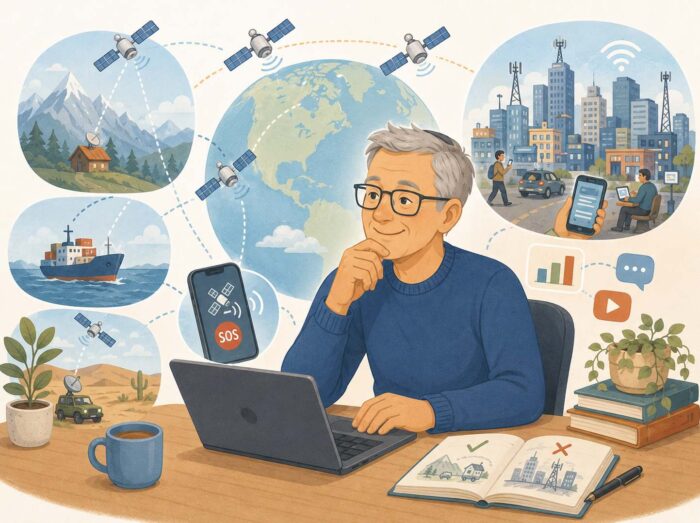
Low Earth Orbit satellites have become enormously popular over the past few years. Starlink is obviously the name most people know, but it is only part of a much bigger development. Companies all over the world are building new satellite constellations, telecom operators are experimenting with direct-to-device connections and smartphones are slowly gaining the ability to communicate with satellites without requiring a traditional satellite phone.

It is another example of something I wrote about earlier in The Space Economy Is Taking Off (https://justme.website/tech/the-space-economy-is-taking-off/): space is increasingly becoming an economic infrastructure rather than something mainly associated with governments, science and spectacular rocket launches.

But whenever a technology suddenly attracts this much attention, another question becomes interesting. What can it actually do? And perhaps even more importantly: what can’t it do?

Strand Consult has published two reports that provide some useful context here. They look specifically at Low Earth Orbit satellite networks and the increasingly popular idea of connecting ordinary mobile devices directly to satellites.See here for more information: https://strandconsult.dk/leo-satellites-the-hype-the-facts-and-the-hard-limits/?utm_campaign=31.+august+2026+-+Presse+-+LEO+Satellites+The+Hype+the+Facts+and+the+Hard+Limits505128.

Satellites are very good at filling gaps

The obvious advantage of satellites is coverage. Building mobile towers and fibre networks makes economic sense in cities and densely populated areas. It becomes much more complicated in mountains, deserts, at sea or in sparsely populated regions. LEO satellites can reach those places without having to build a physical network across every square kilometer of land.

That makes direct-to-device satellite communication particularly interesting as an extension of existing mobile networks. A phone could use a terrestrial network most of the time and switch to a satellite connection when there simply isn’t a mobile tower nearby. That sounds extremely useful. And it probably will be.

But space doesn’t magically create unlimited bandwidth

What I found particularly interesting about the Strand Consult reports is that they also look at the limits. Satellites have limited spectrum and limited capacity. A satellite beam covering a large geographical area has to share that capacity between users underneath it. That is very different from a city packed with mobile base stations, each covering a relatively small area and collectively handling enormous amounts of data.

In remote areas, satellites can therefore be an excellent solution. In densely populated cities with huge amounts of traffic, terrestrial networks are much harder to beat. Strand Consult also points to regulatory issues around spectrum and the practical difficulties of scaling direct-to-cellular satellite services globally.

So the idea that satellites will simply replace mobile networks seems rather unlikely. More interesting is the idea that the two will increasingly work together.

And then there is the extreme scenario

The second Strand Consult report takes things a step further. It imagines the year 2045. The last mobile tower has been switched off and all mobile communication has moved into space. The report isn’t predicting that this will happen. It uses the scenario as a thought experiment: if we really wanted satellites to replace terrestrial mobile networks completely, what would we actually have to build?

The answer involves enormous numbers of satellites, spectrum, network capacity, regulation, investment and geopolitical coordination. Which is exactly why I find these reports interesting. The space economy really is taking off. Satellite connectivity will almost certainly become far more important than it is today.

But that doesn’t mean every network belongs in space. Sometimes the most interesting thing about a new technology isn’t discovering what it can replace. It is discovering where it fits.

Europe Just Opened a New Door to Space

I have written several times on Just Me about the space economy. About how satellites, launch services and new space companies are changing the way we think about access to orbit. For a long time, however, one question remained: could Europe really build its own commercial path into space?

This week, we got a very convincing answer. A German company called Isar Aerospace (https://isaraerospace.com/) has achieved something that feels like a turning point: its Spectrum rocket successfully reached orbit and deployed payloads during its second flight. The mission, called “Onward and Upward”, lifted off from Andøya Space in Norway (https://andoyaspace.no/) and made Isar Aerospace the first European commercial space company to successfully deliver satellites into orbit.

Not just another rocket launch

Of course, rockets reaching space is nothing new. Humanity has been doing that for decades. But this is different. For Europe, access to space has traditionally depended heavily on large institutional programmes. Rockets like Ariane have played a crucial role, but the world of space is changing quickly. Thousands of smaller satellites are being launched, companies want more flexible access to orbit, and commercial players are becoming increasingly important.

This is exactly the market where companies like Isar Aerospace are trying to make a difference. The idea is simple: make launching satellites more flexible, more scalable and more accessible. And that requires something more than just building a rocket. It requires building an entire industrial ecosystem.

The machine behind the machine

One thing I find particularly interesting about Isar Aerospace is that the company is not only developing the Spectrum launch vehicle. It is also building the manufacturing capabilities needed to produce rockets at scale. The company follows a highly integrated approach: designing, manufacturing and testing large parts of the rocket itself instead of relying completely on external suppliers. The next Spectrum vehicles are already in production, and Isar Aerospace is working towards a production facility capable of manufacturing dozens of rockets per year.

This reminds me of something I wrote earlier about European industrial ambitions (see here: https://justme.website/digital-autonomy/building-robots-is-not-enough/). The future is not only about making the final product. It is also about owning the knowledge, machines and processes behind that product. Whether we are talking about semiconductors, humanoid robots or rockets, the same principle appears again and again: the real strategic advantage often sits in the manufacturing capability.

Learning from failure

Another reason this story is interesting is that it shows how innovation actually works. The first Spectrum flight in 2025 was not a complete success. The rocket lifted off and cleared the launch pad, but the mission ended after a short flight. Instead of treating this as a failure, Isar Aerospace used the data to improve the next vehicle. That is how innovation always works. Test. Learn. Improve. Try again.

Space is probably one of the clearest examples of an industry where you cannot simply design everything perfectly on paper. Real-world testing is unavoidable.The second flight showed that this approach worked. Spectrum completed key flight milestones, reached orbital velocity and successfully separated its payloads.

Why Europe needs this

There is also a broader strategic dimension. Space has become critical infrastructure. Satellites support communication, navigation, climate monitoring, agriculture, defence and countless other services. Having independent access to orbit is increasingly seen as part of technological sovereignty. This does not mean Europe should build everything alone. International cooperation remains essential. But having European companies that can provide launch services from European soil gives Europe more options. So this is about technological and digital autonomy as well.

The global space industry is becoming more competitive every year. Companies in the United States, China and other regions are investing heavily. Europe needs companies that can move quickly, experiment and build new capabilities. Isar Aerospace is one example of this new generation of European space companies. Fortunately there are more.

The space economy is becoming real

What I like about this story is that it connects technology, industry and imagination. Space is no longer only about astronauts, giant government programmes and spectacular missions. It is also about factories, software, automation, supply chains and entrepreneurship. A small company from Germany launching a rocket from a small launch site in Norway may sound like science fiction. But this is exactly what the emerging space economy looks like.

Building Robots Is Not Enough

I keep coming back to the same question when writing about European technology: what exactly do we want to keep in Europe? The usual answer is something like: semiconductor production, cloud infrastructure, AI models and perhaps a few strategically important factories. But after reading about French robotics company Wandercraft (https://en.wandercraft.eu/) and its cooperation with Renault, I think there is another part of the story that deserves much more attention. Europe should not only build products. It should also build the machines that build those products.

That may sound slightly old-fashioned in a world where almost every discussion about technology quickly turns into a discussion about software and AI. But there is a very practical reason for it. If you build your own production machines, you learn from them. You discover that a certain component is unnecessarily expensive. That another part could be lighter. That a production step takes too long. That a tolerance does not need to be quite so precise. Or that changing some software, mechanics or electronics could make the entire production process better.

In other words, a factory is not simply a place where products come off a production line. It is also a rather large laboratory.

Robots building European industrial knowledge

Wandercraft is an interesting example. The French company originally developed robotic exoskeletons for people who have difficulty walking. More than ten years of developing balance systems, actuators, mechanics and control software eventually resulted in something else: Calvin, a humanoid robot designed for industrial work.

And importantly, this isn’t primarily a robot designed to dance on a stage or generate spectacular YouTube videos. It is designed to work in a factory. Renault is already testing Calvin in its factory in Douai, where the robot moves things such as car tyres. Renault plans to have around 350 humanoid robots working in its French and Spanish factories by the end of 2027.

But the really interesting part is the relationship between the two companies. Renault is not simply buying robots from Wandercraft. It is also helping the company figure out how to manufacture those robots at scale. Wandercraft brings robotics and AI knowledge. Renault brings decades of experience in mass production, supply chains, quality control and designing products that can actually be manufactured at an acceptable cost. That combination makes a lot of sense.

Keep the feedback loop close

There is another detail I particularly like. Wandercraft says the components in its current robot all come from Europe. That matters. Because if the robot is designed in Europe, manufactured using European components, deployed in European factories and improved based on what happens in those factories, you create a very useful feedback loop: engineers see what breaks, factories discover what works, production specialists improve how the robot itself is manufactured and developers adjust the software and control systems. And then you do it all over again. That is industrial knowledge being created continuously. Move too many parts of that chain elsewhere and eventually part of that knowledge moves with it.

Europe already has an enormous high-quality manufacturing base, many specialised machine builders and companies that know how to manufacture complicated products at scale. We sometimes seem strangely eager to underestimate how valuable that is.

Perhaps technological sovereignty is not only about owning an AI model or running a European cloud. Sometimes it is also about knowing how to build the machine that builds the machine.

Here is a video of Andreas Klinger from the European investment fund PROTOTYPE (https://www.prototypecap.com/) visiting Wandercraft.

School Directors Are Making the Wrong Choice Between Tech and Privacy

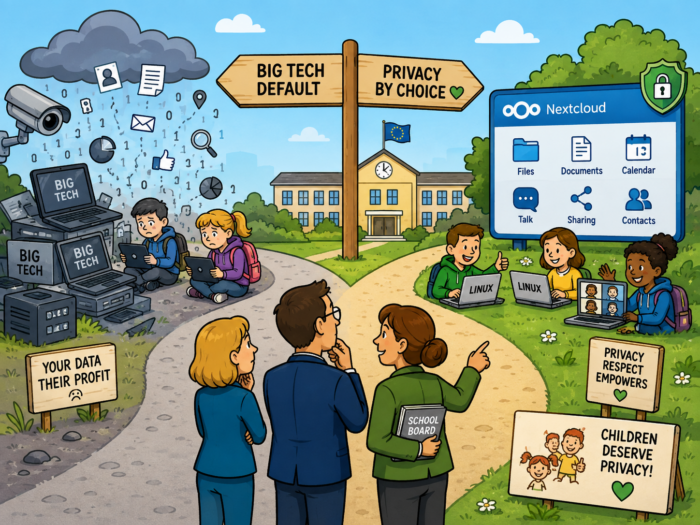
I came across an article by Privacy First about the digital student, and it touches on something that continues to bother me about the way we discuss technology in European education. The discussion is often framed as a choice: we can embrace digital technology in schools, or we can protect the privacy of our children.That is the wrong choice.

You can find the article here: https://privacyfirst.nl/artikelen/de-digitale-leerling/ (text in Dutch). Privacy First rightly points out that schools process enormous amounts of information about pupils, ranging from names and contact details to school results, behaviour and sometimes information about a child’s development. Children are particularly vulnerable because they usually have little choice about the software their school tells them to use.

But the conclusion shouldn’t be that schools therefore need less technology. They need different technology: technology that respects privacy and complies with privacy laws.

Digital does not automatically mean Google

There is absolutely no law of nature saying that digital education requires Chromebooks, Google Workspace, Microsoft 365, Windows laptops or MacBooks. A school can give students Linux laptops. It can use Nextcloud or similar open source platforms for storing and sharing files, working together on documents, calendars, video calls and all the other things schools nowadays expect from a digital workplace.

And before somebody says that this sounds nice in theory but could never work for hundreds of thousands of users: it already does. The French region Île-de-France has deployed a sovereign collaboration environment based on Nextcloud for around 550,000 pupils, teachers and administrative staff. The system is part of the regional monlycée.net environment and was explicitly designed as an alternative to Microsoft solutions. It includes document collaboration through Collabora Online, file storage and integration with the region’s existing systems. The infrastructure is operated in France.

You read that right: half a million users. So perhaps we can finally stop pretending that European and open source alternatives are lovely little hobby projects that might work for three enthusiasts and a Raspberry Pi. See https://nextcloud.com/fr/blog/cloud-souverain-plateforme-collaborative-ile-de-france/ for more information.

We became lazy buyers of IT

There is another part of this discussion that I think we don’t talk about enough. A Belgian CIO recently said something to me that stuck: we have forgotten that we actually have to make conscious choices ourselves.

For many years it was incredibly easy not to choose. Microsoft was already there, so you bought some more Microsoft. Your organisation was using AWS, so the next workload went to AWS as well. Google offered a complete education package, so schools bought Chromebooks and Google services.

You could call that standardisation. I increasingly call it convenience. Or perhaps there is a better word for it: laziness. And that is dangerous, because over time, that convenience has turned into dependency.

That dependency matters much more today than it did ten or fifteen years ago. Europe has become deeply dependent on a relatively small number of American technology companies for cloud computing, productivity software, communication and increasingly AI. In their article, Privacy First has made essentially the same broader point about Europe’s dependence on foreign technology providers and the consequences for autonomy and control over data. With today’s geopolitical uncertainty, treating that dependency as merely a procurement detail is becoming increasingly difficult.

Of course you cannot migrate an entire organisation in a day. Nobody sensible is suggesting that. Île-de-France didn’t do that either. But that argument is rapidly becoming an excuse. If you are responsible for IT in a sizeable European organisation and you are still not investigating alternatives, testing them, identifying dependencies and developing a realistic migration path, I think you have a problem. Migration takes years. Which is precisely why you need to start before circumstances force you to.

And then there are the children

There is something particularly uncomfortable about teaching children about privacy, data protection and digital literacy while at the same time making them use platforms built by some of the world’s largest data-driven technology companies. Privacy First argues that privacy should not simply be another compliance box for schools to tick. It should be a basic design principle of the digital environment children grow up in.

I couldn’t agree more with that conclusion. We have GDPR. We have endless discussions about children’s online safety. We teach pupils to think carefully about what they share online. And then institutions themselves make the fundamental technology choices on their behalf.

Schools deserve support from governments and IT specialists to make better choices. But eventually somebody also has to take responsibility. The technology exists. The alternatives exist. Large-scale examples exist. Île-de-France is already showing that hundreds of thousands of pupils and teachers can work digitally without simply handing the entire environment to Microsoft or Google.

So this really isn’t a discussion about digital versus privacy. It is about whether school directors are willing to do the homework required to have both.

China is Doing what Europe keeps Talking about — But Moving Much Faster

I recently went looking for a story I remembered reading about China replacing Windows with Linux. I could not find it at first, probably because I was searching for the wrong thing.

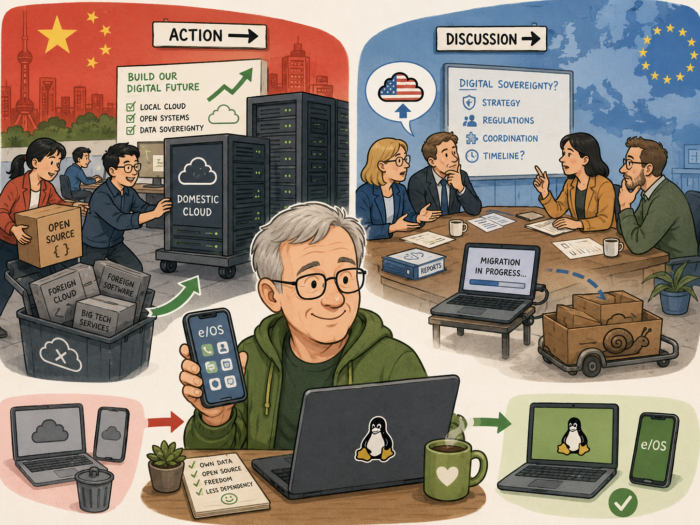
There is no single Chinese order saying that everybody has to throw Windows out. What China has been doing is much more interesting: step by step, it has been reducing its dependence on foreign technology, particularly within government organisations, state-owned companies and strategically important sectors.

The name that keeps coming up is Xinchuang, China’s programme to replace foreign technology with domestic alternatives (https://www.mof.gov.cn/jrttts/202312/t20231226_3924138.htm). That includes processors, databases, applications and operating systems. Chinese government procurement rules introduced in recent years increasingly require systems to meet domestic “safe and reliable” requirements. In practice, that has created much more room for operating systems such as Kylin and UnionTech UOS, both based on Linux.

And China has just taken another step. In August 2026, reports emerged (for example https://www.tomshardware.com/software/operating-systems/china-reportedly-orders-state-agencies-to-uninstall-its-government-only-edition-of-windows-10) that China’s Ministry of State Security had instructed some state-linked organisations to remove Windows 10 China Government Edition earlier than originally planned. This is important nuance: China has not banned Windows everywhere. The order concerns a special government version and a limited part of the Chinese market. Windows is still widely used by consumers and businesses.

Perhaps we should pay more attention to China

Still, I think the direction is interesting. Not because Europe should copy China’s political system or its approach to technology. Obviously not. But there is one thing China seems to understand very well: becoming extremely dependent on a handful of foreign technology companies is a strategic risk.

That is something Europe has been talking about for years. Digital sovereignty, strategic autonomy, European clouds, open source, sovereign AI. Plenty of conferences, reports and policy documents. But meanwhile we keep buying. And buying. And buying.

The numbers are rather impressive. A European Commission document published this year cites research estimating that European companies’ purchases of cloud software add around €264 billion annually to the US economy (https://eur-lex.europa.eu/legal-content/EN/TXT/?qid=1745691400115&uri=CELEX%3A52026SC0502&)

Then there is the price issue. Research commissioned by French CIO association Cigref found that European organisations saw cloud and software costs increase by an average 8.7 percent per year during the past three years. Some organisations experienced much larger increases when contracts were renewed. The same research expects average annual increases of around 12 percent during the coming five years. (https://www.cio-platform.nl/en/weblog/nieuws-extern-detailpagina/2026/07/02/rapidly-rising-cloud-and-software-costs-weigh-on-the-european-economy?)

That 8.7 percent figure is not specifically an “American cloud inflation rate”, so we should be careful with that. But combine rapidly increasing software and cloud prices with Europe’s enormous spending on predominantly American technology and it becomes clear that we are talking about very serious amounts of money. Digital sovereignty is therefore not just about geopolitics. It is also about economics.

I decided to start with myself

I have been gradually trying to reduce my own dependence on Big Tech. My laptop comes from a European company (Slimbook), although calling a computer completely European is almost impossible: the CPU and GPU in mine are from AMD. I use Linux as my operating system. Nearly all the software and cloud services I use are now European, open source, or both.

I came from a MacBook and an iPhone and switched to Linux Mint and Murena /e/OS, a de-Googled version of the open-source version of Android. And to be honest, it works differently in some ways, but certainly not worse.

So personally, I made the switch, and I’m perfectly happy with the result. The difficult part is often not my own technology. It is other people’s technology. Clients still invite me into SharePoint environments. People create WhatsApp groups and simply assume everybody uses WhatsApp. Publishing workflows are still often built around Adobe software. In those situations, digital independence suddenly becomes less of an individual decision. You are part of an ecosystem, and ecosystems are difficult to leave.

But migration costs money…

This is probably one of the biggest obstacles Europe faces as well. One argument I often hear is that replacing existing technology is expensive and risky. Of course it is. If an organisation has spent ten or twenty years building processes around Microsoft 365, Azure, AWS, Google Cloud or Adobe, you cannot simply switch everything off on Friday afternoon and start again with European alternatives on Monday morning. People have to be trained. Applications have to be migrated. Interfaces have to be rebuilt. Data needs to move. Some functionality may not have an equivalent. And some projects will undoubtedly go wrong.

So yes, reducing dependency costs money. But keeping the dependency has a cost too. And that part of the calculation seems to receive much less attention – even by business managers who consider themselves financially savvy. What happens if prices continue to rise by almost 9 percent every year? What happens if a supplier changes its licensing model? What happens if political relations deteriorate badly? And, perhaps the uncomfortable question: what happens if access itself becomes part of a geopolitical conflict?

Canada suddenly makes that question less theoretical

This is why I am watching the current trade conflict between Canada and the United States with some interest. See for example here: https://www.reuters.com/business/trump-time-teach-canada-you-cant-do-this-anymore-2026-08-26/?. Relations between two countries that have been extremely close economic partners for decades have deteriorated remarkably quickly. In August, the US imposed 50 percent tariffs on roughly $20 billion worth of Canadian goods, after which Canada announced matching retaliatory measures.

So far, this is a trade conflict involving physical goods and tariffs. I have seen no evidence that the US government intends to restrict Canadian access to Microsoft 365, Azure, AWS, Google Cloud or other American digital services. But it does raise an interesting question.

Could digital services eventually become economic or political leverage as well?

I don’t know. And that is precisely the problem.

For years we have treated cloud platforms, office software and other digital services almost as utilities. They are just there. We log in every morning and assume they will still be there tomorrow. China clearly doesn’t want to make that assumption. Europe shouldn’t either.

We don’t have to replace everything tomorrow. That would be unrealistic and probably counterproductive. But we could start doing exactly what China has been doing for years: identify dependencies, develop alternatives, change procurement policies and gradually move critical systems to technology over which we have more control. We do not need yet another conference about digital sovereignty. Not another declaration.

What we do need: start migrating. Because the best moment to reduce a dependency is probably while everything is still working.

Open or Open (AI) Washing?

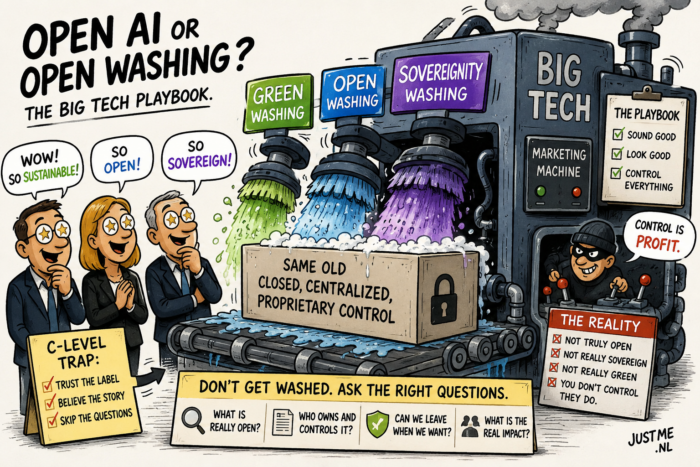
The technology industry has a long history of using attractive words to create a positive image. “Green”, “sustainable”, “responsible”, “sovereign” and now “open” are all terms that sound reassuring. But increasingly, these words are also becoming part of a familiar marketing strategy: make a product or service appear more independent, transparent or responsible than it really is.

We have seen this before with greenwashing. Companies present themselves as environmentally friendly while the reality behind their operations is often much more complex. A few sustainability initiatives or carefully chosen words can create the impression that a company is leading the way, even when the underlying business model has barely changed.

The same pattern is now appearing in other areas of technology. Open washing and sovereignty washing have become part of the same playbook.

Recently, I read an interesting article on Tech Policy Press titled “Open washing is everywhere in AI. Four criteria cut through it.” The author is J.J. Jasser, a professor and director of data analytics at Rollins College in Winter Park, Florida. His research examines artificial intelligence, open-source development, and digital literacy. He also contributes commentary on technology and digital literacy to the Orlando Sentinel.

Jasser explains how the word “open” is increasingly being used in artificial intelligence as a marketing term rather than as a clear technical description. The problem is that “open” can mean many different things. A company may release parts of an AI model, publish limited documentation or offer access through an interface, and then present the technology as open. But true openness requires much more: transparency about development, access to relevant information, the ability to inspect and adapt the technology, and meaningful freedom for users. As the author points out, companies often highlight the elements that support the “open” label while keeping important limitations less visible.

This is exactly why open washing deserves attention. The term creates a sense of trust and independence, while the actual level of openness may be far more limited. The same applies to digital sovereignty. In Europe, concerns about dependence on large technology providers have grown significantly. Organisations want more control over their data, infrastructure and AI capabilities. Big Tech companies have responded by introducing so-called sovereign cloud offerings and European cloud regions.

At first glance, this sounds like the solution Europe has been looking for. Data is stored in Europe, services are operated locally and the word “sovereign” appears prominently in the marketing material. But sovereignty is about much more than location. Who owns the technology? Who controls the software? Which laws apply? Where is the company based? Can customers realistically move away if circumstances change? These are the questions that matter.

Using a European data center does not automatically create digital sovereignty. Just as adding a green label does not automatically make a company sustainable, adding the word sovereign does not automatically create independence.

Unfortunately, many C-level executives still fall for these messages. Under pressure to make decisions about cloud, AI and digital transformation, it is tempting to rely on vendor promises and attractive terminology. But technology leaders need to look beyond the marketing language and examine the real level of control they have.

The lesson from the discussion around open AI is therefore much broader. Whether it is greenwashing, open washing or sovereignty washing, the mechanism is the same: take a concept with a strong positive meaning and use it to improve perception.

The answer is not to reject everything Big Tech offers. Many of these technologies are valuable and play an important role in modern organisations. But companies need to ask harder questions and demand more transparency. Because in the end, words like “open”, “green” and “sovereign” only matter when they are backed by reality. A label is easy to create. Genuine openness, sustainability and independence are much harder to achieve.


The Space Economy Is Taking Off

I have always been fascinated by space. Not only because of the spectacular images from distant galaxies, the engineering challenge of launching rockets, or the incredible scientific discoveries made by missions exploring our solar system. What fascinates me even more is the fact that space technology is increasingly becoming part of our everyday lives.

For many years, space was something that belonged mainly to governments, research institutes and a handful of large aerospace companies. Satellites were expensive, rockets were rare, and space exploration felt like something far removed from our daily reality. That is changing rapidly.

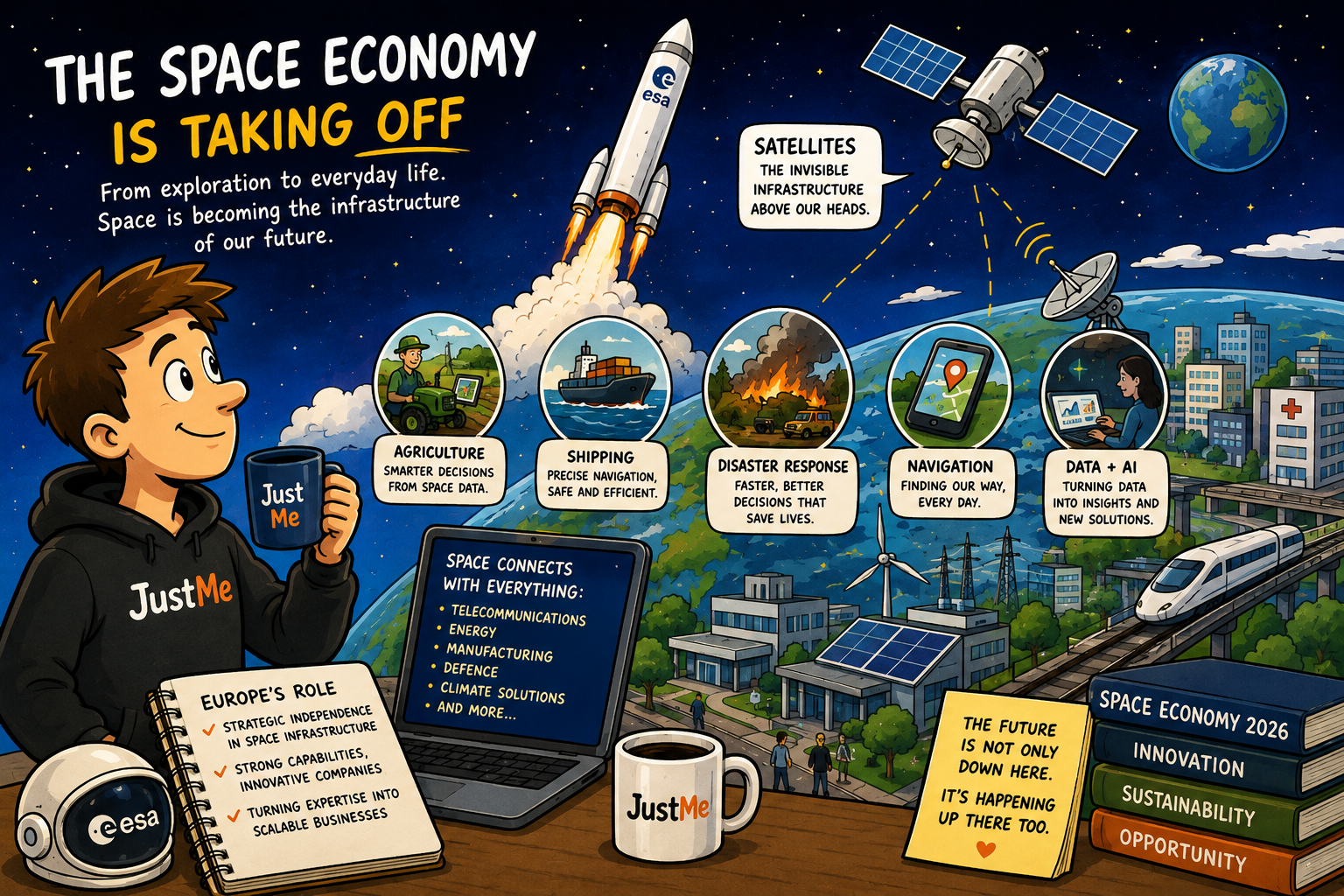
The latest Space Economy Report from the European Space Agency (ESA) shows how quickly space is developing into a mature economic sector. Space is no longer only about exploration and scientific missions. It has become an essential infrastructure layer for modern society — supporting communication, navigation, climate monitoring, agriculture, logistics, security and many other industries. And this is only the beginning.

From government projects to a global commercial ecosystem

One of the most interesting developments of recent years is the shift from a government-driven space sector towards a much broader commercial ecosystem. Companies are building satellites, developing launch services, analysing Earth observation data and creating completely new services based on information collected from orbit. The cost of entering space is decreasing, partly because of reusable launch technology, smaller satellites and more efficient manufacturing processes.

This has created opportunities for thousands of companies that would never have been considered “space companies” in the past. A farmer using satellite images to optimise irrigation is benefiting from space technology. A logistics company using precise positioning data relies on satellites. A telecommunications provider offering connectivity in remote areas depends on orbital infrastructure. And thanks to satellite data, governments can respond much more effectively to natural disasters such as wildfires, floods and earthquakes. In many ways, satellites are becoming the “cloud infrastructure in space”.

Europe’s role in the new space economy

As someone who follows technology, digital sovereignty and autonomy, and European innovation closely, I find the European perspective particularly interesting. The space economy is not only about economic growth. It is also about strategic independence. Just as Europe is discussing digital autonomy in areas such as cloud computing, artificial intelligence and semiconductor technology, space infrastructure is becoming a strategic asset as well.

Reliable access to satellite data, navigation systems and communication capabilities is increasingly important for governments, companies and society as a whole. Europe has strong capabilities in space technology. Organisations such as ESA, national space agencies, research institutes and a growing number of innovative companies are contributing to a competitive European space ecosystem. The challenge therefore is not whether Europe has the knowledge or the technology. The challenge is turning that expertise into scalable businesses and ensuring that Europe remains an important player in a rapidly growing global market.

The connection between space and artificial intelligence

Another reason why the space economy is becoming increasingly interesting is the connection with artificial intelligence. Satellites generate enormous amounts of data. Every day, they collect information about our planet, weather systems, oceans, cities and industrial activities. But collecting data is only the first step. The real value comes from analysing it.

AI will play a crucial role in turning satellite data into information we can actually use in daily (business) life. At the same time, space itself creates new challenges for AI. Processing data closer to where it is generated — potentially directly in orbit — could become increasingly important as the amount of information from satellites continues to grow.

One of the reasons I enjoy following developments in space technology is that they show how innovation often crosses traditional boundaries. Space is no longer an isolated industry. It connects with telecommunications, energy, manufacturing, defence, agriculture, logistics, climate technology and artificial intelligence. The same technologies that help us explore distant planets are also helping us solve problems here on Earth. This is perhaps the most exciting aspect of the new space economy: it is not about escaping from our planet. It is about understanding, protecting and improving it. And that makes this report a very interesting read.

Nextcloud on the Beach

A new episode of my “De Overstap” series has just been published on Computable.nl. In this series, I write about my own attempts to move away from the usual Big Tech ecosystem and see how far you can get with European, open source and more independent alternatives.

Episode 9 became something of a holiday edition. This summer I travelled with my family to the south of France with a tech setup that was almost completely free of the platforms I used to depend on. My laptop was my Slimbook Evo running Linux Mint, while my phone was a Fairphone 6 with Murena’s /e/OS. And yes, for the most part it worked remarkably well.

There was one small adventure on the way. As soon as I crossed the border, my phone suddenly had no mobile internet. Everything seemed to be configured correctly, but eventually I discovered (thank you Mistral Vibefor helping me) that the correct KPN APN setting was simply missing. Once I added it manually, everything worked again.

That experience actually illustrates one of the main points of this new episode. Alternatives to Big Tech increasingly work perfectly well from a technical point of view. But if we really want ordinary users to adopt them, the learning curve still needs to come down. People should not have to know what an APN is just because they choose a different mobile operating system.

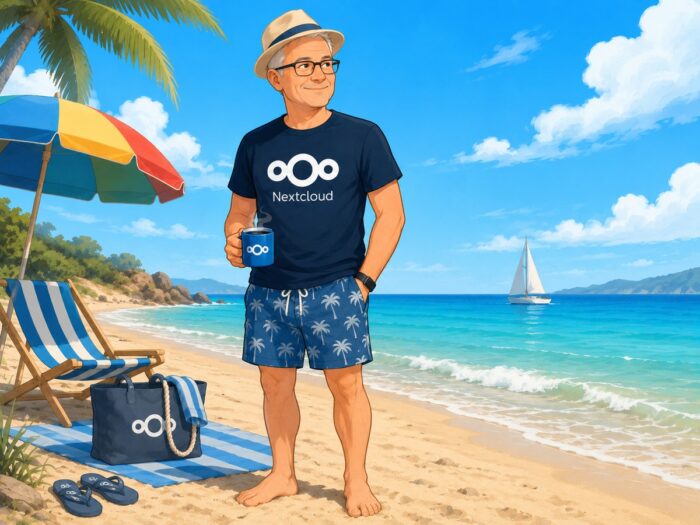
And then there was Nextcloud. I happened to wear an old Nextcloud T-shirt on the beach in France. To my surprise, several French people recognised the logo and started talking to me about Nextcloud, digital autonomy and European alternatives. Hardly scientific market research, of course, but still interesting. Open source alternatives such as Nextcloud seem to be slowly moving beyond their traditional technical audience.

The article also includes my latest experiences with Capacities.io for personal knowledge management, plus a few other interesting alternatives I recently came across, including littleFedi, soev.ai and the Dutch Matrix service mtux.nl.

You can read De Overstap 9: Nextcloud op het strand on Computable.nl: https://www.computable.nl/2026/08/17/de-overstap-9-nextcloud-op-het-strand/.