
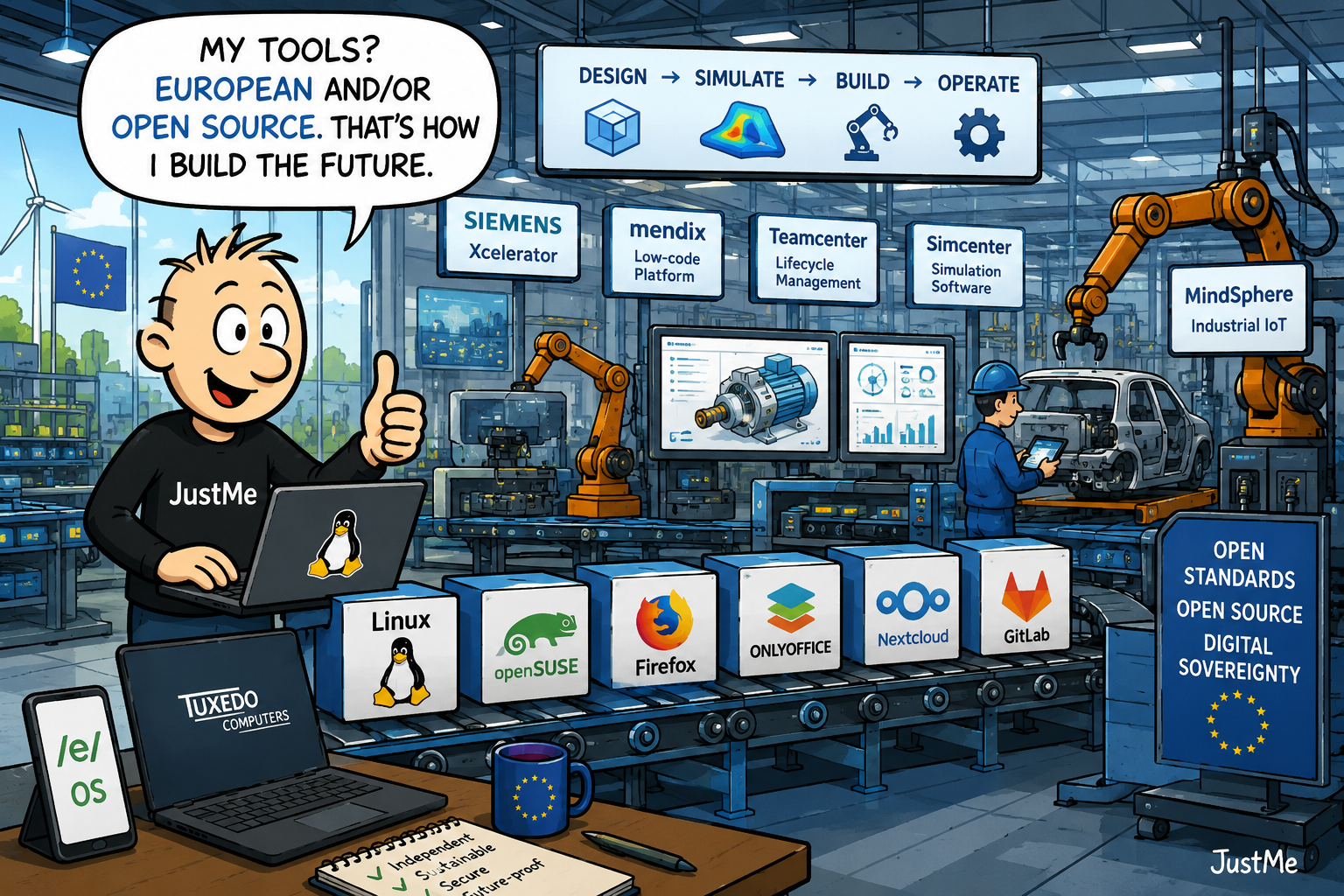
I am personally very interested in digital sovereignty, digital autonomy, European technology and open-source software. Partly because I believe Europe needs more control over the technology on which our companies, governments and societies increasingly depend. The tools I use myself — from my laptop and phone to software applications — are almost exclusively European and/or open source.
At the same time, I sometimes — perhaps even often — get frustrated by the way this discussion is conducted, especially in the Netherlands. There is a persistent assumption that European technology does not amount to very much, that the United States has already won the technology race, and that open source is mostly something complicated for technically minded enthusiasts. I think that picture is far too simplistic.
There is certainly a technology gap in some areas. American hyperscalers dominate cloud computing, many of the most visible AI companies are American, and China has built formidable capabilities in areas such as manufacturing, batteries and robotics. Pretending otherwise would be pointless.
But there is another side to the story. Sometimes I also think CIOs and IT managers make things unnecessarily easy for themselves. If Microsoft, AWS or another established supplier already provides almost everything you need, it is tempting simply to buy whatever your preferred vendor puts in front of you. That is convenient. It reduces the number of suppliers, contracts and technologies that need to be evaluated. But convenience can easily turn into dependency.
European and open-source alternatives are therefore sometimes dismissed as being too difficult before they have even been seriously investigated. And in the Netherlands in particular, I sometimes feel there is too much pessimism surrounding European technology. We talk extensively about everything Europe cannot do, while paying considerably less attention to the areas in which European companies are genuinely world-class.
That was one of the reasons I was particularly interested in visiting Siemens Realize Live Europe in Amsterdam. I knew beforehand that Siemens would offer a rather different perspective on the global technology race.
Europe is not absent from the technology race
I recently wrote about the event for Computable.nl in an article titled “Siemens: Europa is ijzersterk op het gebied van industriële tech” (text is in Dutch). The central message is worth repeating: Europe may not always dominate the headlines surrounding artificial intelligence, cloud platforms or consumer technology, but in industrial technology its position is considerably stronger than the popular narrative sometimes suggests.
One of the most striking examples during the event involved UBTech, a well-known Chinese manufacturer of humanoid robots. At first sight, it appears to be another illustration of Europe’s supposed technological weakness. China builds advanced humanoid robots while Europe watches from the sidelines. Except that this is not what is actually happening.
Siemens demonstrated how UBTech uses technology from the Siemens Xcelerator portfolio to design, simulate, test, manufacture and manage its robots throughout their lifecycle. In other words, some highly advanced Chinese technology is being created with European industrial software and engineering technology.
That changes the picture considerably. Yes, the most visible product may be Chinese, while much of the engineering infrastructure behind it comes from Europe.
Industrial technology deserves more attention
This is perhaps one of the problems with the broader technology debate. We tend to judge technological strength by looking at the companies that are most visible to consumers. Google, Microsoft, Amazon, Apple, OpenAI, Meta and Nvidia naturally receive enormous amounts of media attention. Industrial technology is much less visible. Yet behind virtually every physical product is an enormously complex digital environment. Aircraft, cars, chips, machines, factories, energy systems and robots must be designed, simulated, tested, manufactured and maintained. And Europe has exceptionally strong companies in precisely those areas.
At Realize Live Europe, Siemens repeatedly emphasised this complete industrial digital chain. Its strategy increasingly revolves around what the company calls the digital thread: connecting information from chip and electronics design through mechanical engineering, simulation and manufacturing all the way to factory automation and maintenance.
That includes technologies from companies Siemens has acquired over the years, including Mentor Graphics, Altair and the originally Dutch low-code company Mendix. Instead of presenting these as separate software products, Siemens increasingly positions them as parts of a connected industrial technology platform.
AI, but not AI for AI’s sake
Artificial intelligence naturally played a major role at the event. What I found interesting, however, was that Siemens did not primarily present AI as yet another chatbot. The focus was much more practical. AI is being incorporated into engineering tools, simulation software, manufacturing systems and product lifecycle management. According to Siemens, AI already reduces the time required to create certain technical 2D drawings by around fifty percent, while parts can be classified in Teamcenter roughly ten times faster.
The company is also introducing AI agents capable of carrying out parts of engineering workflows. But engineers remain responsible for supervision and final decisions. This is an important distinction. In industrial environments, AI cannot simply generate something that looks plausible. Engineering information needs to be accurate, traceable and connected to the correct version of a product or production process. That is why Siemens places so much emphasis on data.
Intelligence Center X
One of the major announcements during Realize Live Europe was Intelligence Center X, which Siemens positions as an intelligent layer across its software portfolio. The idea is that AI agents can analyse information, initiate processes and support engineers while remaining connected to the underlying industrial data. Instead of copying enormous quantities of information into separate AI environments, the agents work with data stored in systems such as Teamcenter.
That is significant because industrial data changes continuously. A product configuration may change. A component may be replaced. A new engineering version may become available. Manufacturing parameters may be adjusted. AI systems therefore need more than access to data. They need access to the right and current data, including the context in which that information exists.
Traceability is equally important. Companies need to understand where information came from and why an AI system reached a particular conclusion. These requirements are rather different from those of consumer-oriented generative AI.
Simulation becomes part of design
Another fascinating development is happening in simulation. Traditionally, engineers often designed something first and then used simulation to determine whether the design would actually work. That process is changing. According to Siemens, the combination of GPU acceleration and what it calls Physics AI can make some simulations hundreds or even thousands of times faster.
Examples presented at the event illustrated the impact. Continental has reportedly reduced a complex airbag simulation from around two hours to less than thirty seconds. Magna reduced another simulation from fourteen hours to approximately ten seconds. Rolls-Royce is using Simcenter Simsolid to analyse engine designs much more quickly.
When simulations take seconds rather than hours, they become something very different. An engineer can test many different design options during the design process rather than using simulation mainly as a final verification step. That can potentially change the way products are developed.
AI enters the factory
The same development is happening inside factories. Siemens demonstrated how AI can analyse abnormalities in manufacturing processes and combine information from engineering systems, ERP software and production environments. Instead of requiring engineers to manually investigate every possible relationship between datasets, AI can identify correlations and suggest possible improvements. (Computable)
Again, this does not mean removing humans from the process. It means automating parts of the investigative work while leaving engineers in control. That appears to be an important theme in Siemens’ approach to industrial AI: moving from systems that simply answer questions towards software that can help execute complete processes.
And then there is digital sovereignty
For me, one of the most interesting elements of the Siemens story was its connection with digital sovereignty. Mendix plays an important role here. The Dutch low-code platform, acquired by Siemens in 2018, is becoming part of the company’s broader AI architecture. It can be used to create applications and agentic workflows in which humans and AI agents work together.
But there is also an infrastructure dimension. Siemens is working with German cloud provider STACKIT to allow certain Mendix environments to run on European cloud infrastructure. According to Siemens, this currently primarily concerns projects involving Dutch government organisations, but the approach is expected to expand. Siemens has also been talking with European cloud provider OVHcloud about hosting additional Siemens solutions on European infrastructure.
That is exactly the kind of development I believe deserves considerably more attention. Digital sovereignty should not simply mean complaining about Microsoft, AWS or Google. Nor should it mean replacing American Big Tech with European Big Tech. It should mean creating genuine technological choice. That requires European cloud infrastructure, open standards, open-source technologies, interoperable software and strong European technology companies.
Perhaps we should stop underestimating ourselves
The visit to Siemens Realize Live Europe reinforced something I have thought for some time. Europe certainly has technological weaknesses. We need more investment, more scale, stronger capital markets and probably much more ambition in several areas of digital technology.
But constantly repeating that Europe has already lost the technology race is not particularly helpful either. Because it is not entirely true.
Europe has deep expertise in industrial automation, engineering software, semiconductor technology, manufacturing systems, digital twins, telecommunications, embedded systems, machine building and many other technologies that rarely generate the headlines enjoyed by ChatGPT or the latest American cloud service.
And these technologies matter enormously. Sometimes they are even the technologies being used to create the highly visible American and Chinese innovations that we subsequently point to as evidence that Europe is falling behind. The Siemens event was a useful reminder that technological power is not always found where the headlines are.
You can read my original Dutch article for Computable, “Siemens: Europa is ijzersterk op het gebied van industriële tech” here.
Perhaps the discussion about European digital sovereignty would become more productive if we spent a little less time explaining why things cannot be done — and a little more time looking at the technology that Europe already has.