
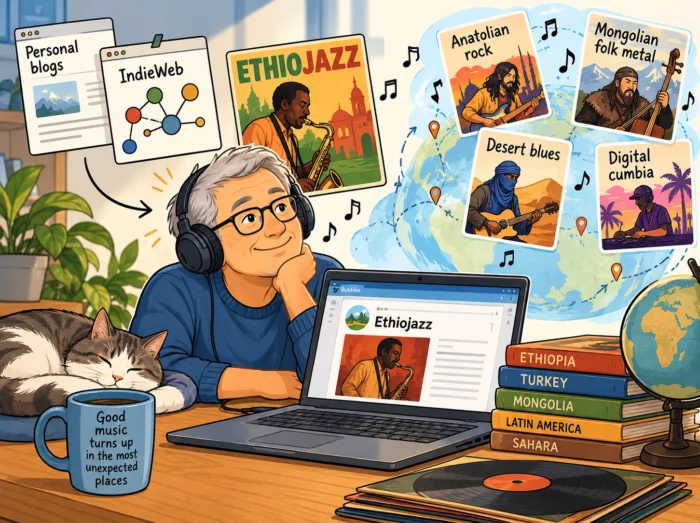
I love wandering around the IndieWeb. Reading personal blogs, following links, ending up on websites I’ve never visited before. Quite often, I find something interesting. Sometimes something completely unexpected. Like Ethiojazz.
I was browsing Bubbles (https://bubbles.town/) when I came across a blog post about Ethiojazz (https://www.rousette.org.uk/archives/ethiojazz/). I’d never heard of it. But the story sounded interesting, so I clicked through and started reading.
Apparently, there’s a fascinating musical history here, involving Ethiopian folk music, jazz, funk and even Armenian influences. Now, that’s not exactly a combination I would have come up with myself. So, naturally, I had to hear what it sounded like. And what wonderful music! I ended up listening to several tracks, wondering how something this good had managed to escape my attention all these years.
But what struck me most wasn’t just the music. It was how I’d found it. Because seriously, how would I ever have thought to search for Ethiojazz? And that, to me, is one of the nicest things about the IndieWeb. Think about it. We have search engines that can find almost anything. Spotify and YouTube offer us millions of songs. AI can answer just about any question we throw at it. But there’s a catch. You have to know what to ask. Or at least have some idea of what you’re looking for. Sure, there are recommendation engines that try to introduce you to music you might like. But in a way, they tend to give you more of the same. Listen to a particular hip-hop artist, and they’ll suggest other hip-hop artists. Enjoy some old-school soul, and they’ll recommend similar songs. That’s all fine, of course. But it doesn’t necessarily help you discover something completely different.
I could have searched for Ethiopian jazz. But why would I? I didn’t even know it existed. There’s something special about discovering something through another person’s blog. Someone, somewhere, happens to be interested in a particular subject. They write about it because they find it fascinating. Not necessarily because it’s trending, because people are searching for it, or because it might attract thousands of visitors. They simply want to share something they enjoy. And then, through a place like Bubbles, that little piece of enthusiasm finds its way to me.
A whole world of strange combinations
My discovery of Ethiojazz also made me curious about other unusual combinations of musical traditions. And there are plenty. There’s Anatolian rock, for example, which combines Turkish folk music with psychedelic rock. Listen to Altın Gün (https://en.wikipedia.org/wiki/Alt%C4%B1n_G%C3%BCn) and you’ll hear traditional Turkish melodies played with electric guitars and a distinctly seventies sound. Or take Mongolian folk metal. Yes, that’s a thing. The Hu (https://www.thehuofficial.com/) combine traditional Mongolian instruments and throat singing with heavy metal. It sounds like an unlikely combination, but it works remarkably well. Then there’s desert blues, with musicians such as Tinariwen (https://en.wikipedia.org/wiki/Tinariwen) and Mdou Moctar (https://en.wikipedia.org/wiki/Mdou_Moctar), whose music brings together Saharan musical traditions and electric guitar sounds. And what about digital cumbia (https://www.melodigging.com/genre/digital-cumbia), where Latin American dance rhythms meet electronic music? I could go on.
The interesting thing isn’t necessarily that these combinations exist. Musicians have always borrowed ideas from other cultures and musical traditions. That’s how music develops. What fascinates me is how much wonderful music is out there that I have never encountered. And how easily I might have missed it altogether.
This is what I love about personal websites
For me, this little musical adventure illustrates something much bigger. The web has become incredibly good at helping us find things. Search engines, social media platforms and recommendation systems are constantly trying to figure out what we want. And quite often, they’re right.
But I don’t always want more of what I already like. Sometimes I want to be surprised. I want to read about something that has absolutely nothing to do with my usual interests. That’s where personal websites and the IndieWeb come in. One day, someone writes about a strange programming language. Another person explains how they repaired a forty-year-old computer. Someone else shares photographs of an abandoned railway station. And another blogger introduces me to Ethiopian jazz. None of these people needs to know who I am. They don’t need to analyse my interests or predict what I might click on. They’re simply sharing something. And I’m free to follow my curiosity.
I also like that these discoveries don’t necessarily lead anywhere useful. I don’t need to turn Ethiojazz into a project, learn to play an Ethiopian instrument or become an expert on the history of African jazz. I can simply enjoy the music.
Leave some room for the unexpected
I spend a lot of time experimenting with AI, websites, RSS and other digital tools. I’m fascinated by what technology makes possible, especially when it helps people create and publish things themselves. But the more I experiment with technology, the more I appreciate the wonderfully unpredictable nature of personal blogs. Not everything needs to be recommended to me because it matches my profile. Not every interesting discovery needs to be the result of a clever algorithm. Sometimes all it takes is someone writing enthusiastically about something I know absolutely nothing about. And someone else making that post easy to discover.
That’s exactly what happened with Ethiojazz. I didn’t wake up thinking I should explore Ethiopian jazz. I didn’t even know it existed. Someone wrote about it on their personal blog, Bubbles brought that blog to my attention, and suddenly I had a whole new world of music to explore. That’s what I love about the IndieWeb. You never quite know what you’ll find.