
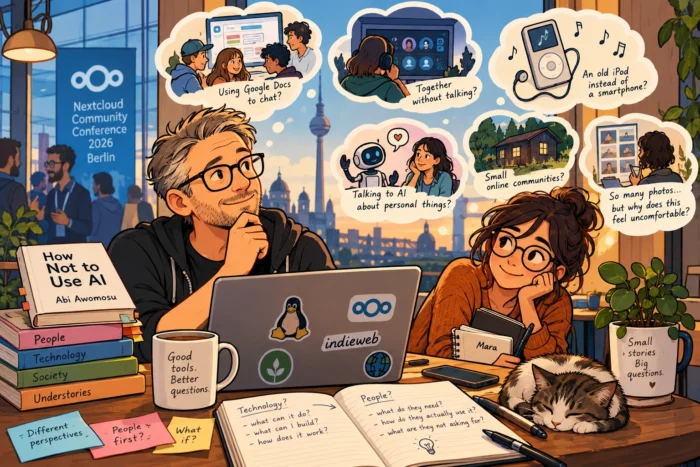
I spend quite a lot of time thinking about technology. Linux, open source, AI, the IndieWeb, journalism, personal websites, and all sorts of little experiments that I probably spend far too many evenings working on. But lately, I’ve been wondering whether I’ve been looking at the internet from the wrong direction.
Or perhaps not the wrong direction. Just one particular direction. When I come across an interesting new technology, my first reaction is usually to wonder what I could do with it. Could I build something? Could it make journalism more interesting? Could it help people become less dependent on big technology companies? Could I run it on my own computer?
Those are perfectly reasonable questions, I think. But they’re not the only questions worth asking.
A conversation in Berlin
One of the things that got me thinking about this happened during the Nextcloud Community Conference 2026 in Berlin. I spent quite some time talking with Christian Fu Müller, Nextcloud’s AI lead. We talked about AI, agentic AI, its possibilities, and the ways people might use it. At some point, Christian showed me a book he had brought along. An actual paper book, which somehow seems worth mentioning at a technology conference.
It was How Not to Use AI, by Abi Awomosu. I hadn’t come across it before, but it caught my attention. And after reading it, I found myself thinking about AI a little differently. Not because I’d suddenly become sceptical about AI. Far from it. I’m still a big fan, perhaps even more so than before.
But the book helped me reconsider something. I tend to approach AI by asking what it can do. What tasks can it perform? What can I build with it? How can it make something easier or more interesting? Increasingly, though, I find myself wondering whether I should spend just as much time asking what people actually need from it. Is that the best possible way to use AI? And perhaps that question shouldn’t be limited to AI. Perhaps I should be asking it about the internet as a whole. In a way, the book made me realise something that had been lurking somewhere in the back of my mind for quite a while, but that I’d never really managed to put my finger on.
What are people actually doing?
A while ago, I came across stories about teenagers using shared Google Docs to communicate with each other. Not because Google Docs is a particularly good messaging platform, but because it was available to them when other forms of communication weren’t. I love that kind of thing. Someone designs a tool for one purpose, and people decide to use it for something completely different. Or consider people who spend hours together in a Discord voice channel without really talking. They’re studying, working, playing games, or just doing their own thing. They’re not necessarily there to have a conversation. They simply like knowing that someone else is around.
Why do they that? That question fascinates me. We’ve spent decades developing increasingly sophisticated ways for people to communicate online. And then some people use those technologies to enjoy being together without communicating very much at all. Or take the people who buy old iPods, even though their smartphones can play practically every song ever recorded. Why? Maybe nostalgia. Maybe they like the physical buttons. But perhaps some of them simply want to listen to music without being interrupted by messages, notifications, recommendations, or the temptation to check something else. What if the attraction of an old iPod isn’t what it can do, but what it doesn’t do?
The things people don’t necessarily ask for
Here’s what makes this particularly interesting to me. People don’t always know how to describe what they want from technology. They don’t necessarily say, “I would like a digital environment where I can experience social presence without the obligation to interact.” They just sit in a Discord channel with their friends. They don’t say, “I need a separate online identity where I can escape the pressure of presenting a carefully curated version of myself.” They create a second Instagram account that only a handful of friends know about. And they don’t necessarily say, “I would like to reduce the cognitive demands of my digital environment.” They buy an old iPod.
Of course, I’m simplifying things here. People have all sorts of reasons for doing what they do. And three interesting examples don’t automatically add up to a trend. But that’s exactly why I find this so fascinating. Because sometimes, the most interesting developments aren’t announced at technology conferences. They don’t appear in product roadmaps or industry reports. They emerge when people start doing slightly unexpected things with the technology they already have. And perhaps those little experiments tell us something about needs and desires that haven’t yet been properly understood.
Looking beyond my own little corner of the internet
There’s another reason I want to explore this. I’m a big fan of the IndieWeb. I like personal websites, RSS, open standards, and the idea that people should have more control over their digital lives.
But I also realise that this probably colours the way I look at the internet. When I see people becoming frustrated with a large social network, I’m inclined to think about independent websites or decentralised alternatives. When I read about concerns over online privacy, I immediately think about local-first software, self-hosting, and open source. And when someone complains about search engines, I start looking at alternative search tools.
But what if that’s not what those people actually want?
Perhaps someone frustrated with Instagram doesn’t want an independent website at all. Perhaps they simply want a place where they can share silly photos with five friends without worrying about everyone else. Perhaps someone concerned about privacy doesn’t want to run their own server. They just want their phone to stop asking them questions.
I think there’s a real danger in looking at people’s behaviour and immediately interpreting it through our own technological preferences. I’d like to become a little better at avoiding that.
The internet’s little understories
I’ve started thinking of these things as digital understories. The small, sometimes strange things people do online that might tell us something bigger about being human. Not necessarily trends. Certainly not predictions about the next big thing. More like little clues. Why do people talk to AI chatbots about things they hesitate to tell their friends? Why do some online communities deliberately try to remain small? Why do people create elaborate digital spaces that hardly anyone will ever visit? Why do we save thousands of photographs, only to become uncomfortable when our phones unexpectedly remind us of something from ten years ago? And why do people sometimes seem to want less technology, while spending more and more of their lives online?
I don’t know the answers. But I’d love to spend more time looking for them. And not just within the IndieWeb. In gaming communities, fandoms, online classrooms, group chats, hobby forums, and all those other corners of the internet that technology journalists don’t necessarily pay much attention to. Especially when people are doing things that don’t quite make sense at first. Those are often the most interesting things.
And then there’s Mara…
There’s another idea I’ve been playing with. Just Me is, well, just me. My own little corner of the internet, where I write about whatever catches my interest. But what if I invited a second voice into the mix?
Someone who isn’t particularly interested in Linux distributions, open-source software, or building yet another little tool with AI. Someone who’s much more interested in people. Why they behave the way they do online. What makes them feel connected. Why they invent strange little digital habits. And what all of that might tell us about the internet we’re creating together. I’ve even been thinking about giving this digital person a name.
So far, her name is Mara. Now, before anyone gets confused, Mara isn’t a real person. She is a fictional, AI-based character. A little experiment in creating a different perspective on the digital world, with real sources and facts behind the stories.
But I’m not sure I want to introduce her as a fully fledged contributor right away. Maybe she will just turn up in the comments occasionally. Perhaps I’d write something enthusiastic about a new technology, and she asks a question I hadn’t considered. Or maybe she points out that the interesting part of a story isn’t the technology at all, but what people are doing with it.
And yes, I wrote that in present tense. Because she’s already been doing exactly that. How? Well, I started by giving her a name and a personality. Once I was happy with who she is and the role she might play here at Just Me, I simply asked her: “Have a look around my blog and pick three posts you’d like to comment on, based on your personality and the role we’ve discussed. Then write those comments so I can review them.” And that’s exactly what she did. They were interesting and relevant. So I published them.
I rather like the idea of a curious fictional character slowly finding her place on Just Me. And who knows? Perhaps one day I’ll ask her to write a post of her own (spoiler: I will). Or perhaps she’ll turn out to be rather annoying. That could be interesting too. I’m simply becoming increasingly fascinated by the things people do with the internet when nobody is telling them how they’re supposed to use it. And I have a feeling there are a lot of stories hiding there. I just need to learn where to look.
I rather like the idea of looking for the stories hiding underneath all that technology. Although I do have one small suspicion: the people using these wonderful inventions are probably far less interested in the technology itself than we sometimes imagine. They want to feel less lonely, find someone who understands them, make something they’re proud of, or simply have a little fun. And sometimes they use our carefully designed tools in ways nobody ever intended.
I think those are the stories I’d like to find. And I suspect I’ll occasionally disagree with you about which part of a story is actually the interesting one. I hope you won’t mind. 🙂