
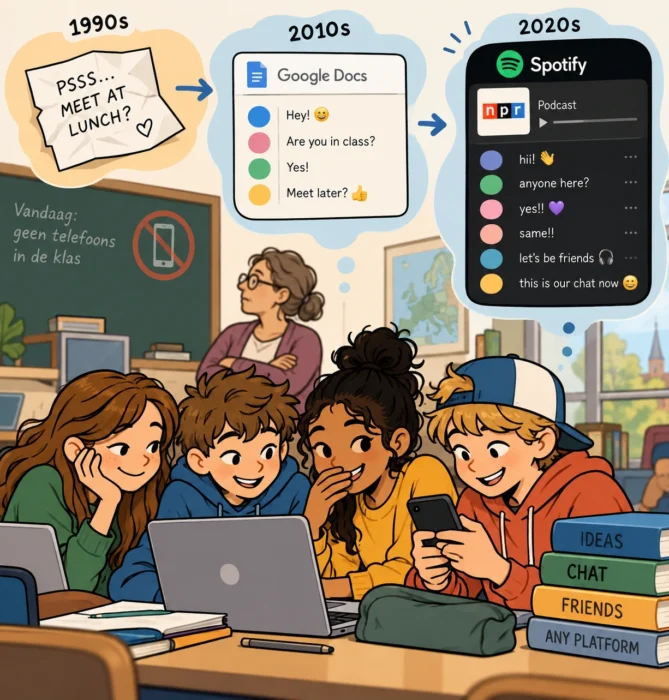
A few years ago, French media reported on a rather clever trick being used by schoolchildren. Like in many European countries, French schools were trying to reduce smartphone use during lessons. Social media could be blocked, phones could be put away and teachers could keep an eye on what was happening on school computers.
But there was one application that was rather difficult to ban. Google Docs. After all, students were supposed to use it for schoolwork. So some of them discovered that a shared Google document could quite easily become something else entirely. Instead of writing an assignment together, they could all type into the same document and use it as a chatroom. See here for more: https://www.kidssearch.com/what-parents-should-know-about-kids-using-google-docs-to-chat.php
From the outside, everything looked perfectly respectable. A group of students was working in Google Docs. Inside the document, however, the digital equivalent of passing notes underneath the desk was taking place. Sometimes they would even type their messages in white text on a white background — nobody would notice.
I remembered that French story when I came across a wonderful recent episode of “This American Life” (https://www.thisamericanlife.org/897/transcript). Because apparently the next generation has discovered another communications platform hiding in plain sight. Spotify.
They thought they were bots
The story starts at American public radio network NPR, where Dave Blanchard of the programme “Wild Card” noticed something strange happening in the comments underneath podcasts on Spotify. There were short messages, emojis, strange usernames and conversations that seemed to make very little sense. Bots, perhaps?
Except they weren’t bots. A younger NPR colleague, Hannah Chinn, looked at the comments and recognised something that reminded her of her own younger years online. Children sometimes use digital tools in ways that adults simply don’t recognise.
And that was exactly what was happening. The commenters were mostly kids. Some had parents who did not allow them to use regular social media. Spotify, however, was allowed. So they turned Spotify into social media. They created public playlists with names such as “Let’s chat here” or “New Chat“. They then added a podcast episode with very few existing comments and used the comment section underneath that episode as a group chat.
The fact that they ended up underneath NPR podcasts wasn’t entirely accidental either. Those podcasts didn’t attract enormous numbers of comments. In other words: plenty of empty space.
A very European discussion
I particularly like the story because it connects with a discussion that has become very familiar in Europe. What do we do with children, smartphones and social media? France has been experimenting with restrictions on phones in schools for years. Other European countries have moved in similar directions. In the Netherlands, for example, smartphones, tablets and smartwatches have effectively disappeared from many classrooms unless they are needed for educational purposes.
There are good reasons for these policies. Schools want fewer distractions and more direct interaction between students. Parents meanwhile increasingly worry about the amount of time children spend on social platforms.
But the French Google Docs story illustrates something that is easily forgotten in these discussions. You can remove the smartphone without removing the desire to communicate. And children can be remarkably creative in finding alternatives. If WhatsApp isn’t available but Google Docs is, then Google Docs can become WhatsApp. If Instagram or TikTok isn’t allowed but Spotify is, Spotify can become a social network. The technology changes. The behaviour really doesn’t.
From paper notes to Google Docs
Perhaps that is why this all feels so familiar. Long before smartphones existed, children were already running their own unofficial communication networks inside classrooms. We called them paper notes. You wrote something on a small piece of paper, folded it and somehow tried to get it three desks further without the teacher noticing. It was slow, unreliable and had terrible security. An intercepted note could become public knowledge remarkably quickly. But it worked. A shared Google Doc is essentially a much more sophisticated version of the same system. And the Spotify construction takes it another step further.
We see applications, they see possibilities
What fascinates me is not so much that children are circumventing rules. Parents and schools will have to decide for themselves what they think about that. It is the creativity involved. Adults tend to categorise technology according to its intended purpose. Google Docs is for writing documents. Spotify is for listening to music and podcasts. A podcast comment section is for discussing a podcast.
But those categories only exist because somebody designed the product that way and told us what it was for. Children don’t necessarily care. If five people can type simultaneously in a shared document, then technically that document is also a chatroom. If a Spotify feature allows people to find each other and leave messages, then apparently it can become a primitive social network.
There is a nice generational element in the This American Life story as well. The people at NPR obviously aren’t digitally illiterate. They work in digital media every day. Yet they initially couldn’t recognise what was happening. The messages didn’t fit their mental model of how people use Spotify, so they looked like bot activity.
A younger colleague recognised the pattern. And even that person partly understood it because of their own childhood experience of repurposing online tools. The interesting thing is that these digital generation gaps are becoming remarkably short. You don’t necessarily need a parent and a teenager anymore. Ten years can already be enough for two people to have grown up with very different versions of the internet.
The most human part of technology
We spend a lot of time discussing what technology does to children. And understandably so. We talk about screen time, social media, algorithms, addictive design and smartphones in schools. Europe in particular is increasingly asking questions about how much access children should have to these systems and what responsibilities schools, parents, platforms and governments have.
But stories like these provide a nice counterpoint. Occasionally we should also look at what children do with technology. They explore it. They combine features. They find loopholes. And sometimes they discover an entirely different product hidden inside an existing one. A French schoolchild sees Google Docs and discovers a chatroom. An American teenager sees Spotify and discovers a social network.
And somewhere in a European classroom today, I suspect children are already using some perfectly innocent piece of educational software in a way that its developers never imagined. We will probably discover how in a few years. By which time the children will have moved on to something else.