
I came across an interesting little post by Kev Quirk about something I had never really thought about before: privacy and Webmentions. And the more I thought about it, the less obvious the answer became.
Kev’s post started with a reader raising a privacy concern about Webmentions. In particular, the reader had stopped using them because people posting replies on the Fediverse may not realise that those replies can subsequently appear on somebody else’s website through Webmentions. You can read his post here: https://kevquirk.com/privacy-and-webmentions?utm_source=chatgpt.com
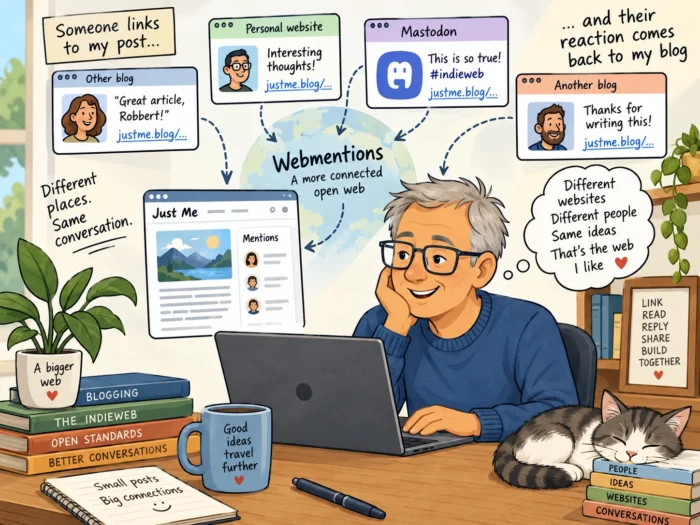
For those who have never encountered Webmentions (https://www.webmentions.com/), the basic idea is rather nice. They are part of the collection of technologies and conventions generally associated with the IndieWeb. If I write something on my website that refers to something on your website, your site can be notified. Similarly, interactions elsewhere can sometimes be brought back to the original article.
Kev himself once described Webmentions rather neatly as comments that can “traverse the IndieWeb”. Which sounds exactly like the sort of thing I should like. Except that I don’t actually use Webmentions on Just Me.
Public means public, doesn’t it?
Kev’s initial reaction to the privacy argument was more or less: if somebody posts something publicly on Mastodon, it is already public. And there is clearly something to that argument. Mastodon isn’t a private messaging service. If I publicly reply to somebody, that message can already travel between servers because that is how federation works. People can link to it. Search engines may find public web pages. Someone can quote it in a blog post.
So why would displaying that same public reply underneath the blog post it discusses suddenly create a privacy problem? That seems a perfectly reasonable question. But then there is another way of looking at it.
I said it there
Imagine I walk into a pub and loudly tell a story to ten people. I clearly can’t claim that the story was private. Other people in the pub may hear it. Someone may even repeat it. But that doesn’t necessarily mean I expected someone to record what I said and put it on a noticeboard outside the supermarket.
Perhaps that distinction matters online as well. When I post a public comment on Mastodon, I am making a public statement. But I am also making that statement in a particular place and within a particular context. Does public therefore automatically mean public everywhere? I don’t know.
And that is exactly why I found the discussion around Kev’s post interesting. The comments and responses don’t simply turn this into a technical discussion about Webmentions. They lead to a much broader question about context, consent and what “public” actually means on the open web.
There is also an interesting cultural element here. Manton Reece, writing about similar questions around blogging and the Fediverse, points out that there is a culture on Mastodon in which posts can sometimes be treated as semi-protected within that environment, even though technically they are published on the open web. That distinction between what technology allows and what people expect is important.
Context is part of publishing
Perhaps location is part of the message. If I leave a comment underneath a blog post, I deliberately put my words underneath that particular article. If I reply to something on Mastodon, I deliberately put them into that conversation. Both may be publicly accessible. But they aren’t necessarily the same thing.
We have become accustomed to thinking about privacy as a binary choice: something is either private or public. The web has always been much messier than that. There is technically public. There is socially public. There is searchable. There is discoverable. There is likely to be seen by the people hanging around here. And there is copied automatically to another website where an entirely different group of people may encounter it. Those aren’t necessarily equivalent.
But isn’t this exactly what the open web is for?
Then again, we should be careful not to take this argument too far. The open web works precisely because things can be linked, quoted, referenced and discussed elsewhere. I regularly write about things other people have written. Bloggers have been doing that since blogging began.
In fact, that is one of the things I like most about the personal web. Someone writes something. Someone else responds on their own website. A third person joins in. Suddenly you have a conversation spread across several independent websites rather than locked inside Facebook, LinkedIn or some other corporate platform. Webmentions are, in a way, simply an attempt to connect those conversations. And that is a very attractive idea.
Interestingly, Kev himself has gone back and forth on Webmentions over the years. He once removed IndieWeb support partly because of its complexity and limited use, and later experimented with Webmentions again. He has also built his own ways of showing what other bloggers have said about his posts. Which perhaps tells us something. This isn’t a solved problem.
I don’t have an answer
I don’t use Webmentions myself. And although I read quite a few personal blogs, I hardly ever leave comments. So this isn’t a problem I urgently need to solve for Just Me. But I find the discussion fascinating because it touches on something much bigger than Webmentions. What exactly do we consent to when we publish something publicly?
If I put a comment on website A, have I implicitly agreed that website B can automatically reproduce it? My first reaction is probably: well, yes. You published it publicly. My second reaction is: hmm. But I published it there. And now I am no longer quite so sure. Which is usually a good indication that a discussion is worth having.