
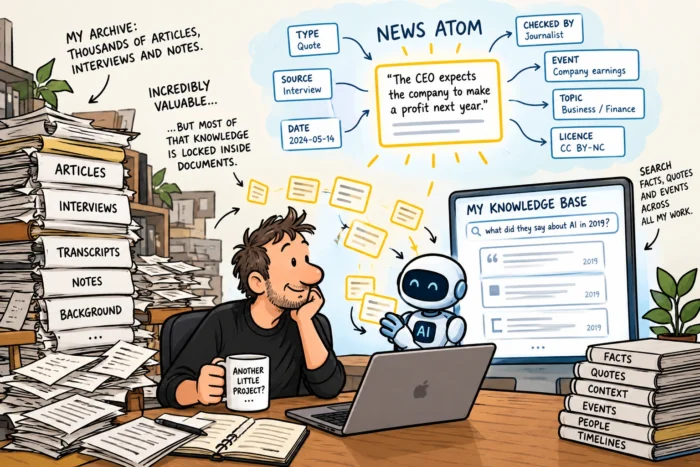
I write a lot. News stories, interviews, background articles, notes, transcripts. After doing that for many years, you end up with quite an archive.And I increasingly think that an archive like that is both incredibly valuable and remarkably stupid.
It is valuable because it contains thousands upon thousands of facts, quotes, explanations, names, dates and connections. But it is stupid because most of that knowledge is locked inside documents. If I want to find one particular fact from an interview I did five years ago, I first have to find the article or transcript that contains it.
I already made a start
Actually, this is not an entirely new problem for me. I recently built “Archive Lens” (https://editorial-ideas.com/posts/2026-09-27-1005-archivelens-a-personal-searchable-wiki-for-every), a small tool that turns my collection of articles and other texts into a personal searchable wiki. It was my first attempt to make all those years of writing more useful than simply storing thousands of files in folders. Archive Lens helps me find information inside those documents.
And that is also why I found a paper by Sannuta Raghu, written during her fellowship at the Reuters Institute, particularly interesting. Her idea is called the “News Atom” (see here: https://.reutersinstitute.politics.ox.ac.uk/introducing-news-atom-metadata-blueprint-journalism-age-ai). News Atoms take that idea an interesting step further: instead of making documents easier to search, why not break their contents down into individual, structured pieces of knowledge?
Breaking journalism into atoms
The basic idea is surprisingly simple. Instead of seeing an article as the smallest useful piece of journalism, Raghu suggests going down to roughly the level of a sentence.
That sentence then becomes a small data object of its own, surrounded by metadata. Where did this information come from? Who checked it? When was it published? Is it a fact, a quote, context or perhaps an expectation? What event does it relate to? And under what licence may it be reused?
Raghu compares this to EXIF metadata in photography. A photograph is not just a collection of pixels. It can also carry information about when and where it was taken, which camera was used and who owns it. Why shouldn’t journalistic information have something similar?
AI changes the problem
This becomes especially interesting with AI. When an AI system processes an article, much of the journalistic context can disappear. There is quite a difference between “the company made a profit” and “the CEO expects the company to make a profit next year”. Humans immediately understand that difference. Once information gets chopped up, copied, summarised and moved between systems, those distinctions can become much harder to preserve.
The News Atom tries to make that context machine-readable. And this is where I started thinking about my own archive again.
My archive could become something else
Imagine taking years of articles and turning them into thousands of these small knowledge objects. Suddenly, my archive would no longer just be a directory containing lots of old documents. It could become a database.
Search for a company and retrieve not only articles, but individual facts, quotes and events. Ask what somebody said about a particular technology three years ago. Connect a new development to something that happened in 2019. Or use a local LLM with RAG to search only information that I have collected, written or verified myself.
The paper even describes the possibility of building an “event bank”, connecting individual News Atoms from articles, podcasts and videos to the same real-world event. Now that is an interesting idea.
Perhaps I need another little project
The News Atom isn’t a finished standard. Raghu explicitly presents it as a blueprint and suggests starting with small experiments, such as CMS plugins or automatically “atomising” existing articles. Which is probably just as well.
Because while reading the paper, I caught myself wondering how difficult it would be to take a few thousand of my own articles, let a local LLM break them into News Atoms, store them in a small database and put a search interface on top.
Would it be possible for publishers to sell News Atoms? For example, could they be sold in bulk to AI companies, or bundled into smaller, more focused “News Atom Sets” for specific target audiences? And could individual journalists do the same? Perhaps they could make their News Atoms available directly through an API, or distribute them through an event bank like the one Raghu suggests?
I really shouldn’t start another project. But I probably will.