
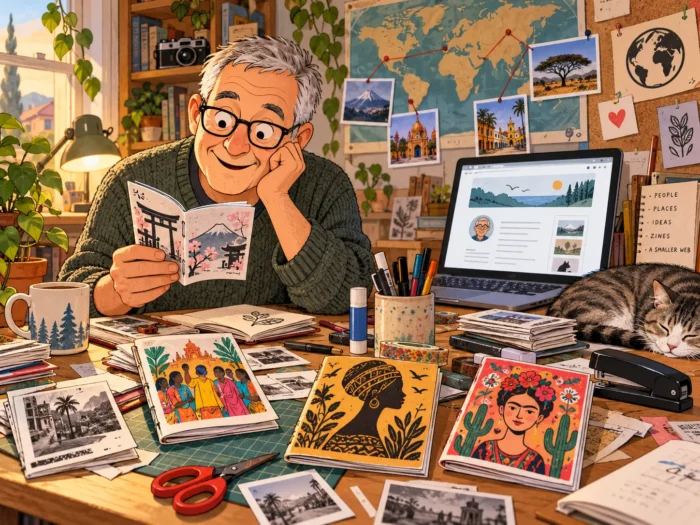
There is something wonderfully strange about people making their own magazines. Not professional magazines with advertising departments, editors and subscription systems. I’m talking about little publications made at home, sometimes consisting of nothing more than a few folded sheets of paper, some photographs, drawings, stories or whatever else someone feels like sharing.
I’ve known about zines (https://en.wikipedia.org/wiki/Zine) for quite some time, but I never realised just how large, diverse and fascinating the world of people making, collecting and exchanging them actually is. And when I say an entire world, I really do mean the world. From photography enthusiasts in Japan to poets in Uganda and creative communities in India, people of all ages are publishing their own little magazines.
Why? That’s what I wanted to find out.
It started with a photographer
My little journey began with two posts on Photoni.st, a personal photography blog written by Cedric. The first was about his Zine Exchange Club (https://photoni.st/index.php/2026/04/24/zine-exchange-club/), and the second showed one of the zines he had created (https://photoni.st/index.php/2026/10/25/zine-exchange-club-zine-1/).
Cedric’s story is rather nice. In the late 1980s, while still at school, he started writing parodies of anarchist manifestos that someone had been putting on the school noticeboards. This turned into a kind of anonymous conversation between the two writers. Eventually, his single-page jokes grew into longer publications.
A few years later, he started a zine called Beark!, containing humour, film reviews and whatever else he felt like writing about. And here’s the part I particularly enjoyed: he distributed it through BBS systems and FTP servers. Yes, BBS! Those wonderful early computer networks I’ve written about before. Today, Cedric makes photography zines. He also runs a small exchange club where people send their publications to one another.
What caught my attention was something he mentioned in his latest post. Most of his zines are unique. He makes one copy, sends it to someone, and that’s it. The recipient may be the only person ever to see it.
Imagine that. We live in a world where people are constantly trying to increase their audience, attract more followers and get their content in front of as many people as possible. And here’s someone happily producing a publication for an audience of one. I rather like that.
But why make a zine at all?
Initially, I assumed zines were mainly created by people who felt that traditional media weren’t covering their interests properly. And historically, that certainly played a role. Science fiction enthusiasts were making fanzines back in the 1930s. They wanted to discuss stories, exchange ideas and create their own communities. Later, punk fans started publishing their own magazines because established music publications often didn’t understand or represent their scene. The riot grrrl movement in the 1990s (https://en.wikipedia.org/wiki/Riot_grrrl) also embraced zines as a way for young women to write about music, feminism and their own experiences without waiting for approval from traditional publishers.
But there are many other reasons to make a zine. Some people want to share their obsession with a particular hobby. Others want to experiment with photography, illustration or creative writing. Some have political or social messages they want to communicate. And others simply enjoy the process of creating something themselves. You don’t need a publisher, a business plan or even a particularly large audience. You just make something. And apparently, people are doing precisely that all over the world.
Japan: where a zine can become a little work of art
Japan was one of the first places that caught my attention when I started looking into contemporary zine culture. There is a fascinating world of independent publishing there, particularly around photography, illustration, typography and graphic design. The Tokyo Art Book Fair (https://tokyoartbookfair.com/) brings together artists, designers and independent publishers. Some produce beautifully designed books, while others create inexpensive, experimental zines.
Browsing through the exhibitors is rather like wandering through an enormous collection of personal creative projects. One Japanese initiative I particularly liked is Anyway Press (http://www.anywaypress.net). Its approach is based on experimenting with language, typography, poetry, colours and shapes through self-publishing. Its motto is wonderfully uncomplicated: “Anyway, let’s print something. And see where it takes us.” Another example is Zerofeedback (https://zrfdbck.com), a Tokyo-based independent publishing platform focused on photography and visual culture.
What interests me here is that zines aren’t necessarily cheap-looking photocopied magazines. They can be carefully designed little art objects. The choice of paper, printing technique, typography and binding can become part of the story. A publication might contain only a few photographs, yet someone has spent hours deciding how those images should appear together. That’s something quite different from posting a few pictures on Instagram.
India: zines as a way of bringing people together
Then I discovered Zinedabaad (https://riyabehl.in/work/zinedabaad), an initiative from India. Founded in 2020 by Riya Behl and Devashree Somani, Zinedabaad explores how zines can be used for creative expression, research and community building.
What began as a single workshop has developed into something much larger. According to co-founder Riya Behl, the collective has collaborated with more than 90 organisations and individuals, organised over 100 workshops, talks and pop-up libraries, and assembled an archive of more than 500 zines from the Global South, particularly South Asia. An archive of more than 500 zines! Just imagine the diversity of stories, ideas, drawings and personal experiences collected there.
And the workshops are particularly interesting. Zines aren’t merely publications that people make at home and distribute afterwards. Making them together can be a social activity in its own right. People who might never consider themselves writers or artists discover that they can create a publication about something important to them. There is no need to convince an editor that your subject is interesting enough. You decide that yourself.
Uganda: poetry, identity and personal stories
I wasn’t expecting my little exploration of zines to take me to Uganda, but that’s exactly what happened. In Kampala, poet and writer Gloria Kiconco (https://www.gloriakiconco.com/about) has been creating and publishing poetry zines for years. Her publications include SOLD OUT (2016), RETURN TO SENDER (2018), created with illustrator Liz Kobusinge, and Tunnel of Delight (2021).
Her work explores subjects such as identity, belonging and mental health. I found her profile at the Prince Claus Fund (https://princeclausfund.nl/awardees/gloria-kiconco) particularly interesting. It describes how she combines self-publishing with readings, spoken-word performances and collaborations with other artists. She has also worked with communities whose voices are often underrepresented in conventional cultural spaces.
Here, zines serve a somewhat different purpose from the photography publications in Japan. They provide a way to tell personal stories, experiment with language and create space for experiences that might not otherwise find a publisher. And the format is accessible. You don’t need an established literary career to produce a small collection of poems. A printer and a few sheets of paper can be enough.
Mexico: publishing without asking permission
Mexico offers yet another variation. Among the exhibitors at the 2025 Tokyo Art Book Fair was arigatos press (https://www.arigatospress.com/arigatos-press), an independent Mexican publishing and art collective. Its members combine photography, illustration, graphic design and literature in zines, prints and other small publications.
The collective describes its work as a way to share artistic practices and political views, while encouraging underrepresented voices to tell their own stories. I find that particularly interesting because it illustrates how zines can exist somewhere between artistic experimentation, personal publishing and activism. Not every zine needs to make a statement, of course. Some are simply funny, beautiful or delightfully weird. But the possibility is always there.
Young people, older people, and everyone in between
Something else surprised me while exploring this world. Zines aren’t exclusively associated with young people. Of course, teenagers and students make them. They’re wonderfully suitable for school projects, creative workshops and experimenting with ideas. But adults of all ages make them too. Some are artists or photographers who have been publishing independently for decades. Others discover the format much later in life.
I even found examples of zine-making workshops organised for senior citizens. Which makes sense when you think about it. There is no age limit on wanting to share a story, make something with your hands or exchange ideas with other people. And unlike so many digital activities, there isn’t really a technical barrier to entry either. Paper, scissors, glue, a pen and perhaps access to a photocopier. That’s about it.
Readers, not followers
Another website I discovered during this little investigation is Zine Exchange (https://zine.exchange/). It’s a platform designed to help people make, discover and exchange physical zines. Its manifesto (https://zine.exchange/manifesto/) contains an idea that I think gets to the heart of this entire phenomenon: readers matter more than followers. The people behind Zine Exchange aren’t interested in creating yet another social network where success is measured by follower counts, likes and impressions. They want people to make something, put it in an envelope and send it to another human being.
And that makes me wonder whether something rather interesting is happening here. For years, the internet has made publishing increasingly easy. Anyone can start a blog, upload photographs, launch a newsletter or publish videos. That’s wonderful, of course. It’s one of the reasons I enjoy the IndieWeb so much. But perhaps the sheer scale of online publishing is also encouraging some people to move in the opposite direction. Instead of trying to reach thousands of people, they create something for ten. Or five. Or just one. Instead of publishing another post that disappears into an endless stream of updates, they create something that someone can actually hold. And instead of depending on an algorithm to find an audience, they simply send their work to someone who wants to read it.
An internet full of little worlds
There is another fascinating aspect to all this. Although zines are often physical publications, the internet plays an important role in helping their makers find one another. Someone in Belgium or France can discover a history zine from Hongkong, an art project in South Africa or a creative collective in Singapore. They can contact the maker, exchange publications or simply explore an entirely unfamiliar world.
A nice starting point is ZineMap (https://zinemap.vercel.app/), a collaborative map where people document zine libraries, events, makers and other parts of the international zine scene. It’s precisely the kind of website that can keep me happily browsing for far longer than I originally intended.
And perhaps that’s what I enjoy most about these discoveries. There’s no single zine culture. There are countless little communities, each doing things in its own way. Some are political. Some are artistic. Some are about photography, music, hobbies or personal experiences. Others are so wonderfully specific that only a handful of people may understand why someone wanted to make them.
But that’s fine. Actually, that’s rather the point. You don’t need to find an existing audience before you start creating something. Sometimes you make something simply because you think it should exist. nThat’s actually how Just Me started, too. I simply wanted a place to write about the things I come across that fascinate me, whatever the subject. Whether anyone actually reads those posts is much less important to me. I just enjoy writing them. Then again, perhaps someone, somewhere, will be delighted to stumble upon something I’ve published here.
I started exploring zines because of a photographer making little booklets and sending them to strangers. A few clicks later, I was reading about independent publishers in Tokyo, creative workshops in India, poetry in Uganda and artists in Mexico. Another reminder of just how much is happening away from the big platforms and familiar websites. And I keep returning to one thought. What if the future of independent publishing isn’t about reaching more people, but about making something that really matters to just a few?