
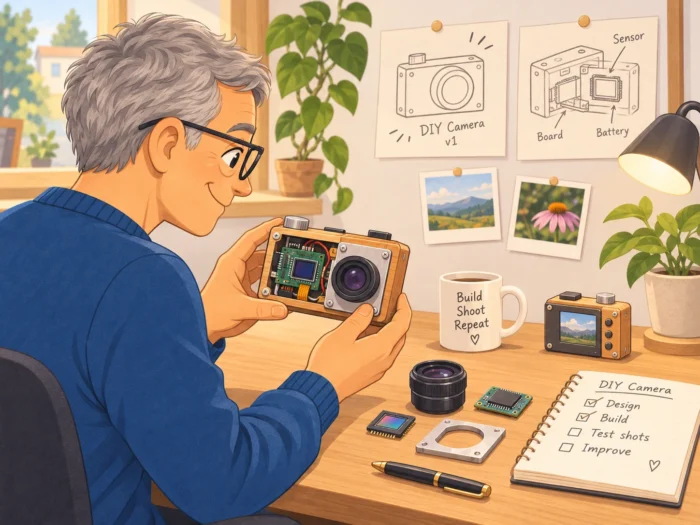
Why people are designing their own digital cameras, bringing forgotten lenses back to life, and discovering that photography can be as much about the camera as the pictures it takes.
This is a very interesting corner of the internet: people who build their own digital cameras. Not simply modifying existing cameras or attaching a different lens, but actually assembling their own photographic devices from sensors, tiny computers, screens, batteries, mechanical switches and 3D-printed parts. Some of these creations look remarkably professional. Others resemble strange little objects you might discover in a second-hand electronics shop, or perhaps in a science fiction film from the 1970s.
What makes these projects particularly interesting is that their creators aren’t necessarily trying to compete with Canon, Nikon, Sony or even the camera in their smartphone. In fact, some deliberately build cameras that are slower, less convenient and technically inferior to commercially available alternatives. They do so because they want a different photographic experience. Or because they enjoy experimenting with electronics and software. Or simply because they have an idea for a camera that doesn’t exist and would like to find out whether they can build it themselves.
A camera from an imaginary future
One of the most striking examples I’ve encountered is Saturnix, developed by a maker who calls himself Yutani. The design takes inspiration from the industrial aesthetics of the 1980s and science fiction films such as Alien. It looks like equipment that might have been used aboard a spaceship imagined forty years ago.
But underneath that retrofuturistic exterior is a modern digital camera. Saturnix uses a Raspberry Pi Zero 2 W, a 16-megapixel autofocus sensor and a small LCD viewfinder. The camera can save RAW and JPEG images and has its own image-processing software that applies different photographic looks. Everything happens on the device itself. You don’t need to connect it to a smartphone or cloud service to process your photographs.
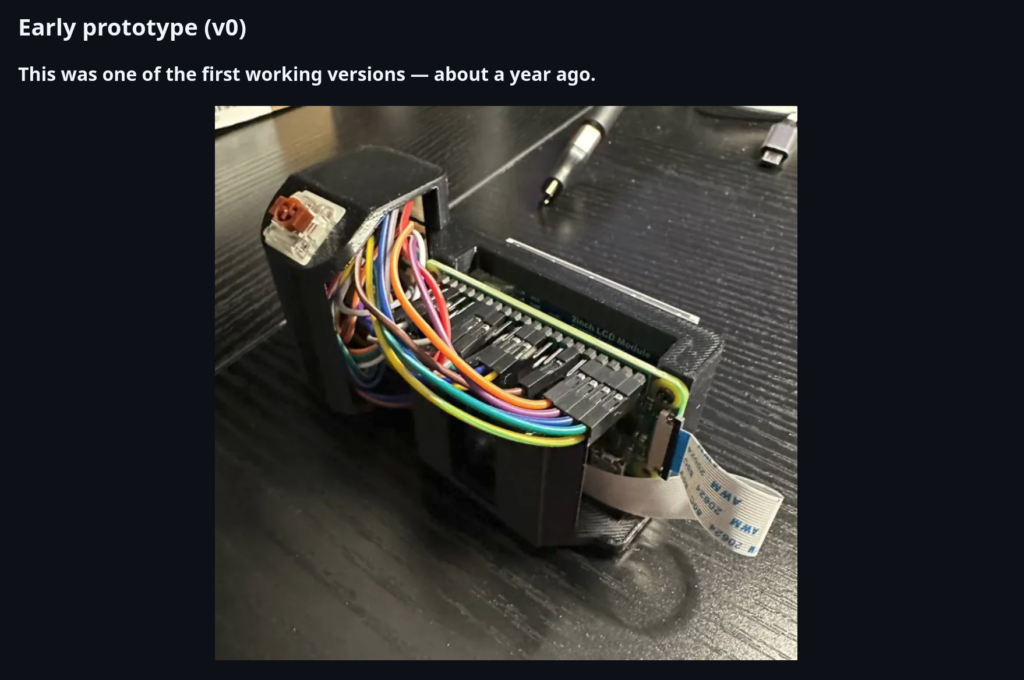
I particularly like one detail: Yutani uses mechanical keyboard switches for the camera’s buttons. Why? Because pressing an actual mechanical button feels different from tapping a touchscreen. The sound, the resistance and the feedback become part of using the camera.
He has also published the hardware designs, software and assembly documentation. You can explore the project at https://github.com/Yutani140x/saturnix-camera. It is open source.
It’s a cool example of something that would make little sense from a conventional product-development perspective. Why spend so much effort building a camera that a smartphone can outperform in many respects? Maybe the answer is: because the objective isn’t necessarily to make a better camera. It’s to make a camera that feels different.
A tiny camera just for fun
Another project takes a very different approach. Turkish maker Doruk Kumkumoğlu created the Optocam Zero, a tiny digital camera measuring approximately 51 by 71 millimeters, with a body only 18 millimeters thick, excluding protruding components.
It is built around a Raspberry Pi Zero 2 W, has a small screen, autofocus and eight photographic filters. There’s even a little strap so you can carry it around. The colourful 3D-printed housing gives it the appearance of a toy, which is more or less the intention.
Kumkumoğlu wanted something playful and uncomplicated, inspired by miniature digital cameras such as the Kodak Charmera (https://www.kodak.com/en/consumer/product/cameras/digital/charmera-keychain-digital-camera/). And he wanted others to be able to build one as well. Consequently, he published a parts list, 3D-printing files, software and detailed assembly instructions.
You can find everything at https://hackaday.io/project/205959-optocam-zero. And a video here: https://www.youtube.com/watch?v=l2oC143P67U.
There are limitations, of course. The camera needs about 22 seconds to start up, for example. That’s hardly ideal when you suddenly spot something interesting and want to photograph it immediately. But perhaps that’s not the point. Carrying a small, quirky camera around might encourage you to photograph things differently. It also raises an interesting question. When was the last time you enjoyed using a camera simply because the camera itself was fun?
The Japanese fascination with building cameras
Looking beyond the English-speaking internet, I found some particularly interesting experiments in Japan. A maker called SKKAW developed KAMPi, a homemade digital camera built around a Raspberry Pi Compute Module 5. His ambition was to create something that could function as an ordinary point-and-shoot camera while retaining the feeling of traditional photography. He designed and assembled the electronics, produced the 3D-printed parts and prepared the software himself.
One particularly interesting choice was to omit autofocus. Modern cameras have become exceptionally good at automatically determining what should be sharp. KAMPi invites the photographer to take more responsibility for that decision.
SKKAW describes the project at https://skkaw.blog/2025/07/18/welcome-to-kampi-my-self-built-digital-camera/.
Another Japanese maker, writing under the name mososom, took a different approach. He wanted to give an old lens a new photographic life. He selected a D-mount lens originally made for an 8mm film camera, a type of lens that can be difficult to adapt to conventional modern digital cameras because of its tiny dimensions.
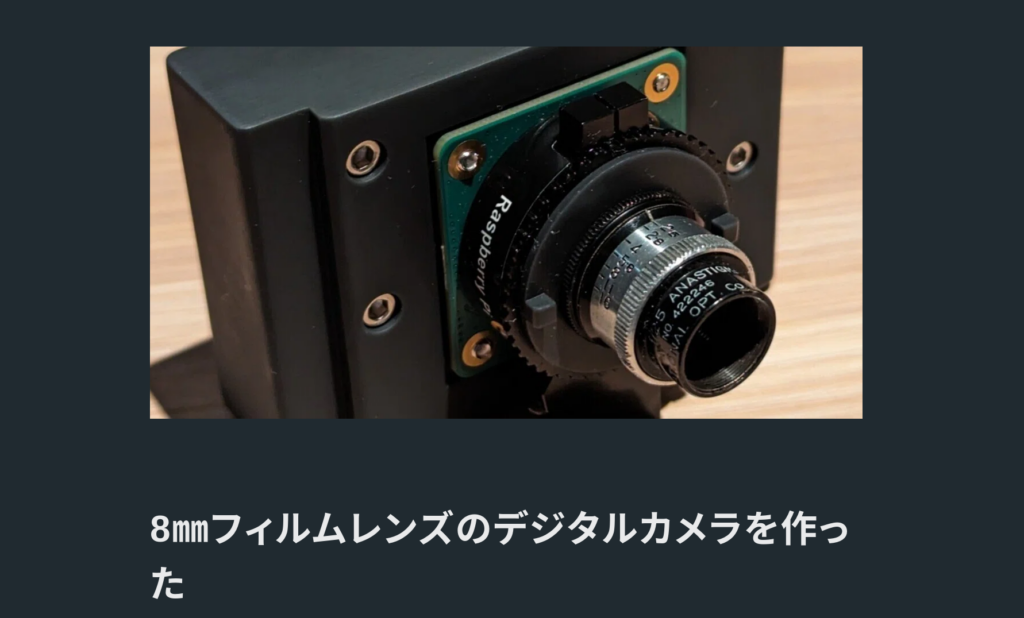
Rather than adapting an existing camera to accept the lens, he built a digital camera around it.
The result combines modern digital components with optical technology that may be more than fifty years old. I find that a fascinating reversal of the usual relationship between camera and lens. Instead of buying a camera and finding compatible lenses, he found an interesting old lens and created a camera to use it.
His Japanese-language article, including photographs of the construction, is available at https://note.com/masosoma/n/n0a92816840e2.
And then there’s another Japanese maker, known as Iwate, who began a personal camera-building project in late 2025. His long-term ambition is nothing less than developing his own mirrorless camera with a full-frame sensor. He explains that his fascination began not so much with photography itself, but with the camera as a machine. As he studied different cameras, he became increasingly interested in how they were constructed and decided to try building one.
His account of that decision is available at https://note.com/yiwate/n/n2982bd901487. In a later post, published in April 2026, he describes designing a custom circuit board and solving some of the problems involved in making the camera behave like a proper portable device.
These projects show how differently people can approach the same basic challenge. For one maker, the attraction is the photographic experience. For another, it’s an old lens. And for a third, it’s the engineering challenge of designing an entirely new camera.
When imperfect photographs are the objective
One of my favourite discoveries is an earlier project by German maker Christopher Getschmann, who wrote about his homemade digital toy cameras in 2022. He was interested in photographic imperfections: unusual lenses, strange distortions, selective focus, vignetting and other characteristics that modern digital cameras generally try to eliminate.
His solution was to build his own cameras using Raspberry Pi components, tiny image sensors and inexpensive lenses originally intended for applications such as surveillance cameras. He designed interchangeable lens mounts, including versions that allow the lens to be tilted or moved relative to the sensor.
These adjustments can produce images with unusual areas of sharpness, distorted perspectives or deliberately darkened corners. The results are not necessarily predictable, and that’s part of their attraction. His cameras also look rather interesting, combining 3D-printed bodies with wooden details. One version uses a small electronic viewfinder, while another has a square screen. You can read his wonderfully detailed account, including examples of the photographs, at https://petapixel.com/2022/04/20/how-i-built-a-digital-toy-camera/.
This project reminded me of lomography and the renewed popularity of old digital compact cameras. There’s a growing fascination, at least in some photographic communities, with images that don’t look perfectly processed. Hard flash, unexpected colours, noise, optical distortions and limited dynamic range can become creative choices rather than technical problems.
Of course, photographers have experimented with such imperfections for decades. What’s different here is that makers can now build digital cameras specifically designed to produce those effects. And that leads to an interesting contradiction. We have spent years developing increasingly sophisticated technologies to eliminate photographic imperfections. Now some people are designing their own cameras to bring those imperfections back.
An old-fashioned viewfinder on a modern digital camera
Canadian photographer Malcolm-Jay Wilson offers another fascinating example of how old and new photographic technologies can be combined. In 2025, he built a digital camera using a Raspberry Pi 5, a Sony image sensor and a viewfinder taken from a Mamiya C220 twin-lens reflex camera. The result allows the photographer to look down into the camera from above, rather than holding it in front of the face.
The camera itself is digital, but the experience of framing a picture is reminiscent of classic medium-format photography. What makes the project particularly interesting is that Wilson isn’t simply trying to reproduce an old camera’s appearance. He is combining a different way of looking at the world with modern photographic capabilities. His camera includes features such as manual shutter-speed control, focus peaking and wireless image transfer. The project is described at https://petapixel.com/2025/08/28/this-awesome-diy-digital-camera-has-a-waist-level-viewfinder/.
I can imagine that using such a camera changes the way you approach a subject. Looking down into a viewfinder, adjusting focus manually and physically handling a rather unusual device all influence the process of taking a photograph. Here is a short video: https://www.youtube.com/shorts/kKk3D6XQ0Bw.
Building a serious digital camera from scratch
Not every project is primarily about creativity or photographic experimentation. Some makers are interested in discovering just how much of a modern camera they can develop themselves. One of the most ambitious examples is the Sitina S1, an open-source full-frame digital camera developed by engineer and photographer Wenting Zhang.
Zhang began working on the project in 2017. Rather than simply connecting a camera module to a Raspberry Pi, he designed electronics, circuit boards, software and a camera body around a Kodak CCD image sensor. The work turned out to be considerably more complicated than he initially expected. Integrating a sensor, processing image data, controlling power consumption and developing a usable interface are all substantial engineering challenges.
His project also illustrates why modern digital cameras are such remarkable pieces of engineering. Behind the apparently simple act of pressing the shutter button lies an enormous amount of sophisticated electronics and software.
Zhang has made his work available as an open-source project so others can study it and potentially build upon it. DPReview published an extensive interview with him in October 2024: https://www.dpreview.com/articles/0535447263/the-sitina-s1-how-a-determined-diy-photographer-built-his-own-full-frame-camera/.
I particularly appreciate that Zhang doesn’t pretend his camera will outperform commercial alternatives. Much of the attraction lies in understanding how a camera works and discovering whether one person can actually build such a complicated device.
Cameras you can repair, modify and understand
There’s another aspect to all this that deserves attention: technological independence. Most modern digital cameras are essentially closed computing systems. Manufacturers determine the hardware, software, supported features and, to a large extent, the product’s lifespan. You might be able to update the firmware or replace a battery, but modifying the camera itself is usually difficult.
A homemade camera can be very different. If you’ve assembled it from documented components and open-source software, you can potentially replace the sensor, modify the interface, change the image-processing algorithms or adapt the device for an entirely different purpose.
The DIY Tender Camera Guide is an interesting example of this philosophy. Developed as an academic project, it describes two approaches to constructing a digital camera from single-board computers and readily available components. The emphasis is on transparency, repairability and replaceable parts. The project explicitly refers to permacomputing, an approach to computing that values longevity, modest resource consumption and maintenance rather than constantly replacing equipment with newer models. You can find the documentation at https://renethoma.github.io/DIY-Tender-Camera-Guide/.
Of course, a homemade camera is not automatically more sustainable than a commercial one. It depends on the components, manufacturing processes, energy consumption and how long the device remains useful. But the ability to understand and repair an apparatus is certainly relevant to discussions about technological independence.
Why build a camera when you already have one?
That, I suppose, is the obvious question. Most of us already carry a surprisingly capable digital camera in our pockets. Smartphones can take excellent photographs, process them automatically, store them online and make them available almost anywhere. Dedicated cameras offer even more sophisticated photographic capabilities.
From a purely practical perspective, building your own camera might seem unnecessary. But practical necessity has never been the only reason people make things. We build model railways even though real trains exist. We restore old radios even though modern receivers are more convenient. We collect vinyl records, experiment with cassette tapes, build mechanical keyboards and create our own software despite the existence of commercial alternatives.
Sometimes the attraction is learning something. Sometimes it’s nostalgia. Sometimes we enjoy the process of making an object, or simply want to discover whether an idea will work. The renewed interest in cyberdecks demonstrates something similar (more on that in a later blog post). People are rediscovering that a computer doesn’t necessarily have to be designed by a large technology company. It can be a deeply personal object, shaped by someone’s interests, imagination and technical abilities. Homemade digital cameras take that idea into the world of photography.
I find this especially interesting because the camera is both a technological instrument and a creative tool. Its design affects not only how it works, but also what you photograph and how you experience the act of taking pictures. A camera with an old movie lens invites different experiments from one with a modern autofocus sensor. A camera with a waist-level viewfinder changes how you frame a scene. A tiny toy camera encourages spontaneous experimentation, while a carefully constructed full-frame camera might inspire an entirely different kind of photography. And if the camera doesn’t behave quite as expected, that might occasionally produce something interesting too.