
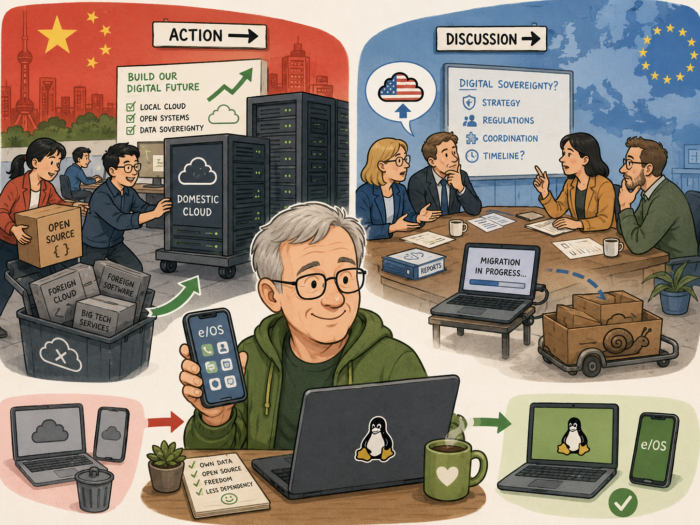
I recently went looking for a story I remembered reading about China replacing Windows with Linux. I could not find it at first, probably because I was searching for the wrong thing.
There is no single Chinese order saying that everybody has to throw Windows out. What China has been doing is much more interesting: step by step, it has been reducing its dependence on foreign technology, particularly within government organisations, state-owned companies and strategically important sectors.
The name that keeps coming up is Xinchuang, China’s programme to replace foreign technology with domestic alternatives (https://www.mof.gov.cn/jrttts/202312/t20231226_3924138.htm). That includes processors, databases, applications and operating systems. Chinese government procurement rules introduced in recent years increasingly require systems to meet domestic “safe and reliable” requirements. In practice, that has created much more room for operating systems such as Kylin and UnionTech UOS, both based on Linux.
And China has just taken another step. In August 2026, reports emerged (for example https://www.tomshardware.com/software/operating-systems/china-reportedly-orders-state-agencies-to-uninstall-its-government-only-edition-of-windows-10) that China’s Ministry of State Security had instructed some state-linked organisations to remove Windows 10 China Government Edition earlier than originally planned. This is important nuance: China has not banned Windows everywhere. The order concerns a special government version and a limited part of the Chinese market. Windows is still widely used by consumers and businesses.
Perhaps we should pay more attention to China
Still, I think the direction is interesting. Not because Europe should copy China’s political system or its approach to technology. Obviously not. But there is one thing China seems to understand very well: becoming extremely dependent on a handful of foreign technology companies is a strategic risk.
That is something Europe has been talking about for years. Digital sovereignty, strategic autonomy, European clouds, open source, sovereign AI. Plenty of conferences, reports and policy documents. But meanwhile we keep buying. And buying. And buying.
The numbers are rather impressive. A European Commission document published this year cites research estimating that European companies’ purchases of cloud software add around €264 billion annually to the US economy (https://eur-lex.europa.eu/legal-content/EN/TXT/?qid=1745691400115&uri=CELEX%3A52026SC0502&)
Then there is the price issue. Research commissioned by French CIO association Cigref found that European organisations saw cloud and software costs increase by an average 8.7 percent per year during the past three years. Some organisations experienced much larger increases when contracts were renewed. The same research expects average annual increases of around 12 percent during the coming five years. (https://www.cio-platform.nl/en/weblog/nieuws-extern-detailpagina/2026/07/02/rapidly-rising-cloud-and-software-costs-weigh-on-the-european-economy?)
That 8.7 percent figure is not specifically an “American cloud inflation rate”, so we should be careful with that. But combine rapidly increasing software and cloud prices with Europe’s enormous spending on predominantly American technology and it becomes clear that we are talking about very serious amounts of money. Digital sovereignty is therefore not just about geopolitics. It is also about economics.
I decided to start with myself
I have been gradually trying to reduce my own dependence on Big Tech. My laptop comes from a European company (Slimbook), although calling a computer completely European is almost impossible: the CPU and GPU in mine are from AMD. I use Linux as my operating system. Nearly all the software and cloud services I use are now European, open source, or both.
I came from a MacBook and an iPhone and switched to Linux Mint and Murena /e/OS, a de-Googled version of the open-source version of Android. And to be honest, it works differently in some ways, but certainly not worse.
So personally, I made the switch, and I’m perfectly happy with the result. The difficult part is often not my own technology. It is other people’s technology. Clients still invite me into SharePoint environments. People create WhatsApp groups and simply assume everybody uses WhatsApp. Publishing workflows are still often built around Adobe software. In those situations, digital independence suddenly becomes less of an individual decision. You are part of an ecosystem, and ecosystems are difficult to leave.
But migration costs money…
This is probably one of the biggest obstacles Europe faces as well. One argument I often hear is that replacing existing technology is expensive and risky. Of course it is. If an organisation has spent ten or twenty years building processes around Microsoft 365, Azure, AWS, Google Cloud or Adobe, you cannot simply switch everything off on Friday afternoon and start again with European alternatives on Monday morning. People have to be trained. Applications have to be migrated. Interfaces have to be rebuilt. Data needs to move. Some functionality may not have an equivalent. And some projects will undoubtedly go wrong.
So yes, reducing dependency costs money. But keeping the dependency has a cost too. And that part of the calculation seems to receive much less attention – even by business managers who consider themselves financially savvy. What happens if prices continue to rise by almost 9 percent every year? What happens if a supplier changes its licensing model? What happens if political relations deteriorate badly? And, perhaps the uncomfortable question: what happens if access itself becomes part of a geopolitical conflict?
Canada suddenly makes that question less theoretical
This is why I am watching the current trade conflict between Canada and the United States with some interest. See for example here: https://www.reuters.com/business/trump-time-teach-canada-you-cant-do-this-anymore-2026-08-26/?. Relations between two countries that have been extremely close economic partners for decades have deteriorated remarkably quickly. In August, the US imposed 50 percent tariffs on roughly $20 billion worth of Canadian goods, after which Canada announced matching retaliatory measures.
So far, this is a trade conflict involving physical goods and tariffs. I have seen no evidence that the US government intends to restrict Canadian access to Microsoft 365, Azure, AWS, Google Cloud or other American digital services. But it does raise an interesting question.
Could digital services eventually become economic or political leverage as well?
I don’t know. And that is precisely the problem.
For years we have treated cloud platforms, office software and other digital services almost as utilities. They are just there. We log in every morning and assume they will still be there tomorrow. China clearly doesn’t want to make that assumption. Europe shouldn’t either.
We don’t have to replace everything tomorrow. That would be unrealistic and probably counterproductive. But we could start doing exactly what China has been doing for years: identify dependencies, develop alternatives, change procurement policies and gradually move critical systems to technology over which we have more control. We do not need yet another conference about digital sovereignty. Not another declaration.
What we do need: start migrating. Because the best moment to reduce a dependency is probably while everything is still working.