
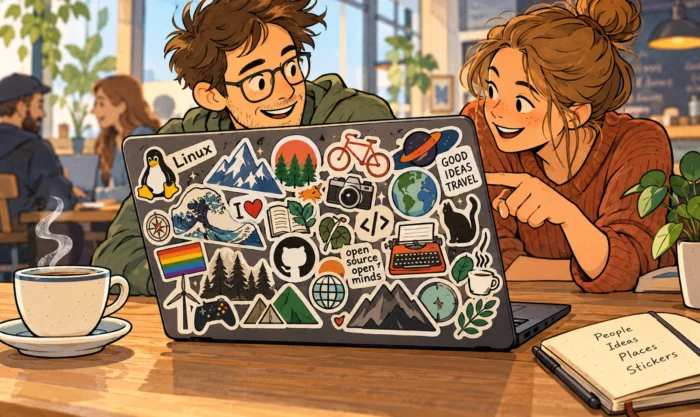
I keep coming across photos of laptops that are almost completely covered in stickers. Sometimes there are just a handful. Sometimes there are dozens, overlapping each other until you can barely recognise the laptop underneath. And I have to admit, I rather like them.
Recently, I came across this wonderful stickerbombed ThinkPad T480 (https://drkhsh.at/posts/2026/01/stickerbombed-thinkpad-t480/). It made me realise that there is something rather fascinating about people turning an ordinary laptop into what almost looks like a little piece of art.
I’m not talking about modifying gaming computers with colourful lighting, transparent cases or elaborate cooling systems. Just ordinary laptops. ThinkPads, MacBooks, Dell Latitudes and whatever else people happen to use. So I started looking into it. And as it turns out, there is quite a story behind those stickers.
This is nothing new
First of all, decorating laptops with stickers is hardly a recent invention. People have been doing it for decades. Long before Instagram, TikTok or the current fascination with personalising everything, programmers, hackers, students and other computer enthusiasts were already covering their laptops with stickers.
In the hacker community, particularly, stickers have been part of the culture for a very long time. Visit a hacker conference and you’ll probably find plenty of laptops advertising Linux distributions, programming languages, security tools, obscure projects and jokes that only a handful of people understand. Some stickers are collected at conferences. Others come from friends, open-source projects or organisations people support. And of course, there are those who simply think a particular sticker looks cool.
In an interesting Computer Weekly article (https://www.computerweekly.com/feature/A-sticky-story-How-and-why-hackers-love-stickers-on-laptops), several security professionals explain why stickers became so popular among hackers. One explanation caught my attention. When you’re a programmer, much of what you create is invisible to the outside world. Your work exists somewhere inside a computer. Stickers offer a way to make some of that otherwise invisible world visible. I like that explanation.
A little piece of your identity
But what exactly is stickerbombing? Is it an art form? A way of communicating? A personal statement? Or simply decoration? I think it’s a bit of everything.
There is certainly an artistic element to it. Some people carefully arrange stickers into beautiful compositions. Others deliberately overlap them, creating a colourful mess that somehow works surprisingly well. But I suspect that for many people, the stickers themselves are more important than the final composition. A sticker from a conference you attended five years ago. A band you used to listen to. A political statement. A programming language you particularly like. A cartoon that makes you laugh. A tiny logo from an open-source project you once contributed to.
Individually, these stickers might not mean much to a stranger. Together, however, they tell a story. In fact, I came across a fascinating project at the University of Zurich (https://dlf.uzh.ch/sites/laptopstickers/) where students documented people’s laptops and interviewed their owners about the stickers. What I particularly liked was that the researchers didn’t just look at the images. They wanted to understand why people had chosen those particular stickers and what they meant to them. Sometimes the answer was deeply personal. Sometimes political. Sometimes surprisingly ordinary. And sometimes people couldn’t really explain their choices at all. They just liked the sticker. Which, when you think about it, is a perfectly good reason.
A sticker that started a friendship
One of the nicest stories I found came from that same Zurich project. A student named Konstantin had a laptop covered with stickers, including several from a climbing gym in Baden, Switzerland, where he worked. Another student recognised the gym’s logo because he knew the place and had helped with its renovation and promotion. So he approached Konstantin and started talking. They soon discovered that they had quite a few friends and acquaintances in common. What began with a simple question about a sticker eventually led to them spending time together outside university.
A sticker on the back of a laptop helped two people discover a connection they might otherwise never have noticed. And I can relate to that. Last summer, while walking along a beach in the south of France wearing an old Nextcloud T-shirt, I was approached several times by complete strangers who recognised the logo. Before I knew it, we were standing there in 35-degree heat, talking about Nextcloud, open source and digital autonomy. I actually wrote about it in an episode of De Overstap on Computable.nl (https://www.computable.nl/2026/08/17/de-overstap-9-nextcloud-op-het-strand/; text in Dutch).
There’s another lovely detail in Konstantin’s story (https://dlf.uzh.ch/sites/laptopstickers/konstantin/). He originally started putting stickers on his laptop because a former flatmate had designed one. He wanted to show her that he appreciated her artwork. One sticker led to another. And another. Eventually, his laptop became a collection of little stories.
Sometimes all it takes is The Office
There’s a similar, if slightly less dramatic, story from the Netherlands. Wisang, a student at the University of Twente, wrote about his laptop stickers (https://www.utwente.nl/en/stories/student/612150/what-your-laptop-stickers-say-about-you/) and how they reflect the communities he belongs to, the music he likes and the places he’s visited. He describes his laptop as a kind of time capsule.
But he also explains that stickers can be excellent conversation starters. See someone with a sticker from a band you like? There’s an obvious reason to say hello. He even recalls talking to someone whose laptop featured a sticker from The Office. That led to a conversation about how the person had failed to finish a paper because they were too busy watching the series for the fifth time.
Not exactly a life-changing encounter of course. But that’s rather the point, isn’t it? We spend so much time communicating through screens that it’s quite refreshing to discover how something stuck on the outside of a screen can encourage people to talk to each other.
Your laptop as a personal time capsule
Another interesting aspect is how these collections develop over time. Some people start with a single sticker and gradually add more. Others deliberately cover every available square centimeter. And sometimes the stickers overlap because there simply isn’t any space left. I wonder how many people could still remember where every sticker came from. Perhaps they got one at their first technology conference. Another from a friend. A third from a project they once worked on. Years later, the laptop might be technically outdated, but its cover contains a small history of its owner’s life.
That also raises an interesting question. What happens when you replace the laptop? Do you start again with a clean surface? Try to peel off the old stickers? Or keep the old laptop because you can’t quite bring yourself to throw away all those memories?
In a Hackaday article about laptops and stickers (https://hackaday.com/2022/01/22/hackers-fingerprints-laptops-and-stickers/), Elliot Williams explores how unique these collections can become. He also makes an observation I particularly like: sometimes people have the same stickers because they gave them to each other. In other words, those little images can represent shared experiences and friendships. Not just individual identity, but a bit of collective history too.
There is even a museum for them
And then I discovered Stickertop.art (https://stickertop.art/). Yes, someone has created an online collection dedicated to laptop covers decorated with stickers. Which I think is a wonderful idea. After all, we preserve photographs, paintings, posters and countless other examples of personal creativity. Why not laptop lids?
A laptop covered with stickers is often a completely unique object. There might be thousands of identical ThinkPads in circulation, but probably only one with that particular combination of stickers arranged in exactly that way. And once the laptop disappears, that little collection disappears with it. Unless somebody takes a photograph.
Making something mass-produced your own
Perhaps what appeals to me most is the contrast between the way laptops are designed and the way some people choose to use them. Manufacturers spend enormous amounts of time making their products look sleek, professional and consistent. A ThinkPad is supposed to look like a ThinkPad. A MacBook is supposed to look like a MacBook. And then someone comes along with a handful of stickers and completely ignores all that carefully considered industrial design.
I find that rather charming. Especially because I like the idea of making technology your own. On Just Me, we talk a lot about personal computing, but much of the technology we use today is remarkably uniform. The same devices, the same operating systems, the same applications and increasingly the same online services. Of course, putting stickers on a laptop doesn’t change any of that technically. But it does change the relationship between the owner and the machine, at least a little. It becomes less anonymous. Less like just another product. More like something that belongs to a particular person.
And perhaps that is what stickerbombing really is. Not necessarily art, although it can be. Not necessarily a deliberate statement of identity, although it often is. And not necessarily an attempt to communicate with strangers, although apparently it sometimes works remarkably well. Maybe it’s simply a way of making an otherwise ordinary object a little more personal. One sticker at a time. And if one of those stickers happens to start a conversation, or even a friendship, that’s a rather nice bonus.