
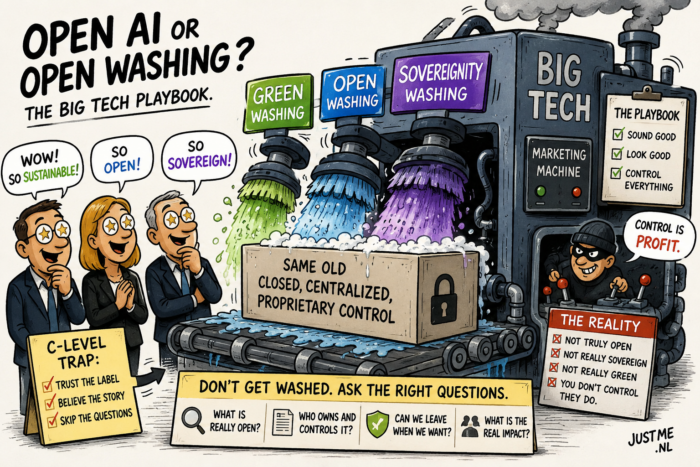
The technology industry has a long history of using attractive words to create a positive image. “Green”, “sustainable”, “responsible”, “sovereign” and now “open” are all terms that sound reassuring. But increasingly, these words are also becoming part of a familiar marketing strategy: make a product or service appear more independent, transparent or responsible than it really is.
We have seen this before with greenwashing. Companies present themselves as environmentally friendly while the reality behind their operations is often much more complex. A few sustainability initiatives or carefully chosen words can create the impression that a company is leading the way, even when the underlying business model has barely changed.
The same pattern is now appearing in other areas of technology. Open washing and sovereignty washing have become part of the same playbook.
Recently, I read an interesting article on Tech Policy Press titled “Open washing is everywhere in AI. Four criteria cut through it.” The author is J.J. Jasser, a professor and director of data analytics at Rollins College in Winter Park, Florida. His research examines artificial intelligence, open-source development, and digital literacy. He also contributes commentary on technology and digital literacy to the Orlando Sentinel.
Jasser explains how the word “open” is increasingly being used in artificial intelligence as a marketing term rather than as a clear technical description. The problem is that “open” can mean many different things. A company may release parts of an AI model, publish limited documentation or offer access through an interface, and then present the technology as open. But true openness requires much more: transparency about development, access to relevant information, the ability to inspect and adapt the technology, and meaningful freedom for users. As the author points out, companies often highlight the elements that support the “open” label while keeping important limitations less visible.
This is exactly why open washing deserves attention. The term creates a sense of trust and independence, while the actual level of openness may be far more limited. The same applies to digital sovereignty. In Europe, concerns about dependence on large technology providers have grown significantly. Organisations want more control over their data, infrastructure and AI capabilities. Big Tech companies have responded by introducing so-called sovereign cloud offerings and European cloud regions.
At first glance, this sounds like the solution Europe has been looking for. Data is stored in Europe, services are operated locally and the word “sovereign” appears prominently in the marketing material. But sovereignty is about much more than location. Who owns the technology? Who controls the software? Which laws apply? Where is the company based? Can customers realistically move away if circumstances change? These are the questions that matter.
Using a European data center does not automatically create digital sovereignty. Just as adding a green label does not automatically make a company sustainable, adding the word sovereign does not automatically create independence.
Unfortunately, many C-level executives still fall for these messages. Under pressure to make decisions about cloud, AI and digital transformation, it is tempting to rely on vendor promises and attractive terminology. But technology leaders need to look beyond the marketing language and examine the real level of control they have.
The lesson from the discussion around open AI is therefore much broader. Whether it is greenwashing, open washing or sovereignty washing, the mechanism is the same: take a concept with a strong positive meaning and use it to improve perception.
The answer is not to reject everything Big Tech offers. Many of these technologies are valuable and play an important role in modern organisations. But companies need to ask harder questions and demand more transparency. Because in the end, words like “open”, “green” and “sovereign” only matter when they are backed by reality. A label is easy to create. Genuine openness, sustainability and independence are much harder to achieve.