
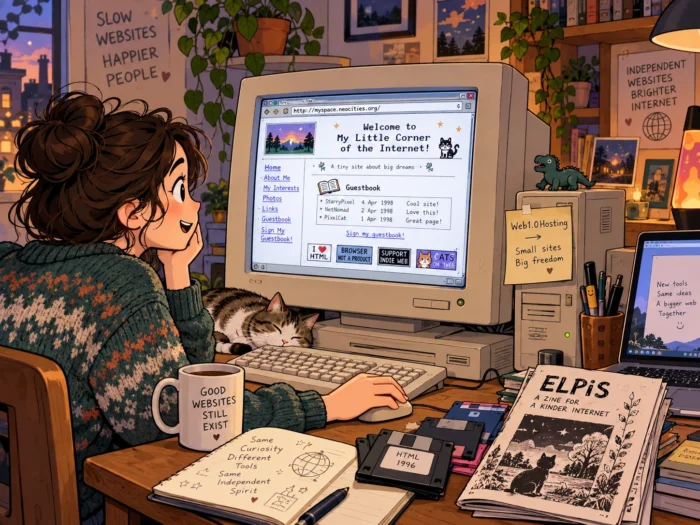
Imagine switching on a thirty-year-old computer, connecting it to the internet, and discovering that you can still create a website, read an online magazine, sign someone’s guestbook, or chat with other people. Not by visiting an archive of long-forgotten websites, but by using services that people are actively developing today. Why would anyone build something like that in 2026?
That was my first thought when I started exploring Web1.0Hosting (https://web1.0hosting.net/). It is a hosting service designed specifically to make websites accessible from old computers, operating systems, palmtops, and even mobile phones from a time when smartphones didn’t exist. You can use it with modern equipment too, of course. But the fascinating part is that modern equipment isn’t a requirement.
The service provides free hosting space, simple tools for building websites, webmail, chat, guestbooks, and other features that were once perfectly ordinary parts of the internet. It even supports WAP, the technology that allowed early mobile phones to access simplified online services (https://en.wikipedia.org/wiki/Wireless_Application_Protocol). And this isn’t just some experimental project with three websites maintained by a handful of nostalgic computer enthusiasts. At the time of writing, Web1.0Hosting reports hosting more than 2000 websites.
I find that quite remarkable. Here we are, living in an age of artificial intelligence, increasingly sophisticated web applications, enormous cloud platforms, and websites that sometimes seem to require a small supercomputer just to display a few paragraphs of text. Meanwhile, someone is deliberately building a hosting service that works on a computer from 1995.
But the more I explored, the more I realised that this isn’t really a story about old computers.
An online magazine that doesn’t believe in endless upgrades
One of the projects associated with Web1.0Hosting is ELPiS Magazine (http://elpis.ws/), a small digital publication devoted to Web 1.0, the small web, the indie web, and other interesting corners of the internet. ELPiS published its first issue in October 2024 and has since developed into a continuing publication. The magazine looks refreshingly old-fashioned, with a simple layout, straightforward navigation, and pages that work on old as well as modern computers.
What caught my attention was the philosophy behind the magazine. Its creator explains that technological development doesn’t necessarily have to mean constantly upgrading software, replacing hardware, or adding more complexity. Instead, people should be able to choose the technologies that actually work for them, rather than simply accepting whatever the technology industry decides they ought to use.
It’s a rather different way of thinking about technological progress. Usually, we discuss technology in terms of what comes next: faster processors, more capable AI systems, new software platforms, and additional functionality. We rarely ask whether we actually need all those improvements. ELPiS raises that question without suggesting that everyone should abandon modern technology and retreat to an old computer in the attic.
There is another aspect of this magazine that I particularly like. In issue eight (https://elpis.ws/cgi-bin/cms/zine_may_25), the creator explains that there is no real editorial plan. Articles appear because someone feels the need to write them. The magazine doesn’t seem particularly concerned with publishing schedules, audience growth, or turning every article into a commercial opportunity.
I recognise something of my own approach to Just Me in that. I started this blog because I enjoy writing about things I discover and find fascinating. Whether a post attracts five readers or five hundred isn’t really the point. Writing it, exploring the subject, and perhaps sharing something interesting with another person is already rewarding. And apparently, there are more people who think that way.
The return of the handmade website
Following the links from ELPiS and Web1.0Hosting leads to a surprisingly lively world of people building their own websites. There is Neocities (https://neocities.org/), for example, where people create personal websites, often using relatively simple HTML and CSS. And there is Nekoweb (https://nekoweb.org/), another platform that encourages people to build and customise their own little pieces of the internet.
Some of these websites look as though they have travelled directly from 1997. Colourful backgrounds, animated GIFs, tiny buttons, strange navigation menus, and pages devoted to subjects that would probably never survive a professional website design meeting. Others are surprisingly elegant, minimalist, and modern. What they have in common is that their creators appear to enjoy the process of making something themselves.
A website can be about someone’s favourite computer game, a collection of photographs, an obscure musical genre, a fictional world, or absolutely nothing in particular. It doesn’t have to attract visitors, generate advertising revenue, or become part of a larger business. And it certainly doesn’t have to please an algorithm.
Something else caught my attention here. On 24 October 2026, a new magazine called INDIEWEB (https://indieweb.nekoweb.org/articles/welcome-to-indieweb/) published its first article. It is devoted to what the editors call the hand-built web. They explain that they kept discovering wonderful personal websites but didn’t have a good place to share them. So they created their own publication.
The magazine celebrates the sort of things that have largely disappeared from mainstream web culture: hand-coded pages, guestbooks, webrings, pixel art, and those tiny 88×31-pixel buttons people once used to link to their favourite websites. It even has an edition that readers can browse online or print and turn into a physical zine.
That last detail made me smile, because I’ve recently been exploring the world of zines (https://en.wikipedia.org/wiki/Zine) myself. Small, independently produced publications are still very much alive, and apparently the people rediscovering the handmade web are also rediscovering ways of publishing that existed long before the internet.
These worlds seem to overlap quite naturally. Both are about making something yourself, sharing it with others, and finding satisfaction in the process rather than measuring success in terms of audience size or commercial potential.
Sometimes an old protocol is enough
The deeper I went into this world, the more familiar names I encountered. For example, ELPiS publishes articles about Gopher (https://gopher.floodgap.com/), the internet protocol that predates the widespread popularity of the World Wide Web. I’ve written about Gopher before on Just Me, partly because I find it fascinating that people are still actively using and maintaining such a simple system for distributing information.
There is also Gemini (https://geminiprotocol.net/), a much newer protocol designed to provide a deliberately lightweight alternative to the complexity of the modern web. Gemini isn’t intended to replace everything the web can do. It focuses on something much simpler: reading, publishing, and navigating information without the enormous technical machinery that often accompanies modern websites. I’ve explored Gemini on Just Me as well (for example here: https://justme.website/tech/there-is-more-to-the-internet-than-the-web/).
Gopher and Gemini aren’t identical, and neither is simply an attempt to recreate the internet of the 1990s. But both demonstrate something interesting. You don’t necessarily need JavaScript frameworks, elaborate user interfaces, tracking systems, or enormous software platforms to share information with other people. Sometimes a document and a link are sufficient.
Of course, that simplicity has limitations. There are excellent reasons why today’s web supports rich applications, interactive services, accessibility features, and multimedia experiences. Nobody seriously needs to suggest that we should give all of that up. But perhaps we have become so accustomed to increasing complexity that we’ve stopped questioning whether it is always necessary. Why should a page containing a thousand words of text need so much technology?
And then Yggdrasil appears
One of the more unexpected details of Web1.0Hosting is that websites hosted on the service are also published through Yggdrasil (https://yggdrasil-network.github.io/). That was a familiar name. I’ve already written about Yggdrasil on Just Me, and I certainly didn’t expect to encounter it again while exploring websites designed for thirty-year-old computers (for more on Yggdrasil, see here: https://justme.website/tech/what-if-your-friends-were-your-cloud/).
Yggdrasil is an experimental decentralised networking project. It allows computers to connect through an encrypted, peer-to-peer routing system. The project explores ways of building networks that don’t depend on the same centralised routing structures we generally associate with the internet. It is important to distinguish this from anonymity networks such as Tor. Yggdrasil isn’t designed to guarantee anonymity. Its primary focus is decentralised networking and routing.
Now consider what Web1.0Hosting is doing. On the one hand, it supports browsers and devices from the 1990s. On the other, it makes websites accessible through an experimental decentralised network. Old and new technologies, working together.
I think that’s a particularly revealing combination. These people aren’t necessarily trying to return to the past. They are quite happy to experiment with new technology. They just don’t accept that new technology must automatically replace everything that came before it. They are choosing which technologies make sense for the things they want to do.
And that, I suspect, is the more important story here.
Perhaps this is about changing our expectations
The more I explore these projects, the more I get the impression that something broader is happening. Not necessarily a large, organised movement and certainly not a revolution. The people building personal websites, publishing small magazines, experimenting with alternative internet protocols, and keeping old computers online have different interests and motivations. Some are motivated by nostalgia. Others enjoy the technical challenge. Some care about privacy, independence, accessibility, or reducing the resources needed to run digital services. And some simply enjoy making things. But many of their activities point towards a similar idea.
At the same time, people are beginning to reconsider not just which digital technologies they use, but what they expect those technologies to do in the first place.
We have become accustomed to the idea that digital services should continually grow. More features, more users, more automation, more personalisation, more integration, more engagement. A personal website should become a professional publication. A small community should grow into a platform. A useful application should acquire dozens of additional features. And sooner or later, almost everything is expected to become a business.
But what if someone doesn’t want any of that? What if a website with twenty regular visitors is exactly what its creator wants? What if a digital magazine doesn’t need a publishing strategy? What if someone prefers a simple text-based service because it does precisely what they need? Or what if an old computer is still useful and enjoyable, even though the technology industry stopped supporting it twenty years ago?
I find those questions increasingly interesting. They also connect with other things I’ve been exploring on Just Me. Communities built around personal websites rather than social media platforms. People exchanging zines simply because they enjoy sharing their ideas. Alternative ways of discovering interesting websites without relying on recommendation algorithms. Even people deliberately choosing devices and applications that do less rather than more. Individually, these may seem like unrelated hobbies or technical experiments. Taken together, they suggest a different relationship with digital technology.
Smaller doesn’t necessarily mean worse
There is a temptation to romanticise the early internet. I occasionally fall into that trap myself. But the internet of the 1990s wasn’t some perfect digital paradise. Connections were slow, websites were frequently broken, finding information could be difficult, and many services were inaccessible or frustrating to use. And let’s not pretend that every personal website was a masterpiece of thoughtful design. Some were practically impossible to read.
Today’s web has brought enormous improvements, and I wouldn’t want to lose them. Nor does a simple website automatically mean a more accessible, secure, or privacy-friendly website. Those things still require careful decisions.
What interests me is something else. The people behind these projects seem unwilling to accept that technological progress can only move in one direction. They are experimenting with the possibility that less functionality might sometimes be enough, that small communities can be perfectly satisfying, and that older technologies can remain valuable alongside newer ones. Perhaps a website doesn’t need to do everything. Perhaps it doesn’t need to grow. Perhaps it doesn’t even need an audience. And perhaps the freedom to make those decisions is a form of digital autonomy that deserves more attention.
The internet is still (once again?) a place to experiment
I started this little exploration wondering why anyone would build a hosting service for computers from the 1990s. I’ve ended up thinking about something much bigger. We talk a great deal about digital autonomy in terms of governments, cloud providers, infrastructure, legislation, and the dominance of large technology companies. Those are important discussions, and I follow them closely in my professional work.
But there is also a much more personal version of digital autonomy. It is the freedom to build a website that looks exactly the way you want it to look. To publish something without worrying about how many people will read it. To continue using a piece of technology because you like it, rather than replacing it because someone has decided it is obsolete. And to experiment with ideas that might never become commercially successful or technologically fashionable.
I don’t know whether the small web will grow into something much bigger. Perhaps it will always remain a collection of relatively small communities, maintained by people who enjoy doing things differently. That would be perfectly fine too. In fact, I suspect many of them would prefer it that way. After all, not everything on the internet needs to become the next big thing. Sometimes a small website is all you need.
(And for those wondering who the young woman in the illustration accompanying this blog post is… Yes, that’s Mara! She’ll be back this weekend with another blog post of her own here on Just Me.)