
I stumbled upon a website the other day that I hadn’t thought about in years: Bookcrossing (https://www.bookcrossing.com/). Remember BookCrossing? The idea is wonderfully simple. You take a book you’ve finished reading, register it on the website, and leave it somewhere for a complete stranger to find. That might be a park bench, a café, a train station, or wherever you think someone might come across it. Inside the book is a unique identification number. If the person who finds it visits BookCrossing and enters that number, they can leave a message. Perhaps they’ll tell you where they found it, whether they enjoyed reading it, or where they plan to leave it next. And so the book continues its journey.
I remember the idea from years ago. But I had absolutely no idea that BookCrossing was still around. It turns out that it is. Very much so.
More than twenty years of books travelling around the world
BookCrossing started in 2001, which means it has been around for a quarter of a century. Just think about that for a moment. Facebook didn’t exist. Twitter didn’t exist. YouTube didn’t exist. Smartphones, at least as we know them today, were still years away. Yet people were already using the internet to connect complete strangers through something as ordinary as a paperback. And they’re still doing it.
BookCrossing has attracted more than a million registered members over the years, and books are still being released into the wild. There are dedicated BookCrossing locations, local meetups, online discussions, and people who have been participating for decades. Of course, that doesn’t necessarily mean BookCrossing is experiencing some huge revival. It may simply be a community that never really went away.
I actually like that possibility even more. Not everything on the internet needs to grow exponentially. Sometimes, an idea is simply good enough to keep people interested for twenty-five years.
There’s something wonderful about not knowing what happens next
The part of BookCrossing that appeals to me most isn’t necessarily the book itself. It’s the uncertainty. You leave a book somewhere, and that’s it. You have no idea who might find it. Perhaps a student picks it up on the way to university. Perhaps a tourist takes it home to another country. Perhaps it ends up on a bookshelf for ten years before someone decides to release it again. Or perhaps nobody ever registers it. That’s fine too.
For me, the interesting thing is that you’ve put something into the world without knowing who will receive it or what they’ll do with it. No followers. No likes. No algorithm carefully selecting an audience for you. Just a book and a stranger. And, with a little luck, a story that continues.
Then there’s Postcrossing
While looking into BookCrossing, I came across another project that follows a remarkably similar idea: Postcrossing (https://www.postcrossing.com/). This one started in 2005 and revolves around postcards. You sign up, request an address, and send a real postcard to a randomly selected participant somewhere in the world. When your postcard arrives and gets registered, you become eligible to receive a postcard from another random participant. It’s such a simple concept. And yet millions upon millions of postcards have travelled around the world because of it.
What fascinates me is that the internet is only part of the process. The website helps people find each other, keeps track of the postcards, and makes the whole thing possible. But the actual experience happens away from the screen. Someone chooses a postcard, writes a few words, attaches a stamp, and drops it into a mailbox. Days or weeks later, somebody else discovers it among their regular mail. I can easily imagine the pleasure of opening your mailbox and finding a postcard from a stranger in Japan, Brazil, or Finland. Not because you bought something. Not because somebody wants to sell you something. Just because another person somewhere in the world decided to send you a postcard.
People are doing similar things digitally
Naturally, I started wondering whether people had come up with digital versions of these ideas. And of course they have. Take Bottled (https://www.bottledapp.com/), for example. It’s essentially a digital version of putting a message in a bottle and throwing it into the sea. You write a message, place it in a virtual bottle, and send it on its way. A random stranger receives it and can decide whether to keep it and start a conversation or let it continue its journey.
Then there’s Slowly (https://slowly.app/), an app that brings back the idea of pen pals. You write digital letters to people around the world, but there’s a twist: delivery takes time. The farther away the recipient lives, the longer your letter takes to arrive. Which is slightly ridiculous when you think about it. We’re deliberately slowing down technology that could deliver a message in milliseconds. But that’s exactly the point. Not every digital interaction needs to happen instantly. Sometimes waiting is part of the fun.
These projects aren’t identical to BookCrossing or Postcrossing, of course. They have their own rules and communities. But there’s a common thread. They use technology to introduce a little unpredictability into our lives. To connect people who otherwise wouldn’t have met. To make receiving something from a stranger feel like a small event.
And that got me thinking.
What if we did this with digital content?
Here’s an idea I can’t seem to get out of my head. Why couldn’t we do something similar with blog posts? Or essays, short stories, photographs, little digital magazines, or whatever else people create and publish online?
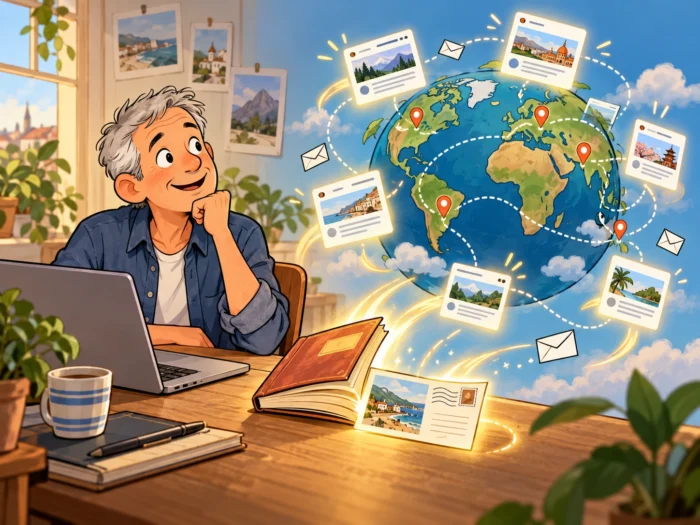
Imagine writing a blog post and registering it with something we might call DigitalCrossing. You publish your article on your own website, just as you normally would. The content stays there. Nothing needs to be uploaded to another platform. But you also give that article a unique identification number and release it into the digital wild. Somewhere in the world, another participating blogger or reader receives a link to your article. Not because they follow you. Not because an algorithm has decided your interests are similar. And certainly not because you’ve paid to reach them. They receive it simply because someone has released it into the wild.
Perhaps they read it. Perhaps they leave a comment. Perhaps they discover that they really like your writing and decide to explore the rest of your website. And then they have a choice. They can keep the link, ignore it, or pass it along to another randomly selected participant. Just like a BookCrossing book.
Imagine following the journey of your blog post
This is where it gets really interesting. Suppose I publish an article here on Just Me about one of my experiments with Linux or some obscure corner of the internet. I register the post with DigitalCrossing and release it. The first person to receive it lives in Finland. They read it, leave a short message, and pass it along. Next, it arrives in Brazil. The Brazilian reader happens to know somebody in Japan who might enjoy the article, so they send it there. That person forwards it to someone in Canada. And suddenly, my little blog post has travelled around the world.
I could visit a page showing its journey. Not a dashboard full of impressions, engagement rates, conversion funnels, and all the other stuff that seems to dominate the modern internet. Just a simple record of where my article has been and, if people choose to leave them, a few comments from the people who encountered it.
Of course, it wouldn’t really be tracking every visit. It would record the people who voluntarily acknowledge receiving and passing along the article. That’s perfectly fine. BookCrossing doesn’t know about every person who picks up a book either. The gaps are part of the story.
This could actually be quite simple
The more I think about it, the less complicated it seems. You’d need a website where people can register their own content, a way to assign unique IDs, a mechanism for randomly passing links between participating users, and a simple page showing where each item has travelled. That’s basically it.
And there’s no reason it would have to become another giant social platform. In fact, I’d prefer it didn’t. The whole thing could be built around RSS, links, and perhaps Webmentions to allow participating websites to communicate with each other. You wouldn’t need to copy anyone’s content or store everybody’s articles in one central database. The original piece would remain on its creator’s website. And perhaps individual bloggers could run their own little DigitalCrossing nodes, connected to others.
It would take some work to build something reliable and prevent spam and abuse, obviously. People would also need control over what they receive and whether their participation is visible. But the basic concept doesn’t seem particularly difficult to implement. Especially now that AI-assisted coding makes it easier for people like me to experiment with software ideas without having to become professional developers first. And experimenting with ideas like this is something I enjoy doing anyway.
Not another recommendation engine
There’s one thing I would absolutely want to avoid. I wouldn’t want DigitalCrossing to become a recommendation engine. We already have plenty of those. You read about Linux? Here’s more Linux. You like photography? Here’s another photography blog. You follow someone who writes about retro computers? Here’s a list of other retro-computing enthusiasts. There’s nothing necessarily wrong with that. But it tends to give us more of what we already know.
One of the lovely things about BookCrossing is that you might find a book you would never have chosen for yourself. Maybe you’re interested in technology, but the book you discover on a train is about gardening in the nineteenth century. You pick it up anyway. And who knows? Perhaps you enjoy it.
I’d want DigitalCrossing to work in much the same way. Someone who normally reads about cooking might receive one of my posts about a strange Linux experiment. I might receive a beautifully written story about somebody restoring an old boat in Norway. Would I ever have searched for that? Probably not. Would I read it? Quite possibly. And that’s what makes the idea interesting to me.
Perhaps we should let our content go travelling
I don’t know whether somebody has already built exactly what I’m describing. I’ve found several projects that do parts of it, but not a well-established community where digital content travels from person to person in quite the same way as a BookCrossing book. Maybe it exists somewhere in a forgotten corner of the internet. And perhaps I’ll stumble across it one day.
But if it doesn’t, I think it would be a fun thing to build. Not as a business. Not as a new social network. And certainly not as yet another way to maximise traffic to our websites. Just as a small experiment in connecting people and helping them discover things they weren’t looking for. After all, isn’t that one of the reasons many of us fell in love with the internet in the first place?
BookCrossing has been sending physical books around the world since 2001. Postcrossing has been doing something similar with postcards since 2005. Maybe it’s time we gave our blog posts the same opportunity. Write something. Release it into the wild. See where it goes. I rather like that idea.