
Over the past few months, I have become increasingly interested in collecting images. Not necessarily beautiful photographs or illustrations, but also screenshots of websites, unusual interfaces, old software, experimental devices and all kinds of visual discoveries I come across while wandering around the internet.
At first, I thought of these images mainly as things worth keeping. A screenshot might help me remember an interesting website. A photograph could be useful for a future article. An unusual illustration might inspire an idea. But recently, I have started wondering whether these collections could serve another purpose entirely. What if collecting images could become a way of researching the world? What if photographs, screenshots and illustrations could help us identify developments before we even have the words to describe them?
That question became even more interesting when I discovered the website of designer Christopher Butler (https://www.chrbutler.com/).
Thinking with pictures
Butler has an interesting habit. He collects photographs, illustrations, historical images, designs and other visual material, arranging them into extensive collections he calls mood boards. Some focus on machines, others on displays, artificial beings, architecture or imagined futures. His mood board archive (https://www.chrbutler.com/archives?category=mood-board) is worth exploring. Not because every collection necessarily tells a clearly defined story, but because the images begin to interact with one another. An old computer interface might appear alongside a contemporary experimental device. A science fiction illustration from decades ago might resemble something an engineer is developing today. Photographs of industrial machinery, consumer electronics and futuristic architecture might share a visual language that is difficult to describe but immediately recognisable.
In his essay Why I Make Mood Boards (https://www.chrbutler.com/why-i-make-mood-boards), Butler describes how these collections often begin with a single image. Something catches his attention, he starts a folder and gradually adds more material. Sometimes the collection develops over many months before it becomes clear what the images have in common.
That is the part I find particularly interesting. Butler is not necessarily looking for pictures to illustrate an idea he already has. The pictures themselves help him develop the idea. This reverses the usual relationship between research and illustration. Instead of writing something and subsequently finding suitable images, you begin with images and allow them to suggest what might be worth writing about. Of course, not every visual resemblance represents a meaningful development. But a collection can reveal patterns that deserve further investigation.
My adventures with screenshots
This reminded me of my earlier explorations of screenshots. I have written on Just Me about the surprising possibilities of collecting screenshots, including the people and tools associated with Screenshot Conf (https://justme.website/content-creation/i-went-looking-at-a-conference-about-screenshots-about-what-and-found-a-filesystem-for-browser-tabs/). What initially fascinated me was the idea that a screenshot apparently could be more than a convenient way to remember what appeared on a computer screen.
It is a way to capture information, and with tools like NormCap (https://dynobo.github.io/normcap/), you can easily extract that information from the image. A screenshot can also preserve a moment in the history of the web. It can document an interface that may disappear tomorrow, capture an unusual design decision or preserve a small piece of internet culture that would otherwise be forgotten. Think about the enormous variety of personal websites, experimental web applications, digital art projects and unusual interfaces scattered across the internet. Many of them are temporary. Their creators redesign them, move to another platform or simply stop maintaining them. A screenshot allows us to preserve something of their appearance, even when the original website eventually disappears.
But collecting screenshots raises another possibility. What happens when you begin comparing them? Imagine having hundreds of screenshots of personal websites collected over several years. Perhaps you would notice that certain design elements keep returning. Hand-drawn navigation, colourful backgrounds, animated GIFs, dense pages filled with text or interfaces that deliberately reject the conventions of modern web design. Individually, these might look like isolated experiments. Together, they could suggest a renewed interest in more personal, unconventional forms of web design.
That would not automatically prove the existence of a trend. After all, the screenshots reflect what I personally found interesting enough to save. But they could provide an excellent starting point for investigating one. This is where the idea of screenshots as a form of visual research becomes particularly appealing to me. Instead of treating them as souvenirs from my travels around the internet, I could start treating them as observations. And observations become much more interesting when you can compare them.
Then came Beeldvinder
My interest in collecting photographs eventually led to another experiment. I asked Claude to help me build a small application called Beeldvinder, which is Dutch for something like Image Finder. The idea was simple: I wanted a better way to explore the photographs and illustrations stored on my own SSD. Beeldvinder can search for images using keywords, but it can also do something I find much more interesting. I can give it an example photograph, and it searches my collection for visually similar images.
The software runs locally on my Linux laptop. I don’t need to upload my photographs to an external service, and the collection remains under my own control. Considering the specifications of my laptop, I have also been pleasantly surprised by how quickly it finds relevant pictures. I may move it to my hosted Nextcloud environment, though. That’s partly because I’m considering dusting off my so-called “hobby laptop” again. It’s a very cool ThinkPad, and I’d love to start using it for creative tools like Processing (https://processing.org/). I’d also like to keep my work and hobbies a little more separate. Some of my hobby projects involve experimenting with tools I’ve built myself, and I’d rather minimise the risk of one of those experiments accidentally wreaking havoc on my work environment.
Back to Beeldvinder. Initially, it was simply a practical solution to a familiar problem. Over the years, I have collected so many images that finding a particular photograph can become surprisingly difficult. Searching by filename is often useless, especially when images have names such as IMG_4837.jpg or screenshot_2026-10-14.png. But the visual search functionality introduced a different way of exploring my collection. I no longer needed to remember where an image was stored or how I had described it. I could simply show Beeldvinder an example and ask it to find pictures that looked similar.
And that made me wonder: what if the next step isn’t finding images, but discovering relationships between them?
From image search to visual discovery
Suppose I have collected photographs of homemade synthesizers, cyberdecks, experimental handheld computers and unusual electronic instruments. These are different categories of devices, and I might have stored them in completely separate folders. Yet they could share certain characteristics: visible electronic components, physical switches, modular construction, small displays or enclosures made with 3D printers. A visual search system might bring some of these images together, even though I never thought of them as belonging to the same collection.
That could lead to an interesting question. Are we seeing a growing interest in devices that are deliberately understandable, repairable and limited to a specific purpose? Are some makers moving away from the sealed, multifunctional products that dominate consumer electronics? Perhaps. But I would need to investigate before drawing that conclusion. The important thing is that the images could suggest a question I might otherwise never have asked. This is also where Beeldvinder could eventually develop into something more than a search tool. Imagine an application that periodically examines your image archive and identifies unexpected similarities between photographs collected months or years apart.
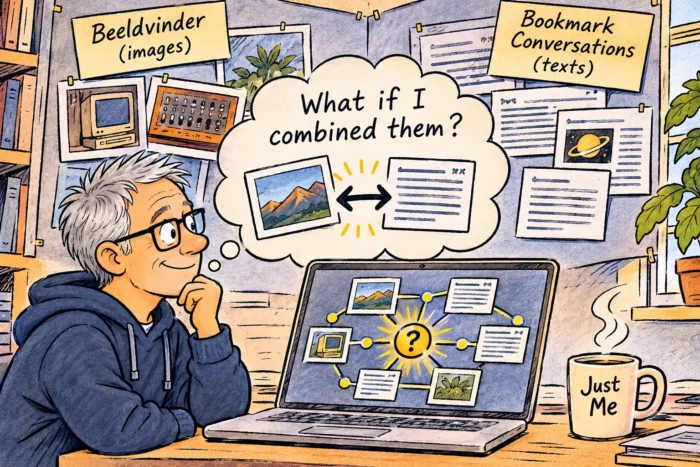
Another experiment of mine is Bookmark Conversations (https://justme.website/content-creation/read-later-more-like-read-never-so-i-built-bookmark-conversations/), a tool I built to explore the connections between articles, websites and other information I’ve saved in my Obsidian vault. In a way, I’m doing something very similar to what I’m experimenting with in Beeldvinder, except that Bookmark Conversations works with text and bookmarks rather than images.
The underlying idea is the same: over time, we collect enormous amounts of interesting material, but rarely revisit it or discover how different pieces might relate to one another. Bookmark Conversations automatically examines my saved material, looks for unexpected connections and presents its discoveries without me having to search for them. Ideally, it helps me rediscover forgotten information and notice relationships I might never have thought of myself. There’s just one small problem: it hasn’t discovered a single new connection in over a week, so I’m beginning to wonder whether it’s still working properly. But that’s a story for another blog post.
Beeldvinder might notice that several screenshots of independent websites share a particular approach to navigation. Or that a collection of contemporary DIY electronics projects resembles industrial equipment from the 1970s. Instead of simply presenting search results, it could suggest possible connections. Something like: These images appear to share certain visual characteristics. Have you noticed? That would turn a personal image archive into something resembling a visual discovery engine.
To be clear, Beeldvinder doesn’t currently do all this. It searches for images using text and visual similarity. The idea of automatically identifying and interpreting unexpected connections would be a possible future experiment. But Christopher Butler’s mood boards have made me think about what such an experiment could look like.
Visual research isn’t limited to technology
Butler is certainly not the only person exploring the possibilities of visual collections. Similar approaches can be found in art, design, cultural history and personal publishing. One interesting example comes from Brazil. The CASCA Archive (https://casca-archive.org/), created by designer Victor Yves, collects examples of graphic design and visual culture from northeastern Brazil. Its material includes posters, record sleeves, packaging, book covers, woodcuts and examples of cordel, the region’s tradition of inexpensive illustrated booklets.
What makes this project interesting is the way individual objects become part of a much larger visual story. A single record sleeve might attract attention because of its typography or illustration. But when you bring together hundreds of record sleeves, posters, printed advertisements and other everyday objects, recurring styles and influences may become visible.
The archive helps document a regional visual culture that might otherwise remain scattered across private collections and forgotten publications. CASCA is primarily concerned with cultural history rather than predicting future developments. Nevertheless, the underlying principle is closely related to Butler’s work: bringing images together can reveal relationships that are difficult to recognise when you examine them individually.
Another perspective comes from Eastern Europe, where artists and designers have used visual diaries and personal blogs to document their creative processes. The New East Digital Archive published a collection of examples under the title Everyday Visions: Ten Must-See Blogs by New Female Creatives (https://www.new-east-archive.org/features/show/3463Masha/blogs-female-Russian-designers-artists-filmmakers-photographers). Among the featured projects was Cassiopeia, established by Irina Kikina and Maria Gribova, which combined visual art and textile design. Other artists shared sketches, experimental photography, unfinished work and fragments of their everyday visual surroundings.
These collections are different from Butler’s mood boards. They are often closer to creative diaries than systematic investigations. But they demonstrate another important possibility: images can reveal how someone thinks, experiments and develops ideas without requiring a detailed written explanation. A sketch, a photograph and a reference image placed next to one another can sometimes communicate a creative process more effectively than several paragraphs of text.
The difference between collecting and researching
There is, however, an important distinction between a folder full of pictures and a visual research project. Collecting is relatively easy. Most of us do it almost automatically. We save photographs, take screenshots, bookmark illustrations and download images that catch our attention. Research begins when we start asking questions about what we have collected. Why do certain visual elements keep appearing? Are these similarities connected, or merely coincidental? Did one designer influence another? Are we looking at a historical pattern, a contemporary development or simply the preferences of the person who assembled the collection?
If I collect hundreds of photographs of homemade electronics, I am likely to discover recurring characteristics of homemade electronics. That doesn’t necessarily mean those characteristics are becoming more popular across society. Likewise, if Butler collects images that reflect a particular vision of the future, the resulting mood board may tell us as much about his interests as about the direction technology is actually taking.
That doesn’t make the collection less valuable. It simply means we should distinguish between discovering a possible pattern and demonstrating that the pattern represents a wider development. A visual collection can be an excellent starting point for research. It cannot automatically replace research. It also helps to preserve information about the images themselves. Who created them? When? Where were they originally published? What was their original purpose? Without that context, it becomes much easier to draw misleading conclusions from images that happen to look alike.
Could AI become a visual research assistant?
This is where the combination of image collections and AI becomes particularly interesting. Modern computer vision systems can compare images using much more than filenames or manually assigned keywords. They can identify visual characteristics, recognise objects and, depending on the technology, compare images according to their semantic content. Researchers at the University of São Paulo have explored related possibilities through the Meta-Acervos project, which uses computer vision to investigate visual relationships between artworks in Brazilian collections. The university published an article about the project here: https://jornal.usp.br/universidade/navegador-usa-inteligencia-artificial-para-pesquisa-visual-em-diferentes-colecoes-de-arte/.
What interests me is the possibility of applying similar techniques to the much less formal collections that people maintain on their own computers. Imagine combining a tool such as Beeldvinder with a system that can examine groups of visually related images and suggest possible interpretations. It might discover that photographs of homemade electronic instruments from different countries share particular design elements. It could identify recurring patterns in screenshots of independent websites or suggest unexpected relationships between old computer interfaces and contemporary software.
Of course, AI can make mistakes here, too. Visual resemblance doesn’t automatically imply historical influence, cultural significance or a genuine trend. And an AI-generated interpretation is still a hypothesis that needs to be checked. But that is precisely why I find the idea appealing. I wouldn’t necessarily want a computer to tell me what my image collection means. I would much rather have it point out something unexpected and invite me to investigate.
In a way, that would resemble what I have been experimenting with in my Bookmark Conversations project, where software examines saved bookmarks and tries to identify connections I might not have noticed myself. One project explores relationships between things I have read or bookmarked. Another could explore relationships between things I have seen. Both are attempts to make personal collections more useful by allowing them to surprise their owner.
Perhaps a blog doesn’t always need words
There is another aspect of Butler’s website that I particularly like. He publishes his mood boards on his own website, alongside essays, notes and other material. The visual collections are not merely illustrations accompanying written articles. They are publications in their own right.
That raises an interesting question about personal websites. Why do we automatically assume that a blog post should consist mainly of text? Of course, I enjoy writing. Just Me is largely a collection of written observations and experiments. But a visual essay could be equally interesting. Imagine a post consisting of fifty screenshots showing how independent websites have evolved over the past few years. Or a collection of photographs documenting the extraordinary variety of homemade electronic devices. Or a visual comparison of computer interfaces from different decades. A short introduction could explain what the collection is about, while the images themselves provide most of the material. Visitors could explore the relationships, notice details and perhaps arrive at interpretations different from those of the person who assembled the collection.
There is something rather appealing about that. On social media, images tend to disappear into an endless stream. On a personal website, a carefully assembled collection can have a permanent address, a clear subject and a context that remains under the creator’s control. It can also grow over time. New images can be added, connections can be revised and a collection can gradually become a visual record of an evolving idea.
Of course, publishing collections of other people’s photographs and illustrations raises questions about copyright and attribution. A personal archive and a public visual essay are not quite the same thing. But screenshots of one’s own experiments, original photographs, openly licensed material and appropriately authorised images already offer plenty of possibilities.
Maybe I’ve been collecting research material all along
Looking back, I find it amusing how these different experiments have started to connect. My interest in screenshots began with the simple observation that they can preserve interesting fragments of the internet. Beeldvinder emerged because I wanted a better way to search through the photographs and illustrations stored on my SSD. My experiments with Bookmark Conversations grew from the idea that saved information becomes more valuable when software can help uncover unexpected relationships. And now Christopher Butler’s mood boards have introduced another possibility: perhaps images themselves can become a way of exploring ideas and developments.
I don’t think this requires turning every photograph into research material. Sometimes a beautiful picture is simply a beautiful picture, and a strange screenshot is worth keeping because … well, it is somehow bizarre or makes me smile. But there is something intriguing about the possibility that collections assembled without any particular purpose might eventually reveal something unexpected. Perhaps the screenshots I have been saving are not just reminders of websites I once visited. Perhaps the photographs stored on my SSD are not merely illustrations waiting to be used in an article.
Maybe, somewhere among those thousands of files, there are visual connections I haven’t noticed yet. And perhaps the next interesting experiment with Beeldvinder shouldn’t be about finding a particular picture more quickly. Perhaps it should be about discovering something I wasn’t looking for in the first place. And that makes me wonder: what might happen if I combined the capabilities of Beeldvinder and Bookmark Conversations into a single tool, allowing it to discover unexpected connections not just between bookmarks or images, but between both?