
How About We Stop Organising Everything Like It’s 1984?

For decades, we have been organising digital information in roughly the same way. There are folders, folders inside folders, and files inside those folders. Save some bookmarks and, before you know it, you have another list. A very long list, usually.

I have always been fascinated by people who try something different. Tags are one obvious alternative. Instead of forcing something into one particular folder, you can describe it from several different angles. That is one of the things I like about the way I currently use Capacities.io (https://capacities.io/): pages, objects and tags allow information to be connected rather than simply stored somewhere in a hierarchy. Word clouds are another simple example. They don’t necessarily organise information better, but they do allow you to look at it differently.

And then I came across Pixel Area (https://pxlarea.com/). Pixel Area — or pxlarea — takes yet another approach. It is basically a 100 × 100 grid containing room for 10,000 links to websites. Instead of browsing through a directory or looking at a ranked list of recommended sites, you wander around a field of pixels. Each claimed square represents someone’s blog, digital garden, photo journal or other personal corner of the web. Move around, discover a pixel and see where it takes you.

There are deliberately no rankings and no “top blogs”. Sites can have tags, so you can make pixels matching particular subjects appear like a little constellation. There is also a random option if you simply want to see where you end up. If a site has been updated recently, Pixel Area can show that too. It turns discovering websites into something much more spatial and slightly more accidental than scrolling through yet another list.

Kobala (https://kobala.nl/startpagina-functies/?utm_source=chatgpt.com) is another example of a different way to organise links. Instead of relying on a traditional bookmark list hidden somewhere in your browser, it lets you create a visual start page made up of blocks for websites and other online resources. It is a simple idea, but that is exactly what makes it interesting: the information is still basically a collection of links, yet changing the way those links are presented can make them much easier to scan and use.

And let’s not forget Start.me (https://start.me). Start.me is yet another take on the browser start page, turning bookmarks, feeds, notes and widgets into a visual dashboard of blocks. Instead of digging through folders or long bookmark lists, you can arrange the information you use most often in one clear, customisable overview.

I like all these ideas. Perhaps one of the most fascinating is Surf by Berlin-based Deta (https://deta.surf/). Surf describes itself as an intelligent notebook that brings your files and the web into your stream of thought. The interesting part for me was the way it blurred the distinction between my own information and information somewhere else. You could put your own files, notes, PDFs, websites and other material together inside one notebook and then use AI on top of that collection. Instead of constantly jumping between a file manager, browser, notes app and AI tool, the notebook became the place where all those different kinds of information met. Unfortunately I had to stop using Surf when I moved from macOS to Linux.

And while writing this post I discovered something rather nice: that is no longer true. Surf is now available for Linux and Windows as well, and Deta has made its core open source. It is also local-first, with notes and resources stored on your own device (https://github.com/deta/surf/blob/main/docs/INSTALL.md). Hmm. I may have to have another look.

Is this an exhaustive overview of alternative ways of organising and presenting information? No absolutely not. I haven’t even mentioned things I wrote about earlier, such as TabFS (https://justme.website/content-creation/maybe-screenshots-are-the-simplest-personal-knowledge-management-tool-we-already-have/) or Screenshot Conf (https://justme.website/content-creation/i-went-looking-at-a-conference-about-screenshots-about-what-and-found-a-filesystem-for-browser-tabs/). And there must be hundreds of other experiments I have never heard of.

That is actually the part I find most interesting. We have had folders, files and lists for such a long time that they can start to feel like the natural shape of information. But they aren’t. They are simply conventions we became used to. Every now and then someone comes along and asks: what if we did this differently?

At the moment, Capacities, and their pages and tags work well for me. Pixel Area probably isn’t going to replace that. Nor do I think Pixel Area is the ideal way of navigating information or discovering websites. But that isn’t really the point. Someone builds Pixel Area. Other people try it. Someone sees an interesting idea in it, combines it with something completely different and builds something new. Then someone else improves on that. And step by step we discover, hopefully, slightly better ways of dealing with all the information we keep creating.
Pebble’s Index 01 Is Exactly the Kind of Smart Device I Want

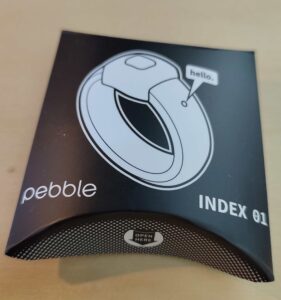
One of the nicer surprises waiting for me when we returned from our summer holiday at the Mediterranean was a small package from Pebble. Inside was the Index 01 (https://repebble.com/index).

I have been using it for a few weeks now and, although calling it a smart ring is technically correct, it is probably not what most people imagine when they hear that term. There is no screen. No heart-rate sensor. No sleep score. No attempt to tell me whether I am stressed, healthy or sufficiently recovered from yesterday. It is basically a ring with a button and a microphone. And I really like it.

Press, speak, forget about it

You wear the Index 01 on a finger — Pebble suggests the index finger, although other fingers can work as well — and use your thumb to press the small button. Then you bring the ring close to your mouth and say whatever you want to remember. “Buy buttermilk.” “Order new sports shoes for my daughter.” “Look up that article about industrial robots.” That sort of thing. The recording is transferred over Bluetooth to the Pebble app on your phone. There it is converted to text and an LLM works out what you meant. A request to buy buttermilk can end up on a shopping list, while the sports shoes become something to remember or do. If the software puts something in the wrong place, you can simply move or correct it in the Pebble app. But in my experience that hardly ever happens.

Dutch works just fine

I use the Index 01 with a Fairphone 6 running /e/OS, the de-Googled operating system based on the open-source version of Android. The same Pebble app connects both my Pebble smartwatch and the Index 01. So far the combination has worked remarkably well. The Bluetooth connection is reliable, activating the microphone is simple and I speak all my messages in Dutch. The speech recognition and LLM have no problem with that. In practice, my little spoken notes almost always end up where I expect them to.

There is something slightly magical about thinking I must remember this, pressing a button, saying five words and then carrying on with whatever I was doing. No phone to unlock. No app to find. No keyboard. That small reduction in friction makes a surprisingly big difference.

No charging

There is another unusual design choice. You cannot charge the Index 01. Pebble put a non-rechargeable battery inside and designed the device for extremely low power consumption. Depending on usage, Pebble says it should last for years. Founder Eric Migicovsky has described his own usage pattern as potentially giving around two years of operation.

Once the battery is empty, it is empty. That sounds strange in a world where seemingly everything needs to be charged every evening. But it also fits the product. The Index 01 isn’t trying to be a tiny computer on your finger. The ring records your voice and sends it to your phone. Most of the clever processing happens there.

I paid roughly €70 plus shipping for mine, although I may have had an early-adopter price. The current listed price is $75, with Pebble indicating a higher regular price later.

Now I want it in Capacities

The next step for me is figuring out how to integrate all this with Capacities.io (https://capacities.io/), which I use as my personal knowledge management system. Capacities has quite a steep learning curve. At least it did for me. Once you begin to understand how it allows you to organise information, however, it becomes very useful. At the same time, I am the first to admit that I am probably still using only a small percentage of what Capacities can actually do.

So perhaps the Index 01 can become part of that workflow as well. Pebble already supports external integrations through webhooks and MCP, the Model Context Protocol. The company explicitly designed the system so people can route notes and actions into their own tools. That sounds promising. I have no idea yet exactly how I will connect it to Capacities. But finding that out seems like a good subject for another blog post.

Technology that mostly leaves me alone

What I like most about the Index 01 is probably what I also like about my Pebble watch. Showing me the time aside, my Pebble watch is mainly there for notifications. That means I don’t have to pick up my phone every time something happens. I decide which notifications are important enough to reach my wrist and largely ignore the rest.

Don’t get me wrong, Pebble does have a huge collection of watch apps and watchfaces — thousands of them — but I have barely explored them. I don’t really need to. For me, the combination of the Pebble watch and Index 01 already does something much more valuable. It creates a relatively quiet technological environment. No constant demands for attention. No device desperately trying to become the center of my life. Just the notifications I have decided I want — plus a small ring that lets me capture a thought before I forget it. That is about as much “smart” as I need from a ring.

Here is the original video in which Pebble founder Eric Migicovsky introduced the Index 01:

Maybe Screenshots Are the Simplest Personal Knowledge Management Tool We Already Have

Via my recent post, I Went Looking at a Conference About Screenshots (About What?) and Found a Filesystem for Browser Tabs (see here: https://justme.website/content-creation/i-went-looking-at-a-conference-about-screenshots-about-what-and-found-a-filesystem-for-browser-tabs/), I seem to have stumbled into a new world. Or perhaps I should say that I have returned to an old one. Plain text files, bitmap images and other simple file formats have been around for as long as I can remember. They are boring in the best possible way: simple, understandable and usually not tied to a particular service or vendor. But after years of apps, platforms, cloud services and increasingly complicated workflows, I had more or less stopped thinking about them.

Then I discovered Screenshot Conf. And that made me look at screenshots differently.

A screenshot isn’t necessarily just an illustration

I take screenshots all the time. But I mostly use them as illustrations. Something interesting happens on my screen, I capture it, crop it and use it somewhere. That is about it. But screenshots can obviously be much more than that. They can be artistic objects. They can become part of collages. They can document software, interfaces and moments in digital history.

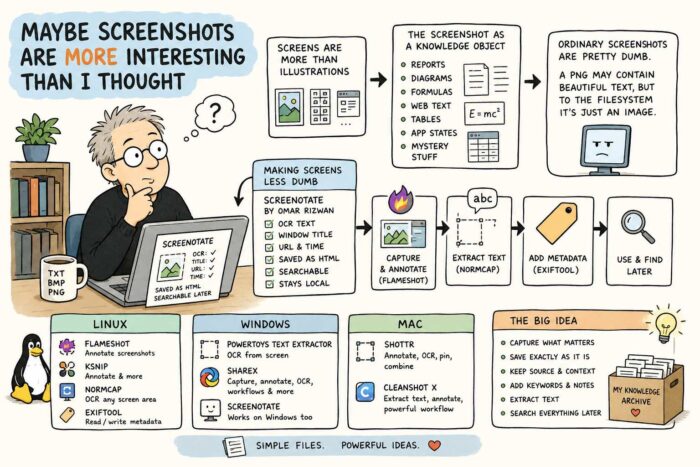
Even more interesting to me, however, is the idea of the screenshot as a knowledge object. You can capture part of a technical report. A diagram. A complicated mathematical formula. A paragraph from a website. A table from a PDF. A particular state of an application. Or simply something you don’t yet know what to do with, but suspect might become useful later.

The screenshot preserves exactly what you saw. The problem is that ordinary screenshots are fairly dumb. There may be a beautifully readable paragraph inside a PNG file, but as far as the filesystem is concerned, it is still just an image.

Making screenshots less dumb

This is where things become more interesting. Omar Rizwan, one of the people behind Screenshot Conf (https://screenshot.arquipelago.org/) and also the creator of TabFS (https://omar.website/tabfs/), made a tool called Screenotate for macOS and Windows (https://screenotate.com/). Screenotate doesn’t merely save the image. It uses OCR to recognise the text inside the screenshot and can also store information such as the window title, URL and time of capture. The result is searchable. Rizwan designed it so that screenshots remain on your own computer, with each capture stored as a self-contained HTML file.

That changes the nature of a screenshot quite dramatically. Imagine capturing one interesting equation from a 120-page research report. Normally you would later have to remember which report was that again? With a tool that also stores the source and recognises the text, the screenshot becomes part of a searchable personal archive.

That started me looking for other tools that do similar things. And there are quite a few.

Linux: Flameshot, NormCap and metadata

On Linux, Flameshot (https://flameshot.org/) is probably one of the better-known screenshot tools. It lets you annotate a screenshot immediately with arrows, text, highlights, shapes, blur and other elements. It also has a command-line interface, which means it can become part of scripts and more elaborate workflows.

Ksnip (https://ksnip.com/) takes a similar approach and combines screenshots with annotation tools.

For OCR, I particularly like the idea behind NormCap (https://dynobo.github.io/normcap/). Instead of capturing an image, you select a piece of the screen and NormCap tries to recognise the information inside it and copies the result as text. It is available for Linux, Windows and macOS and uses Tesseract OCR.

And if you really want to treat screenshots as proper information objects, there is ExifTool (https://exiftool.org/). It can read and write metadata, including XMP metadata in PNG files. That means you could add things such as descriptions, tags or other information to screenshots and potentially automate that process with scripts.

So a Linux workflow could be surprisingly simple: Take the screenshot with Flameshot. Annotate it. Extract useful text with NormCap. Add metadata with ExifTool. Suddenly a PNG is becoming something rather more useful.

Windows has some very good options too

Windows users have PowerToys Text Extractor (https://github.com/microsoft/PowerToys/blob/main/doc/devdocs/modules/textextractor.md), Microsoft’s open-source OCR utility. Press a keyboard shortcut, draw a rectangle around something on screen and the recognised text is copied to your clipboard. It even works on text displayed inside images or videos.

There is also ShareX (https://getsharex.com/), which has developed into much more than a screenshot utility, with capture, editing and workflow features. And, of course, Screenotate itself works on Windows too.

And on the Mac

macOS already does quite a lot with screenshots and text recognition itself, but there are some interesting specialised tools.

Shottr (https)://shottr.cc/, for example, combines screenshots, annotation and OCR. You can select text that normally isn’t selectable, recognise it and copy it directly to the clipboard. It can also combine screenshots, pin them on screen and add annotations.

CleanShot X (https://cleanshot.com/) takes a similarly broad approach. It can extract text from screenshots and open existing screenshots directly in its annotation environment.

Screenshots as a personal knowledge layer

What interests me most is not really which screenshot application has the longest feature list. It is the underlying idea. We usually think about screenshots as disposable images. Take one, send it to someone, use it in a blog post and forget about it.

But what if screenshots become part of a personal knowledge system? You could capture an important paragraph without copying an entire document. Save a formula exactly as it was typeset. Preserve a table together with its source URL. Add keywords. Extract the text. Annotate why you thought it was interesting. Search everything later.

When I was still using an iPhone, I deliberately set the system language to English. One of the reasons was Apple Notes. Set to English, it gave me access to OCR features that were surprisingly useful for collecting information. I could be reading a magazine, come across a paragraph or even a complete article that I wanted to keep, photograph it directly from Notes and have the app turn the image into editable text inside the note. In a way, it was exactly the same idea: capture something visually first, then use OCR to turn the interesting part back into text that you can search, store and work with later.

Screenshots are fundamentally just files. That means you are not necessarily dependent on one enormous knowledge-management application to do all this. The screenshot itself can become the basic object. That feels strangely old-fashioned. And perhaps that is exactly why I like it.