
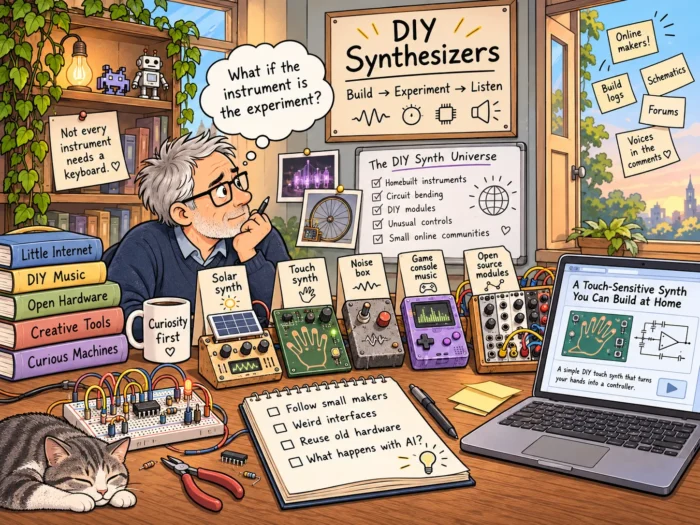
I have been spending quite some time lately exploring the world of people who build their own technology. Cyberdecks, digital cameras, strange little computers, and all sorts of electronic devices that their creators apparently couldn’t find in any shop. Or perhaps they could, but simply preferred to make something themselves.
Recently, I started noticing another category of projects appearing in these communities: DIY synthesizers. And the more I looked into them, the more I discovered a world that is much larger, stranger and more international than I had expected.
Of course, people have been building their own electronic musical instruments for decades. There is nothing particularly new about soldering together an oscillator or assembling a modular synthesizer from a kit. What interests me is how this tradition is evolving. Cheap microcontrollers, open-source hardware, 3D printing, online communities and, increasingly, AI are giving people new possibilities to design instruments that might never have existed otherwise.
Who says a synthesizer needs a keyboard?
When most people think of a synthesizer, they probably imagine something resembling a traditional electronic keyboard. Perhaps with a collection of knobs, switches and flashing lights. But spend a little time exploring experimental electronic music communities and that familiar image quickly disappears. Some instruments are little more than exposed circuit boards. Others have wooden enclosures, copper touch surfaces, unusual sensors or handmade controls. Some look more like sculptures than musical equipment. And some deliberately produce sounds that their creators cannot entirely predict.
One interesting example is Folktek (https://folktekarchive.com/), whose experimental electronic instruments combine sound generation with unusual physical interfaces and artistic design. These are instruments that invite you to explore them rather than simply play them in the conventional sense. This is closely related to something called circuit bending, a practice in which people modify existing electronic devices, often toys or inexpensive keyboards, to create sounds their original designers never intended.
What I like about this approach is that the interface becomes part of the experiment. Instead of asking how to reproduce the experience of playing a piano, these makers ask a much more interesting question: what other ways could we invent to make sound?
Making music with sunlight
One of my favourite discoveries is SolarpunkSynth, developed by Marc Dusseiller, also known online as dusjagr. The project is available on GitHub (https://github.com/dusjagr/SolarpunkSynth/), complete with electronic designs, documentation and instructions for building it yourself.
As its name suggests, SolarpunkSynth is powered by solar energy. But this is not simply a conventional synthesizer connected to a solar panel. The instrument uses an extremely low-power electronic circuit, with three interconnected oscillators that can produce experimental sounds and rhythmic patterns. The amount of energy available influences how the circuit behaves. In other words, the environment can become part of the musical experience.
The synthesizer is based on an earlier design called StarvationSynth, developed by Ralf Schreiber and Uwe Schüler. Dusseiller adapted the concept for workshops and artistic projects, including an exhibition at FabCafe Tokyo.
What makes this particularly interesting is that the instrument was developed to be accessible to beginners. Workshops have been organised in Taipei, Chiang Mai and Tokyo, where participants can build their own devices without needing extensive knowledge of electronics.
There is also a rather interesting connection between the electronic circuit and the visual appearance of the instrument. Some versions use artistic PCB designs, turning the printed circuit board into something that is both functional and decorative. It is a small example of how sustainability, electronics, design and experimental music can intersect.
An experimental synthesizer from Argentina
Another discovery took me to Tucumán, Argentina, where artist and inventor Mateo Carabajal creates handmade electronic instruments under the name Los Aparatos. His work was featured by Create Digital Music in August 2026 (https://cdm.link/los-aparatos/).
One of his instruments, the Auduina MK2, combines electronic sound generation with unconventional forms of control. Its colourful enclosure looks playful, but the underlying idea is interesting: rather than relying exclusively on knobs or traditional keys, the instrument can respond to different electrical inputs and touch-based interactions. Some of Carabajal’s creations can even be controlled using an electronic drawing pen inspired by the Drawdio concept, which translates changes in electrical resistance into sound.
Apparaently there is also a broader DIY electronics culture across Latin America in which artists experiment with discarded electronic equipment, toys, sensors and handmade circuits. Often, the process of building and sharing knowledge matters just as much as the finished instrument. It reminds me of something I keep encountering in other maker communities: technology becomes much more interesting once people stop treating its original intended purpose as a limitation.
Inside a hackerspace in Kyiv
An entirely different story comes from Ukraine. In October 2025, Create Digital Music published a fascinating report about the experimental electronic music scene surrounding the NU31 hackerspace in Kyiv (https://cdm.link/kyiv-diy/). Despite the ongoing war, a community of musicians, artists and electronics enthusiasts continues to meet, build instruments and explore experimental sounds.
The article links to a Ukrainian-language documentary in which members of the community explain their work and the importance of these activities. What struck me was how naturally electronic music and hackerspace culture seem to fit together. A hackerspace already brings together people who enjoy experimenting with hardware, programming and unfamiliar technologies. Once someone starts building circuits that produce sound, the transition to making music is not particularly large.
And unlike conventional music production, where performers generally use finished instruments, this scene allows people to invent the tools they need as they go along. The resulting instruments may be rough, unpredictable or difficult to reproduce. But that is not necessarily considered a problem. Sometimes the imperfections are precisely what makes them interesting.
Your old game console has a second career
Another unexpected connection is emerging between retro gaming and electronic music. MusicRadar recently published an article about developers who have been turning old handheld game consoles into musical instruments (https://www.musicradar.com/music-tech/gear-gadgets/i-hope-granular-synthesis-becomes-the-new-doom-something-people-try-to-run-on-all-kinds-of-musical-devices-we-speak-to-the-industrious-innovators-who-have-repurposed-long-dead-video-game-consoles-to-make-music).
One example is DZA.grain, a granular sampler that runs on devices such as the Nintendo 3DS and Sony PSP. Granular synthesis works by breaking recorded audio into tiny fragments and rearranging them to create new sounds. Another initiative, sndstation, aims to turn inexpensive Linux-based handheld gaming devices into platforms for music software.
What is especially interesting here is that the developers are not simply trying to recreate a desktop music application on a smaller screen. They are experimenting with the physical characteristics of these devices. Buttons, joysticks and other controls can become completely different ways of interacting with sound.
I can see a clear connection with the cyberdeck projects I have been exploring. In both communities, people take existing hardware and give it a new identity. And instead of adding another electronic product to the world, they find something unexpected to do with equipment that already exists.
The synthesizer as an open-source playground
Not all DIY synthesizer projects are quite so unconventional. There is also a growing collection of open-source hardware projects that make it easier to build useful musical instruments. One example is the Workshop System from Music Thing Modular (https://www.musicthing.co.uk/workshopsystem/), a compact modular synthesizer that combines analogue electronics with a programmable computer. It is designed to be modified and expanded. Users can develop their own software, exchange ideas and create entirely new functions for the same hardware. Create Digital Music published an interesting overview of the surrounding community in January 2026 (https://cdm.link/diy-world-of-music-thing-workshop-system/). What emerges is a picture of a small ecosystem in which the original instrument becomes a starting point for other people’s ideas.
Another example is TŒRN, an open-source sampler and sequencer developed around a Teensy microcontroller (https://github.com/Soundpauli/toern). It uses a colourful 16-by-16 LED matrix as its main interface, together with physical controls. Rather than relying on conventional menus and screens, it allows users to build musical patterns by interacting directly with the illuminated grid. The software and hardware design files are available for people who want to explore the project, although the hardware design has restrictions on commercial reuse.
What’s interesting about these projects is that the instrument does not necessarily stop evolving when its original developer considers it finished. Other people can contribute software, propose modifications or build their own variations. This is familiar territory for anyone involved in open-source software. But seeing the same principles applied to physical musical instruments makes the results much more tangible.
What if AI designs the synthesizer?
And then I came across something that adds an entirely new dimension to this story. On 14 November 2026, Tim published a detailed account of an experiment titled Agentic AI Designs an Analog Synthesizer (https://cpldcpu.github.io/2026/11/14/touchsynth/).
The project is called TouchSynth. Instead of manually designing all the electronics himself, Tim used Claude Code with Opus 5.5 to develop a complete analogue synthesizer from a relatively simple initial idea. He asked the AI to work with a selection of inexpensive electronic components and suggested creating a microcontroller-controlled synthesizer with touch-sensitive keys on its printed circuit board.
The AI proposed an architecture with a digitally controlled oscillator, a transistor ladder filter inspired by classic Moog synthesizers, and a voltage-controlled amplifier. It then generated the electronic circuits, simulated their behaviour using ngspice, created the PCB design in KiCad and wrote firmware for the microcontroller.
This was not just an exercise in generating attractive diagrams. Tim actually had the circuit boards manufactured. According to his account, only nineteen hours elapsed between the first prompt and the moment the manufacturing files were ready for ordering. Much of that time was spent on automated PCB routing.
After the assembled boards arrived, he used the AI to help test and calibrate the actual electronics. The measurements corresponded remarkably well with the earlier simulations. There were still problems, of course. The PCB layout required human intervention, and the touch-sensitive keys turned out to be rather difficult to use because of their small size. But the synthesizer worked.
I find this an almost bizarre experiment, not so much because AI was able to design a synthesizer, but because it suggests a different way for people to approach hardware projects. Until recently, building something like this required considerable expertise in electronics, circuit simulation, PCB design and embedded programming. Those skills are still important, particularly when something goes wrong. But the experiment suggests that AI may be able to help people cross some of the technical barriers between having an idea and building a working physical object.
And that raises a much bigger question, which I think deserves a separate blog post. If AI can help us design complex electronic devices, what happens to the world of people who simply enjoy making things?
The pleasure of making something that doesn’t have to exist
The more I explore DIY synthesizers, the more I realise that this is not exclusively a story about music. It is also about people’s relationship with technology. Commercial electronics are usually designed to perform a specific function as reliably and conveniently as possible. You buy a device, learn how to operate it and hopefully spend very little time thinking about its internal workings.
DIY synthesizers often reverse that relationship. The internal workings become the attraction. The strange noises, the unexpected behaviour, the awkward interfaces and sometimes even the failures are part of the experience.
There is also something quite social about this world. People share electronic schematics, publish firmware, organise workshops, record demonstrations and help complete strangers reproduce their experiments. And the communities extend far beyond the places we normally associate with electronic music. From Argentina to Japan, from Kyiv to small European makerspaces, people are inventing their own approaches to making sound.
One thing I still wonder about is how many of these people would primarily describe themselves as musicians. Some undoubtedly would. Others might consider themselves electronics hobbyists, programmers, designers or simply curious people who enjoy building things.
Perhaps the distinction does not matter very much. I have been thinking a lot lately about the importance of toy projects: little technical experiments that do not necessarily need a practical purpose or commercial future. They exist because someone was curious enough to try something.
DIY synthesizers seem to fit that idea almost perfectly. You can build one to make music. You can build one to learn electronics. You can build one because you want to see whether an old game console can produce sounds it was never designed to make. Or because you wonder what happens when a little circuit is powered by sunlight. And now, apparently, you can even ask an AI to help invent one.
I suspect the most interesting instruments in this world are not necessarily the ones that sound the best. They are the ones that make someone else look at them and think: I wonder if I could build something like that. Or, even better: I wonder what would happen if I built it differently.