
I have always been fascinated by space. Not only because of the spectacular images from distant galaxies, the engineering challenge of launching rockets, or the incredible scientific discoveries made by missions exploring our solar system. What fascinates me even more is the fact that space technology is increasingly becoming part of our everyday lives.
For many years, space was something that belonged mainly to governments, research institutes and a handful of large aerospace companies. Satellites were expensive, rockets were rare, and space exploration felt like something far removed from our daily reality. That is changing rapidly.
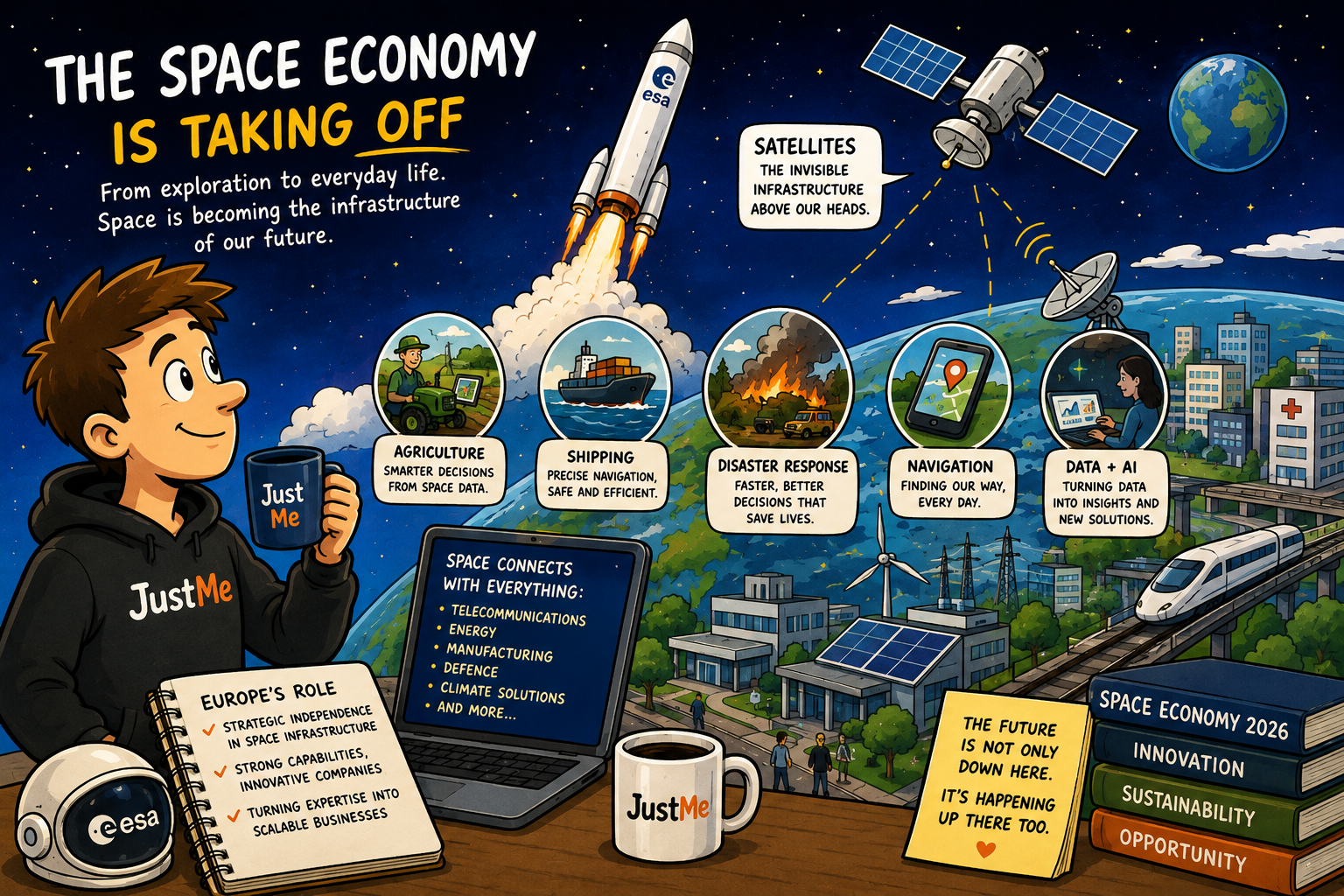
The latest Space Economy Report from the European Space Agency (ESA) shows how quickly space is developing into a mature economic sector. Space is no longer only about exploration and scientific missions. It has become an essential infrastructure layer for modern society — supporting communication, navigation, climate monitoring, agriculture, logistics, security and many other industries. And this is only the beginning.
From government projects to a global commercial ecosystem
One of the most interesting developments of recent years is the shift from a government-driven space sector towards a much broader commercial ecosystem. Companies are building satellites, developing launch services, analysing Earth observation data and creating completely new services based on information collected from orbit. The cost of entering space is decreasing, partly because of reusable launch technology, smaller satellites and more efficient manufacturing processes.
This has created opportunities for thousands of companies that would never have been considered “space companies” in the past. A farmer using satellite images to optimise irrigation is benefiting from space technology. A logistics company using precise positioning data relies on satellites. A telecommunications provider offering connectivity in remote areas depends on orbital infrastructure. And thanks to satellite data, governments can respond much more effectively to natural disasters such as wildfires, floods and earthquakes. In many ways, satellites are becoming the “cloud infrastructure in space”.
Europe’s role in the new space economy
As someone who follows technology, digital sovereignty and autonomy, and European innovation closely, I find the European perspective particularly interesting. The space economy is not only about economic growth. It is also about strategic independence. Just as Europe is discussing digital autonomy in areas such as cloud computing, artificial intelligence and semiconductor technology, space infrastructure is becoming a strategic asset as well.
Reliable access to satellite data, navigation systems and communication capabilities is increasingly important for governments, companies and society as a whole. Europe has strong capabilities in space technology. Organisations such as ESA, national space agencies, research institutes and a growing number of innovative companies are contributing to a competitive European space ecosystem. The challenge therefore is not whether Europe has the knowledge or the technology. The challenge is turning that expertise into scalable businesses and ensuring that Europe remains an important player in a rapidly growing global market.
The connection between space and artificial intelligence
Another reason why the space economy is becoming increasingly interesting is the connection with artificial intelligence. Satellites generate enormous amounts of data. Every day, they collect information about our planet, weather systems, oceans, cities and industrial activities. But collecting data is only the first step. The real value comes from analysing it.
AI will play a crucial role in turning satellite data into information we can actually use in daily (business) life. At the same time, space itself creates new challenges for AI. Processing data closer to where it is generated — potentially directly in orbit — could become increasingly important as the amount of information from satellites continues to grow.
One of the reasons I enjoy following developments in space technology is that they show how innovation often crosses traditional boundaries. Space is no longer an isolated industry. It connects with telecommunications, energy, manufacturing, defence, agriculture, logistics, climate technology and artificial intelligence. The same technologies that help us explore distant planets are also helping us solve problems here on Earth. This is perhaps the most exciting aspect of the new space economy: it is not about escaping from our planet. It is about understanding, protecting and improving it. And that makes this report a very interesting read.