LEO Satellites Are Taking Off, But They Can’t Do Everything

Low Earth Orbit satellites have become enormously popular over the past few years. Starlink is obviously the name most people know, but it is only part of a much bigger development. Companies all over the world are building new satellite constellations, telecom operators are experimenting with direct-to-device connections and smartphones are slowly gaining the ability to communicate with satellites without requiring a traditional satellite phone.

It is another example of something I wrote about earlier in The Space Economy Is Taking Off (https://justme.website/tech/the-space-economy-is-taking-off/): space is increasingly becoming an economic infrastructure rather than something mainly associated with governments, science and spectacular rocket launches.

But whenever a technology suddenly attracts this much attention, another question becomes interesting. What can it actually do? And perhaps even more importantly: what can’t it do?

Strand Consult has published two reports that provide some useful context here. They look specifically at Low Earth Orbit satellite networks and the increasingly popular idea of connecting ordinary mobile devices directly to satellites.See here for more information: https://strandconsult.dk/leo-satellites-the-hype-the-facts-and-the-hard-limits/?utm_campaign=31.+august+2026+-+Presse+-+LEO+Satellites+The+Hype+the+Facts+and+the+Hard+Limits505128.

Satellites are very good at filling gaps

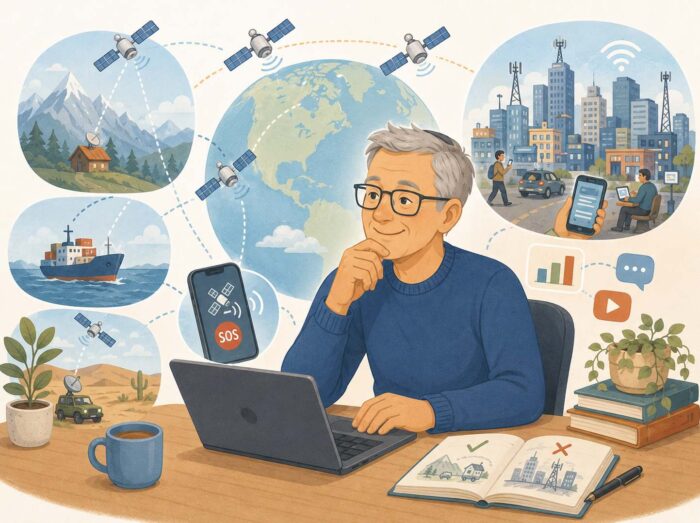
The obvious advantage of satellites is coverage. Building mobile towers and fibre networks makes economic sense in cities and densely populated areas. It becomes much more complicated in mountains, deserts, at sea or in sparsely populated regions. LEO satellites can reach those places without having to build a physical network across every square kilometer of land.

That makes direct-to-device satellite communication particularly interesting as an extension of existing mobile networks. A phone could use a terrestrial network most of the time and switch to a satellite connection when there simply isn’t a mobile tower nearby. That sounds extremely useful. And it probably will be.

But space doesn’t magically create unlimited bandwidth

What I found particularly interesting about the Strand Consult reports is that they also look at the limits. Satellites have limited spectrum and limited capacity. A satellite beam covering a large geographical area has to share that capacity between users underneath it. That is very different from a city packed with mobile base stations, each covering a relatively small area and collectively handling enormous amounts of data.

In remote areas, satellites can therefore be an excellent solution. In densely populated cities with huge amounts of traffic, terrestrial networks are much harder to beat. Strand Consult also points to regulatory issues around spectrum and the practical difficulties of scaling direct-to-cellular satellite services globally.

So the idea that satellites will simply replace mobile networks seems rather unlikely. More interesting is the idea that the two will increasingly work together.

And then there is the extreme scenario

The second Strand Consult report takes things a step further. It imagines the year 2045. The last mobile tower has been switched off and all mobile communication has moved into space. The report isn’t predicting that this will happen. It uses the scenario as a thought experiment: if we really wanted satellites to replace terrestrial mobile networks completely, what would we actually have to build?

The answer involves enormous numbers of satellites, spectrum, network capacity, regulation, investment and geopolitical coordination. Which is exactly why I find these reports interesting. The space economy really is taking off. Satellite connectivity will almost certainly become far more important than it is today.

But that doesn’t mean every network belongs in space. Sometimes the most interesting thing about a new technology isn’t discovering what it can replace. It is discovering where it fits.
Europe Just Opened a New Door to Space

I have written several times on Just Me about the space economy. About how satellites, launch services and new space companies are changing the way we think about access to orbit. For a long time, however, one question remained: could Europe really build its own commercial path into space?

This week, we got a very convincing answer. A German company called Isar Aerospace (https://isaraerospace.com/) has achieved something that feels like a turning point: its Spectrum rocket successfully reached orbit and deployed payloads during its second flight. The mission, called “Onward and Upward”, lifted off from Andøya Space in Norway (https://andoyaspace.no/) and made Isar Aerospace the first European commercial space company to successfully deliver satellites into orbit.

Not just another rocket launch

Of course, rockets reaching space is nothing new. Humanity has been doing that for decades. But this is different. For Europe, access to space has traditionally depended heavily on large institutional programmes. Rockets like Ariane have played a crucial role, but the world of space is changing quickly. Thousands of smaller satellites are being launched, companies want more flexible access to orbit, and commercial players are becoming increasingly important.

This is exactly the market where companies like Isar Aerospace are trying to make a difference. The idea is simple: make launching satellites more flexible, more scalable and more accessible. And that requires something more than just building a rocket. It requires building an entire industrial ecosystem.

The machine behind the machine

One thing I find particularly interesting about Isar Aerospace is that the company is not only developing the Spectrum launch vehicle. It is also building the manufacturing capabilities needed to produce rockets at scale. The company follows a highly integrated approach: designing, manufacturing and testing large parts of the rocket itself instead of relying completely on external suppliers. The next Spectrum vehicles are already in production, and Isar Aerospace is working towards a production facility capable of manufacturing dozens of rockets per year.

This reminds me of something I wrote earlier about European industrial ambitions (see here: https://justme.website/digital-autonomy/building-robots-is-not-enough/). The future is not only about making the final product. It is also about owning the knowledge, machines and processes behind that product. Whether we are talking about semiconductors, humanoid robots or rockets, the same principle appears again and again: the real strategic advantage often sits in the manufacturing capability.

Learning from failure

Another reason this story is interesting is that it shows how innovation actually works. The first Spectrum flight in 2025 was not a complete success. The rocket lifted off and cleared the launch pad, but the mission ended after a short flight. Instead of treating this as a failure, Isar Aerospace used the data to improve the next vehicle. That is how innovation always works. Test. Learn. Improve. Try again.

Space is probably one of the clearest examples of an industry where you cannot simply design everything perfectly on paper. Real-world testing is unavoidable.The second flight showed that this approach worked. Spectrum completed key flight milestones, reached orbital velocity and successfully separated its payloads.

Why Europe needs this

There is also a broader strategic dimension. Space has become critical infrastructure. Satellites support communication, navigation, climate monitoring, agriculture, defence and countless other services. Having independent access to orbit is increasingly seen as part of technological sovereignty. This does not mean Europe should build everything alone. International cooperation remains essential. But having European companies that can provide launch services from European soil gives Europe more options. So this is about technological and digital autonomy as well.

The global space industry is becoming more competitive every year. Companies in the United States, China and other regions are investing heavily. Europe needs companies that can move quickly, experiment and build new capabilities. Isar Aerospace is one example of this new generation of European space companies. Fortunately there are more.

The space economy is becoming real

What I like about this story is that it connects technology, industry and imagination. Space is no longer only about astronauts, giant government programmes and spectacular missions. It is also about factories, software, automation, supply chains and entrepreneurship. A small company from Germany launching a rocket from a small launch site in Norway may sound like science fiction. But this is exactly what the emerging space economy looks like.

Space Data Is Starting to Feel Like Software

A little while ago, I wrote about how the space economy is taking off. You can find it here: https://justme.website/tech/the-space-economy-is-taking-off/. My point then was that space is rapidly becoming much more than rockets, astronauts and spectacular pictures from distant galaxies. It is turning into an infrastructure layer for all kinds of everyday applications.

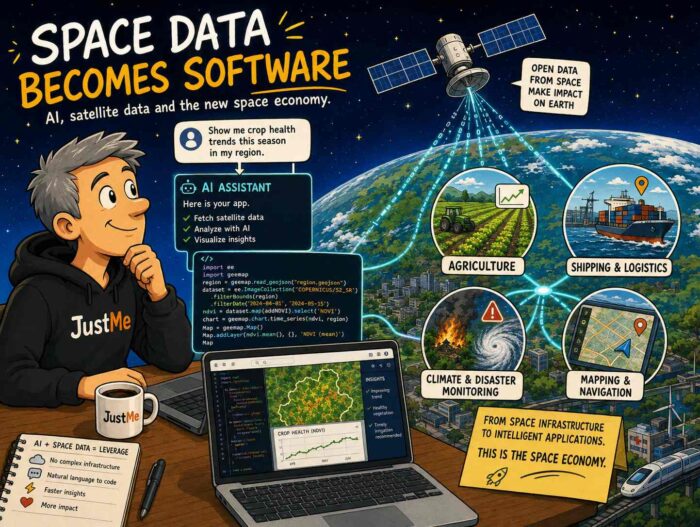
I recently came across another example that makes that development much more tangible. The video Apparently, Satellite Apps Are Vibe-Codeable Now (https://youtu.be/49EMkFgFzgY?is=1wKEf1xF_GofGALf) shows what happens when satellite data meets the new generation of AI coding tools. At the centre of the story is Tilebox (https://tilebox.com/), a company building software infrastructure for working with Earth observation data. And it is a good illustration of where the space economy may be heading.

The difficult part is increasingly down here

Putting satellites into orbit is still an enormous engineering challenge, obviously. But once they are there, they generate huge amounts of data. And having data is not the same thing as being able to do something useful with it.

Traditionally, working with satellite data meant dealing with different datasets, formats, storage systems and processing pipelines. Tilebox tries to put an abstraction layer around all of that. Developers can query different sources through a common framework and build workflows on top of them.

That in itself is interesting. But AI changes the picture again.

Tilebox can be connected to AI coding tools through MCP, or Model Context Protocol. MCP is an open standard and open-source framework introduced by Anthropic in November 2024. Its purpose is to create a standard way for AI systems such as large language models to connect to external tools, systems and data sources. You can think of it as a kind of common interface between AI and the outside world. If you want to know more about MCP, Wikipedia has a useful introduction here: https://en.wikipedia.org/wiki/Model_Context_Protocol.

Back to Tilebox. Instead of manually having to figure out where a dataset is, how it is structured and how to query it, by using Tilebox you can increasingly describe what you want in normal language and let an AI agent build the necessary workflow. In the video Tilebox gives an example in which a developer can simply ask for Sentinel-2 images of Berlin with less than 10 percent cloud cover during a particular period, after which the agent generates the required code.

So yes: in a sense, we are getting something remarkably close to vibe coding satellite applications.

A much bigger developer community

This is exactly why I find the space economy so interesting. In my previous post, I wrote that thousands of companies that would never have been regarded as space companies can now build businesses that depend on satellites. Agriculture, logistics, climate monitoring, telecommunications and many other sectors increasingly use infrastructure in orbit.

Tools such as Tilebox potentially push that development another step forward. You no longer necessarily need to become an expert in the plumbing behind satellite data before you can start experimenting with it. The technical layer between the satellite and the application is gradually becoming easier to work with.

That is something we have seen before in computing. Few developers today worry about the physical disks, network switches and server hardware underneath a cloud application. Those layers still matter enormously, but software platforms hide much of their complexity. Something similar appears to be happening with space data.

Space becomes a platform

There is another interesting connection with AI here. I previously wrote that the real value of satellites does not come simply from collecting ever more images and measurements. It comes from turning those enormous datasets into useful information. AI is particularly good at helping with exactly that problem. Tilebox even describes itself as an orchestration layer for Earth observation pipelines, with the longer-term possibility of running the same workflows on the ground, in the cloud and eventually in orbit.

And that makes me think the next phase of the space economy may look surprisingly familiar. Satellites provide the infrastructure. Platforms provide access to the data. AI helps us work with it. Developers build applications on top.

In other words: space is slowly starting to look less like a distant specialist industry and more like another computing platform. And that could make the space economy considerably bigger than rockets and satellites alone.

The Space Economy Is Taking Off

I have always been fascinated by space. Not only because of the spectacular images from distant galaxies, the engineering challenge of launching rockets, or the incredible scientific discoveries made by missions exploring our solar system. What fascinates me even more is the fact that space technology is increasingly becoming part of our everyday lives.

For many years, space was something that belonged mainly to governments, research institutes and a handful of large aerospace companies. Satellites were expensive, rockets were rare, and space exploration felt like something far removed from our daily reality. That is changing rapidly.

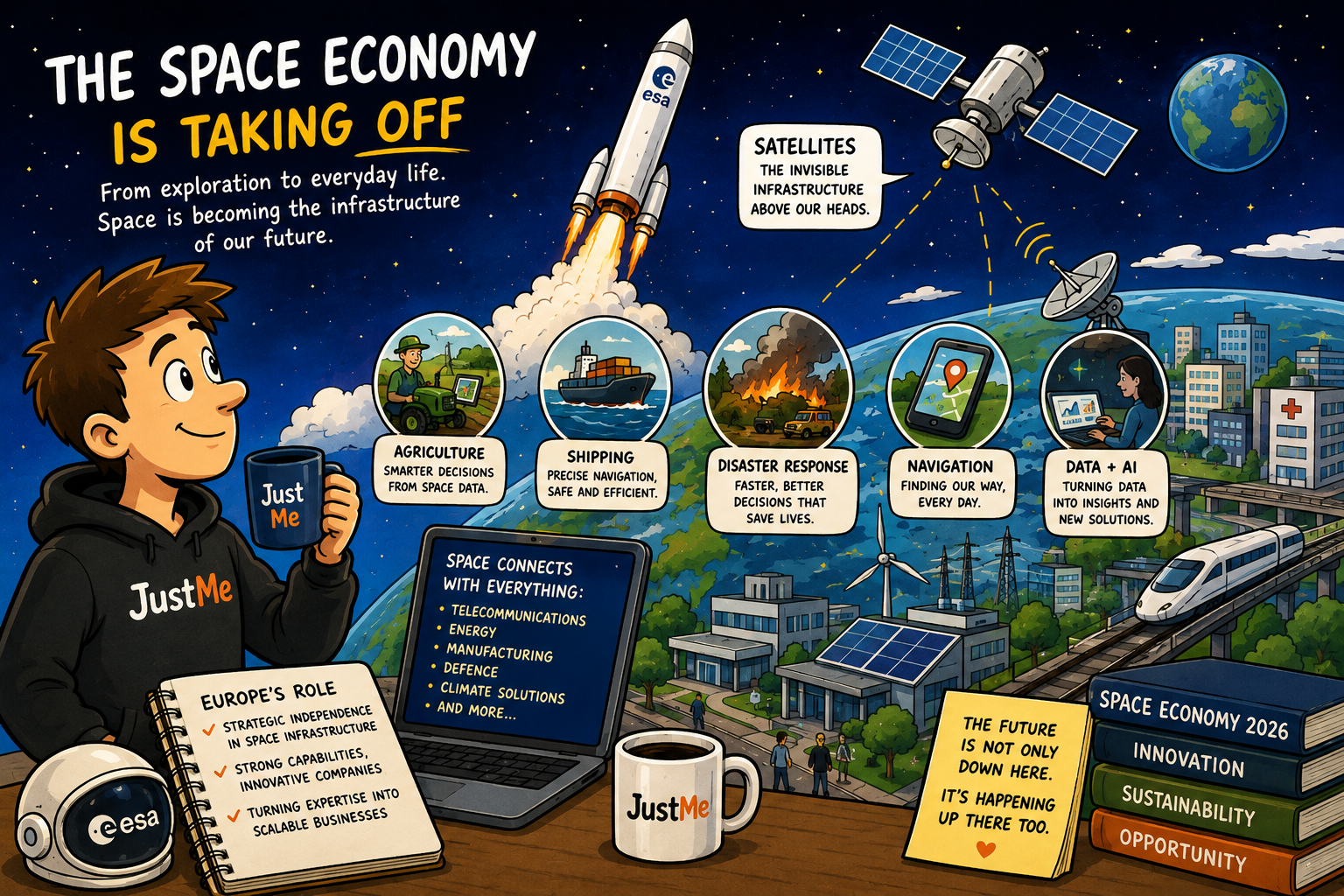
The latest Space Economy Report from the European Space Agency (ESA) shows how quickly space is developing into a mature economic sector. Space is no longer only about exploration and scientific missions. It has become an essential infrastructure layer for modern society — supporting communication, navigation, climate monitoring, agriculture, logistics, security and many other industries. And this is only the beginning.

From government projects to a global commercial ecosystem

One of the most interesting developments of recent years is the shift from a government-driven space sector towards a much broader commercial ecosystem. Companies are building satellites, developing launch services, analysing Earth observation data and creating completely new services based on information collected from orbit. The cost of entering space is decreasing, partly because of reusable launch technology, smaller satellites and more efficient manufacturing processes.

This has created opportunities for thousands of companies that would never have been considered “space companies” in the past. A farmer using satellite images to optimise irrigation is benefiting from space technology. A logistics company using precise positioning data relies on satellites. A telecommunications provider offering connectivity in remote areas depends on orbital infrastructure. And thanks to satellite data, governments can respond much more effectively to natural disasters such as wildfires, floods and earthquakes. In many ways, satellites are becoming the “cloud infrastructure in space”.

Europe’s role in the new space economy

As someone who follows technology, digital sovereignty and autonomy, and European innovation closely, I find the European perspective particularly interesting. The space economy is not only about economic growth. It is also about strategic independence. Just as Europe is discussing digital autonomy in areas such as cloud computing, artificial intelligence and semiconductor technology, space infrastructure is becoming a strategic asset as well.

Reliable access to satellite data, navigation systems and communication capabilities is increasingly important for governments, companies and society as a whole. Europe has strong capabilities in space technology. Organisations such as ESA, national space agencies, research institutes and a growing number of innovative companies are contributing to a competitive European space ecosystem. The challenge therefore is not whether Europe has the knowledge or the technology. The challenge is turning that expertise into scalable businesses and ensuring that Europe remains an important player in a rapidly growing global market.

The connection between space and artificial intelligence

Another reason why the space economy is becoming increasingly interesting is the connection with artificial intelligence. Satellites generate enormous amounts of data. Every day, they collect information about our planet, weather systems, oceans, cities and industrial activities. But collecting data is only the first step. The real value comes from analysing it.

AI will play a crucial role in turning satellite data into information we can actually use in daily (business) life. At the same time, space itself creates new challenges for AI. Processing data closer to where it is generated — potentially directly in orbit — could become increasingly important as the amount of information from satellites continues to grow.

One of the reasons I enjoy following developments in space technology is that they show how innovation often crosses traditional boundaries. Space is no longer an isolated industry. It connects with telecommunications, energy, manufacturing, defence, agriculture, logistics, climate technology and artificial intelligence. The same technologies that help us explore distant planets are also helping us solve problems here on Earth. This is perhaps the most exciting aspect of the new space economy: it is not about escaping from our planet. It is about understanding, protecting and improving it. And that makes this report a very interesting read.