
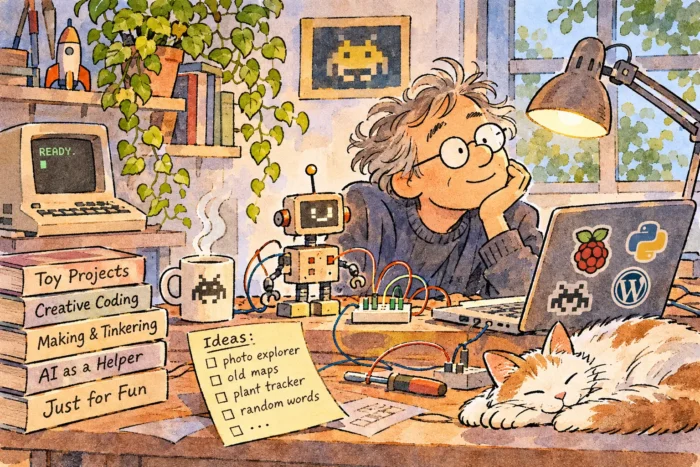
While browsing the programme for WordCamp Netherlands 2026, I came across a session with a title that immediately caught my attention: Toy Projects & Real Skills: Why Side Projects are Essential in the AI Era (https://netherlands.wordcamp.org/2026/session/toy-projects-real-skills-why-side-projects-are-essential-in-the-ai-era/).
The session, by Christoph Daum, is primarily aimed at software developers. His argument is that small personal projects offer an opportunity to experiment with new technologies, improve technical skills and try things that would be too risky in a professional environment. Without deadlines, demanding clients or the possibility of accidentally breaking an important production system.
That makes perfect sense. But what interested me even more was the underlying idea of a toy project. Something you build simply because you want to experiment with it. Not necessarily because somebody needs it, or because it solves an important problem, but because you are curious about what might happen.
I think this idea deserves a much wider audience than software developers. Technology has become such an important part of our lives that almost everybody uses it constantly, regardless of profession, age or interests. We communicate through digital platforms, organize our lives with apps, store our memories on computers and increasingly rely on algorithms to help us make decisions. Yet most of the time, we simply use whatever somebody else has created for us. Why not play with technology ourselves?
Remember when computers were toys?
There was a time when experimenting with computers was almost unavoidable. In the early days of home computing, machines such as the Commodore 64, ZX Spectrum and BBC Micro invited their owners to explore what was going on inside. Computer magazines published pages of BASIC code that readers could type into their machines. Sometimes the result was a simple game. Sometimes it was a useful little program.
Quite often, after spending an entire afternoon carefully entering all those lines, it didn’t work at all. But that was part of the experience. You would try to find the mistake, change something, discover a new command or modify the program to do something slightly different. You were not merely using a computer. You were discovering what a computer could do.
Of course, those early machines were hardly accessible to everybody. They required patience, technical curiosity and, often, a considerable amount of frustration. Today’s polished computers and smartphones are infinitely easier to use.
But somewhere along the way, something changed. Computers gradually became appliances. Software arrived as finished products, with carefully designed interfaces and predefined possibilities. We became very good at using technology, but perhaps a little less accustomed to changing it ourselves.
There have always been exceptions. The open-source community, electronics hobbyists, makers and people building personal websites never stopped experimenting. But for many ordinary computer users, the idea of creating their own software probably felt increasingly unrealistic.
Now something interesting is happening. The barriers are coming down again.
The return of the digital tinkerer
Several developments are making it easier to experiment with technology. Small computers such as the Raspberry Pi, inexpensive sensors, microcontrollers and open-source software have made electronics and computing more accessible. Online communities share designs, instructions and code. And there are wonderful projects specifically intended to help people discover the creative possibilities of technology.
Take Scratch (https://scratch.mit.edu/), for example. Developed at MIT, it allows people to create animations, interactive stories and games by combining visual programming blocks. It was designed primarily for young people, but there is no reason adults cannot enjoy it too.
Or look at Processing (https://processing.org/), a programming environment that has been bringing artists, designers and technology together since 2001. Instead of treating programming exclusively as a way of building applications, Processing encourages people to use code as a creative medium. You can draw with it, make animations, create interactive artworks or explore how mathematical patterns produce unexpected visual results. Its browser-based relative, p5.js (https://p5js.org/), takes a similar approach.
These projects demonstrate something important: learning to use technology does not have to begin with a practical problem. It can begin with the desire to make something interesting, beautiful, strange or simply amusing.
And then there is AI. With today’s AI coding assistants, people who have never seriously programmed before can experiment with creating their own software. You can describe an idea, ask for a prototype, try it, discover what doesn’t work and gradually improve it. This does not magically turn everybody into a software engineer. Nor does it guarantee that the resulting software is reliable or secure. But it changes the starting point. Instead of spending weeks learning the basics before seeing anything happen, you can begin with an idea and learn along the way. That opens up possibilities far beyond the traditional world of programming.
What would you make if you could?
Imagine a history teacher who has collected hundreds of old photographs of a particular town. She could build a little interactive map that shows how the streets and buildings have changed over time. Or a gardener who wants to track the development of plants in his greenhouse, combining photographs, temperature measurements and personal observations. Perhaps his homemade dashboard would even produce colorful illustrations of each growing season.
A music enthusiast might create a program that explores unexpected connections between records in a collection. Not necessarily by genre or artist, but perhaps by recording studio, musicians involved or the cities where albums were made. Someone interested in family history could experiment with an interactive timeline. A birdwatcher could build a sound archive. A collector of postcards could create a digital map of all the places represented in the collection.
None of these people needs to become a professional programmer. Nor do their projects need to become polished applications that other people can use. They are simply personal experiments that combine an existing interest with the possibilities of technology. And that combination is where things become particularly interesting. Because the most original ideas often come from people who are not thinking like software developers at all. They are thinking like gardeners, collectors, musicians, teachers or artists. Their curiosity comes first. Technology follows.
Creativity isn’t just about making art
We tend to associate creativity with activities such as painting, writing, photography and music. Technology, by contrast, is often presented as something practical and functional. I have never quite understood that distinction. Designing a little program that organizes photographs in an unusual way can be every bit as creative as making a collage. Connecting a sensor to a small computer and using the resulting measurements to produce an animation involves imagination as well as technology.
Creativity is not necessarily about producing beautiful things. Sometimes it is about noticing connections that other people overlook, combining familiar elements in unexpected ways or asking unusual questions. What would happen if I combined this with that? Could I make something respond to the weather? Could I turn a collection of old documents into something people can explore? Could I create a digital version of a physical object? The answers might be completely impractical. That doesn’t make the questions any less interesting.
I have experienced some of this myself. Over the past few months, I have been experimenting with several small software projects, often with the help of AI. One of them, Beeldvinder, searches my own collection of photographs using keywords or an example image. Another explores connections between articles and bookmarks I have collected over time. I have also experimented with a simple Markdown browser and using Signal from the Linux terminal.
Some of these projects began with a practical irritation. Others were simply experiments to see whether an idea could work. What I enjoy most is often not the final application, but the process of discovering possibilities I hadn’t considered when I started. And sometimes the most interesting feature is one that emerges halfway through the experiment.
The freedom of making something useless
There is one aspect of toy projects that I particularly like: they don’t have to be useful. We live in a world where almost everything seems to require a purpose. A hobby should help us develop skills. A creative activity should produce something worth sharing. A technical experiment should improve productivity or perhaps become the foundation of a business. Even side projects are frequently discussed in terms of career development, professional portfolios and entrepreneurial opportunities.
But what if you just want to make something? Imagine a website that displays a random forgotten word from an old dictionary every morning. Or a tiny program that generates imaginary railway stations. Perhaps a digital clock that measures time in an entirely invented system, or an application that creates unusual patterns from the weather outside your window. You might spend two evenings building it, enjoy the result for a week and then never open it again.
So what? You learned something. You followed your curiosity. Perhaps you discovered a technique that you will use again someday. Perhaps you didn’t. The experiment was still worthwhile.
I think this is where the word toy becomes especially appropriate. Children rarely ask whether playing with building blocks will improve their professional prospects. They build something, knock it down, try another arrangement and discover what happens. Adults could probably benefit from a little more of that attitude.
The difference between making and playing
There is a subtle but important distinction between making something and playing with something. When we make something, we usually have a result in mind. We want a working application, a finished website or a device that performs a particular function. Playing is different. The activity itself is part of the reward. We explore without necessarily knowing where we are going.
Of course, the two often overlap. A toy project may eventually become a useful tool. A seemingly pointless experiment might reveal an interesting solution to a real problem. And something built purely for pleasure could turn out to be useful to other people.
But it is important that those outcomes remain possibilities rather than requirements. A toy project should be allowed to fail. It should be allowed to become something entirely different from what you originally imagined. And it should be perfectly acceptable to abandon it when your curiosity moves elsewhere.
There is also a social aspect to all this. The maker movement, open-source communities and the early personal web have long demonstrated how much people enjoy sharing experiments. Not necessarily as finished products, but as invitations for other people to explore, modify and build upon them. I particularly like personal websites that contain small, strange experiments. An unusual navigation system, an experimental visual effect or a tiny tool that its creator built simply because they wanted it to exist. These are reminders that the web can be a playground rather than just another collection of standardized services.
AI makes it easier, but curiosity still matters
Naturally, AI deserves a place in this story. It has become considerably easier to turn an idea into a working prototype, especially when you can describe what you want in ordinary language. That is an enormous opportunity for people who are interested in technology but have never learned to program.
However, I would be careful not to confuse easier creation with greater creativity. AI can suggest solutions, explain technical concepts and generate code. But the personal curiosity behind a good toy project still has to come from somewhere. A language model doesn’t know why you have spent twenty years collecting postcards, why you are fascinated by obscure radio stations or why a particular detail in an old photograph interests you. Those are the things that make your experiments personal.
There is another danger, too. When AI can produce something that looks impressive almost immediately, we may be tempted to skip the messy process of experimentation. Ask for an application, receive the result, and move on. Yet much of the pleasure comes from understanding what happens when you change something. Why does one approach work while another fails? What happens if you combine two techniques? Can you make the result behave differently?
AI is most interesting here when it becomes a companion to experimentation rather than a machine that simply delivers finished products. And although toy projects are wonderfully low-stakes, a little common sense remains necessary. Experiments involving personal data, internet-connected devices or access to important files still require care. There is nothing wrong with keeping your digital playground separate from the systems you rely on every day.
The right to be an amateur
Perhaps there is an even bigger idea hiding behind all this. We have become accustomed to professional-looking results. Our photographs are automatically enhanced, websites are built from polished templates and AI can generate illustrations, software and text that appear remarkably finished. It is easy to start believing that everything we create should meet the same standards.
But there is something liberating about being an amateur. You can make mistakes. You can use an inelegant solution because it happens to work. You can spend hours on something that a professional might solve in ten minutes. You can create an application with an ugly interface that makes perfect sense to you and nobody else.
This is not an argument against quality or expertise. Professional software development involves responsibilities that toy projects generally do not. But those responsibilities are precisely why personal experiments are so valuable. They create a little space where you are allowed to be inexperienced, curious and occasionally completely wrong. And in a world where technology is becoming increasingly important to almost every aspect of our lives, perhaps that freedom matters more than ever.
Just start playing
I like the idea that inspired the WordCamp session because it reminds us of something easily forgotten: technology is not exclusively the territory of specialists. You don’t need to understand every detail of a computer to experiment with it, just as you don’t need to be a professional photographer to enjoy taking pictures.
Start with something you already find interesting. A collection, a hobby, an unusual question or a small irritation in everyday life. See whether technology could help you explore it in a different way. Perhaps you will discover a useful tool. Perhaps you will produce a little digital artwork. Perhaps you will simply spend an enjoyable afternoon discovering why something doesn’t work. All three are perfectly good outcomes.
Technology has become too important in our lives to leave all the experimenting to professionals. We should all play with it a little more. And the nice thing about a toy project is that you don’t have to become a programmer. You don’t have to start a business. You don’t even have to finish what you started. Just find something that makes you curious, and see what happens when you start playing with it.