
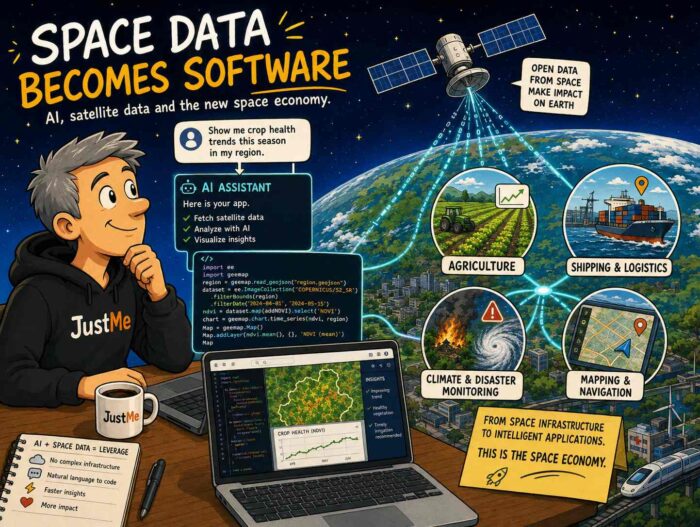
A little while ago, I wrote about how the space economy is taking off. You can find it here: https://justme.website/tech/the-space-economy-is-taking-off/. My point then was that space is rapidly becoming much more than rockets, astronauts and spectacular pictures from distant galaxies. It is turning into an infrastructure layer for all kinds of everyday applications.
I recently came across another example that makes that development much more tangible. The video Apparently, Satellite Apps Are Vibe-Codeable Now (https://youtu.be/49EMkFgFzgY?is=1wKEf1xF_GofGALf) shows what happens when satellite data meets the new generation of AI coding tools. At the centre of the story is Tilebox (https://tilebox.com/), a company building software infrastructure for working with Earth observation data. And it is a good illustration of where the space economy may be heading.
The difficult part is increasingly down here
Putting satellites into orbit is still an enormous engineering challenge, obviously. But once they are there, they generate huge amounts of data. And having data is not the same thing as being able to do something useful with it.
Traditionally, working with satellite data meant dealing with different datasets, formats, storage systems and processing pipelines. Tilebox tries to put an abstraction layer around all of that. Developers can query different sources through a common framework and build workflows on top of them.
That in itself is interesting. But AI changes the picture again.
Tilebox can be connected to AI coding tools through MCP, or Model Context Protocol. MCP is an open standard and open-source framework introduced by Anthropic in November 2024. Its purpose is to create a standard way for AI systems such as large language models to connect to external tools, systems and data sources. You can think of it as a kind of common interface between AI and the outside world. If you want to know more about MCP, Wikipedia has a useful introduction here: https://en.wikipedia.org/wiki/Model_Context_Protocol.
Back to Tilebox. Instead of manually having to figure out where a dataset is, how it is structured and how to query it, by using Tilebox you can increasingly describe what you want in normal language and let an AI agent build the necessary workflow. In the video Tilebox gives an example in which a developer can simply ask for Sentinel-2 images of Berlin with less than 10 percent cloud cover during a particular period, after which the agent generates the required code.
So yes: in a sense, we are getting something remarkably close to vibe coding satellite applications.
A much bigger developer community
This is exactly why I find the space economy so interesting. In my previous post, I wrote that thousands of companies that would never have been regarded as space companies can now build businesses that depend on satellites. Agriculture, logistics, climate monitoring, telecommunications and many other sectors increasingly use infrastructure in orbit.
Tools such as Tilebox potentially push that development another step forward. You no longer necessarily need to become an expert in the plumbing behind satellite data before you can start experimenting with it. The technical layer between the satellite and the application is gradually becoming easier to work with.
That is something we have seen before in computing. Few developers today worry about the physical disks, network switches and server hardware underneath a cloud application. Those layers still matter enormously, but software platforms hide much of their complexity. Something similar appears to be happening with space data.
Space becomes a platform
There is another interesting connection with AI here. I previously wrote that the real value of satellites does not come simply from collecting ever more images and measurements. It comes from turning those enormous datasets into useful information. AI is particularly good at helping with exactly that problem. Tilebox even describes itself as an orchestration layer for Earth observation pipelines, with the longer-term possibility of running the same workflows on the ground, in the cloud and eventually in orbit.
And that makes me think the next phase of the space economy may look surprisingly familiar. Satellites provide the infrastructure. Platforms provide access to the data. AI helps us work with it. Developers build applications on top.
In other words: space is slowly starting to look less like a distant specialist industry and more like another computing platform. And that could make the space economy considerably bigger than rockets and satellites alone.