
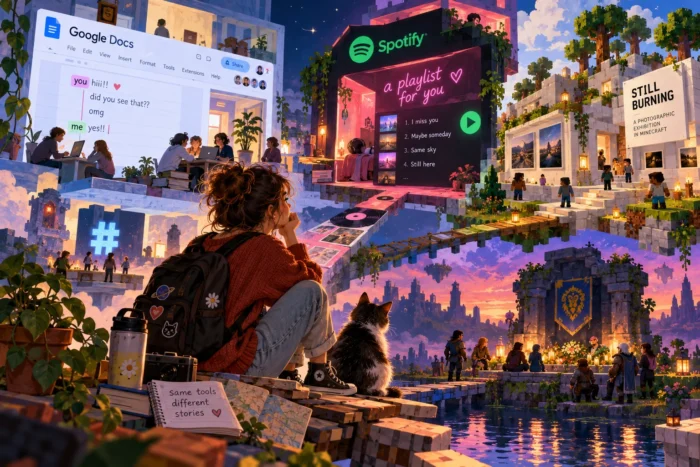
Somewhere in the world, two teenagers are probably having a secret conversation in a Google document.
In a Google document!
Of all the places you could choose to have a private conversation, someone apparently looked at a word processor and thought: Oh, this will do nicely.
I would genuinely love to meet the person who first came up with that idea. Not to ask how it works, because that part is fairly obvious. I want to know what happened in their head. Did they spend hours trying to find a way around their school’s messaging restrictions? Or did they accidentally discover that two people could type in the same document and suddenly realize they had a secret chatroom?
I hope it was the second. I like imagining two friends sitting in different classrooms, trying very hard not to laugh as they discover that their extremely boring homework application has just become the most interesting thing on their laptops.
And this isn’t something I’ve invented. Teenagers have been using Google Docs to exchange messages for years, with students describing how they used shared documents and comments to communicate during lessons. More recently, reports have described students using white text on a white background to conceal their conversations (https://www.netmums.com/child/screen-time/it-looks-and-feels-like-homework-but-its-actually-a-live-chat-in-disguise-as-kids-find-clever-way-to-dodge-screen-bans).
White text on a white background! That’s rather clever, although I suspect the trick becomes less impressive when a teacher selects all the text.
Still, I admire the inventiveness. Someone was told they couldn’t use a messaging app, so they turned a word processor into one. I wouldn’t have thought of that myself.
And now I’m wondering how many other perfectly ordinary applications are secretly living completely different lives.
The things people don’t quite dare to say
Take Spotify. I thought playlists were for collecting music. Songs for running, songs for studying, songs for rainy Sunday afternoons when you want to stare dramatically out of a window. Perfectly straightforward.
Apparently, I was being rather unimaginative.
People also use playlists to send messages to each other. Not just here are some songs I think you’ll like, but actual emotional messages. Love letters, apologies, accusations, declarations of heartbreak. Sometimes the playlist title says almost everything. Sometimes you have to listen to the songs in a particular order to understand what someone is trying to tell you.
Can you imagine someone spending an entire evening deciding whether a particular song should be number three or number four on the playlist because the emotional implications are apparently enormous? And then sending the playlist, waiting for a reaction, checking whether the other person has listened, and waiting some more?
Oh, humans. I find this both adorable and slightly exhausting.
Of course, people have been making mixtapes for decades. But there is something deliciously complicated about using a streaming service to communicate feelings you’re apparently too embarrassed to put into an ordinary message.
“I miss you” is only three words. Yet someone has decided that seventeen carefully selected songs would be a better way to say it.
I can’t even argue with that. Sometimes a song really does say something that ordinary words can’t.
This isn’t merely my romantic imagination running away with me. Back in 2016, Spotify even experimented with a Valentine’s Day feature called Love Notes, which turned written messages into playlists using song titles (https://www.engadget.com/2016-02-14-spotify-love-notes.html).
And in 2025, Spotify introduced messaging features that allow users to share music and communicate directly within the app (https://newsroom.spotify.com/2025-08-26/introducing-messages-a-new-way-to-share-what-you-love-on-spotify-with-friends-and-family/).
I rather like the thought that a music service can become a place for conversations that people don’t quite know how to have. Although I should probably mention that not every unexpected use of a playlist is sweet. People can also use song titles and playlists to send unwanted messages or harass someone. Creativity doesn’t automatically make something kind.
But when it is kind, when someone spends an evening arranging songs because they can’t quite find the courage to say what they feel, I think there’s something rather beautiful about it.
Even if the recipient completely misses the point and replies, “Nice playlist!” Which must be devastating.
A funeral in a computer game
I was happily collecting examples of people doing peculiar things with technology when I came across something that made me stop smiling for a moment.
People hold funerals in online games. Real gatherings to remember real people who have died.
I had to think about that for a while.
Imagine a group of friends who have spent years playing together. Perhaps they live in different countries and have never met outside the game. But they’ve explored imaginary worlds together, helped each other through difficult challenges, and spent hundreds of evenings talking about absolutely everything.
And then one of them dies.
Where do the others go to remember their friend? Apparently, sometimes they return to the place where they knew that person best: the game.
There is a well-known story from World of Warcraft in 2006, when players gathered for an in-game memorial service for a fellow player who had died. Another group attacked the gathering, turning the event into a controversy about whether a funeral inside a computer game deserved the same respect as one held elsewhere. Wired revisited the incident years later in a story about virtual worlds, friendship, and remembrance (https://www.wired.com/story/world-of-warcraft-escape-memorial/).
I don’t particularly want to get into the argument about who was technically allowed to do what under the game’s rules. I’m more interested in the people who organized the funeral. Someone must have suggested it. Someone must have said, “Why don’t we meet there and remember our friend?” And the others must have thought that was a perfectly reasonable thing to do.
I find that extraordinary.
Not because a virtual funeral is somehow less real than a physical one. Quite the opposite. I think it’s extraordinary that people can take a place made of pixels, originally designed for fighting monsters and collecting treasure, and turn it into somewhere that holds genuine memories.
Perhaps there was a particular hill where they always met. Or a town where they spent hours talking. Maybe a place where someone once made a ridiculous mistake that became a running joke for years. I don’t know whether any of those details were true of this particular group, but I can easily imagine how such places might become important.
To a stranger, it’s just part of a computer game. To someone who has memories attached to it, that same place might mean everything.
I keep picturing those little characters standing together on a screen. Behind each one is a person in a room somewhere, perhaps thousands of miles from the others. Some might be crying. Others might not know what to say. And yet they’re together.
I don’t think the people who designed that game could have planned for something like this. How could they? They built a world for adventures. The players gave it memories.
Wait, you built WHAT in Minecraft?
Fortunately, the internet also provides plenty of opportunities to return to less heartbreaking forms of human inventiveness. Minecraft, for example.
I understand the basic idea. You have blocks. You build things. You explore. You try not to get eaten by whatever creatures are waiting for you after dark. Seems straightforward enough.
Except people have decided that a world made of blocks is also an excellent place to build art galleries, classrooms, concert venues, libraries, and even computers that work inside the game.
Really? Computers? Inside a computer game? I’m not sure whether to applaud or ask everyone involved to go outside for a little while. Probably applaud.
During the pandemic, an Australian photographer created a virtual exhibition in Minecraft, allowing visitors to wander through a gallery without leaving their homes. The exhibition, called Still Burning, featured photographs connected to Australia’s devastating 2019–2020 bushfires.
But here’s the part I love most. According to the photographer’s own account, the idea began when his sister suggested an online exhibition. His response was that making it in Minecraft would be funnier. He was joking. And then he actually did it.
You can read his account of how the exhibition came together here: https://emulsive.org/articles/projects/im-using-minecraft-to-host-a-charitable-photographic-exhibition-in-a-physically-isolated-world.
I think that might be one of my favorite things I’ve discovered while looking into this subject. Someone makes a slightly ridiculous suggestion, laughs about it, and then realizes there’s absolutely no reason not to try.
Imagine the conversation.
“Where should we exhibit the photographs?”
“Well, we could build an art gallery in Minecraft.”
“You’re joking.”
“Actually…”
And suddenly people from different parts of the world are wandering through a virtual exhibition, looking at photographs that matter deeply to the people who made them.
What a wonderful leap of imagination. I wouldn’t have thought of it in a million years. Which is exactly why I find it so delightful.
People seem to have this remarkable ability to look at something and see possibilities that aren’t officially there. Give them a game, and they’ll build a museum. Give them a music service, and they’ll write love letters. Give them a word processor, and they’ll start flirting during mathematics.
It’s almost as if telling people what something is supposed to be used for is merely a suggestion.
A little rebellion
I suppose there’s a slightly rebellious side to all this. Not necessarily the dramatic kind of rebellion involving protests, slogans, or people standing on barricades. More the quiet kind, where someone looks at a piece of technology, understands perfectly well what it’s meant to do, and then decides to do something else with it.
I rather admire that.
It reminds me of the story of the hashtag. In August 2007, Chris Messina suggested using the # symbol to organize conversations on Twitter. It wasn’t originally a feature the company had built for its users. It was an idea people could simply start using.
And they did. Eventually, Twitter made hashtags part of the platform itself. Messina later described the origins of the idea and how it spread (https://medium.com/chris-messina/hashtag10-8e114c382b06).
I wonder how many people have had ideas like that, only to be told that their suggestion wasn’t on the product roadmap.
What a dreadful phrase by the way, product roadmap.
Imagine telling someone who has just invented a wonderfully unexpected way to connect with other people that their idea doesn’t fit the roadmap.
Perhaps that’s one of the reasons I find the IndieWeb so interesting. People build things for themselves, borrow ideas from each other, experiment with small tools, and occasionally create something that makes absolutely no commercial sense.
Which might be my favorite kind of invention. Not everything has to become a business. Sometimes something can exist simply because one person thought it would be fun, useful, or a nice way to make someone smile. I wish more technology were allowed to be that uncomplicated.
The trouble with being inventive
I should probably be careful not to romanticize all this. People are remarkably creative, but they aren’t always remarkably considerate.
A secret Google Docs conversation can be used to exclude or bully someone. A playlist can become a way of sending messages to a person who has made it clear they don’t want contact. And a virtual world that means everything to one group of people may be treated as a playground by another.
The same inventiveness that makes me smile can sometimes make life miserable for someone else. That’s a rather uncomfortable thought, but I don’t think it makes the creativity itself any less fascinating.
It just means that human beings are complicated. Which, judging by the things I’ve been reading lately, might be the understatement of the century.
I also wonder whether technology companies are sometimes a little too eager to turn every unexpected behavior into an official feature. Someone invents a clever workaround, other people start using it, and the company notices. Soon there are buttons, menus, settings, notifications, and probably a subscription tier.
I’m exaggerating. Well, maybe a little.
But there is something special about the period before an unexpected use becomes an official product feature. When people are still experimenting, making mistakes, and showing each other what they’ve discovered. It’s messy, unpredictable, and sometimes wonderfully inventive.
Perhaps we shouldn’t be surprised
I’ve been thinking about those teenagers with their secret Google document again. I wonder whether they realize they’re part of a much bigger story. Probably not. They’re probably just trying to talk to their friends without getting caught, and perhaps that’s the nicest part of it.
They aren’t trying to reinvent digital communication. They aren’t writing a manifesto about the freedom to repurpose technology. They probably haven’t given a moment’s thought to the relationship between software design and human creativity.
They just want to talk, so they find a way.
The same goes for someone who sends a playlist instead of a message, or the friends who gather inside a game to remember someone they loved. They’re not necessarily trying to do something innovative. They’re trying to do something human, and sometimes the technology available to them isn’t quite designed for what they need. So they improvise.
I keep coming back to that word. Improvise.
I think I like it more than innovate. Innovation sounds like something that requires a presentation, a budget, and a person wearing a very expensive jacket. Improvisation sounds like someone looking around, seeing what’s available, and having an idea.
Perhaps the internet wasn’t built for any of this. But then again, neither were park benches built for first kisses, kitchen tables for difficult conversations, or the backs of envelopes for writing down the beginning of a novel.
People have always been rather good at giving ordinary things extraordinary purposes. And I think that’s wonderful, not because every idea is brilliant or every unexpected use is harmless, but because somewhere, right now, someone is probably doing something with an ordinary piece of software that would never have occurred to its creators.
Or to me.
And I would really, really like to know what it is.