Why I Still Return to CDs, Vinyl and the Imperfect Sound of Music

For many people, music has become something almost invisible. It is everywhere, all the time. A few taps on a smartphone are enough to summon almost any song ever recorded. Streaming services have made music more accessible than any generation before us could have imagined. Yet something has changed along the way: the relationship between listener and music.

An interesting reflection on this comes from an article on Pigeons & Planes called “The Lost Joy of Music Piracy: What.CD, Oink, and the Banalities of Streaming”, written by Eden DaSilva. The article looks back at the strange and fascinating world of early online music communities such as Oink and What.CD, and explores how those platforms created a different kind of relationship with music. You can read Eden DaSilva’s original article on Pigeons & Planes.

The title may sound surprising. After all, music piracy is usually discussed in terms of lost revenue, copyright violations and damage to artists. But DaSilva’s article focuses on something else: the passion, curiosity and discovery that existed in some of these online communities. These were not simply places where people downloaded files. They were often communities of music enthusiasts who searched for rare recordings, discussed albums in detail and treated music collections almost like digital record stores or personal archives.

And that idea made me think about my own relationship with music.

Convenience is not the same as connection

Streaming is incredibly convenient. I use it myself. Being able to discover new artists, explore unfamiliar genres and instantly find a song that has just crossed my mind is something I would not want to lose.

There is also something wonderful about discovering music completely by accident. One warm summer evening, I was walking through an old town in France when I heard music drifting out of an open window somewhere above the street. I stopped, took out my phone and opened Shazam. Within seconds it identified the artist as Linh, a French singer I had never heard of before. You can find her here on Spotify.

I started listening to more of her music and was immediately drawn to her wonderful voice and songs that seem to contain an enormous amount of attention to small musical details. And, as so often happens with music, one discovery led to another. Through Linh I started exploring other French artists and eventually found singers such as Zaz on Spotify, whose distinctive voice and mixture of French chanson, pop and jazz opened yet another musical door. That is perhaps one of the nicest things about modern digital music: sometimes all it takes is an open window, a summer evening and Shazam to send you down a completely new musical path.

But convenience is not the same as connection. Sometimes I deliberately move away from streaming and return to music that I actually own. I still have a collection of CDs, and rather than letting them disappear into a cupboard somewhere, I have made them available through my own media server using Jellyfin and Plex. (I can never decide which option is perfect for me).

Using these apps, those albums become part of my personal digital library again. They are not just something I temporarily access through a subscription service. They are my collection, selected over decades, containing memories and associations. There is something satisfying about opening that library and seeing albums that I chose myself. There is a story behind many of them: where I bought them, when I discovered the artist, which period of my life they are connected to.

It is a very different experience from opening a streaming service and being presented with a seemingly endless collection of playlists and recommendations selected by an algorithm.

Hunting for little gems

The same feeling applies even more strongly to vinyl. Whenever I visit vintage stores, I keep an eye open for old records. These are not necessarily expensive collector’s items. In fact, the most interesting discoveries are often the unexpected ones: forgotten albums sitting quietly between hundreds of others, waiting for someone to notice them.

During a visit this summer to the old town of Perpignan in southern France, I walked into a small record store and found exactly such a treasure: Gary Burton’s Throb, a jazz album originally released in 1969. It was not an album I had specifically gone looking for. It was simply one of those discoveries that happen when you browse through physical records instead of typing an artist or album title into a search box.

Back home, I put the record on the turntable. And it sounded incredible.

Or is it the noise?

Of course, a modern digital version streamed in high quality might technically offer cleaner sound. The background noise would be gone. There would be no tiny clicks, no occasional crackle and none of the small imperfections caused by decades of playing and handling a physical record. But perhaps those imperfections are part of the magic. Maybe Throb doesn’t sound incredible despite those little noises. Maybe it sounds incredible partly because of them.

There is something about putting an old record on a turntable and hearing that brief crackle before the music starts. It immediately changes the experience. You know that you are listening to a physical object. A groove cut into a piece of vinyl more than half a century ago is mechanically producing the music that fills the room. Technically, that shouldn’t make the music better. Emotionally, it just might.

A vinyl record is not simply an audio file. It is a physical object that has travelled through time. Its small noises tell a story. They remind you that music is not only about technical perfection. It is also (mostly?) about atmosphere, emotion, memory and the experience of listening.

Perhaps that is why an old jazz record can still feel so alive. The tiny sounds between the notes create a sense of presence. They make you aware that this is not simply another recording being delivered by a digital service. Or an AI tool. It is a performance captured in another era and brought back to life in your own room.

When everything is available

None of this means that streaming is somehow bad. Quite the opposite. Streaming has opened the door to an unimaginable amount of music. Someone discovering jazz today can move from Miles Davis to Charles Mingus, Gary Burton, Keith Jarrett or hundreds of obscure artists within minutes. A teenager can explore music recorded decades before they were born without having to spend a fortune buying records. That is an extraordinary achievement.

But perhaps there is a paradox hidden inside that abundance. When everything is available instantly, individual pieces of music can start to feel less valuable. Discovery becomes effortless. Algorithms suggest what we might like. Playlists replace albums. Songs are skipped after twenty seconds. Music increasingly becomes something running in the background while we work, travel or scroll through our phones. There is always another song waiting. And another.

DaSilva’s article about the old piracy communities is interesting precisely because it reminds us that digital music did not always work like this. Finding music could require effort. People searched, collected, compared different versions and shared discoveries with others. Strangely enough, having less convenient access to music could sometimes create a stronger relationship with it.

Europe Doesn’t Need Its Own Big Tech. It Needs a More Diverse Internet

For quite some time now, Europe’s debate about digital sovereignty has largely revolved around one question: how do we reduce our dependence on American Big Tech?

It is an understandable concern. European governments, businesses and public institutions depend heavily on a relatively small group of US companies for cloud infrastructure, workplace software, search, social media, advertising, mobile ecosystems and increasingly artificial intelligence. That concentration creates questions around control, jurisdiction, data, resilience and economic power.

But there is a danger in defining digital sovereignty too narrowly. If Europe simply replaces American Big Tech with European Big Tech, we may change the nationality of the companies involved without solving the underlying problem. What Europe needs is not merely European technology. It needs technological diversity.

Monoculture is the real vulnerability

Hamish Campbell, who writes extensively about the open web and the Open Media Network, makes an important distinction. The problem with today’s internet is not simply that companies such as Google, Meta or Amazon have become extremely powerful. It is that digital infrastructure has developed into something resembling a monoculture.

When a small number of platforms dominate communications, infrastructure and online identity, dependency follows. Dependency gives those platforms control, while concentration makes the wider ecosystem vulnerable. Campbell therefore argues that the answer cannot be another monoculture carrying different branding.

That observation is particularly relevant to the European sovereignty debate. Imagine Europe successfully creates one major European cloud provider, one dominant European social network, one European AI platform and one European office-software ecosystem. European institutions might become less dependent on US companies, but customers could still face exactly the same structural problems: vendor lock-in, difficult migrations, concentrated market power and enormous dependence on individual suppliers. Sovereignty without diversity can simply create a different dependency.

We need an ecosystem, not a champion

Europe therefore needs to look beyond the traditional idea that every technology market requires a handful of very large “champions”.

The open web offers a different model. Instead of searching for one platform capable of replacing Facebook, X, Microsoft or Google, the objective can be to create an ecosystem in which many different services coexist and communicate through open standards.

Campbell describes the open web as something that should deliberately be messy: different technologies, organisations, communities and approaches existing alongside each other rather than converging on one supposedly perfect solution.

That messiness may actually be an advantage. A healthy digital ecosystem could include commercial companies, open-source projects, cooperatives, universities, public infrastructure providers and thousands of smaller hosting and software businesses. Some might operate locally, others internationally. They would not necessarily use identical technology, provided that open standards and interoperability allow users and information to move between them.

The comparison with biodiversity is obvious. An ecosystem containing many different species is generally more capable of adapting when circumstances change than one dominated by a single organism. Digital infrastructure deserves the same thinking.

Federation alone is not enough

The Fediverse demonstrates some of these possibilities. Instead of one company owning the entire social network, independent servers can communicate through common protocols such as ActivityPub. But decentralisation at the technical level does not automatically guarantee decentralisation in practice.

Campbell warns that federated systems can decentralise servers while gradually recentralising culture, governance and influence. The challenge is therefore not simply scaling the infrastructure. Communities, governance structures and shared social infrastructure must scale with it.

That lesson should be taken seriously in Europe. Building alternatives to hyperscalers is not enough if those alternatives eventually follow precisely the same path: consolidation, acquisition, platform concentration and lock-in.

Dependency is remarkably difficult to escape

There is another reason diversity matters. Once a platform becomes deeply embedded in everyday economic and social activity, leaving becomes increasingly difficult.

A small business may depend on Instagram to reach customers. A community organisation might coordinate activities through Facebook. Friends and families may communicate through WhatsApp. Companies can build entire business processes around one cloud provider. Campbell describes this as an infrastructure problem rather than simply an individual choice. People cannot easily leave dominant platforms when everyone and everything they need remains there.

Twenty years of platform dominance have therefore created something much deeper than market share. They have created habits, dependencies, technical architectures and network effects that reinforce one another.

Sovereignty should mean having choices

This changes the meaning of digital sovereignty. True digital autonomy should not mean that every server, application or cloud service must carry a European flag. Nor should it mean creating European equivalents of every American hyperscaler.

It should mean that organisations retain meaningful choices. They should be able to change providers without rebuilding their entire IT environment. Data should be portable. Standards should be open. Different platforms should interoperate. Open-source alternatives should remain viable. Smaller providers should be able to participate without first becoming hyperscalers themselves.

The strategic objective should therefore be bigger than replacing Big Tech. Europe needs an internet and technology industry where no single company becomes indispensable in the first place. Because the strongest form of digital sovereignty is not owning the next hyperscaler. It is not needing one.

De Overstap: My Search for a More Sovereign Digital Life

Over the past few months, I have been writing a regular blog for Dutch IT publication Computable.nl called De Overstap (text is in Dutch)— which roughly translates as Making the Switch.

The subject is digital sovereignty. But rather than approaching it primarily as a policy discussion, I am trying to look at a much more practical question: what actually happens when individuals and organisations try to reduce their dependence on Big Tech?

There is no shortage of discussion in Europe about digital sovereignty, technological autonomy and the dominance of mainly American hyperscalers. What interests me is what happens after that discussion. Which alternatives already exist? Are they good enough? What makes migration difficult? And are European and open-source solutions genuinely usable in everyday working environments?

Computable describes the series as a guide for IT professionals and decision-makers looking for alternative business solutions. So far, seven editions have been published.

It started with my MacBook

The first edition, “How do I get rid of my MacBook?”, was deliberately personal. After years inside Apple’s ecosystem, I moved much of my daily work to Linux, LibreOffice, Thunderbird, Nextcloud and other predominantly European or open-source tools.

The interesting discovery was that the move itself was considerably easier than expected. But it also revealed something important: you never operate completely independently. Customers, colleagues and other organisations may still expect Microsoft Teams, Adobe software or proprietary file formats. Digital sovereignty is therefore not simply a matter of choosing another laptop.

Half a million French students show what is possible

The second edition moved from my desk to the French education system. In Île-de-France, almost 550,000 students, teachers and staff use an environment based partly on Nextcloud and hosted using European infrastructure.

It is an interesting example because it demonstrates that open-source and European alternatives are not limited to enthusiasts or small experiments. They can operate at substantial scale. The article also looked at NLnet Labs moving projects from GitHub to Codeberg and at emerging European office platforms.

Open source needs an enterprise model too

Edition three examined an often overlooked problem. Having technically capable open-source software is not enough for large organisations. Enterprises also want contracts, support, accountability and somebody to call when something goes wrong.

One possible answer comes from organisations such as the Dutch Opensource Business Alliance, where specialist companies can work together in consortia and present customers with something resembling the service model they are accustomed to receiving from large proprietary vendors. The edition also explored European attitudes towards replacing US technology and alternatives to platforms such as GitHub and Notion.

Where does the money for migration come from?

Digital sovereignty sounds attractive until somebody asks who is going to pay for it.

The fourth De Overstap therefore looked at the economics of migration. One potentially useful approach is to examine existing IT contracts first. Organisations may be able to free up part of the necessary migration budget by benchmarking and renegotiating existing software and services agreements.

The broader point is that sovereignty cannot be treated purely as an architectural issue. Technology, procurement, contracts and financial planning are closely connected. This edition also examined the Dutch government’s decision to operate its own environment for hosting open-source code.

Sometimes you have to switch twice

My own migration did not proceed in a perfectly straight line either.

I originally switched from macOS to openSUSE on a Lenovo ThinkPad. It worked, but there were enough small issues — particularly involving hardware and some everyday applications — to interfere with my work. So I started again, this time with a Spanish Slimbook EVO running Linux Mint.

That experience became edition five. For me, Linux Mint turned out to be much closer to what mainstream users need: an operating environment that does not make the operating system itself a daily project. The article also looked at the contradictions that can arise when supposedly European services still depend on American cloud infrastructure.

The laptop was easy. Now for the smartphone

Edition six moved to perhaps the more difficult part of leaving Big Tech behind: the mobile phone.

My Linux laptop had by then become an ordinary piece of working equipment. My phone remained more complicated. Moving from an iPhone to a conventional Android device simply means moving from one dominant US ecosystem to another.

So I looked at European and more open alternatives, including France’s /e/OS and Murena and Finland’s Sailfish OS and Jolla. The article also explored developments around sovereign cloud infrastructure and European AI.

Convenience still beats principles surprisingly often

The seventh and, at the moment, most recent edition asks how much progress Europe is really making.

There are certainly more sovereign-cloud projects, open-source migrations and proofs of concept than there were only a short time ago. But there is also a striking contradiction. Organisations may discuss sovereignty, NIS2 and strategic dependence in one meeting, while adopting another service from Microsoft or another hyperscaler in the next.

That does not necessarily mean they do not understand the problem. Often the forces pulling in the opposite direction are very practical: existing platforms, perceived migration risks, pressure to introduce AI quickly and management’s desire to demonstrate immediate productivity improvements. Convenience, in other words, still frequently wins over principles.

A journey rather than a destination

That is probably why I enjoy writing De Overstap. It is not really a blog about replacing Microsoft, Apple, Google or AWS with a predetermined list of European products.

It is about discovering what genuine digital autonomy looks like in practice — including the compromises, failed experiments, unexpected alternatives and very ordinary usability issues that are easily forgotten in high-level debates about sovereignty.

And there is plenty more to explore.

All editions of De Overstap can be found here.

The Digital Footprints We Leave Behind: Preserving Our Stories Beyond the Web

Blogs are strange things. They are personal, sometimes deeply personal, collections of thoughts, experiences, ideas and observations. Unlike a printed diary that can disappear into a drawer, a blog lives somewhere on the internet. It can remain accessible for years, even decades, long after the person who wrote it has stopped adding new stories.

This raises an interesting question: what happens to the digital stories we leave behind?

That is exactly the topic explored by Michael Harley in his thoughtful blog post about the future of our online writings and the question of digital legacy. It is a fascinating reflection on what happens to the content we create once we are no longer actively maintaining it.

For many bloggers, writing is not just about publishing information. A blog is often a digital extension of ourselves. It contains memories, opinions, lessons learned, discoveries, frustrations and moments of inspiration. In many ways, it is comparable to the letters, notebooks and diaries that previous generations left behind. The difference is that digital content can potentially survive forever — but only if someone takes care of it.

Harley’s article made me think about my own blog.. Here I publish articles, observations and personal stories there. Some are about technology, digital sovereignty, open source and the future of IT. Others are much more personal reflections about music, travel, creativity and the small moments that make life interesting. But what happens with all that content in ten, twenty or fifty years?

A Periodic ePub Version of My Content

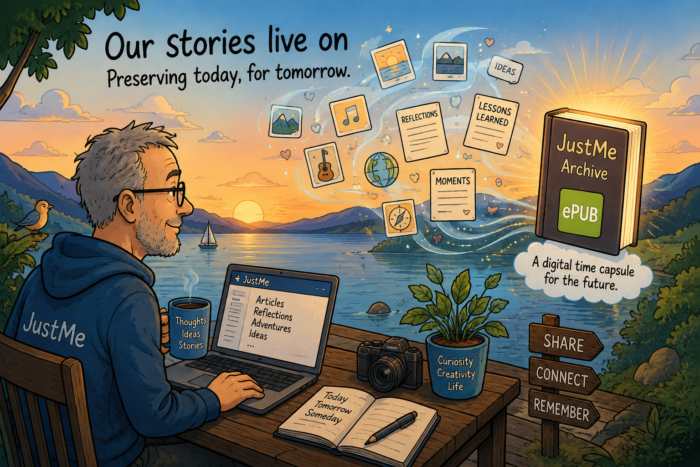
One idea that particularly appeals to me is creating a periodic ePub version of the content published on JustMe. Perhaps every month, every quarter or once a year, the latest articles could be collected into a digital book. An ePub is a simple but powerful format: it can be stored, copied, read on different devices and preserved much more easily than a constantly changing website.

Such a digital “JustMe Archive” would create a kind of time capsule. It would not only preserve the texts themselves, but also capture a specific moment in time. Reading old blog posts often reveals more than just the subject being discussed. It shows how people thought about technology, society and the world around them at that particular moment.

Of course, no digital archive is completely future-proof. Websites disappear, platforms change, domains expire and file formats become outdated. Preserving digital content requires some attention. But perhaps that is exactly the point: our digital memories need the same care that previous generations gave to photo albums, letters and physical documents.

The question of digital legacy is becoming increasingly relevant. Many of us have created a substantial online presence, whether through blogs, social media, photographs or other digital projects. Yet we rarely think about what happens to these creations when we are no longer around.

A blog is more than a collection of web pages. It is a record of curiosity, creativity and human experience. Creating regular ePub archives could be a simple way to ensure that this record does not disappear.After all, perhaps the most valuable thing we leave behind is not the technology we used to create our stories, but the stories themselves.

Europe Is Better at Tech Than We Like to Admit

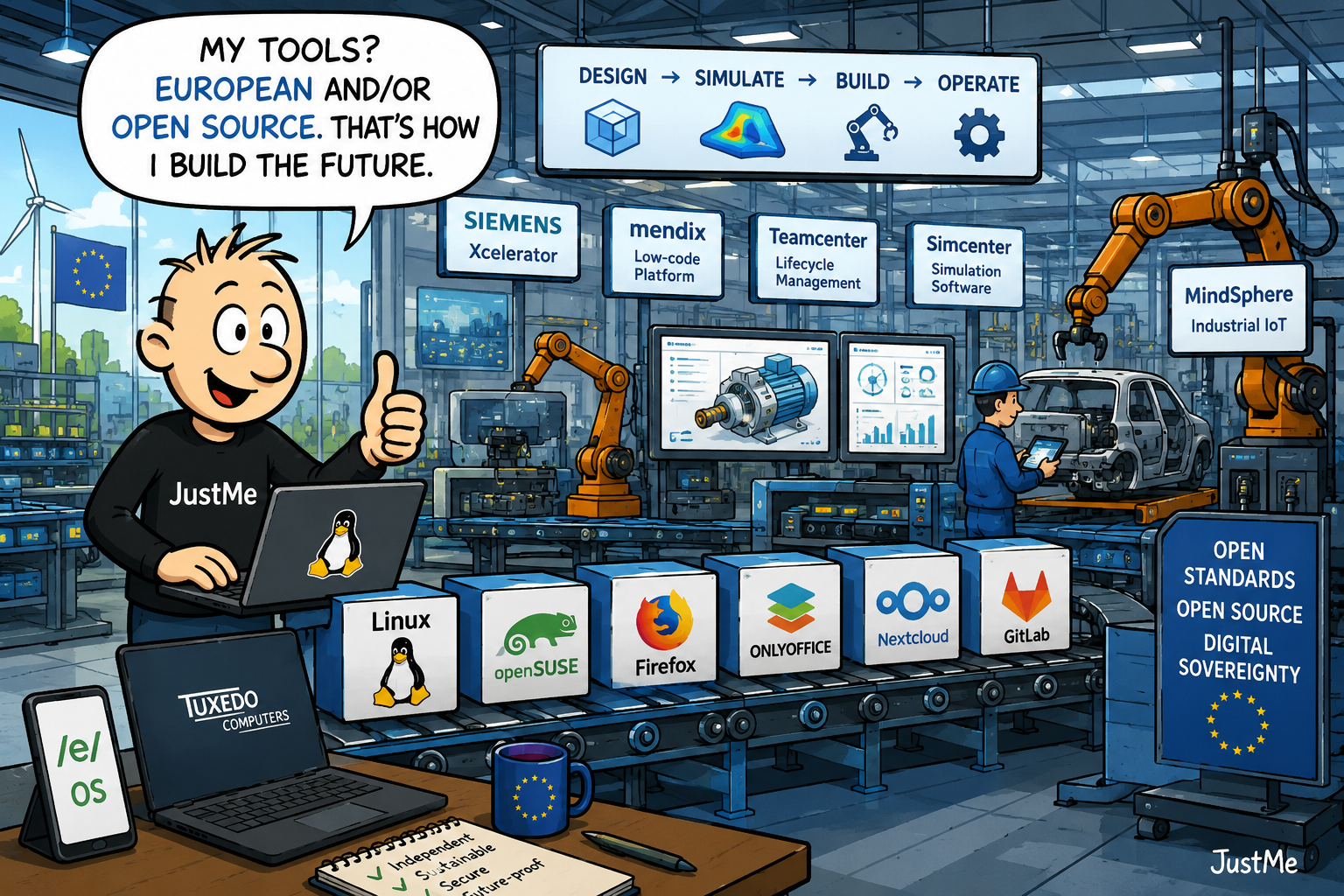
I am personally very interested in digital sovereignty, digital autonomy, European technology and open-source software. Partly because I believe Europe needs more control over the technology on which our companies, governments and societies increasingly depend. The tools I use myself — from my laptop and phone to software applications — are almost exclusively European and/or open source.

At the same time, I sometimes — perhaps even often — get frustrated by the way this discussion is conducted, especially in the Netherlands. There is a persistent assumption that European technology does not amount to very much, that the United States has already won the technology race, and that open source is mostly something complicated for technically minded enthusiasts. I think that picture is far too simplistic.

There is certainly a technology gap in some areas. American hyperscalers dominate cloud computing, many of the most visible AI companies are American, and China has built formidable capabilities in areas such as manufacturing, batteries and robotics. Pretending otherwise would be pointless.

But there is another side to the story. Sometimes I also think CIOs and IT managers make things unnecessarily easy for themselves. If Microsoft, AWS or another established supplier already provides almost everything you need, it is tempting simply to buy whatever your preferred vendor puts in front of you. That is convenient. It reduces the number of suppliers, contracts and technologies that need to be evaluated. But convenience can easily turn into dependency.

European and open-source alternatives are therefore sometimes dismissed as being too difficult before they have even been seriously investigated. And in the Netherlands in particular, I sometimes feel there is too much pessimism surrounding European technology. We talk extensively about everything Europe cannot do, while paying considerably less attention to the areas in which European companies are genuinely world-class.

That was one of the reasons I was particularly interested in visiting Siemens Realize Live Europe in Amsterdam. I knew beforehand that Siemens would offer a rather different perspective on the global technology race.

Europe is not absent from the technology race

I recently wrote about the event for Computable.nl in an article titled “Siemens: Europa is ijzersterk op het gebied van industriële tech” (text is in Dutch). The central message is worth repeating: Europe may not always dominate the headlines surrounding artificial intelligence, cloud platforms or consumer technology, but in industrial technology its position is considerably stronger than the popular narrative sometimes suggests.

One of the most striking examples during the event involved UBTech, a well-known Chinese manufacturer of humanoid robots. At first sight, it appears to be another illustration of Europe’s supposed technological weakness. China builds advanced humanoid robots while Europe watches from the sidelines. Except that this is not what is actually happening.

Siemens demonstrated how UBTech uses technology from the Siemens Xcelerator portfolio to design, simulate, test, manufacture and manage its robots throughout their lifecycle. In other words, some highly advanced Chinese technology is being created with European industrial software and engineering technology.

That changes the picture considerably. Yes, the most visible product may be Chinese, while much of the engineering infrastructure behind it comes from Europe.

Industrial technology deserves more attention

This is perhaps one of the problems with the broader technology debate. We tend to judge technological strength by looking at the companies that are most visible to consumers. Google, Microsoft, Amazon, Apple, OpenAI, Meta and Nvidia naturally receive enormous amounts of media attention. Industrial technology is much less visible. Yet behind virtually every physical product is an enormously complex digital environment. Aircraft, cars, chips, machines, factories, energy systems and robots must be designed, simulated, tested, manufactured and maintained. And Europe has exceptionally strong companies in precisely those areas.

At Realize Live Europe, Siemens repeatedly emphasised this complete industrial digital chain. Its strategy increasingly revolves around what the company calls the digital thread: connecting information from chip and electronics design through mechanical engineering, simulation and manufacturing all the way to factory automation and maintenance.

That includes technologies from companies Siemens has acquired over the years, including Mentor Graphics, Altair and the originally Dutch low-code company Mendix. Instead of presenting these as separate software products, Siemens increasingly positions them as parts of a connected industrial technology platform.

AI, but not AI for AI’s sake

Artificial intelligence naturally played a major role at the event. What I found interesting, however, was that Siemens did not primarily present AI as yet another chatbot. The focus was much more practical. AI is being incorporated into engineering tools, simulation software, manufacturing systems and product lifecycle management. According to Siemens, AI already reduces the time required to create certain technical 2D drawings by around fifty percent, while parts can be classified in Teamcenter roughly ten times faster.

The company is also introducing AI agents capable of carrying out parts of engineering workflows. But engineers remain responsible for supervision and final decisions. This is an important distinction. In industrial environments, AI cannot simply generate something that looks plausible. Engineering information needs to be accurate, traceable and connected to the correct version of a product or production process. That is why Siemens places so much emphasis on data.

Intelligence Center X

One of the major announcements during Realize Live Europe was Intelligence Center X, which Siemens positions as an intelligent layer across its software portfolio. The idea is that AI agents can analyse information, initiate processes and support engineers while remaining connected to the underlying industrial data. Instead of copying enormous quantities of information into separate AI environments, the agents work with data stored in systems such as Teamcenter.

That is significant because industrial data changes continuously. A product configuration may change. A component may be replaced. A new engineering version may become available. Manufacturing parameters may be adjusted. AI systems therefore need more than access to data. They need access to the right and current data, including the context in which that information exists.

Traceability is equally important. Companies need to understand where information came from and why an AI system reached a particular conclusion. These requirements are rather different from those of consumer-oriented generative AI.

Simulation becomes part of design

Another fascinating development is happening in simulation. Traditionally, engineers often designed something first and then used simulation to determine whether the design would actually work. That process is changing. According to Siemens, the combination of GPU acceleration and what it calls Physics AI can make some simulations hundreds or even thousands of times faster.

Examples presented at the event illustrated the impact. Continental has reportedly reduced a complex airbag simulation from around two hours to less than thirty seconds. Magna reduced another simulation from fourteen hours to approximately ten seconds. Rolls-Royce is using Simcenter Simsolid to analyse engine designs much more quickly.

When simulations take seconds rather than hours, they become something very different. An engineer can test many different design options during the design process rather than using simulation mainly as a final verification step. That can potentially change the way products are developed.

AI enters the factory

The same development is happening inside factories. Siemens demonstrated how AI can analyse abnormalities in manufacturing processes and combine information from engineering systems, ERP software and production environments. Instead of requiring engineers to manually investigate every possible relationship between datasets, AI can identify correlations and suggest possible improvements. (Computable)

Again, this does not mean removing humans from the process. It means automating parts of the investigative work while leaving engineers in control. That appears to be an important theme in Siemens’ approach to industrial AI: moving from systems that simply answer questions towards software that can help execute complete processes.

And then there is digital sovereignty

For me, one of the most interesting elements of the Siemens story was its connection with digital sovereignty. Mendix plays an important role here. The Dutch low-code platform, acquired by Siemens in 2018, is becoming part of the company’s broader AI architecture. It can be used to create applications and agentic workflows in which humans and AI agents work together.

But there is also an infrastructure dimension. Siemens is working with German cloud provider STACKIT to allow certain Mendix environments to run on European cloud infrastructure. According to Siemens, this currently primarily concerns projects involving Dutch government organisations, but the approach is expected to expand. Siemens has also been talking with European cloud provider OVHcloud about hosting additional Siemens solutions on European infrastructure.

That is exactly the kind of development I believe deserves considerably more attention. Digital sovereignty should not simply mean complaining about Microsoft, AWS or Google. Nor should it mean replacing American Big Tech with European Big Tech. It should mean creating genuine technological choice. That requires European cloud infrastructure, open standards, open-source technologies, interoperable software and strong European technology companies.

Perhaps we should stop underestimating ourselves

The visit to Siemens Realize Live Europe reinforced something I have thought for some time. Europe certainly has technological weaknesses. We need more investment, more scale, stronger capital markets and probably much more ambition in several areas of digital technology.

But constantly repeating that Europe has already lost the technology race is not particularly helpful either. Because it is not entirely true.

Europe has deep expertise in industrial automation, engineering software, semiconductor technology, manufacturing systems, digital twins, telecommunications, embedded systems, machine building and many other technologies that rarely generate the headlines enjoyed by ChatGPT or the latest American cloud service.

And these technologies matter enormously. Sometimes they are even the technologies being used to create the highly visible American and Chinese innovations that we subsequently point to as evidence that Europe is falling behind. The Siemens event was a useful reminder that technological power is not always found where the headlines are.

You can read my original Dutch article for Computable, “Siemens: Europa is ijzersterk op het gebied van industriële tech” here.

Perhaps the discussion about European digital sovereignty would become more productive if we spent a little less time explaining why things cannot be done — and a little more time looking at the technology that Europe already has.