Why DeepL Shows That Europe Can Build World-Class Technology

I recently read an interview with one of DeepL’s founders. It offered an interesting and rather different perspective on how AI is developing in Europe. When people talk about artificial intelligence, the conversation often quickly moves to Silicon Valley. The names are familiar: OpenAI, Google, Microsoft, Anthropic or Meta. Europe is frequently described as a continent that regulates technology rather than creates it.

I have always found that narrative too simplistic. Europe may not produce dozens of giant consumer technology platforms, but it does have companies that build highly advanced technology with a very different approach. A good example is DeepL, the Cologne-based AI company that started with machine translation and has grown into one of Europe’s most successful artificial intelligence companies.

In an interview with Bechtle, DeepL founder and CEO Jarek Kutylowski explains why the company has taken a different path from many AI competitors. His message is interesting because it is not about creating the loudest AI story. It is about building technology that people can trust and actually use.

Quality before hype

One of the most striking points from Kutylowski is his focus on quality. DeepL did not become successful by trying to be everywhere at once. Instead, the company concentrated on one very specific problem: making translations better. That sounds simple, but it is exactly where many AI projects struggle. The current AI landscape is full of impressive demonstrations, prototypes and experiments. However, moving from an exciting demo to reliable business use is a completely different challenge.

Kutylowski argues that companies need AI systems that deliver consistent results, especially when they are used in professional environments. A translation error in a casual conversation may be annoying. A wrong translation in a legal document, medical communication or international business process can have much bigger consequences. This focus on reliability is one of the reasons why DeepL has built such a strong reputation.

An opportunity in AI

The success of DeepL also challenges the idea that Europe cannot compete in artificial intelligence. Europe has a different technology culture. Issues such as privacy, security, transparency and control are often considered important from the start. For many organisations, especially in sectors like healthcare, government, finance and manufacturing, these are not secondary concerns. They are fundamental requirements.

In the interview Kutylowski highlights that AI adoption is not only about having the biggest models. It is about solving real problems for users and organisations. That is an important lesson. The future of AI will probably not belong only to companies that create the largest models. It will also belong to companies that understand specific industries, workflows and customer needs.

AI becomes part of everyday work

Another interesting point Kutylowski makes in the interview is the shift from AI experiments towards practical applications. Many organisations are currently exploring AI, but the real challenge is integration. How do you connect AI with existing processes? How do you make sure employees can use it effectively? How do you protect sensitive information?

This is where enterprise AI becomes very different from consumer AI. Businesses need control, security and predictable outcomes. DeepL’s move beyond translation into broader AI-powered communication tools reflects this change. AI is becoming less of a separate technology and more of an invisible layer within everyday business activities.

A more balanced view of artificial intelligence

The interview with Jarek Kutylowski offers a refreshing perspective in a time where AI discussions are often dominated by extremes. Some predict that AI will transform everything overnight. Others focus mainly on the risks. The reality is probably somewhere in between.

AI will change the way organisations work, but success will depend on thoughtful implementation. Companies need technology partners that understand not only algorithms, but also business processes, security requirements and human behaviour. DeepL is an interesting example because it shows another possible path for European technology: focused, specialised and built around trust.

The AI race is not only about who builds the biggest model. It is also about who builds technology that people are willing to use every day. And that is an area where Europe may have more strengths than many people realise.

Europe Doesn’t Need Its Own Big Tech. It Needs a More Diverse Internet

For quite some time now, Europe’s debate about digital sovereignty has largely revolved around one question: how do we reduce our dependence on American Big Tech?

It is an understandable concern. European governments, businesses and public institutions depend heavily on a relatively small group of US companies for cloud infrastructure, workplace software, search, social media, advertising, mobile ecosystems and increasingly artificial intelligence. That concentration creates questions around control, jurisdiction, data, resilience and economic power.

But there is a danger in defining digital sovereignty too narrowly. If Europe simply replaces American Big Tech with European Big Tech, we may change the nationality of the companies involved without solving the underlying problem. What Europe needs is not merely European technology. It needs technological diversity.

Monoculture is the real vulnerability

Hamish Campbell, who writes extensively about the open web and the Open Media Network, makes an important distinction. The problem with today’s internet is not simply that companies such as Google, Meta or Amazon have become extremely powerful. It is that digital infrastructure has developed into something resembling a monoculture.

When a small number of platforms dominate communications, infrastructure and online identity, dependency follows. Dependency gives those platforms control, while concentration makes the wider ecosystem vulnerable. Campbell therefore argues that the answer cannot be another monoculture carrying different branding.

That observation is particularly relevant to the European sovereignty debate. Imagine Europe successfully creates one major European cloud provider, one dominant European social network, one European AI platform and one European office-software ecosystem. European institutions might become less dependent on US companies, but customers could still face exactly the same structural problems: vendor lock-in, difficult migrations, concentrated market power and enormous dependence on individual suppliers. Sovereignty without diversity can simply create a different dependency.

We need an ecosystem, not a champion

Europe therefore needs to look beyond the traditional idea that every technology market requires a handful of very large “champions”.

The open web offers a different model. Instead of searching for one platform capable of replacing Facebook, X, Microsoft or Google, the objective can be to create an ecosystem in which many different services coexist and communicate through open standards.

Campbell describes the open web as something that should deliberately be messy: different technologies, organisations, communities and approaches existing alongside each other rather than converging on one supposedly perfect solution.

That messiness may actually be an advantage. A healthy digital ecosystem could include commercial companies, open-source projects, cooperatives, universities, public infrastructure providers and thousands of smaller hosting and software businesses. Some might operate locally, others internationally. They would not necessarily use identical technology, provided that open standards and interoperability allow users and information to move between them.

The comparison with biodiversity is obvious. An ecosystem containing many different species is generally more capable of adapting when circumstances change than one dominated by a single organism. Digital infrastructure deserves the same thinking.

Federation alone is not enough

The Fediverse demonstrates some of these possibilities. Instead of one company owning the entire social network, independent servers can communicate through common protocols such as ActivityPub. But decentralisation at the technical level does not automatically guarantee decentralisation in practice.

Campbell warns that federated systems can decentralise servers while gradually recentralising culture, governance and influence. The challenge is therefore not simply scaling the infrastructure. Communities, governance structures and shared social infrastructure must scale with it.

That lesson should be taken seriously in Europe. Building alternatives to hyperscalers is not enough if those alternatives eventually follow precisely the same path: consolidation, acquisition, platform concentration and lock-in.

Dependency is remarkably difficult to escape

There is another reason diversity matters. Once a platform becomes deeply embedded in everyday economic and social activity, leaving becomes increasingly difficult.

A small business may depend on Instagram to reach customers. A community organisation might coordinate activities through Facebook. Friends and families may communicate through WhatsApp. Companies can build entire business processes around one cloud provider. Campbell describes this as an infrastructure problem rather than simply an individual choice. People cannot easily leave dominant platforms when everyone and everything they need remains there.

Twenty years of platform dominance have therefore created something much deeper than market share. They have created habits, dependencies, technical architectures and network effects that reinforce one another.

Sovereignty should mean having choices

This changes the meaning of digital sovereignty. True digital autonomy should not mean that every server, application or cloud service must carry a European flag. Nor should it mean creating European equivalents of every American hyperscaler.

It should mean that organisations retain meaningful choices. They should be able to change providers without rebuilding their entire IT environment. Data should be portable. Standards should be open. Different platforms should interoperate. Open-source alternatives should remain viable. Smaller providers should be able to participate without first becoming hyperscalers themselves.

The strategic objective should therefore be bigger than replacing Big Tech. Europe needs an internet and technology industry where no single company becomes indispensable in the first place. Because the strongest form of digital sovereignty is not owning the next hyperscaler. It is not needing one.

De Overstap: My Search for a More Sovereign Digital Life

Over the past few months, I have been writing a regular blog for Dutch IT publication Computable.nl called De Overstap (text is in Dutch)— which roughly translates as Making the Switch.

The subject is digital sovereignty. But rather than approaching it primarily as a policy discussion, I am trying to look at a much more practical question: what actually happens when individuals and organisations try to reduce their dependence on Big Tech?

There is no shortage of discussion in Europe about digital sovereignty, technological autonomy and the dominance of mainly American hyperscalers. What interests me is what happens after that discussion. Which alternatives already exist? Are they good enough? What makes migration difficult? And are European and open-source solutions genuinely usable in everyday working environments?

Computable describes the series as a guide for IT professionals and decision-makers looking for alternative business solutions. So far, seven editions have been published.

It started with my MacBook

The first edition, “How do I get rid of my MacBook?”, was deliberately personal. After years inside Apple’s ecosystem, I moved much of my daily work to Linux, LibreOffice, Thunderbird, Nextcloud and other predominantly European or open-source tools.

The interesting discovery was that the move itself was considerably easier than expected. But it also revealed something important: you never operate completely independently. Customers, colleagues and other organisations may still expect Microsoft Teams, Adobe software or proprietary file formats. Digital sovereignty is therefore not simply a matter of choosing another laptop.

Half a million French students show what is possible

The second edition moved from my desk to the French education system. In Île-de-France, almost 550,000 students, teachers and staff use an environment based partly on Nextcloud and hosted using European infrastructure.

It is an interesting example because it demonstrates that open-source and European alternatives are not limited to enthusiasts or small experiments. They can operate at substantial scale. The article also looked at NLnet Labs moving projects from GitHub to Codeberg and at emerging European office platforms.

Open source needs an enterprise model too

Edition three examined an often overlooked problem. Having technically capable open-source software is not enough for large organisations. Enterprises also want contracts, support, accountability and somebody to call when something goes wrong.

One possible answer comes from organisations such as the Dutch Opensource Business Alliance, where specialist companies can work together in consortia and present customers with something resembling the service model they are accustomed to receiving from large proprietary vendors. The edition also explored European attitudes towards replacing US technology and alternatives to platforms such as GitHub and Notion.

Where does the money for migration come from?

Digital sovereignty sounds attractive until somebody asks who is going to pay for it.

The fourth De Overstap therefore looked at the economics of migration. One potentially useful approach is to examine existing IT contracts first. Organisations may be able to free up part of the necessary migration budget by benchmarking and renegotiating existing software and services agreements.

The broader point is that sovereignty cannot be treated purely as an architectural issue. Technology, procurement, contracts and financial planning are closely connected. This edition also examined the Dutch government’s decision to operate its own environment for hosting open-source code.

Sometimes you have to switch twice

My own migration did not proceed in a perfectly straight line either.

I originally switched from macOS to openSUSE on a Lenovo ThinkPad. It worked, but there were enough small issues — particularly involving hardware and some everyday applications — to interfere with my work. So I started again, this time with a Spanish Slimbook EVO running Linux Mint.

That experience became edition five. For me, Linux Mint turned out to be much closer to what mainstream users need: an operating environment that does not make the operating system itself a daily project. The article also looked at the contradictions that can arise when supposedly European services still depend on American cloud infrastructure.

The laptop was easy. Now for the smartphone

Edition six moved to perhaps the more difficult part of leaving Big Tech behind: the mobile phone.

My Linux laptop had by then become an ordinary piece of working equipment. My phone remained more complicated. Moving from an iPhone to a conventional Android device simply means moving from one dominant US ecosystem to another.

So I looked at European and more open alternatives, including France’s /e/OS and Murena and Finland’s Sailfish OS and Jolla. The article also explored developments around sovereign cloud infrastructure and European AI.

Convenience still beats principles surprisingly often

The seventh and, at the moment, most recent edition asks how much progress Europe is really making.

There are certainly more sovereign-cloud projects, open-source migrations and proofs of concept than there were only a short time ago. But there is also a striking contradiction. Organisations may discuss sovereignty, NIS2 and strategic dependence in one meeting, while adopting another service from Microsoft or another hyperscaler in the next.

That does not necessarily mean they do not understand the problem. Often the forces pulling in the opposite direction are very practical: existing platforms, perceived migration risks, pressure to introduce AI quickly and management’s desire to demonstrate immediate productivity improvements. Convenience, in other words, still frequently wins over principles.

A journey rather than a destination

That is probably why I enjoy writing De Overstap. It is not really a blog about replacing Microsoft, Apple, Google or AWS with a predetermined list of European products.

It is about discovering what genuine digital autonomy looks like in practice — including the compromises, failed experiments, unexpected alternatives and very ordinary usability issues that are easily forgotten in high-level debates about sovereignty.

And there is plenty more to explore.

All editions of De Overstap can be found here.

Europe Is Better at Tech Than We Like to Admit

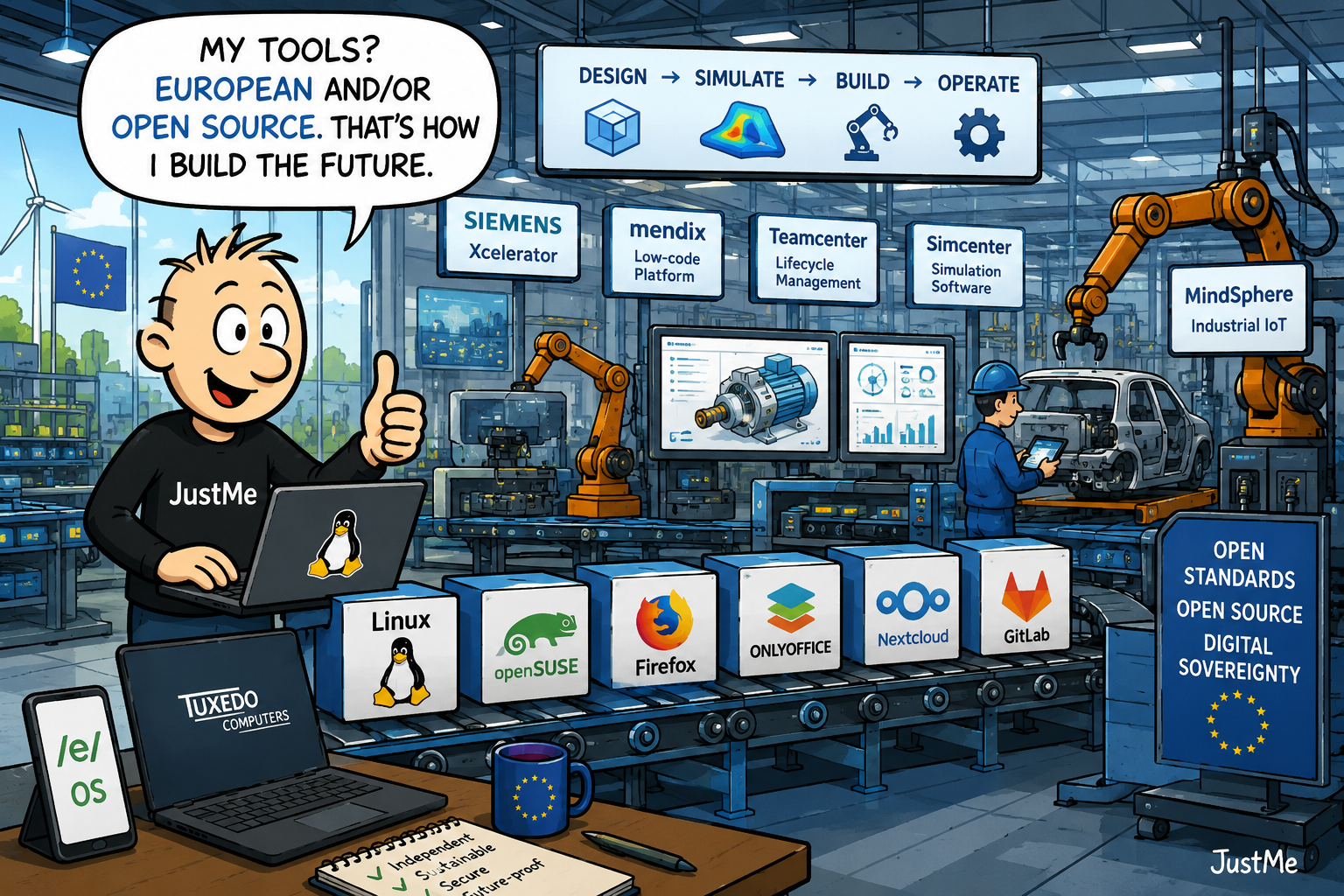
I am personally very interested in digital sovereignty, digital autonomy, European technology and open-source software. Partly because I believe Europe needs more control over the technology on which our companies, governments and societies increasingly depend. The tools I use myself — from my laptop and phone to software applications — are almost exclusively European and/or open source.

At the same time, I sometimes — perhaps even often — get frustrated by the way this discussion is conducted, especially in the Netherlands. There is a persistent assumption that European technology does not amount to very much, that the United States has already won the technology race, and that open source is mostly something complicated for technically minded enthusiasts. I think that picture is far too simplistic.

There is certainly a technology gap in some areas. American hyperscalers dominate cloud computing, many of the most visible AI companies are American, and China has built formidable capabilities in areas such as manufacturing, batteries and robotics. Pretending otherwise would be pointless.

But there is another side to the story. Sometimes I also think CIOs and IT managers make things unnecessarily easy for themselves. If Microsoft, AWS or another established supplier already provides almost everything you need, it is tempting simply to buy whatever your preferred vendor puts in front of you. That is convenient. It reduces the number of suppliers, contracts and technologies that need to be evaluated. But convenience can easily turn into dependency.

European and open-source alternatives are therefore sometimes dismissed as being too difficult before they have even been seriously investigated. And in the Netherlands in particular, I sometimes feel there is too much pessimism surrounding European technology. We talk extensively about everything Europe cannot do, while paying considerably less attention to the areas in which European companies are genuinely world-class.

That was one of the reasons I was particularly interested in visiting Siemens Realize Live Europe in Amsterdam. I knew beforehand that Siemens would offer a rather different perspective on the global technology race.

Europe is not absent from the technology race

I recently wrote about the event for Computable.nl in an article titled “Siemens: Europa is ijzersterk op het gebied van industriële tech” (text is in Dutch). The central message is worth repeating: Europe may not always dominate the headlines surrounding artificial intelligence, cloud platforms or consumer technology, but in industrial technology its position is considerably stronger than the popular narrative sometimes suggests.

One of the most striking examples during the event involved UBTech, a well-known Chinese manufacturer of humanoid robots. At first sight, it appears to be another illustration of Europe’s supposed technological weakness. China builds advanced humanoid robots while Europe watches from the sidelines. Except that this is not what is actually happening.

Siemens demonstrated how UBTech uses technology from the Siemens Xcelerator portfolio to design, simulate, test, manufacture and manage its robots throughout their lifecycle. In other words, some highly advanced Chinese technology is being created with European industrial software and engineering technology.

That changes the picture considerably. Yes, the most visible product may be Chinese, while much of the engineering infrastructure behind it comes from Europe.

Industrial technology deserves more attention

This is perhaps one of the problems with the broader technology debate. We tend to judge technological strength by looking at the companies that are most visible to consumers. Google, Microsoft, Amazon, Apple, OpenAI, Meta and Nvidia naturally receive enormous amounts of media attention. Industrial technology is much less visible. Yet behind virtually every physical product is an enormously complex digital environment. Aircraft, cars, chips, machines, factories, energy systems and robots must be designed, simulated, tested, manufactured and maintained. And Europe has exceptionally strong companies in precisely those areas.

At Realize Live Europe, Siemens repeatedly emphasised this complete industrial digital chain. Its strategy increasingly revolves around what the company calls the digital thread: connecting information from chip and electronics design through mechanical engineering, simulation and manufacturing all the way to factory automation and maintenance.

That includes technologies from companies Siemens has acquired over the years, including Mentor Graphics, Altair and the originally Dutch low-code company Mendix. Instead of presenting these as separate software products, Siemens increasingly positions them as parts of a connected industrial technology platform.

AI, but not AI for AI’s sake

Artificial intelligence naturally played a major role at the event. What I found interesting, however, was that Siemens did not primarily present AI as yet another chatbot. The focus was much more practical. AI is being incorporated into engineering tools, simulation software, manufacturing systems and product lifecycle management. According to Siemens, AI already reduces the time required to create certain technical 2D drawings by around fifty percent, while parts can be classified in Teamcenter roughly ten times faster.

The company is also introducing AI agents capable of carrying out parts of engineering workflows. But engineers remain responsible for supervision and final decisions. This is an important distinction. In industrial environments, AI cannot simply generate something that looks plausible. Engineering information needs to be accurate, traceable and connected to the correct version of a product or production process. That is why Siemens places so much emphasis on data.

Intelligence Center X

One of the major announcements during Realize Live Europe was Intelligence Center X, which Siemens positions as an intelligent layer across its software portfolio. The idea is that AI agents can analyse information, initiate processes and support engineers while remaining connected to the underlying industrial data. Instead of copying enormous quantities of information into separate AI environments, the agents work with data stored in systems such as Teamcenter.

That is significant because industrial data changes continuously. A product configuration may change. A component may be replaced. A new engineering version may become available. Manufacturing parameters may be adjusted. AI systems therefore need more than access to data. They need access to the right and current data, including the context in which that information exists.

Traceability is equally important. Companies need to understand where information came from and why an AI system reached a particular conclusion. These requirements are rather different from those of consumer-oriented generative AI.

Simulation becomes part of design

Another fascinating development is happening in simulation. Traditionally, engineers often designed something first and then used simulation to determine whether the design would actually work. That process is changing. According to Siemens, the combination of GPU acceleration and what it calls Physics AI can make some simulations hundreds or even thousands of times faster.

Examples presented at the event illustrated the impact. Continental has reportedly reduced a complex airbag simulation from around two hours to less than thirty seconds. Magna reduced another simulation from fourteen hours to approximately ten seconds. Rolls-Royce is using Simcenter Simsolid to analyse engine designs much more quickly.

When simulations take seconds rather than hours, they become something very different. An engineer can test many different design options during the design process rather than using simulation mainly as a final verification step. That can potentially change the way products are developed.

AI enters the factory

The same development is happening inside factories. Siemens demonstrated how AI can analyse abnormalities in manufacturing processes and combine information from engineering systems, ERP software and production environments. Instead of requiring engineers to manually investigate every possible relationship between datasets, AI can identify correlations and suggest possible improvements. (Computable)

Again, this does not mean removing humans from the process. It means automating parts of the investigative work while leaving engineers in control. That appears to be an important theme in Siemens’ approach to industrial AI: moving from systems that simply answer questions towards software that can help execute complete processes.

And then there is digital sovereignty

For me, one of the most interesting elements of the Siemens story was its connection with digital sovereignty. Mendix plays an important role here. The Dutch low-code platform, acquired by Siemens in 2018, is becoming part of the company’s broader AI architecture. It can be used to create applications and agentic workflows in which humans and AI agents work together.

But there is also an infrastructure dimension. Siemens is working with German cloud provider STACKIT to allow certain Mendix environments to run on European cloud infrastructure. According to Siemens, this currently primarily concerns projects involving Dutch government organisations, but the approach is expected to expand. Siemens has also been talking with European cloud provider OVHcloud about hosting additional Siemens solutions on European infrastructure.

That is exactly the kind of development I believe deserves considerably more attention. Digital sovereignty should not simply mean complaining about Microsoft, AWS or Google. Nor should it mean replacing American Big Tech with European Big Tech. It should mean creating genuine technological choice. That requires European cloud infrastructure, open standards, open-source technologies, interoperable software and strong European technology companies.

Perhaps we should stop underestimating ourselves

The visit to Siemens Realize Live Europe reinforced something I have thought for some time. Europe certainly has technological weaknesses. We need more investment, more scale, stronger capital markets and probably much more ambition in several areas of digital technology.

But constantly repeating that Europe has already lost the technology race is not particularly helpful either. Because it is not entirely true.

Europe has deep expertise in industrial automation, engineering software, semiconductor technology, manufacturing systems, digital twins, telecommunications, embedded systems, machine building and many other technologies that rarely generate the headlines enjoyed by ChatGPT or the latest American cloud service.

And these technologies matter enormously. Sometimes they are even the technologies being used to create the highly visible American and Chinese innovations that we subsequently point to as evidence that Europe is falling behind. The Siemens event was a useful reminder that technological power is not always found where the headlines are.

You can read my original Dutch article for Computable, “Siemens: Europa is ijzersterk op het gebied van industriële tech” here.

Perhaps the discussion about European digital sovereignty would become more productive if we spent a little less time explaining why things cannot be done — and a little more time looking at the technology that Europe already has.

Sovereign Cloud Is No Longer a European Theory — It Is Happening

For quite some time, digital sovereignty has been one of the recurring themes in European technology discussions. Governments, CIOs and policymakers have talked extensively about reducing Europe’s dependency on American hyperscalers, regaining control over data and infrastructure, and creating more room for European and open-source technology.

What struck me during the Nextcloud Enterprise Summit 2026 in Munich, which I attended in June, was how much that discussion has changed. The question is increasingly no longer whether organisations should become more digitally sovereign. The much more practical question is: how do we actually migrate?

I wrote about the event in more detail for Computable. What I saw in Munich convinced me that sovereign cloud is moving beyond policy papers and political ambitions. Real organisations are already making the transition, sometimes at considerable scale.

From discussion to implementation

That is perhaps the most important development. Digital sovereignty used to be discussed primarily in terms of legislation, geopolitical risk and strategic dependency. Those questions remain important, of course, but they are now increasingly accompanied by something much more tangible: migration projects. During the Nextcloud Summit, several organisations explained how they are moving workloads, collaboration environments and digital workplaces towards infrastructure over which they have considerably more control.

One of the most striking examples came from France. The French Ministry of Education operates Nuage, a Nextcloud-based environment that currently has more than 400,000 active accounts and is expected eventually to scale towards 1.2 million users. That immediately changes the nature of the discussion. Sovereign collaboration platforms are clearly no longer limited to small pilots involving a few technically enthusiastic departments. They can operate at genuinely large scale.

Other examples discussed in Munich included organisations and projects involving an Austrian ministry, Amnesty International, Dutch education and research organisation SURF and Deutsche Telekom. The latter has already been operating its Nextcloud-based MagentaCloud for German consumers for years and is also using the technology for large enterprise projects.

Sovereignty also needs a usable workplace

There is, however, an important condition. An alternative to Microsoft 365 or Google Workspace cannot succeed simply because it is European, open source or politically attractive. People actually have to use it every day. That sounds obvious, but it is sometimes overlooked in discussions about digital sovereignty.

Users need to edit documents, share files, organise calendars, communicate with colleagues, participate in video meetings and increasingly also work with AI assistants. If a sovereign alternative makes those everyday activities significantly more difficult, migration becomes a much harder organisational challenge.

This is why many of the relatively modest improvements announced in Nextcloud Hub 26 Spring are actually important. Nextcloud combines file management, collaborative document editing, chat, video conferencing, calendars, workflow automation and AI functionality within one environment. Organisations can operate that environment themselves or obtain it through a European cloud provider.

The latest release also adds Euro-Office as a second standard office option alongside Collabora. Euro-Office focuses strongly on compatibility with Microsoft Office documents and browser performance, while Collabora remains available for organisations that prioritise Open Document Format compatibility. That choice illustrates something that I believe will become increasingly important in the sovereign-cloud market: there probably will not be one single replacement for Microsoft 365. Instead, we are likely to see increasingly modular environments in which organisations select components according to their own requirements.

Migration is not a switch

Another message from the summit was equally important: migration should not be presented as a simple rip and replace operation. Large organisations cannot usually switch thousands of users, documents, calendars, mailboxes, applications and established workflows from one platform to another over a weekend. The transition is much more likely to happen gradually.

Migration specialists such as Germany’s Audriga and Dutch company Sendent demonstrated how important interoperability becomes during that process. Organisations may continue using parts of their existing environment while gradually moving files, calendars, communication and collaboration towards a more open infrastructure.

This approach also makes sovereign cloud much more realistic. The objective does not have to be immediate technological purity. The objective can be progressively reducing dependency while increasing control. That is a very different way of thinking about migration.

Sovereignty is more than data location

The summit also highlighted another issue that is sometimes simplified too much. Storing data in Europe does not automatically make an IT environment sovereign. True digital sovereignty involves questions such as who controls the software, who can access the data, which jurisdiction applies, how easily workloads can be moved, who controls updates, what happens if a supplier changes strategy and whether an organisation can realistically continue operating without that supplier.

Nextcloud’s new Governance functionality reflects that broader view. It introduces enterprise capabilities around areas such as data lifecycle management, access control, sensitivity labels, legal hold and archiving. For governments, healthcare organisations, educational institutions and large companies, this is crucial. Digital sovereignty is not simply about choosing another cloud provider. It is also about being able to demonstrate who controls information and under which rules.

Next is the hardware question

Perhaps one of the most interesting discussions in Munich went even further down the technology stack. Suppose an organisation runs Nextcloud instead of Microsoft 365. Suppose the platform is hosted by a European provider. And suppose the underlying cloud environment uses technologies such as OpenStack and Kubernetes. That certainly reduces dependency.

But underneath those software layers there are still servers, storage systems, network equipment, racks, firmware, processors, power supplies and management interfaces. In other words: how sovereign is your sovereign cloud if the physical infrastructure remains completely dependent on a handful of proprietary suppliers?

German cloud and datacentre company ScaleUp Technologies used the summit to draw attention to open hardware and the Open Compute Project. Open specifications for servers, racks, storage, networking and power infrastructure can make it easier to avoid dependence on a single hardware supplier or proprietary architecture.

That does not suddenly mean that Europe will manufacture every component itself. Nor does open hardware magically eliminate technological dependencies. But it does broaden the sovereignty discussion. We are moving from discussing individual applications to considering the entire technology stack.

A more mature discussion

That was ultimately my main takeaway from attending the Nextcloud Summit. European digital sovereignty is becoming much less theoretical. There are now organisations running sovereign collaboration environments at hundreds of thousands or even millions of users. There are migration specialists, hosting providers, implementation partners and increasingly mature software platforms. There are also serious discussions about governance, interoperability and even the underlying hardware infrastructure.

None of this means that migrating away from established hyperscaler ecosystems is easy. It is not. But there is an important difference between something being difficult and something being impossible. The cases presented in Munich showed that migration to more sovereign cloud environments is already taking place. Not through one dramatic European departure from American Big Tech, but through hundreds of practical decisions about software, hosting, governance, interoperability and infrastructure.

And perhaps that is exactly how European digital sovereignty will ultimately develop: not as one enormous technological revolution, but as a gradual rebuilding of control, layer by layer.

Moving Away from Microsoft 365: Digital Autonomy Starts with Control

Digital sovereignty and digital autonomy are often discussed in rather abstract terms. We talk about reducing dependence on Big Tech, keeping European data in Europe, choosing open-source technology and creating alternatives to the large American cloud platforms. But eventually, every discussion about digital autonomy runs into a very practical question: how do you actually move away from an environment such as Microsoft 365?

That question is much more complicated than simply installing Nextcloud, copying a few folders and cancelling a number of Microsoft licences. Microsoft 365 has become deeply embedded in the daily operations of many organisations. Documents, e-mail, calendars, identities, permissions and collaboration processes are interconnected in ways that are not always immediately visible.

Frank Dengler

That is why I recently spoke with Frank Dengler, director of German migration specialist Audriga. I wanted to talk to him because of his extensive practical experience with migrations between e-mail, groupware and cloud storage environments. In particular, Audriga has worked extensively on the practical challenges involved in moving organisations from Microsoft 365 towards more open environments based on technologies such as Nextcloud.

The resulting conversation, originally published by Business Meets IT, made one thing particularly clear: migrating away from Microsoft is certainly possible, but the technology itself is rarely the biggest challenge.

First understand what you already have

One of Dengler’s most important observations is that organisations should not start a migration by looking for migration tools. That may sound slightly counterintuitive. After all, when organisations start thinking about moving away from Microsoft 365, some of the first questions are usually technical. How do we migrate Exchange mailboxes? How do we copy SharePoint libraries? Which tool can move OneDrive files into Nextcloud? Those questions matter, but they come later.

The first question should be much simpler: what are we actually using? Microsoft 365 environments tend to grow organically. A SharePoint site created years ago may have become an important repository for a department. A shared mailbox may quietly function as the central workflow for customer enquiries. Teams may provide the user interface, while the actual documents are stored somewhere in SharePoint. Calendars, address books, distribution lists and access rights may have accumulated over many years.

The organisation therefore needs to map those dependencies before moving anything. In other words, migration starts with inventory rather than technology. Which users exist? Which groups? Which SharePoint sites are still active? Where are business-critical files stored? Which mailboxes are personal and which are shared or functional? Which calendars are actually being used? And which permissions have become essential to everyday processes?

Only after answering those questions can an organisation decide what needs to be migrated, redesigned, cleaned up or perhaps simply left behind.

Files are never just files

This is particularly important when migrating documents. At first sight, moving files from OneDrive or SharePoint to Nextcloud sounds relatively straightforward. But Dengler points out that documents always have context. Who owns them? Who is allowed to open them? Which folder structure is relevant? Is version history important? Are there external links? Are particular permissions attached to individual folders or documents?

SharePoint makes this particularly interesting because access rights can exist at several levels: sites, libraries, folders and even individual files. Documents opened through Teams may actually reside in SharePoint in the background. Simply copying the files therefore does not necessarily recreate the way people work. A migration can consequently be an excellent opportunity to clean things up.

Old documents, abandoned accounts, duplicate files and forgotten shared folders do not necessarily have to follow the organisation into its new environment. Moving to another platform can force an organisation to reconsider which information still has value, who owns it and who genuinely needs access to it. That is an interesting aspect of digital autonomy that often receives too little attention. It is not only about where information is stored. It is also about understanding and governing that information.

Avoid the big bang

For small and relatively simple organisations, migrating everything during one weekend may sometimes be feasible. For larger organisations, Dengler generally favours a phased migration using a period of coexistence. Microsoft 365 and the new open environment temporarily operate alongside each other. Departments, teams or particular data domains are then moved in successive waves.

There is an obvious advantage to this approach: organisations can learn. The first migration wave will almost certainly uncover things that were missed during preparation. Those lessons can then be applied to the next department or user group. Problems remain relatively contained instead of suddenly affecting the entire organisation.

But coexistence should remain temporary. If Microsoft 365 and Nextcloud continue running indefinitely without a clear plan, the organisation risks creating yet another layer of complexity. Users may no longer know which environment contains the authoritative version of a document or which system they should use for a particular task. A phased migration therefore needs an endpoint.

Identity comes first

Another lesson from Dengler’s experience is that identity should be treated as part of the foundation. Before documents, calendars or mailboxes can be moved, users and groups need to exist correctly in the new environment. Nextcloud can work with technologies such as LDAP, SAML-based single sign-on, directory synchronisation, Microsoft Entra ID or an existing Active Directory infrastructure.

This also raises a broader strategic question. An organisation may decide to continue using Microsoft Entra ID as its identity provider while moving documents and collaboration services away from Microsoft. There is nothing inherently wrong with that. A migration towards greater autonomy does not require every dependency to disappear on day one.

But organisations should understand which dependencies are temporary and which ones they intend to retain. That distinction is essential. Otherwise, an organisation may believe it has become independent because its documents have moved to Nextcloud while a critical part of its digital workplace still depends completely on another supplier.

E-mail is where things become serious

Documents are often a sensible starting point. E-mail tends to be considerably more sensitive. A personal mailbox can be relatively straightforward to migrate. Real corporate environments, however, contain shared mailboxes, aliases, distribution lists, delegation rules, functional addresses, calendars and meeting-room resources.

During a phased migration, routing becomes particularly important. Some employees may still use Exchange Online while others have already moved to the new mail and groupware environment. The infrastructure then has to know exactly where a message for each individual user should be delivered.

That sounds like a technical detail, but it is one of the areas where careful planning makes phased migration possible. Rather than switching an entire organisation at once, individual departments or groups can be migrated while mail continues to flow correctly.

Calendars deserve similar attention. Recurring meetings, time zones, attendees, shared calendars and meeting rooms can all introduce unexpected problems.

The important question is therefore not merely whether calendar data has technically been transferred. It is whether the calendar still works as a coordination system for the organisation.

Test whether people can work

That brings us to perhaps the most practical lesson from my conversation with Dengler. Testing should not simply confirm that migration software successfully moved a certain number of gigabytes. It should confirm that people can continue doing their jobs.

Early test migrations should therefore use realistic accounts, large mailboxes, complex folder structures, shared calendars and active collaboration environments. Key users from the organisation should participate as well. IT can verify that files exist, permissions have been transferred and systems respond correctly. But only actual users can determine whether their working environment still makes sense.

The ultimate test is remarkably simple: can this department arrive on Monday morning and work normally? If the answer is no, the migration is not finished.

Digital autonomy also requires an exit

Perhaps the most important point is that moving data into Nextcloud is not the end of the process. If Microsoft 365 remains permanently available as an archive, emergency environment or shadow platform, the organisation has not truly removed the dependency.

That does not mean the old environment needs to disappear immediately. There may be legal, technical or operational reasons for keeping certain services running temporarily. But there should be an exit plan.

At some point Microsoft 365 may become read-only. Licences can be terminated. Remaining information may be archived or deleted. Guest accounts can be removed and obsolete shared environments shut down.

Digital autonomy therefore involves something that organisations do not always associate with technology strategy: the ability to leave.

An organisation is much more autonomous when it knows how to move its information, understands its dependencies and can switch suppliers or platforms when circumstances change.

Control matters more than technology

That was also the central message I took away from my conversation with Frank Dengler. Nextcloud and other open-source technologies make alternatives to Microsoft 365 technically possible. But simply installing different software does not automatically create digital autonomy. Governance, identity, ownership, permissions, migration planning, user acceptance and eventually the ability to shut down the old environment matter just as much.

Digital autonomy is therefore not primarily a debate about replacing Microsoft software with open-source software. It is about regaining control. Control over data. Control over identities. Control over infrastructure. Control over suppliers. And, perhaps most importantly, control over the ability to change direction in the future.

The technology to do this already exists. The more difficult question is whether organisations are prepared to understand their current dependencies well enough to actually use that freedom. That, ultimately, is what makes migration an important part of the wider European discussion about digital sovereignty and autonomy.

Why I Started Just Me

As a journalist, there are many subjects I write about professionally. Technology is an obvious one. So are cloud computing, data centers, cybersecurity, AI and industrial technology. But there are also many subjects that fascinate me personally and that do not always fit neatly into one of the websites, magazines or other platforms I write for.

That is one of the reasons I started Just Me. I wanted a place where I could simply write about the things I find interesting. And there are quite a few of those.

Technology, but not only technology

Technology will certainly be an important part of this blog. I have always been interested in new technologies and in the way they change the world around us. AI is an obvious example, but I am just as interested in developments around open source software, European technology and the growing discussion about digital sovereignty and autonomy.

I find it fascinating to look beyond the individual product or announcement and ask what a development actually means. Who controls the technology we use? Where is our data stored? How dependent have we become on a relatively small number of technology companies? And what alternatives are emerging?

Sustainability is another subject that regularly catches my attention. Particularly when it intersects with technology. Energy, data centers, renewable power, more efficient computing and smarter use of resources are all subjects I expect to return to regularly. European companies are actually at the forefront of developments like these.

Looking a little further away

I have been fascinated by spaceflight for as long as I can remember. And right now, space is becoming particularly interesting again. New launch companies, satellites, lunar missions, reusable rockets, space-based infrastructure and an increasingly important European space industry are creating an enormous number of stories worth following.

Space technology is also becoming much more closely connected to everyday life on Earth. Satellites help us understand climate change, monitor agriculture, improve communications and respond to natural disasters. At the same time, ideas that sounded highly futuristic only a few years ago are gradually becoming serious engineering projects. That makes space exactly the sort of subject I enjoy writing about.

Building my own knowledge system

Another recurring subject will probably be personal knowledge management. I read a lot. I save articles. I make notes. I bookmark websites. I collect ideas for future stories. And, like many people who do this, I am constantly trying to find better ways to organise all that information. That has led me to tools and concepts such as digital notebooks, knowledge graphs, linked notes, RSS, self-hosted services and personal archives. At the moment, I’m using Capacities.io for this. It has quite a steep learning curve, but I have to say: it really works for me!

I am interested not only in the tools themselves, but also in the underlying question: how do you build a useful collection of knowledge without simply creating an enormous digital pile that you never look at again?

Music, blogs and the small internet

Then there is music. I enjoy streaming, but I also like CDs, vinyl records and even cassettes. There is something interesting about the different ways in which we discover, collect and listen to music. Sometimes the technology becomes part of the experience: the crackle of vinyl, the mechanical sound of a cassette player or simply rediscovering an album you had forgotten about for decades.

The same is true for blogs on the indyweb. I have become increasingly interested in personal websites and independent blogs. In a web dominated by enormous platforms, algorithms and automatically generated content, there is something refreshing about discovering a small website maintained by one person who simply writes about things he or she cares about. One post might be about software development. The next about a record they bought. Another about a walk through a city, a book they read or a strange technical problem they finally managed to solve.

There does not always have to be a content strategy behind it. Sometimes somebody simply has something interesting to say.

A place for curiosity

That is roughly what I want Just Me to be. Not a tightly defined technology publication. Not a personal diary either. And certainly not a blog that tries to stay within one carefully selected niche. It is simply a place where I can follow my curiosity. One day that may result in a story about European technology or digital autonomy. Another day it might be about a spacecraft, a useful open source application, a personal knowledge management experiment, an interesting blog I discovered or an old record that suddenly sounds wonderful again.

There is plenty to write about. And that is exactly what I intend to do.