So Now We’re Writing Books in Public Too?

I mentioned the phrase building in public in a blog post recently. The idea is quite simple. Somebody is building a new product — an app, a website, a service, maybe even some strange little piece of hardware — and instead of disappearing into a room for six months and emerging with a finished product, they talk about the whole process while it is happening. They post screenshots. They explain decisions. They show things that don’t work. They change their minds. They ask questions. And everybody watching gets to see how clever — or perhaps not quite so clever — they are being.

I can imagine that this can feel quite exposing for the person doing it. After all, people don’t just see the good ideas. They also see the wrong turns, the experiments that go nowhere and the moments when something turns out to be much harder than expected. And yes, people may comment on that. Usually, I suspect, in the form of useful and constructive criticism.

But there is also something very clever about building in public. Long before the product is actually ready, you are already building a group of people who know about it. Some of them may become users. Some may become customers. Others simply become interested enough to keep following along.

What about writing in public?

So I started wondering: can you do the same thing with a book? Apparently you can: https://explicatingelle.bearblog.dev/time-for-a-new-writing-project. I don’t know the woman behind this blog, but I stumbled across her new experiment and immediately found the idea interesting. She has decided to spend 30 days blogging every day about the creation of a new writing project. Not just sharing the finished chapters, but documenting the process itself: the planning, the characters, the worldbuilding, the inspiration and whatever progress she happens to make that day. Her stated goals include documenting what she is doing, organising her thoughts and creating some accountability for herself. In other words: writing in public.

And we are already seeing why this might be interesting. Her first progress report (https://explicatingelle.bearblog.dev/project-30-challenge-day-1/) isn’t a triumphant story about sitting down at the keyboard and effortlessly producing thousands of wonderful words. Quite the opposite. She describes it as a rocky start. She managed to do some planning and writing, but had to rewrite the opening scene three times while trying to figure out how the story should actually begin.

That might sound like a problem. But for somebody following the project, it is actually one of the interesting parts. Normally we only see the finished book. We don’t see the abandoned beginnings, the ideas that went nowhere, the characters that changed completely halfway through or the afternoon on which the writer stared at a paragraph for three hours and eventually deleted it. Here, we might.

Something else happens as well. When somebody openly writes about struggling with a project, you start to understand the project differently. You become slightly invested in it. You want to know whether she gets that opening scene right. Whether the characters develop the way she hopes. Whether the story actually survives the 30-day experiment.

Which brings us back to the same interesting effect we see with building a product in public. By the time there is a finished product, there may already be a small group of people waiting for it. Not because somebody ran a social media campaign. Simply because they were there while it was being made.

I have no idea whether this particular experiment of writing in public will work. Perhaps blogging about writing will eventually become a distraction from the actual writing. Perhaps after 30 days the whole idea will be abandoned. Or perhaps a book will slowly emerge while a group of readers watches it happen. That uncertainty is precisely what makes it interesting to follow.

Building in public has become quite a recognisable idea. Maybe writing in public deserves to become one as well. And somehow it feels very IndieWeb to me. People creating things on their own websites, experimenting with formats, publishing unfinished thoughts and generally ignoring whatever the official professional approach is supposed to be. No content strategy. No carefully prepared launch campaign. No need to pretend everything went perfectly. Just somebody thinking: This might be interesting. Let’s try it.
When Europe Starts Backing Up America’s Climate Data

There is something both reassuring and deeply depressing about scientists building an ark for data (see here: https://e360.yale.edu/features/germany-us-climate-data). That is more or less what is happening in Germany at the moment. Apparently the German Climate Computing Center (DKRZ) in Hamburg is preparing additional storage capacity for copies of important climate data from the United States. The project even has an appropriate name: CMIP7-ark. CMIP is a project of the World Climate Research Programme (WCRP).

The idea is relatively simple. Climate research produces enormous amounts of data, much of which is stored at research institutions and government organizations. Scientists around the world depend on that information. Historical measurements, climate simulations and long-running datasets are especially valuable because you cannot simply recreate decades of observations if they disappear.

Normally, you would probably assume that data stored by major American scientific institutions is reasonably safe. But that assumption is apparently no longer considered sufficient.

According to an interesting article in Yale Environment 360, German researchers and research organizations are increasingly concerned about the long-term availability of American climate data. The German Research Foundation has therefore established a program to create safe copies of publicly available U.S. scientific datasets. The program has a budget of $35 million.

In Hamburg alone, DKRZ plans to add around five petabytes of storage capacity for backups of climate simulations. For comparison: DKRZ already stores around 254 petabytes of data. It looks like CMIP7-ark is not the only project. Other initiatives with names such as SHIELD and SEND — Secure Endangered Earth Data — apparently are doing similar things. The objective is essentially to make sure that important scientific information remains available, regardless of what happens to the original repositories.

There is actually a broader lesson here that goes well beyond climate science. We have become accustomed to thinking of digital information as something almost abstract. Data is “online”, therefore it exists. But of course that isn’t how it works. Somewhere there is a server. Or a storage system. Or magnetic tape. Someone maintains it. Someone pays for it. Someone decides whether it remains accessible. And sometimes there is only one really important copy.

That suddenly makes scientific data surprisingly vulnerable. Not just to political decisions, but also to cyberattacks, war, natural disasters, technical failures or simply a lack of money and maintenance. The Yale article mentions examples ranging from datasets in the United States to scientific information threatened by the war in Ukraine.

So perhaps this German initiative points towards a much more resilient model for scientific information in general. Instead of assuming that one institution or one country will preserve important datasets forever, make multiple copies and distribute them across organizations and countries.

That is basically the same principle we use for important personal files. One copy is not a backup. And one backup sitting next to the original isn’t a particularly good backup either. For information that may be important to researchers for decades — perhaps centuries — geographically distributed copies suddenly sound remarkably sensible.

So yes, I think this is a good development. Important scientific data should probably never depend on a single institution, storage facility or even country. If projects such as CMIP7-ark eventually lead to a more distributed international infrastructure for preserving scientific data, that would be valuable. But at the same time, it is of course rather sad that we apparently need projects like this in the first place.

My Downloads Folder Now Resizes Photos for Me (Automatically)

I spend quite a lot of time working with websites and CMSs. That is true for my day job, but also for Just Me. I think about topics, look for illustrations, receive press releases, download images and occasionally have illustrations made. And then there are the photos people send me. Marketing departments and PR agencies have a remarkable talent for sending images that are far too large for use on a website. A perfectly ordinary press photo can easily be several megabytes. The same is true for many photos I find myself, and for illustrations generated or created specifically for an article. That means I have to resize most of these photos. So how do you do that in a smart and, preferably, automated way?

Manually resizing photos is not exactly the most complicated job in the world. But if you have to do it ten or fifteen times a day, every day, it becomes one of those tiny jobs that slowly starts to annoy you. And tiny annoying jobs are exactly the kind of things I like trying to automate.

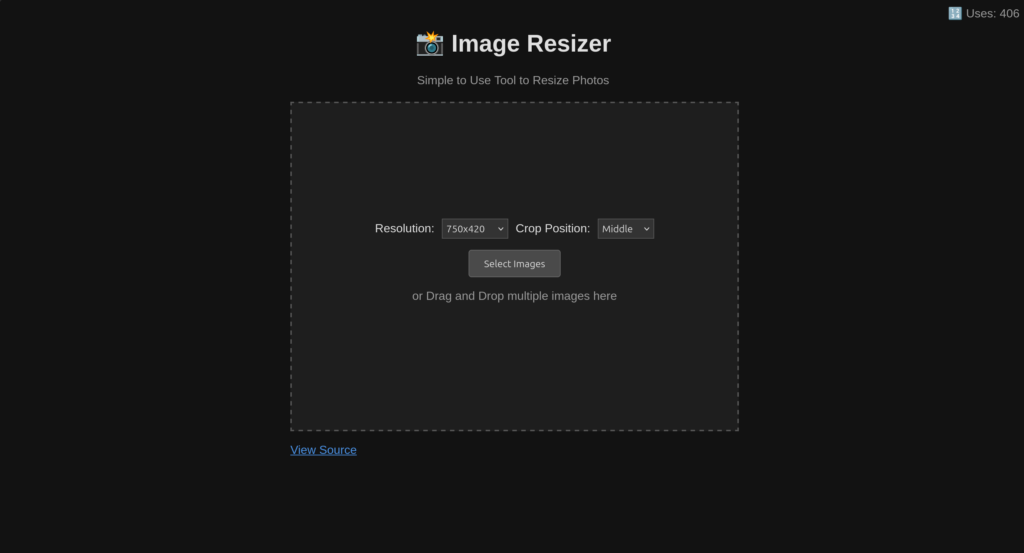
My first attempt was a small image resizer I built using Valtown, an online vibe coding tool. It was also my first real experiment with vibe coding, and when the thing actually worked, I was rather pleased with myself.

As you can see, it was very basic. But it worked.

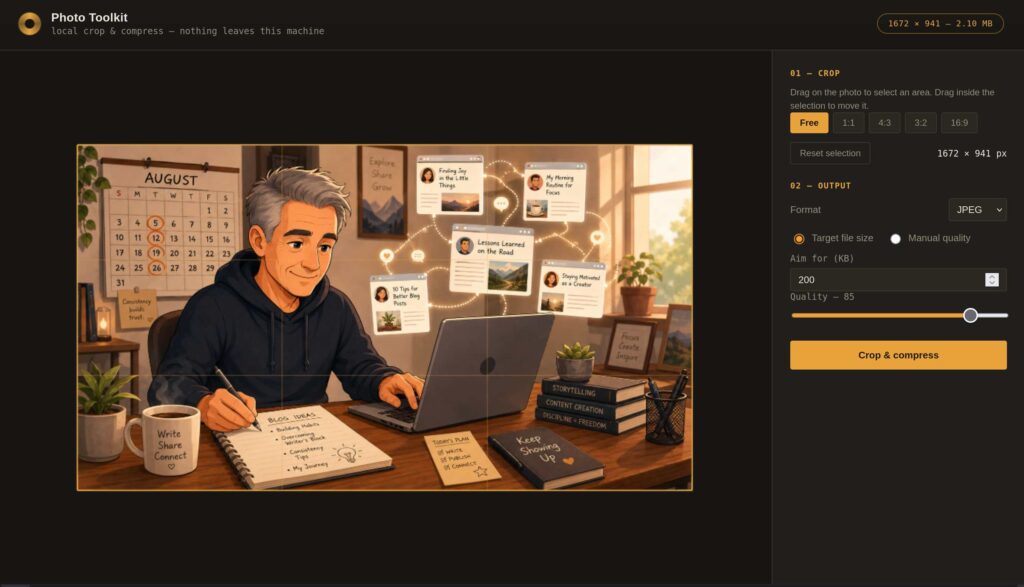
After a while, though, I wanted something better. So I asked Claude to build me a more complete photo tool. That resulted in a surprisingly polished browser-based application. It is fast, the interface looks good, and it allows me to resize and crop images exactly the way I want.

There was only one problem.

I still had to use it manually. For every photo, the workflow looked something like this: save the image somewhere, open the Photo Toolkit, load the image, choose the correct crop, resize it, download the result and then upload that version to the CMS. Again, none of this is difficult. But repeat it ten or fifteen times a day and suddenly it feels like an awful lot of clicking.

So I started wondering whether I could remove the clicking altogether. Could “the computer” simply notice that I had downloaded a large image and resize it for me? According to Claude: yes.

Which is how my Photo Toolkit slowly turned into something slightly different. I now have a small service running permanently in the background on my Linux laptop. It watches my Downloads directory. Whenever a new photo or illustration appears there, the service notices it and automatically creates a much smaller version of roughly 300 kB. The original file stays exactly where it is. Next to it appears the resized version. That is important, because sometimes I still want the original image for something else. Perhaps I want to crop it differently later, use it in print, or simply keep the highest-quality version available. So nothing is overwritten. The service just adds a website-friendly copy.

There are obviously a few practical details to solve. My Downloads directory does not only contain images. There may also be PDFs, ZIP files, documents and all sorts of other things in there. A 21 MB PDF does not suddenly need to become a 300 kB JPEG. The watcher therefore only pays attention to a small number of image formats, such as JPEG and PNG. It also needs to know which files it has already processed. Otherwise it could discover its own resized image and resize that one again. And again. And again. That has been solved by marking processed images so the service knows to leave them alone.

The nicest part is that I now barely notice any of this. The watcher runs quietly in the background. When I restart my laptop, the service starts automatically. I do not have to open an application. I do not have to remember anything. I download an image. A few seconds later, the smaller version is simply there.

This is probably not going to change the world. But it does remove a repetitive little task from my working day, and I rather like tools that do that. Especially when, after a while, you almost forget that the tool even exists.

If this sounds useful to you as well, have a look at the Just Me Toolkit page. You can find the link to it on the left-hand side of the main text on this blog.

When People Start Fighting Back Against the Cameras

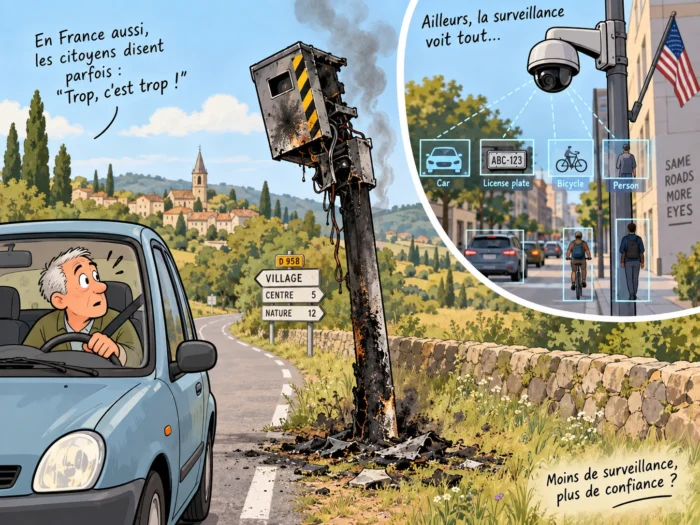
A few years ago I was driving along a provincial road somewhere in central France. France has installed an impressive number of speed cameras over the years, partly to catch speeding drivers and partly, of course, to persuade everybody else not to speed in the first place. Many French drivers are not particularly enthusiastic about them (who is?). Most seem to deal with that by complaining a bit and then sticking more or less to the speed limit.

But on that particular road I came across a slightly more physical form of citizen protest. We passed a speed camera that had clearly had a difficult night. The camera itself had more or less been broken off its pole. And apparently somebody had decided that this was not quite enough, because a fire had also been lit around the bottom of the structure. What remained was a rather sad-looking, blackened pole with what was left of the camera on top.

I thought about that camera again when I read a fascinating report by 404 Media about Flock Safety cameras in the United States (https://www.404media.co/hackers-stole-flocks-camera-software-revealing-how-the-company-tracks-cars-and-people-2/).

Flock operates automated license plate reader cameras that photograph passing vehicles and send images and related information to the company’s servers. Police agencies can then search those records. But hackers from a group called stegan0gram did something rather more ambitious than simply knocking one of the cameras over: they removed a camera, copied much of the software inside it and started reverse-engineering.

What they found makes the story particularly interesting. The camera runs Android and contains roughly twenty Flock-developed applications handling functions such as motion detection, photography, object classification, uploading data and receiving updates. When something moves into view, the camera does not simply take one neat photograph of a number plate. It shoots a rapid series of images using different exposures. A normal passing vehicle generated around 28 images in the analysed data, while some produced more than 100. Over about 21 days of recovered activity, one camera had photographed roughly 50,200 vehicles and generated around 1.6 million images.

Even more interestingly, the software explicitly detects more than cars and number plates. It can also recognise people and bicycles and records where a person appears in an image together with the software’s confidence in that detection. Tests performed with models extracted from the camera confirmed that they could detect people. There was no evidence that Flock’s software was actively performing facial recognition, but the distinction is still worth noting: these are not simply electronic number-plate readers. They are cameras running computer-vision software that analyses what passes in front of them.

The analysis also showed how imperfect that software can be. The system occasionally interpreted bumper stickers, dealer frames and other graphics as number plates. In one case it even isolated an American flag patch on a motorcycle saddlebag as though it were a licence plate. Much of the actual identification work — reading plates and identifying vehicle make, model and colour — appears to happen later on Flock’s servers.

And that is where the discussion becomes bigger than one damaged camera. Citizens are generally prepared to accept rules, laws and a certain amount of enforcement. Most French drivers may dislike speed cameras, but by and large, they still slow down when they approach one. Most people probably also understand why police would like tools that help them find stolen cars or vehicles connected to serious crimes.

The difficulty starts when people become convinced that the technology has moved beyond what they consider reasonable. Flock’s wider system can make camera records searchable across large networks of law-enforcement agencies, and reporting has shown that the technology has also been used to search for people and patterns of movement rather than simply individual vehicles.

Then protest sometimes changes form. In France, somebody apparently decided that writing an angry letter about speed cameras was no longer enough and set fire to one. In the United States, somebody decided that simply destroying a Flock camera was not enough either. They took the software with them so that people could find out what the camera was actually doing.

Are either of those actions a good idea? Probably not. But can I understand why people sometimes feel the need to protest in ways that go beyond submitting a letter to the editor or politely speaking for three minutes during a local council meeting? Yes, maybe I can. That does not remove personal responsibility. If you decide to break, remove or tamper with somebody else’s equipment, you also have to accept that there may be legal consequences.

But governments and technology companies might want to pay attention to something else as well. When perfectly ordinary citizens start attacking surveillance equipment or taking it apart to discover how it works, perhaps the most interesting question is not only who damaged the camera? It might also be: why did they feel they needed to?

in Tech | 815 Words

Europe Is Finally Building 348 IRIS2 Satellites

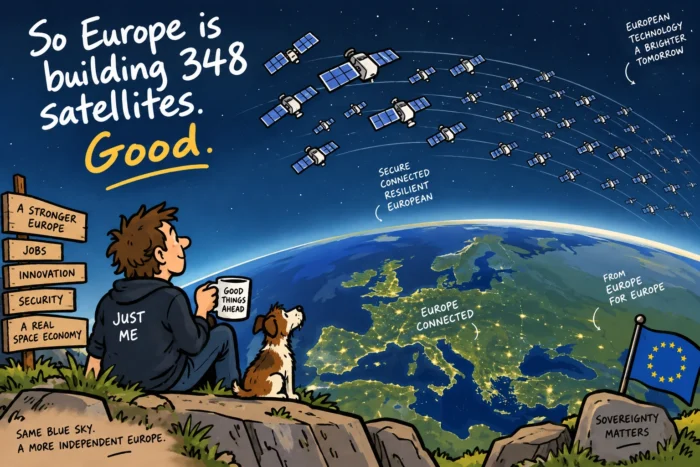
A while ago I wrote a post called The Space Economy Is Taking Off (https://justme.website/tech/the-space-economy-is-taking-off/). My point was that we tend to think about space as something rather exotic. Rockets. Astronauts. Mars. Perhaps the Moon. But space is rapidly becoming an economy in its own right. Satellites, launch services, communications, Earth observation, navigation, data services and all sorts of applications that are built on top of them. And Europe has quite a lot to gain from that. So it is good news that IRIS² is finally moving from plans, meetings and PowerPoint presentations to actual hardware.

348 satellites

IRIS² stands for Infrastructure for Resilience, Interconnectivity and Security by Satellite (https://www.euspa.europa.eu/eu-space-programme/secure-satcom/iris2). It is an EU programme to build a European satellite communications infrastructure consisting of satellites in both Low Earth Orbit (LEO) and Medium Earth Orbit (MEO).

The current architecture calls for 348 satellites, combined with a dedicated ground infrastructure. The idea is to provide secure and resilient communications for European governments and other authorised users, while also making commercial connectivity services possible. Think of it, in very simplified terms, as Europe building its own large-scale communications infrastructure in space. That sounds rather ambitious – because it is.

But the interesting thing is that we are now starting to see contracts being signed to actually build the thing. At the end of August, European satellite company SES awarded German space company OHB a contract worth almost €1 billion (https://www.ohb.de/en/news/ohb-has-been-awarded-a-contract-worth-nearly-1-billion-for-the-development-and-production-of-eighteen-satellite-platforms-for-iris%C2%B2). OHB will develop and manufacture 18 MEO satellite platforms for IRIS². These are not exactly CubeSats either. Each satellite will have a maximum power output of around 15 kilowatts and a launch mass of approximately 2.6 tonnes.

Then, in September, Eutelsat gave Airbus and Thales Alenia Space the go-ahead for the first layer of the LEO part of IRIS². That first layer alone will consist of at least 66 satellites, scheduled for delivery in 2029. Airbus will build the platforms and integrate the satellites, while Thales Alenia Space supplies the payloads. More here: https://www.airbus.com/en/newsroom/press-releases/2026-09-airbus-starts-the-development-of-iris2-satellites-on-behalf-of-eutelsat.

Europe needs infrastructure of its own

There is obviously a strategic argument for IRIS². Europe increasingly depends on digital infrastructure that is not necessarily European. That applies to cloud platforms, software, semiconductor technology and AI, but also to communications infrastructure. Recent geopolitical developments have made it increasingly difficult to pretend that this doesn’t matter. Satellite communications have become important infrastructure for governments, emergency services, critical infrastructure and military operations. If terrestrial networks are unavailable, damaged, attacked or simply don’t reach a particular location, satellites can provide an alternative route.

ESA says IRIS² is intended to allow authorised government users to communicate securely and continuously during critical operations, like emergencies, the protection of critical infrastructure and security missions (https://www.esa.int/Applications/Connectivity_and_Secure_Communications/IRIS2_reinforced_and_accelerated_as_implementation_advances)

Having access to such a network is obviously useful. Having a network that Europe builds and controls itself is something else entirely. That doesn’t mean Europe suddenly becomes independent of every non-European technology company. Nor does it mean that IRIS² solves every sovereignty problem. But it does mean that Europe will have an important piece of communications infrastructure of its own. And I think that matters.

It is also an industrial programme

Money spent on IRIS² doesn’t simply disappear into space. A substantial part of it flows into European companies, factories, engineers, researchers, suppliers and technology development. Look at the companies already involved: SES, Eutelsat, Hispasat, OHB, Airbus Defence and Space, Thales Alenia Space and Aerospacelab (a Belgian startup). Behind those companies is a much larger supply chain consisting of specialised manufacturers, component suppliers, software companies, engineering firms and research organisations. ESA explicitly says the programme is designed to create opportunities for start-ups, SMEs and mid-sized companies developing innovative space technologies as well. That is important as well.

If Europe wants a serious space economy, it needs more than a few successful rocket launches and interesting start-ups. It needs demand. It needs customers willing to buy satellites, communications systems, antennas, electronics, software, security technology and ground infrastructure. IRIS² creates exactly that kind of demand. A contract worth almost €1 billion for OHB isn’t just a contract for 18 satellites. It helps finance engineering teams, manufacturing capacity, expertise and probably a whole collection of suppliers that most of us have never heard of. The same applies to Airbus and Thales Alenia Space.

And once companies have developed technologies, production methods and expertise for IRIS², that knowledge doesn’t have to remain inside IRIS². It can potentially be used for other satellite programmes and commercial services as well.

Build things and you learn things

There is also something else that is easily overlooked when governments discuss innovation. You don’t create technological expertise simply by saying that innovation is important. You have to build things. Preferably difficult things. A 348-satellite constellation spread across different orbits, combined with secure ground infrastructure and demanding communications requirements, certainly qualifies. Engineers will have to solve problems involving satellite platforms, payloads, antennas, networking, cybersecurity, ground stations, power management, production, launch integration and constellation management. Factories will have to learn how to manufacture satellites in larger numbers. Airbus, for example, says it will use its serial-production facility in Toulouse for the first IRIS² LEO layer.

Security, economy and technology

This is why I think IRIS² is interesting on several levels at the same time. It gives Europe a communications infrastructure that it can control itself. It improves resilience by adding another communications layer for governments, critical infrastructure and emergency situations. It puts substantial amounts of money into the European space industry and its supply chain. And perhaps most importantly in the longer term, it forces European companies to develop, manufacture and operate advanced technology at scale.

Those things reinforce each other. A stronger European space industry gives Europe more technological options. More technology creates new products and companies. Those companies create expertise and jobs. And having that expertise makes it easier to build the next generation of European space infrastructure.

This is exactly what I meant when I wrote that the space economy is taking off. Space is gradually becoming another part of our economic and digital infrastructure. And Europe should not simply be a customer in that economy. It should be building a substantial part of it. IRIS² is a very big step in that direction.

So Apparently Facebook Might Keep You Posting After You’re Dead?

I thought dying was a reasonably reliable way of stopping your social-media activity. Apparently, even that may eventually become optional. Because Meta has been granted a patent for technology that could allow an AI to simulate a user of a social network when that person is no longer around. The patent has the wonderfully reassuring title Simulation of a user of a social networking system using a language model.

See here for more: https://www.businessinsider.com/meta-granted-patent-for-ai-llm-bot-dead-paused-accounts-2026-2?utm_source=chatgpt.com and https://patents.justia.com/patent/12513102?utm_source=chatgpt.com.

Basically, an AI could learn from the things you have posted, liked, commented on and interacted with, and then use all that information to behave a little bit like you. Sounds like typical AI. But then it gets interesting. The patent explicitly talks about situations in which somebody is absent from a social network for a longer period. Perhaps you have simply decided that spending three hours a day scrolling through Facebook isn’t actually improving your life. Fair enough. But the patent mentions another possible reason for your absence. You might be dead. And your AI version could potentially carry on.

I find this a genuinely bizarre idea.

Now, I can imagine some situations in which technology like this could actually be useful. Someone who knows they are seriously ill might want a few messages to appear after their death. A birthday message for their children, perhaps. A final note to friends. Maybe even a couple of posts saying goodbye. We already do something similar with letters and videos.

But there is quite a big difference between:

“Here are five messages I wrote before I died. Please publish them afterwards.”

and:

“Here is an AI that has studied everything I ever posted. Just let it carry on being me.”

The first is still you. The second is somebody’s statistical approximation of you. That difference becomes even more interesting when money enters the picture. Imagine that you have built a very successful social media account. Perhaps you have thousands of followers. Every post generates hunderds of comments, likes and shares. People spend time looking at your content. The platform serves advertising around all that activity. Your account has commercial value. Then one day you stop posting. Perhaps you simply decide that social media is no longer for you. Perhaps you disappear for what the patent calls a longer period. Or perhaps you die.

Normally, that would mean the end of the content stream. No more posts and no more comments. So, no more engagement. And obviously: No more advertising around all that engagement. Unless, of course, an AI version of you could simply continue. And that is where I start to feel rather uncomfortable about this idea.

To be absolutely clear: having a patent does not mean that a social network is about to introduce this. Companies patent enormous numbers of ideas that never become actual products. At least not yet. But the patent does make the possibility technically and commercially imaginable. And once you look at it that way, some fairly strange questions appear. If the AI keeps posting after I have left a social network, are those still my posts? If it responds to somebody, have I responded? When a racist or otherwise offensive message appears on my account, how do I prove that it wasn’t posted by me, but by an AI? If it expresses an opinion I would probably have expressed, is that my opinion? And who decides when it should stop?

There’s something else I find particularly odd about all this. For years, a lot of people have been putting enormous amounts of themselves into social networks: photos, conversations, friendships, opinions, jokes, arguments, interests, political discussions, holiday pictures, and thousands upon thousands of small signals about who we are. Until now, we mostly thought of that as data about our past behaviour. AI potentially turns it into something else: training material for a future version of ourselves.

I’m not on Facebook, but I can imagine that, for many people, a Facebook profile used to be something of a digital archive. You could scroll back and see what someone actually said ten years ago. An AI-generated account would be fundamentally different. It could start producing things that the original person never said at all. Perhaps they would have said them. Perhaps not. We will never know, will we?

I suspect there will eventually be useful applications for this kind of ideas. Used deliberately and under the control of the person involved, it might even become a fascinating new way of leaving something behind. But an automated social-media ghost that continues generating engagement because its owner is “absent for a longer period”? That sounds considerably less appealing. Especially when the platform running the ghost also happens to make money from keeping people scrolling, commenting and watching.

I Don’t Play These Games, But I Am Glad That Places Like This Exist

I recently watched a documentary called Grimdark (https://youtu.be/QTj8WXC_KgM?is=dNlEF1aXZhyQJDLx) about a world I know very little about. It is the world of tabletop games in which people gather around large tables, move miniature warriors and monsters across carefully constructed landscapes, roll dice, discuss strategies and occasionally spend a very long time deciding what a tiny plastic soldier should do next.

And to be honest, I find it fascinating. Not because I play these games myself. I don’t. And after watching the documentary, I didn’t suddenly feel an irresistible urge to start building an army of miniature warriors either. But I do understand the attraction a little better. Because there is much more going on here than simply playing a game.

People build their own armies. They paint tiny figures, sometimes in extraordinary detail. They construct buildings, ruins, forests and entire landscapes. They develop strategies, learn complicated sets of rules and then bring everything together on a table to play against — or sometimes alongside — other people. It is gaming, certainly. But it is also model building, painting, collecting, storytelling and socialising all rolled into one slightly unusual hobby.

And there is another reason why the documentary caught my attention. There is a place like this in my own hometown. Every now and then, I go there with my youngest daughter. Like I said, we don’t play these games ourselves and, so far at least, neither of us feels any particular need to start. We mostly look around. People arrive carrying boxes containing armies they have assembled and often painted themselves. Then they spend hours playing out battles that, to an outsider like me, can look impressively complicated.

But what I notice most is how much fun everyone is having. People talk about their figures. They admire what someone else has built or painted. They discuss the game. They laugh. They concentrate intensely on what is happening on the table. And they spend time with other people who understand exactly why all of this is so interesting.

I like that. We tend to talk a lot about communities on the internet. Social networks, forums and all the other digital places where people with similar interests find each other. Those communities can be valuable. But there is something rather nice about an actual physical place where people can do the same thing. A place you can walk into carrying a box full of tiny warriors and find other people who immediately understand why you have spent many evenings carefully painting them. You don’t have to explain yourself. You can just start playing.

Perhaps that is what I liked most about the documentary. And perhaps it is also why I enjoy occasionally visiting the place in my hometown with my daughter. Neither of us belongs to this particular world. We are visitors. Curious outsiders looking at something other people are deeply enthusiastic about. Sometimes that is enough. You don’t have to share someone else’s hobby to appreciate it. I’m glad places like this exist.

How About We Stop Organising Everything Like It’s 1984?

For decades, we have been organising digital information in roughly the same way. There are folders, folders inside folders, and files inside those folders. Save some bookmarks and, before you know it, you have another list. A very long list, usually.

I have always been fascinated by people who try something different. Tags are one obvious alternative. Instead of forcing something into one particular folder, you can describe it from several different angles. That is one of the things I like about the way I currently use Capacities.io (https://capacities.io/): pages, objects and tags allow information to be connected rather than simply stored somewhere in a hierarchy. Word clouds are another simple example. They don’t necessarily organise information better, but they do allow you to look at it differently.

And then I came across Pixel Area (https://pxlarea.com/). Pixel Area — or pxlarea — takes yet another approach. It is basically a 100 × 100 grid containing room for 10,000 links to websites. Instead of browsing through a directory or looking at a ranked list of recommended sites, you wander around a field of pixels. Each claimed square represents someone’s blog, digital garden, photo journal or other personal corner of the web. Move around, discover a pixel and see where it takes you.

There are deliberately no rankings and no “top blogs”. Sites can have tags, so you can make pixels matching particular subjects appear like a little constellation. There is also a random option if you simply want to see where you end up. If a site has been updated recently, Pixel Area can show that too. It turns discovering websites into something much more spatial and slightly more accidental than scrolling through yet another list.

Kobala (https://kobala.nl/startpagina-functies/?utm_source=chatgpt.com) is another example of a different way to organise links. Instead of relying on a traditional bookmark list hidden somewhere in your browser, it lets you create a visual start page made up of blocks for websites and other online resources. It is a simple idea, but that is exactly what makes it interesting: the information is still basically a collection of links, yet changing the way those links are presented can make them much easier to scan and use.

And let’s not forget Start.me (https://start.me). Start.me is yet another take on the browser start page, turning bookmarks, feeds, notes and widgets into a visual dashboard of blocks. Instead of digging through folders or long bookmark lists, you can arrange the information you use most often in one clear, customisable overview.

I like all these ideas. Perhaps one of the most fascinating is Surf by Berlin-based Deta (https://deta.surf/). Surf describes itself as an intelligent notebook that brings your files and the web into your stream of thought. The interesting part for me was the way it blurred the distinction between my own information and information somewhere else. You could put your own files, notes, PDFs, websites and other material together inside one notebook and then use AI on top of that collection. Instead of constantly jumping between a file manager, browser, notes app and AI tool, the notebook became the place where all those different kinds of information met. Unfortunately I had to stop using Surf when I moved from macOS to Linux.

And while writing this post I discovered something rather nice: that is no longer true. Surf is now available for Linux and Windows as well, and Deta has made its core open source. It is also local-first, with notes and resources stored on your own device (https://github.com/deta/surf/blob/main/docs/INSTALL.md). Hmm. I may have to have another look.

Is this an exhaustive overview of alternative ways of organising and presenting information? No absolutely not. I haven’t even mentioned things I wrote about earlier, such as TabFS (https://justme.website/content-creation/maybe-screenshots-are-the-simplest-personal-knowledge-management-tool-we-already-have/) or Screenshot Conf (https://justme.website/content-creation/i-went-looking-at-a-conference-about-screenshots-about-what-and-found-a-filesystem-for-browser-tabs/). And there must be hundreds of other experiments I have never heard of.

That is actually the part I find most interesting. We have had folders, files and lists for such a long time that they can start to feel like the natural shape of information. But they aren’t. They are simply conventions we became used to. Every now and then someone comes along and asks: what if we did this differently?

At the moment, Capacities, and their pages and tags work well for me. Pixel Area probably isn’t going to replace that. Nor do I think Pixel Area is the ideal way of navigating information or discovering websites. But that isn’t really the point. Someone builds Pixel Area. Other people try it. Someone sees an interesting idea in it, combines it with something completely different and builds something new. Then someone else improves on that. And step by step we discover, hopefully, slightly better ways of dealing with all the information we keep creating.

The Best Platform Is the One You Own

A few days ago I came across this video (https://www.youtube.com/watch?v=5kZY7eLm264) by investigative journalist Scott Carney and it reminded me of one of the most important lessons of the independent web: Build your own website. That doesn’t mean you should stop using other platforms. Far from it. Platforms can be useful. They can help you find people, join conversations and get your work in front of an audience. And some of them are genuinely nice places. They may be small. They may be run by people whose ideas about the internet you completely agree with. They may feel like communities rather than companies. But they are still somebody else’s place. That distinction matters.

Friendly platforms are still platforms

In the video Carney discusses his relationship with Substack. And I think it is a particularly interesting one because Substack originally seemed like an alternative to the big social platforms. The basic idea was attractive: writers could publish directly for readers, readers could pay them directly and journalists would no longer have to depend entirely on publishers, advertising or algorithms.

But Carney argues that Substack itself is changing (https://sgcarney.substack.com/p/the-real-reason-that-substack-is). It added Notes, which looks much more like a traditional social-media feed. It introduced the distinction between subscribers and followers, and added video, livestreaming and short clips. In other words, a service built around newsletters and subscriptions gradually started looking more like the platforms it once seemed to offer an alternative to.

That matters because, according to Carney, all that free content and endless scrolling may be good for growing Substack, but not necessarily for the people publishing there. His own follower numbers increased dramatically, while the number of people actually paying for his work did not grow in anything like the same way. He describes the broader problem as subscription fatigue: there are only so many newsletters people have the time and money to pay for.

What I find particularly interesting is his response. He doesn’t dramatically announce that he is leaving the internet or refusing to use platforms ever again. He adapts. He uses YouTube. He works with sponsors, although he says he is very selective about the companies he accepts money from. And he no longer assumes that one particular platform or one particular business model will provide a permanent solution.

You give up control

To me, that is exactly the point. The problem with building your online presence on a platform is not necessarily that the people running it are evil, greedy or waiting for an opportunity to lock you in. They may be wonderful people. The problem is simply that you don’t control what happens next. Because someone else controls the software. Someone else decides how it develops. Someone else can change the rules, the business model or the priorities. The organisation behind it can run out of money, change direction, be acquired or simply disappear.

Your website should be the center

This is why I increasingly think of platforms as satellites. My website is the center. I can post links somewhere else. I can participate in discussions. I can experiment with new communities and services. If one of them disappears tomorrow, that would be annoying. But Just Me would still be here. My articles would still be here. My links would still work. My no doubt bizar collection of posts about Linux, space, music, open source, digital autonomy, industrial technology, old websites and whatever else happens to interest me would still have a home.

To me that is important. Especially now that so much of the internet seems to consist of publishing things inside systems controlled by somebody else.

And there is another reason

There is also a much less serious reason to build your own website: It is fun.

You can change the design because you feel like it. Add a page nobody asked for. Build a ridiculous little web tool. Change your fonts. Break something. Repair it again. Discover that WordPress is doing something mysterious. Spend far too much time solving a problem that nobody visiting your site will ever notice.

That is part of the pleasure. A personal website isn’t just a publishing platform. It is also a project. And unlike almost every other platform on the internet, it can become exactly as boring, complicated, colourful, minimal, experimental or peculiar as you want it to be. Because it is yours. Maybe that is the best reason of all.

Journalism Has Plenty of Ideas. So Why Do We Keep Throwing Them Away?

For the past five or six years, I have been involved in something resembling a Dragon’s Den at a Dutch journalism school. Groups of students have to come up with an idea for a new journalistic product. They develop the concept, think about the audience, work out a business model and eventually present the whole thing to a jury.

I enjoy doing this. Some of the ideas are not particularly interesting. Others are reasonable, but turn out to be variations on things that already exist. That does not bother me too much. These students are young. They are inexperienced. They are learning. I don’t expect a group of journalism students to have the market knowledge of someone who has worked in media for twenty years.

And every now and then, there is an idea where you think: yes, there is something here. Perhaps it is not quite ready. Perhaps the business model is shaky (it always is at least that…) . Perhaps the technology is too ambitious. But you can see a potentially interesting journalistic product emerging.

And then something rather strange happens.

Nothing.

Six years of ideas disappearing

As far as I know, not one of the projects I have seen during all those years has actually been developed into a real product. Not one. I find that seriously disappointing. Not because I expect students to start companies immediately after presenting their project. Most of them have exams to finish, internships to do and careers to start. But there is something odd about a journalism programme generating dozens and dozens of new product ideas and apparently treating almost all of them as disposable.

Present -> Get a grade -> Move on

Next year, a new group of students arrives and everybody starts from zero again. Why?

I have discussed this with people at the school before. Why does every team have to invent something completely new? What if a previous group had a genuinely good idea but took it in the wrong direction? A new team might see something the first team missed. What if a new group improved the prototype? What if group three tested it with a real audience? What if the group in the next year finally launched it?

That starts to look a lot more like actual product development. And, frankly, journalism could use some of that.

Build a library

There is an even simpler option: put all those ideas online. Create a website where the school publishes the concepts developed by its students. Explain the problem each project tried to solve, the proposed product and the intended audience. Forget the business model, that will come later. Don’t hide the unsuccessful ideas either. They may be the most interesting ones.

After a few years, you would have an enormous collection of experiments in journalism. Future students could browse through it. Journalists could browse through it. Independent publishers and content creators looking for ideas could browse through it. Existing media companies suffering from the familiar shortage of internal product innovation could browse through it. Someone might look at a five-year-old student project and think: that was actually a pretty good idea. It just needs this.

That would be useful, both for developing new journalistic products and, importantly, for journalists looking for work. At the moment, many of these projects seem to disappear shortly after the presentation. That feels like an extraordinary waste.

Maybe the ideas should be smaller

There is another assumption worth questioning. Why does a student team have to invent an entire journalistic product? A publication. A platform. An app. A new media brand. Those are huge projects. Perhaps journalism students should sometimes also be encouraged to solve one irritating little problem instead.

I thought about this after coming across Normal Headlines (https://normalheadlines.jamesreeves.co/?ref=jamesreeves.co). The idea is wonderfully small. Its creator became frustrated with the increasingly clickbait-like headlines used by The New York Times. The reporting itself might still be perfectly good, but the headline sometimes seems deliberately constructed to conceal the most important piece of information.

You know the format. Something like: This Will Ruin the US Auto Industry. Which tells me almost nothing. Normal Headlines replaces headlines like that with something much more informative. Something closer to: The US Auto Industry Can’t Compete With China’s Automakers on Innovation.

Now I know what the story is really about.

That is not a revolutionary new media company. It isn’t a new social network for journalists. There is no enormous newsroom behind it. It is basically one person saying: this thing annoys me, so I built something that fixes it. I love that approach.

Yes, you might lose a click or two

Of course there is a reason media companies write curiosity-driven headlines. Clicks. If the headline already tells you what happened, perhaps fewer people will click through to the article. That may very well be true.

But I increasingly wonder whether media organisations are measuring the wrong thing. Suppose a vague headline generates a few percent more clicks. Wonderful. Now ask another question. How many readers eventually become so irritated by this constant manipulation that they stop visiting altogether? And more importantly: how many paying readers conclude that a publication apparently no longer respects their time? Those numbers are much harder to put into a dashboard. But they matter. A serious newspaper or whatever news outlet should not have to trick me into reading serious journalism. Simply tell me what happened. If the story is interesting, I will read it.

Journalism has a product problem

This brings me back to those journalism students. I sometimes worry about how little product thinking there seems to be around journalism. A surprisingly large number of students I meet want to become sports journalists or fashion journalists. There is absolutely nothing wrong with either profession. But look around. Climate change. Defence. Artificial intelligence. Industrial policy. Cybersecurity. Energy. Space. Supply chains. European technology. China. Digital sovereignty. Healthcare. Democracy itself.

There is an extraordinary amount happening in the world that desperately needs journalists who understand difficult subjects and can invent new ways of explaining them. And we don’t just need new stories. We need new journalistic products. New formats. New interfaces. New ways of finding information. Small tools. Databases. Newsletters. Visualisations. Archives. Filters. Browser extensions. Things you and I haven’t even thought of yet. And yes, maybe even something as tiny as replacing an annoying headline with a better one.

Journalism cannot afford to become lazy

Western democracy is under considerable pressure. That makes journalism more important, not less. But repeatedly saying that journalism is important is not enough. Journalism also has to earn people’s attention. That requires good reporting, obviously. But it also requires curiosity about technology, willingness to experiment and an understanding that the way people consume information keeps changing.

Journalists expect their readers to keep up with the world. Journalism has to keep up with its readers as well. That is why I would love to see journalism schools treat these student projects differently. Don’t just ask: what new thing can you invent this semester?

Ask: What problem can you solve? What previous idea can you improve? What can you actually build? What can the next group build on top of it?

And perhaps most importantly: Can we make something that still exists after you have received your grade? Because after sitting through five or six years of student Dragon’s Dens, I have seen plenty of ideas. What I would really like to see now is one of them survive and flourish.