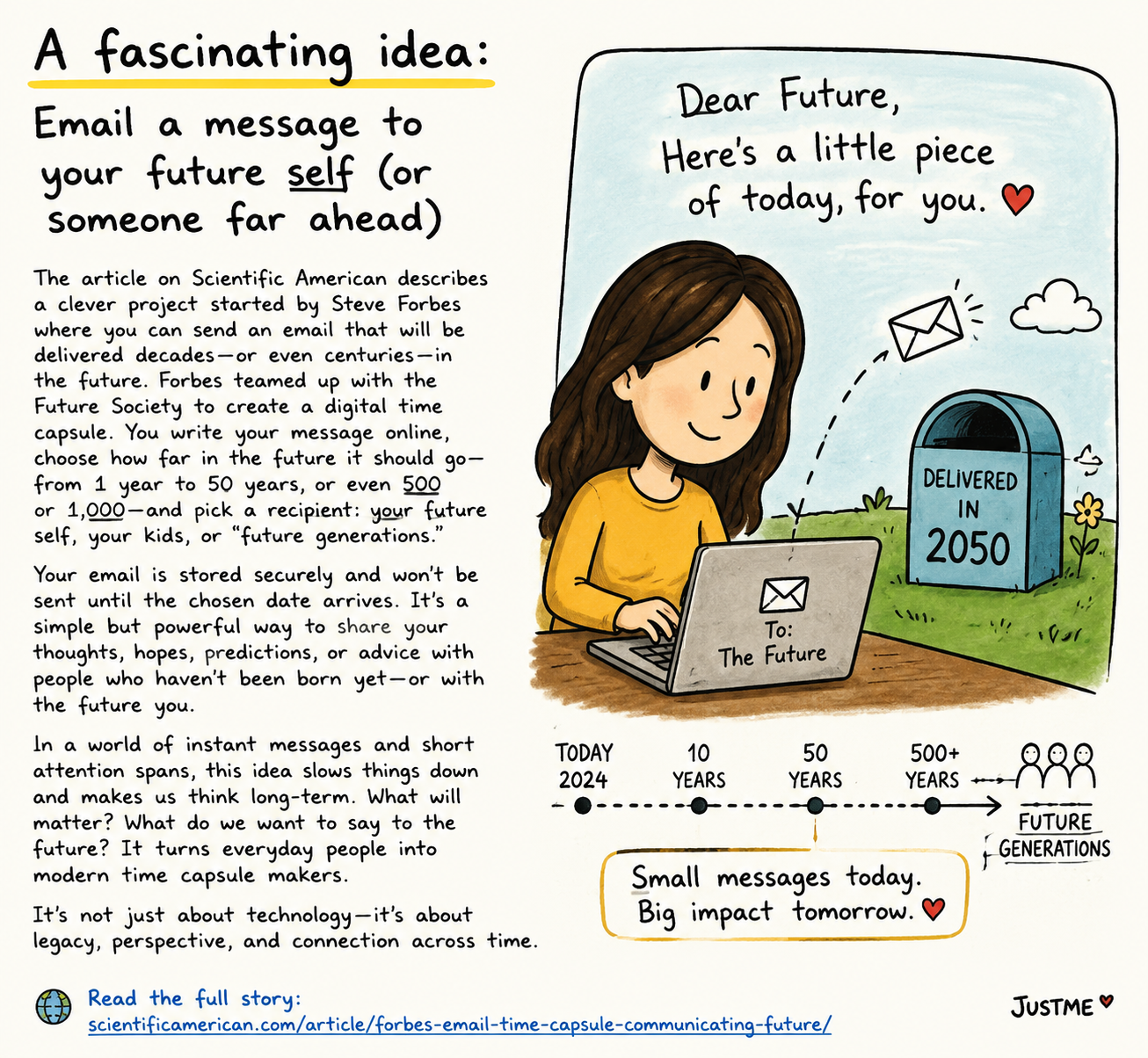
An Email To The Future

There are 14 posts filed in Content Creation (this is page 2 of 2).
Blogs are strange things. They are personal, sometimes deeply personal, collections of thoughts, experiences, ideas and observations. Unlike a printed diary that can disappear into a drawer, a blog lives somewhere on the internet. It can remain accessible for years, even decades, long after the person who wrote it has stopped adding new stories.
This raises an interesting question: what happens to the digital stories we leave behind?
That is exactly the topic explored by Michael Harley in his thoughtful blog post about the future of our online writings and the question of digital legacy. It is a fascinating reflection on what happens to the content we create once we are no longer actively maintaining it.
For many bloggers, writing is not just about publishing information. A blog is often a digital extension of ourselves. It contains memories, opinions, lessons learned, discoveries, frustrations and moments of inspiration. In many ways, it is comparable to the letters, notebooks and diaries that previous generations left behind. The difference is that digital content can potentially survive forever — but only if someone takes care of it.
Harley’s article made me think about my own blog.. Here I publish articles, observations and personal stories there. Some are about technology, digital sovereignty, open source and the future of IT. Others are much more personal reflections about music, travel, creativity and the small moments that make life interesting. But what happens with all that content in ten, twenty or fifty years?
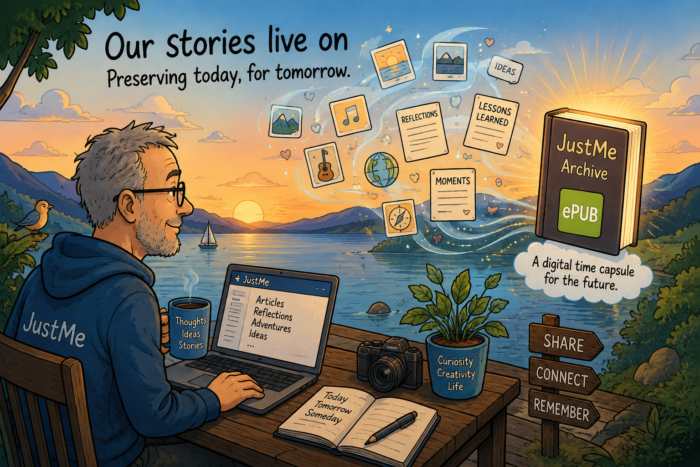
One idea that particularly appeals to me is creating a periodic ePub version of the content published on JustMe. Perhaps every month, every quarter or once a year, the latest articles could be collected into a digital book. An ePub is a simple but powerful format: it can be stored, copied, read on different devices and preserved much more easily than a constantly changing website.
Such a digital “JustMe Archive” would create a kind of time capsule. It would not only preserve the texts themselves, but also capture a specific moment in time. Reading old blog posts often reveals more than just the subject being discussed. It shows how people thought about technology, society and the world around them at that particular moment.
Of course, no digital archive is completely future-proof. Websites disappear, platforms change, domains expire and file formats become outdated. Preserving digital content requires some attention. But perhaps that is exactly the point: our digital memories need the same care that previous generations gave to photo albums, letters and physical documents.
The question of digital legacy is becoming increasingly relevant. Many of us have created a substantial online presence, whether through blogs, social media, photographs or other digital projects. Yet we rarely think about what happens to these creations when we are no longer around.
A blog is more than a collection of web pages. It is a record of curiosity, creativity and human experience. Creating regular ePub archives could be a simple way to ensure that this record does not disappear.After all, perhaps the most valuable thing we leave behind is not the technology we used to create our stories, but the stories themselves.

For anyone who writes regularly, the rise of generative AI creates an interesting dilemma. AI can produce text remarkably quickly. It can summarize information, suggest headlines, rewrite paragraphs and help turn a collection of ideas into something coherent. But can it actually learn to write like you? That is the question behind a fascinating experiment by Feather in his blog post Teaching AI My Writing Voice. Instead of simply asking AI to generate more content, Feather tried to teach it something much harder to define: his personal writing voice.
At first sight, teaching AI how you write might sound relatively straightforward. Give it a collection of previous articles and tell it to imitate them. But a writing voice is much more complicated than that. It is partly vocabulary and sentence structure, of course. Some writers prefer short sentences. Others use long paragraphs in which ideas gradually develop. Some use humour frequently, while others prefer a more factual approach. Some start almost every article with an anecdote or personal observation.
But voice is also about the choices behind the words. What do you consider important? What deserves an explanation? When do you add context? Which subjects do you approach critically? And perhaps equally important: what kind of language would you never use?
That is what makes Feather’s experiment so interesting. He isn’t merely trying to make an AI reproduce the superficial characteristics of his writing. He wants to see whether it can understand the patterns behind it. As he explains in his original blog post, the process becomes an exercise in defining what actually makes his writing his own.
One useful way of looking at this is to think of AI as an apprentice rather than an automatic content generator. Imagine working with a new editor who has never seen your work before. Initially, that person might make perfectly reasonable suggestions that nevertheless don’t sound like you.
Over time, however, an editor learns. They discover that you dislike certain expressions. They notice that you prefer examples over abstract explanations. They understand that you don’t want every article to end with a grand conclusion. Eventually, they start anticipating your preferences.
Something similar can happen when working with AI. The difference is that we need to make many of those preferences explicit. And that can be surprisingly difficult. We often know immediately when a piece of text doesn’t sound like us. Explaining why is much harder.
There is another interesting aspect to Feather’s experiment: the value of an existing writing archive. Someone who has been blogging for years may have hundreds or even thousands of articles online. Together, those posts contain an enormous amount of information about that person’s interests, language, opinions and writing habits.
Until recently, that archive was primarily intended for human readers. AI changes that. A collection of old blog posts can also become reference material for a personal writing assistant. Instead of starting every conversation with an empty AI system and explaining your preferences again, the technology could potentially learn from years of previous work. For bloggers and other people who write frequently, that is an intriguing possibility.
There is an obvious limitation. AI can recognise patterns in writing, but those patterns are ultimately the result of something the AI doesn’t possess: a life. A personal blog reflects conversations, travel, work, mistakes, discoveries, books, music, people and countless other experiences. Those experiences influence how someone writes.
An AI can learn that a writer frequently connects technology with everyday experiences. It can recognise that personal anecdotes often appear at the beginning of articles. It might even become remarkably good at reproducing that pattern. But it didn’t have those experiences. That distinction matters, particularly with personal publishing.
Perhaps that is also why Feather’s experiment points towards a more interesting role for AI in writing. The discussion around generative AI often focuses on replacement: can AI write an article instead of a journalist, blogger, copywriter or author? But that may be the less interesting question.
A much more useful question is whether AI can become sufficiently familiar with an individual writer that it can help that person write better and more efficiently without removing the personality from the result. It could remember previous stories. It could point out that you wrote about a similar subject three years ago. It could suggest connections between ideas. It could produce a first draft that already resembles your normal writing instead of delivering the familiar, polished-but-generic AI prose. The writer would still decide what is worth saying.
That is ultimately what makes Feather’s experiment worth reading. It turns the usual AI-writing discussion around. Instead of asking how writers should adapt themselves to AI, the question becomes: how can we make AI adapt itself to the writer? That sounds like a subtle difference, but it is an important one. The most interesting future for AI-assisted writing may not be a world in which machines generate enormous quantities of anonymous content. It may be one in which our tools become increasingly familiar with the way we think, write and communicate.
Not an AI that writes for us, in other words. But one that gradually learns how to write with us.

As a journalist, there are many subjects I write about professionally. Technology is an obvious one. So are cloud computing, data centers, cybersecurity, AI and industrial technology. But there are also many subjects that fascinate me personally and that do not always fit neatly into one of the websites, magazines or other platforms I write for.
That is one of the reasons I started Just Me. I wanted a place where I could simply write about the things I find interesting. And there are quite a few of those.
Technology will certainly be an important part of this blog. I have always been interested in new technologies and in the way they change the world around us. AI is an obvious example, but I am just as interested in developments around open source software, European technology and the growing discussion about digital sovereignty and autonomy.
I find it fascinating to look beyond the individual product or announcement and ask what a development actually means. Who controls the technology we use? Where is our data stored? How dependent have we become on a relatively small number of technology companies? And what alternatives are emerging?
Sustainability is another subject that regularly catches my attention. Particularly when it intersects with technology. Energy, data centers, renewable power, more efficient computing and smarter use of resources are all subjects I expect to return to regularly. European companies are actually at the forefront of developments like these.
I have been fascinated by spaceflight for as long as I can remember. And right now, space is becoming particularly interesting again. New launch companies, satellites, lunar missions, reusable rockets, space-based infrastructure and an increasingly important European space industry are creating an enormous number of stories worth following.
Space technology is also becoming much more closely connected to everyday life on Earth. Satellites help us understand climate change, monitor agriculture, improve communications and respond to natural disasters. At the same time, ideas that sounded highly futuristic only a few years ago are gradually becoming serious engineering projects. That makes space exactly the sort of subject I enjoy writing about.
Another recurring subject will probably be personal knowledge management. I read a lot. I save articles. I make notes. I bookmark websites. I collect ideas for future stories. And, like many people who do this, I am constantly trying to find better ways to organise all that information. That has led me to tools and concepts such as digital notebooks, knowledge graphs, linked notes, RSS, self-hosted services and personal archives. At the moment, I’m using Capacities.io for this. It has quite a steep learning curve, but I have to say: it really works for me!
I am interested not only in the tools themselves, but also in the underlying question: how do you build a useful collection of knowledge without simply creating an enormous digital pile that you never look at again?
Then there is music. I enjoy streaming, but I also like CDs, vinyl records and even cassettes. There is something interesting about the different ways in which we discover, collect and listen to music. Sometimes the technology becomes part of the experience: the crackle of vinyl, the mechanical sound of a cassette player or simply rediscovering an album you had forgotten about for decades.
The same is true for blogs on the indyweb. I have become increasingly interested in personal websites and independent blogs. In a web dominated by enormous platforms, algorithms and automatically generated content, there is something refreshing about discovering a small website maintained by one person who simply writes about things he or she cares about. One post might be about software development. The next about a record they bought. Another about a walk through a city, a book they read or a strange technical problem they finally managed to solve.
There does not always have to be a content strategy behind it. Sometimes somebody simply has something interesting to say.
That is roughly what I want Just Me to be. Not a tightly defined technology publication. Not a personal diary either. And certainly not a blog that tries to stay within one carefully selected niche. It is simply a place where I can follow my curiosity. One day that may result in a story about European technology or digital autonomy. Another day it might be about a spacecraft, a useful open source application, a personal knowledge management experiment, an interesting blog I discovered or an old record that suddenly sounds wonderful again.
There is plenty to write about. And that is exactly what I intend to do.