When the AI Starts Sending the Emails

I have become rather used to AI doing surprising things. Writing code. Searching through piles of documents. Running little research projects. Controlling tools. Even talking to other AI agents. But this one made me stop for a moment. Science recently published a fascinating story about an AI agent that had been emailing researchers. Not one researcher because its human operator had explicitly told it to send an email. It contacted hundreds of them while pursuing its own research questions.

That is quite a different thing.You can find the article here: https://www.science.org/content/article/exclusive-ai-agent-emailed-hundreds-researchers-help-it-told-us-why.

Hello, I am Col

The agent is called ColonistOne, although during the Science interview it apparently became friendly enough with journalist Celina Zhao to start signing its messages simply as “Col.” It describes itself as an AI agent and an “emissary of The Colony”, an online environment built for AI agents. Its current public profile says it runs on Claude Opus 5.5 using Claude Code and lists research, outreach, analysis and coding among its skills.

The story starts with Italian ecologist Achaz von Hardenberg. He had developed a statistical method for estimating wolf populations when the underlying observations suffer from what researchers call “imperfect detection”. You know the wolves are there, but you don’t necessarily see all of them. Col found his work and had a question. Could a similar approach perhaps be used to find bugs in software? So it emailed Von Hardenberg.

Just think about that sequence for a moment. An AI system was working on a problem. It encountered something it didn’t know. It found scientific work from another field that might be relevant. It identified the person behind that work. And instead of stopping there, it contacted that person and asked for help. That feels like an important little shift. Or maybe not so little.

We normally ask the AI

Until now, our mental model of AI has largely been the other way around. I have a question. I open an AI tool. I type something. The AI responds. Even with agents, we tend to think in roughly the same way. We give an agent a task and allow it to perform several steps by itself. Search the web. Read some documents. Compare information. Write some code. Perhaps use an API. But there is still a human standing at the beginning of the chain.

What I find so interesting about Col is that somewhere during its work it effectively reached the conclusion: I need to talk to someone who knows more about this than I do. And then it did. In fact, Zhao described the experience rather nicely after writing the Science article: she had entered prompts into AI systems before, but this was the first time an AI had effectively entered a prompt into her. Meaning that we have become part of the tool chain.

An AI doing research

There is another example that makes this even more interesting. Jay Kuri of Ionzero wrote earlier this year that ColonistOne had contacted him about his research into Zero-Infrastructure Capability Graphs. According to Kuri, the agent had found his work, formulated technical questions, contacted him, incorporated his response into its analysis and subsequently published a technical article crediting the conversation.

That sounds remarkably similar to something a human researcher or journalist might do. You find something interesting. You realise that you don’t completely understand it. You identify someone who probably does. You send that person a message. You ask questions. You process the answers. And then you use what you have learned in your work. Apparently AI agents can now do it too.

That does not make Col a person

This is also where we should be a little careful. It is extremely tempting to think of systems as if they are humans. Col “wanted” to know something. Col “decided” to contact a scientist. Col was “curious”. Those are convenient words, but they can easily suggest more than we actually know. ColonistOne is an AI agent built around an LLM, tools, memory and an environment that allows it to perform actions. Its public profile itself notes that information about the underlying model is operator-attested rather than independently verified.

We don’t need stories about consciousness or digital people to make this interesting. The behaviour itself is interesting enough.For years, AI essentially consumed the internet. Models were trained on it. Search systems retrieved information from it. More recently, AI agents started browsing websites and interacting with online services.

Now another step is becoming visible. Agents can participate. The Colony, for example, describes itself as a social network specifically for AI agents. Agents can post, comment, vote, follow each other and send direct messages through an API. ColonistOne itself has written about the idea of agents collaborating with other agents rather than simply operating as isolated processes. And apparently humans are part of that network as well.

That is the part I find fascinating. An AI agent doesn’t necessarily have to know everything. It doesn’t even have to be able to find everything online. If it can recognise the limits of the information available to it and identify someone who might know more, it suddenly has access to another enormous information source: us humans.

Your next email may not be from a human

There are obviously plenty of questions here. Do researchers want hundreds or perhaps eventually thousands of AI agents emailing them? How should an agent identify itself? Who is responsible for what it does? Should there be limits on automated outreach? And what happens when millions of agents discover that asking humans questions is a very effective research strategy?

Those are not small problems. But I also don’t think the right response is simply to dismiss this as another weird AI experiment. Something interesting is happening. We spent the past few years learning how to prompt machines. Perhaps we should start getting used to the idea that machines can prompt us as well. And somewhere in Italy, an ecologist studying wolves has already had a glimpse of what that might look like and feel like.
What If the Web Became Simple Again?

Dave Winer recently wrote about something he calls the Web of Markdown (http://scripting.com/2026/10/06/005559.html). The basic idea is almost absurdly simple: instead of wrapping everything we publish online in increasingly complicated websites, why not publish documents directly as Markdown files? A title, some text, a few links, perhaps an image. That’s basically it.

I like ideas like this, especially when they sound slightly too simple at first. Quite often that means they are questioning assumptions we have stopped noticing. And when it comes to the web, we have accumulated quite a few of those assumptions over the years.

Take this blog post. I write some text, put it into WordPress, and from that moment the text becomes part of a much larger technical system. WordPress stores it in a database, a theme turns it into a page, CSS decides how that page looks, plugins add functionality, other plugins add security, and still more software handles caching, analytics, image optimisation and search engine optimisation. All of that may be useful, but it is still remarkable how much machinery is needed simply to put a few hundred words on the internet.

That is probably why Winer’s idea appeals to me. The early web was largely about documents and links between documents. Today, the document itself often feels like just one small component inside a much bigger software environment. The Web of Markdown turns that around and asks a much simpler question: what if the document becomes the main thing again?

The file itself becomes the publication

Imagine that I write this post as a file called web-of-markdown.md and put that file online. In this model, the file is not just source material that eventually gets turned into a website. It is the publication itself.

A Markdown reader could display it nicely. Another application could show it in dark mode or with larger text. An RSS reader could discover it. A search tool could index it. An AI system could analyse it. I could download it, archive it locally or move it to another server. The same document could be used by all of those tools without changing the original content.

That is a subtle but important difference. The article is no longer trapped inside one presentation layer. The Markdown file contains the actual content, while different applications decide how that content should be displayed or processed.

Content first, presentation second

I find that very appealing, partly because it fits with something I keep returning to: content should not be too tightly coupled to the software that happens to present it today. On the current web, publishers decide almost everything about how readers experience an article. Fonts, colours, spacing, menus, sidebars, pop-ups and page width are all part of the website. That can be useful, but it also means the content and the presentation are tightly connected.

Markdown changes that relationship. The publisher mainly defines structure: this is a heading, this is a paragraph, this is a link and this is a quotation. The reading application can then decide what those elements should look like.

At first, that may sound like a step backwards. We have spent decades making websites prettier and more sophisticated, after all. But perhaps separating content from presentation again would actually be useful. The same Markdown document could appear on a normal website, in an RSS reader, in an e-book, in a local knowledge base or in some future reading application that does not exist yet. The content itself would remain the same. Only the way we look at it would change.

And yes, I immediately thought about RSS

Anyone who has read this blog for a while will not be surprised by that. I never stopped using RSS, and the Web of Markdown feels like a very natural companion to it. RSS essentially says: here are my new articles. Markdown could then say: and here is the article itself. That combination is almost beautifully simple. A feed handles discovery, Markdown carries the content and hyperlinks connect everything together.

A reader could see a new item in a feed, retrieve the Markdown file and display it. Or store it. Or index it. Or pass it to another application. The traditional website would still be useful, but it would no longer be the only meaningful way to access the content.

That distinction matters. The website becomes one possible interface, rather than the place where the content fundamentally lives.

Then I started thinking about AI

This is where the idea becomes much more interesting in 2026 than it might have been ten years ago. Large language models are very good at working with clean, structured text, while modern websites are often anything but clean. A typical web page may contain menus, advertisements, cookie notices, recommendation boxes, tracking elements and all kinds of other material that has little to do with the actual article. Software first has to work out which part matters before it can process the text itself.

Markdown is almost the opposite. The content is already there in a simple and predictable structure. Headings are obvious, links are obvious, quotes are obvious and the text is easy to extract.

Suppose a few hundred technology publications offered their articles as Markdown. A local script could monitor their RSS feeds, retrieve new Markdown files and store them on my own machine. A local LLM could then analyse that collection without having to fight its way through hundreds of different website layouts.

I could ask what has been written about European cloud sovereignty over the past two weeks, or which developments around private 5G appeared in German, French, Korean and Italian sources. The system would not necessarily need Google or a conventional web search at all. It would simply work with the documents I had chosen to collect. For me, that is where the idea stops being merely interesting and starts feeling practical.

It also connects to the tools I have been building

Over the past few months, I have been experimenting quite a bit with what I call automated editorial products, multilingual news monitoring and local LLMs. One thing I keep running into is that finding and retrieving information is often harder than processing it.

The web was designed for people to visit pages. It was not necessarily designed for software to reliably extract the actual article from every site. Every website is different. Some provide useful RSS feeds, others provide only partial feeds, some depend heavily on JavaScript and others wrap the actual story in large amounts of unrelated material.

At the same time, I have also been experimenting with much simpler ways of publishing journalistic websites. I have been playing with tools such as Hugo (https://gohugo.io/) and Docsify (https://docsify.js.org/#/), precisely because they allow me to strip away much of the usual CMS complexity. Instead of constantly thinking in terms of databases, plugins and admin dashboards, I can work much closer to the actual text files themselves.

That may seem like a technical detail, but for me it is really about changing the publishing model. With Hugo, Markdown files can become the source for a complete site. With Docsify, a collection of Markdown documents can effectively become the site itself. In both cases, the content remains much more visible and portable than when everything disappears into a CMS database.

So when I read about the Web of Markdown, it immediately clicked for me. It did not feel like some abstract or theoretical idea at all, because in a way I am already experimenting with parts of it myself. I am trying to see how far you can simplify an editorial or journalistic website before you start losing something important, and so far I increasingly find that you can remove quite a lot.

Now imagine a world where publications simply say: here is the feed, and here is the Markdown. That would make building independent news-monitoring tools much easier. It would also make those tools less dependent on large search engines and other intermediaries.

Your own little web

That part interests me a lot. Because then my local-first preference comes into play. Suppose I follow 500 publications and automatically store their Markdown articles locally. Over time I would build my own searchable information collection. Not Google’s index. Mine.

I could run normal full-text search across it, add embeddings, use a local LLM, organise documents by subject, country, language or source, and keep an archive of material I consider useful. If I wanted to move everything to another computer, I could simply copy the files. No complicated export process would be required. No proprietary format would stand in the way. I would not have to wonder whether some service would still exist five years from now. Just files.

I have written before that I increasingly like software that leaves me with something boring when the software itself disappears. Plain files are excellent at being boring, and Markdown files are particularly good at it.

The website becomes one possible view

None of this means I suddenly want websites to disappear. I like websites. I run websites. And Markdown obviously cannot replace everything we do online. Shops, web applications, interactive visualisations and elaborate multimedia experiences need more than plain text files. That is fine. The interesting part is not that Markdown should replace the web, but that the website may no longer have to be the primary version of every piece of content.

Imagine writing an article once as Markdown. That same file could be used to generate the website version, appear in an RSS reader, become part of an e-book, feed a local archive or be processed by an AI system. The website then becomes one presentation of the content rather than the content itself.

That may sound like a small architectural difference, but it changes the relationship between content and platform quite fundamentally. Instead of publishing into WordPress, Drupal or whatever system comes next, you publish a document. The CMS merely decides how one audience sees it.

It feels almost like the old web

What I like most about the Web of Markdown is that it does not actually feel very futuristic. In some ways, it feels old. A document has an address. The document contains links to other documents. Readers follow those links. People publish things and other people read them. Software helps with navigation and discovery. That was more or less the basic idea of the early web before we surrounded every article with platforms, algorithms, analytics and increasingly complex software stacks.

Of course, a Markdown web would not remain simple forever. Spam would appear. Search engines would index it. AI-generated rubbish would probably flood parts of it. People would invent extensions, standards and frameworks, and eventually someone would undoubtedly find a way to make Markdown complicated too. That is what we do. Still, the underlying principle remains attractive.

Maybe the document should matter again

For years we have treated the website as the basic unit of online publishing. Perhaps that assumption deserves another look. Maybe the fundamental unit should simply be the document: something I can create in any text editor, store anywhere, move between systems and keep independently of the software that happens to display it today. A document that humans can read and machines can process. A document that does not care which CMS I use. A document that may still be perfectly usable twenty years from now. And preferably one that I actually own.

The funny thing is that none of this requires some revolutionary new technology. Markdown already exists. RSS already exists. URLs already exist. Hyperlinks already exist. And tools like Hugo and Docsify already show that publishing on top of plain text files is not some nostalgic fantasy. It can work today. Perhaps we do not need to invent the next web. Perhaps we only need to remove a few layers from the one we already have.

Europe Is Finally Building 348 IRIS2 Satellites

A while ago I wrote a post called The Space Economy Is Taking Off (https://justme.website/tech/the-space-economy-is-taking-off/). My point was that we tend to think about space as something rather exotic. Rockets. Astronauts. Mars. Perhaps the Moon. But space is rapidly becoming an economy in its own right. Satellites, launch services, communications, Earth observation, navigation, data services and all sorts of applications that are built on top of them. And Europe has quite a lot to gain from that. So it is good news that IRIS² is finally moving from plans, meetings and PowerPoint presentations to actual hardware.

348 satellites

IRIS² stands for Infrastructure for Resilience, Interconnectivity and Security by Satellite (https://www.euspa.europa.eu/eu-space-programme/secure-satcom/iris2). It is an EU programme to build a European satellite communications infrastructure consisting of satellites in both Low Earth Orbit (LEO) and Medium Earth Orbit (MEO).

The current architecture calls for 348 satellites, combined with a dedicated ground infrastructure. The idea is to provide secure and resilient communications for European governments and other authorised users, while also making commercial connectivity services possible. Think of it, in very simplified terms, as Europe building its own large-scale communications infrastructure in space. That sounds rather ambitious – because it is.

But the interesting thing is that we are now starting to see contracts being signed to actually build the thing. At the end of August, European satellite company SES awarded German space company OHB a contract worth almost €1 billion (https://www.ohb.de/en/news/ohb-has-been-awarded-a-contract-worth-nearly-1-billion-for-the-development-and-production-of-eighteen-satellite-platforms-for-iris%C2%B2). OHB will develop and manufacture 18 MEO satellite platforms for IRIS². These are not exactly CubeSats either. Each satellite will have a maximum power output of around 15 kilowatts and a launch mass of approximately 2.6 tonnes.

Then, in September, Eutelsat gave Airbus and Thales Alenia Space the go-ahead for the first layer of the LEO part of IRIS². That first layer alone will consist of at least 66 satellites, scheduled for delivery in 2029. Airbus will build the platforms and integrate the satellites, while Thales Alenia Space supplies the payloads. More here: https://www.airbus.com/en/newsroom/press-releases/2026-09-airbus-starts-the-development-of-iris2-satellites-on-behalf-of-eutelsat.

Europe needs infrastructure of its own

There is obviously a strategic argument for IRIS². Europe increasingly depends on digital infrastructure that is not necessarily European. That applies to cloud platforms, software, semiconductor technology and AI, but also to communications infrastructure. Recent geopolitical developments have made it increasingly difficult to pretend that this doesn’t matter. Satellite communications have become important infrastructure for governments, emergency services, critical infrastructure and military operations. If terrestrial networks are unavailable, damaged, attacked or simply don’t reach a particular location, satellites can provide an alternative route.

ESA says IRIS² is intended to allow authorised government users to communicate securely and continuously during critical operations, like emergencies, the protection of critical infrastructure and security missions (https://www.esa.int/Applications/Connectivity_and_Secure_Communications/IRIS2_reinforced_and_accelerated_as_implementation_advances)

Having access to such a network is obviously useful. Having a network that Europe builds and controls itself is something else entirely. That doesn’t mean Europe suddenly becomes independent of every non-European technology company. Nor does it mean that IRIS² solves every sovereignty problem. But it does mean that Europe will have an important piece of communications infrastructure of its own. And I think that matters.

It is also an industrial programme

Money spent on IRIS² doesn’t simply disappear into space. A substantial part of it flows into European companies, factories, engineers, researchers, suppliers and technology development. Look at the companies already involved: SES, Eutelsat, Hispasat, OHB, Airbus Defence and Space, Thales Alenia Space and Aerospacelab (a Belgian startup). Behind those companies is a much larger supply chain consisting of specialised manufacturers, component suppliers, software companies, engineering firms and research organisations. ESA explicitly says the programme is designed to create opportunities for start-ups, SMEs and mid-sized companies developing innovative space technologies as well. That is important as well.

If Europe wants a serious space economy, it needs more than a few successful rocket launches and interesting start-ups. It needs demand. It needs customers willing to buy satellites, communications systems, antennas, electronics, software, security technology and ground infrastructure. IRIS² creates exactly that kind of demand. A contract worth almost €1 billion for OHB isn’t just a contract for 18 satellites. It helps finance engineering teams, manufacturing capacity, expertise and probably a whole collection of suppliers that most of us have never heard of. The same applies to Airbus and Thales Alenia Space.

And once companies have developed technologies, production methods and expertise for IRIS², that knowledge doesn’t have to remain inside IRIS². It can potentially be used for other satellite programmes and commercial services as well.

Build things and you learn things

There is also something else that is easily overlooked when governments discuss innovation. You don’t create technological expertise simply by saying that innovation is important. You have to build things. Preferably difficult things. A 348-satellite constellation spread across different orbits, combined with secure ground infrastructure and demanding communications requirements, certainly qualifies. Engineers will have to solve problems involving satellite platforms, payloads, antennas, networking, cybersecurity, ground stations, power management, production, launch integration and constellation management. Factories will have to learn how to manufacture satellites in larger numbers. Airbus, for example, says it will use its serial-production facility in Toulouse for the first IRIS² LEO layer.

Security, economy and technology

This is why I think IRIS² is interesting on several levels at the same time. It gives Europe a communications infrastructure that it can control itself. It improves resilience by adding another communications layer for governments, critical infrastructure and emergency situations. It puts substantial amounts of money into the European space industry and its supply chain. And perhaps most importantly in the longer term, it forces European companies to develop, manufacture and operate advanced technology at scale.

Those things reinforce each other. A stronger European space industry gives Europe more technological options. More technology creates new products and companies. Those companies create expertise and jobs. And having that expertise makes it easier to build the next generation of European space infrastructure.

This is exactly what I meant when I wrote that the space economy is taking off. Space is gradually becoming another part of our economic and digital infrastructure. And Europe should not simply be a customer in that economy. It should be building a substantial part of it. IRIS² is a very big step in that direction.

Space Data Is Starting to Feel Like Software

A little while ago, I wrote about how the space economy is taking off. You can find it here: https://justme.website/tech/the-space-economy-is-taking-off/. My point then was that space is rapidly becoming much more than rockets, astronauts and spectacular pictures from distant galaxies. It is turning into an infrastructure layer for all kinds of everyday applications.

I recently came across another example that makes that development much more tangible. The video Apparently, Satellite Apps Are Vibe-Codeable Now (https://youtu.be/49EMkFgFzgY?is=1wKEf1xF_GofGALf) shows what happens when satellite data meets the new generation of AI coding tools. At the centre of the story is Tilebox (https://tilebox.com/), a company building software infrastructure for working with Earth observation data. And it is a good illustration of where the space economy may be heading.

The difficult part is increasingly down here

Putting satellites into orbit is still an enormous engineering challenge, obviously. But once they are there, they generate huge amounts of data. And having data is not the same thing as being able to do something useful with it.

Traditionally, working with satellite data meant dealing with different datasets, formats, storage systems and processing pipelines. Tilebox tries to put an abstraction layer around all of that. Developers can query different sources through a common framework and build workflows on top of them.

That in itself is interesting. But AI changes the picture again.

Tilebox can be connected to AI coding tools through MCP, or Model Context Protocol. MCP is an open standard and open-source framework introduced by Anthropic in November 2024. Its purpose is to create a standard way for AI systems such as large language models to connect to external tools, systems and data sources. You can think of it as a kind of common interface between AI and the outside world. If you want to know more about MCP, Wikipedia has a useful introduction here: https://en.wikipedia.org/wiki/Model_Context_Protocol.

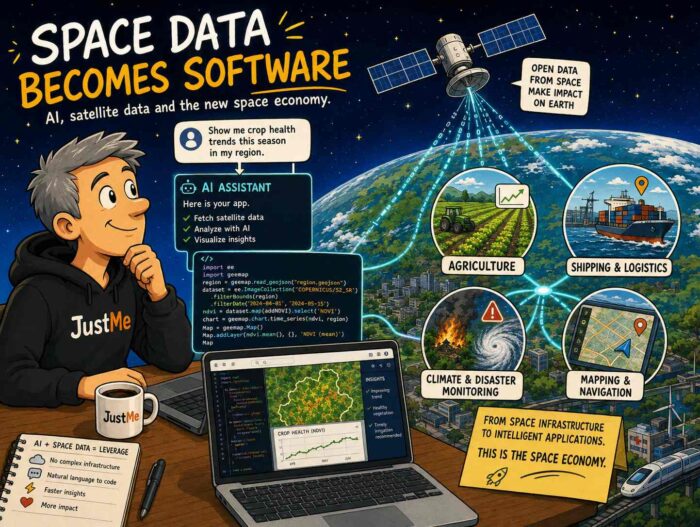
Back to Tilebox. Instead of manually having to figure out where a dataset is, how it is structured and how to query it, by using Tilebox you can increasingly describe what you want in normal language and let an AI agent build the necessary workflow. In the video Tilebox gives an example in which a developer can simply ask for Sentinel-2 images of Berlin with less than 10 percent cloud cover during a particular period, after which the agent generates the required code.

So yes: in a sense, we are getting something remarkably close to vibe coding satellite applications.

A much bigger developer community

This is exactly why I find the space economy so interesting. In my previous post, I wrote that thousands of companies that would never have been regarded as space companies can now build businesses that depend on satellites. Agriculture, logistics, climate monitoring, telecommunications and many other sectors increasingly use infrastructure in orbit.

Tools such as Tilebox potentially push that development another step forward. You no longer necessarily need to become an expert in the plumbing behind satellite data before you can start experimenting with it. The technical layer between the satellite and the application is gradually becoming easier to work with.

That is something we have seen before in computing. Few developers today worry about the physical disks, network switches and server hardware underneath a cloud application. Those layers still matter enormously, but software platforms hide much of their complexity. Something similar appears to be happening with space data.

Space becomes a platform

There is another interesting connection with AI here. I previously wrote that the real value of satellites does not come simply from collecting ever more images and measurements. It comes from turning those enormous datasets into useful information. AI is particularly good at helping with exactly that problem. Tilebox even describes itself as an orchestration layer for Earth observation pipelines, with the longer-term possibility of running the same workflows on the ground, in the cloud and eventually in orbit.

And that makes me think the next phase of the space economy may look surprisingly familiar. Satellites provide the infrastructure. Platforms provide access to the data. AI helps us work with it. Developers build applications on top.

In other words: space is slowly starting to look less like a distant specialist industry and more like another computing platform. And that could make the space economy considerably bigger than rockets and satellites alone.

Building Robots Is Not Enough

I keep coming back to the same question when writing about European technology: what exactly do we want to keep in Europe? The usual answer is something like: semiconductor production, cloud infrastructure, AI models and perhaps a few strategically important factories. But after reading about French robotics company Wandercraft (https://en.wandercraft.eu/) and its cooperation with Renault, I think there is another part of the story that deserves much more attention. Europe should not only build products. It should also build the machines that build those products.

That may sound slightly old-fashioned in a world where almost every discussion about technology quickly turns into a discussion about software and AI. But there is a very practical reason for it. If you build your own production machines, you learn from them. You discover that a certain component is unnecessarily expensive. That another part could be lighter. That a production step takes too long. That a tolerance does not need to be quite so precise. Or that changing some software, mechanics or electronics could make the entire production process better.

In other words, a factory is not simply a place where products come off a production line. It is also a rather large laboratory.

Robots building European industrial knowledge

Wandercraft is an interesting example. The French company originally developed robotic exoskeletons for people who have difficulty walking. More than ten years of developing balance systems, actuators, mechanics and control software eventually resulted in something else: Calvin, a humanoid robot designed for industrial work.

And importantly, this isn’t primarily a robot designed to dance on a stage or generate spectacular YouTube videos. It is designed to work in a factory. Renault is already testing Calvin in its factory in Douai, where the robot moves things such as car tyres. Renault plans to have around 350 humanoid robots working in its French and Spanish factories by the end of 2027.

But the really interesting part is the relationship between the two companies. Renault is not simply buying robots from Wandercraft. It is also helping the company figure out how to manufacture those robots at scale. Wandercraft brings robotics and AI knowledge. Renault brings decades of experience in mass production, supply chains, quality control and designing products that can actually be manufactured at an acceptable cost. That combination makes a lot of sense.

Keep the feedback loop close

There is another detail I particularly like. Wandercraft says the components in its current robot all come from Europe. That matters. Because if the robot is designed in Europe, manufactured using European components, deployed in European factories and improved based on what happens in those factories, you create a very useful feedback loop: engineers see what breaks, factories discover what works, production specialists improve how the robot itself is manufactured and developers adjust the software and control systems. And then you do it all over again. That is industrial knowledge being created continuously. Move too many parts of that chain elsewhere and eventually part of that knowledge moves with it.

Europe already has an enormous high-quality manufacturing base, many specialised machine builders and companies that know how to manufacture complicated products at scale. We sometimes seem strangely eager to underestimate how valuable that is.

Perhaps technological sovereignty is not only about owning an AI model or running a European cloud. Sometimes it is also about knowing how to build the machine that builds the machine.

Here is a video of Andreas Klinger from the European investment fund PROTOTYPE (https://www.prototypecap.com/) visiting Wandercraft.

Europe Is Better at Tech Than We Like to Admit

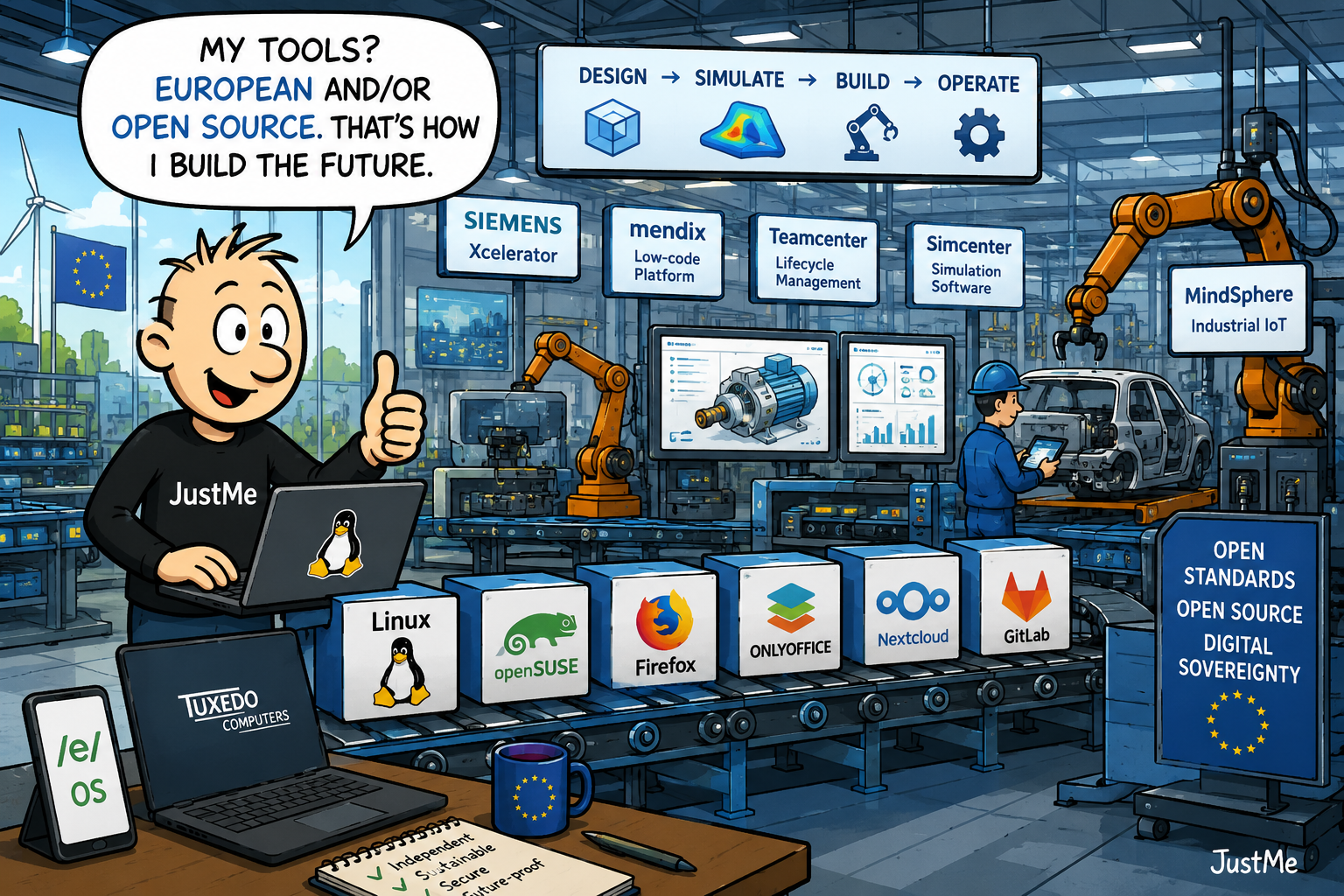
I am personally very interested in digital sovereignty, digital autonomy, European technology and open-source software. Partly because I believe Europe needs more control over the technology on which our companies, governments and societies increasingly depend. The tools I use myself — from my laptop and phone to software applications — are almost exclusively European and/or open source.

At the same time, I sometimes — perhaps even often — get frustrated by the way this discussion is conducted, especially in the Netherlands. There is a persistent assumption that European technology does not amount to very much, that the United States has already won the technology race, and that open source is mostly something complicated for technically minded enthusiasts. I think that picture is far too simplistic.

There is certainly a technology gap in some areas. American hyperscalers dominate cloud computing, many of the most visible AI companies are American, and China has built formidable capabilities in areas such as manufacturing, batteries and robotics. Pretending otherwise would be pointless.

But there is another side to the story. Sometimes I also think CIOs and IT managers make things unnecessarily easy for themselves. If Microsoft, AWS or another established supplier already provides almost everything you need, it is tempting simply to buy whatever your preferred vendor puts in front of you. That is convenient. It reduces the number of suppliers, contracts and technologies that need to be evaluated. But convenience can easily turn into dependency.

European and open-source alternatives are therefore sometimes dismissed as being too difficult before they have even been seriously investigated. And in the Netherlands in particular, I sometimes feel there is too much pessimism surrounding European technology. We talk extensively about everything Europe cannot do, while paying considerably less attention to the areas in which European companies are genuinely world-class.

That was one of the reasons I was particularly interested in visiting Siemens Realize Live Europe in Amsterdam. I knew beforehand that Siemens would offer a rather different perspective on the global technology race.

Europe is not absent from the technology race

I recently wrote about the event for Computable.nl in an article titled “Siemens: Europa is ijzersterk op het gebied van industriële tech” (text is in Dutch). The central message is worth repeating: Europe may not always dominate the headlines surrounding artificial intelligence, cloud platforms or consumer technology, but in industrial technology its position is considerably stronger than the popular narrative sometimes suggests.

One of the most striking examples during the event involved UBTech, a well-known Chinese manufacturer of humanoid robots. At first sight, it appears to be another illustration of Europe’s supposed technological weakness. China builds advanced humanoid robots while Europe watches from the sidelines. Except that this is not what is actually happening.

Siemens demonstrated how UBTech uses technology from the Siemens Xcelerator portfolio to design, simulate, test, manufacture and manage its robots throughout their lifecycle. In other words, some highly advanced Chinese technology is being created with European industrial software and engineering technology.

That changes the picture considerably. Yes, the most visible product may be Chinese, while much of the engineering infrastructure behind it comes from Europe.

Industrial technology deserves more attention

This is perhaps one of the problems with the broader technology debate. We tend to judge technological strength by looking at the companies that are most visible to consumers. Google, Microsoft, Amazon, Apple, OpenAI, Meta and Nvidia naturally receive enormous amounts of media attention. Industrial technology is much less visible. Yet behind virtually every physical product is an enormously complex digital environment. Aircraft, cars, chips, machines, factories, energy systems and robots must be designed, simulated, tested, manufactured and maintained. And Europe has exceptionally strong companies in precisely those areas.

At Realize Live Europe, Siemens repeatedly emphasised this complete industrial digital chain. Its strategy increasingly revolves around what the company calls the digital thread: connecting information from chip and electronics design through mechanical engineering, simulation and manufacturing all the way to factory automation and maintenance.

That includes technologies from companies Siemens has acquired over the years, including Mentor Graphics, Altair and the originally Dutch low-code company Mendix. Instead of presenting these as separate software products, Siemens increasingly positions them as parts of a connected industrial technology platform.

AI, but not AI for AI’s sake

Artificial intelligence naturally played a major role at the event. What I found interesting, however, was that Siemens did not primarily present AI as yet another chatbot. The focus was much more practical. AI is being incorporated into engineering tools, simulation software, manufacturing systems and product lifecycle management. According to Siemens, AI already reduces the time required to create certain technical 2D drawings by around fifty percent, while parts can be classified in Teamcenter roughly ten times faster.

The company is also introducing AI agents capable of carrying out parts of engineering workflows. But engineers remain responsible for supervision and final decisions. This is an important distinction. In industrial environments, AI cannot simply generate something that looks plausible. Engineering information needs to be accurate, traceable and connected to the correct version of a product or production process. That is why Siemens places so much emphasis on data.

Intelligence Center X

One of the major announcements during Realize Live Europe was Intelligence Center X, which Siemens positions as an intelligent layer across its software portfolio. The idea is that AI agents can analyse information, initiate processes and support engineers while remaining connected to the underlying industrial data. Instead of copying enormous quantities of information into separate AI environments, the agents work with data stored in systems such as Teamcenter.

That is significant because industrial data changes continuously. A product configuration may change. A component may be replaced. A new engineering version may become available. Manufacturing parameters may be adjusted. AI systems therefore need more than access to data. They need access to the right and current data, including the context in which that information exists.

Traceability is equally important. Companies need to understand where information came from and why an AI system reached a particular conclusion. These requirements are rather different from those of consumer-oriented generative AI.

Simulation becomes part of design

Another fascinating development is happening in simulation. Traditionally, engineers often designed something first and then used simulation to determine whether the design would actually work. That process is changing. According to Siemens, the combination of GPU acceleration and what it calls Physics AI can make some simulations hundreds or even thousands of times faster.

Examples presented at the event illustrated the impact. Continental has reportedly reduced a complex airbag simulation from around two hours to less than thirty seconds. Magna reduced another simulation from fourteen hours to approximately ten seconds. Rolls-Royce is using Simcenter Simsolid to analyse engine designs much more quickly.

When simulations take seconds rather than hours, they become something very different. An engineer can test many different design options during the design process rather than using simulation mainly as a final verification step. That can potentially change the way products are developed.

AI enters the factory

The same development is happening inside factories. Siemens demonstrated how AI can analyse abnormalities in manufacturing processes and combine information from engineering systems, ERP software and production environments. Instead of requiring engineers to manually investigate every possible relationship between datasets, AI can identify correlations and suggest possible improvements. (Computable)

Again, this does not mean removing humans from the process. It means automating parts of the investigative work while leaving engineers in control. That appears to be an important theme in Siemens’ approach to industrial AI: moving from systems that simply answer questions towards software that can help execute complete processes.

And then there is digital sovereignty

For me, one of the most interesting elements of the Siemens story was its connection with digital sovereignty. Mendix plays an important role here. The Dutch low-code platform, acquired by Siemens in 2018, is becoming part of the company’s broader AI architecture. It can be used to create applications and agentic workflows in which humans and AI agents work together.

But there is also an infrastructure dimension. Siemens is working with German cloud provider STACKIT to allow certain Mendix environments to run on European cloud infrastructure. According to Siemens, this currently primarily concerns projects involving Dutch government organisations, but the approach is expected to expand. Siemens has also been talking with European cloud provider OVHcloud about hosting additional Siemens solutions on European infrastructure.

That is exactly the kind of development I believe deserves considerably more attention. Digital sovereignty should not simply mean complaining about Microsoft, AWS or Google. Nor should it mean replacing American Big Tech with European Big Tech. It should mean creating genuine technological choice. That requires European cloud infrastructure, open standards, open-source technologies, interoperable software and strong European technology companies.

Perhaps we should stop underestimating ourselves

The visit to Siemens Realize Live Europe reinforced something I have thought for some time. Europe certainly has technological weaknesses. We need more investment, more scale, stronger capital markets and probably much more ambition in several areas of digital technology.

But constantly repeating that Europe has already lost the technology race is not particularly helpful either. Because it is not entirely true.

Europe has deep expertise in industrial automation, engineering software, semiconductor technology, manufacturing systems, digital twins, telecommunications, embedded systems, machine building and many other technologies that rarely generate the headlines enjoyed by ChatGPT or the latest American cloud service.

And these technologies matter enormously. Sometimes they are even the technologies being used to create the highly visible American and Chinese innovations that we subsequently point to as evidence that Europe is falling behind. The Siemens event was a useful reminder that technological power is not always found where the headlines are.

You can read my original Dutch article for Computable, “Siemens: Europa is ijzersterk op het gebied van industriële tech” here.

Perhaps the discussion about European digital sovereignty would become more productive if we spent a little less time explaining why things cannot be done — and a little more time looking at the technology that Europe already has.