School Directors Are Making the Wrong Choice Between Tech and Privacy

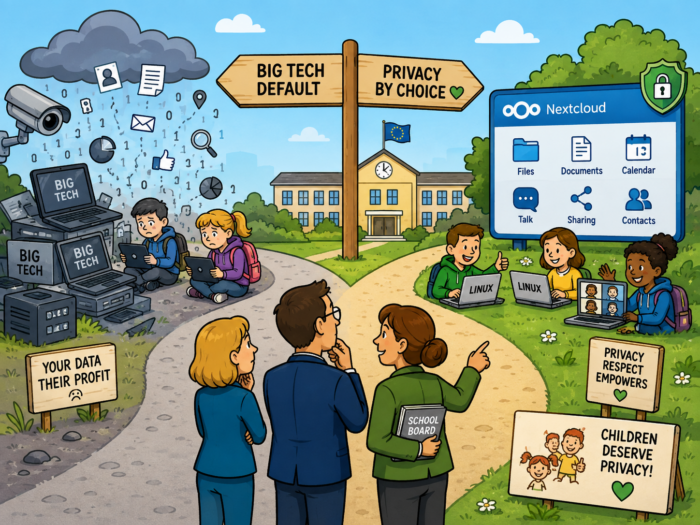
I came across an article by Privacy First about the digital student, and it touches on something that continues to bother me about the way we discuss technology in European education. The discussion is often framed as a choice: we can embrace digital technology in schools, or we can protect the privacy of our children.That is the wrong choice.

You can find the article here: https://privacyfirst.nl/artikelen/de-digitale-leerling/ (text in Dutch). Privacy First rightly points out that schools process enormous amounts of information about pupils, ranging from names and contact details to school results, behaviour and sometimes information about a child’s development. Children are particularly vulnerable because they usually have little choice about the software their school tells them to use.

But the conclusion shouldn’t be that schools therefore need less technology. They need different technology: technology that respects privacy and complies with privacy laws.

Digital does not automatically mean Google

There is absolutely no law of nature saying that digital education requires Chromebooks, Google Workspace, Microsoft 365, Windows laptops or MacBooks. A school can give students Linux laptops. It can use Nextcloud or similar open source platforms for storing and sharing files, working together on documents, calendars, video calls and all the other things schools nowadays expect from a digital workplace.

And before somebody says that this sounds nice in theory but could never work for hundreds of thousands of users: it already does. The French region Île-de-France has deployed a sovereign collaboration environment based on Nextcloud for around 550,000 pupils, teachers and administrative staff. The system is part of the regional monlycée.net environment and was explicitly designed as an alternative to Microsoft solutions. It includes document collaboration through Collabora Online, file storage and integration with the region’s existing systems. The infrastructure is operated in France.

You read that right: half a million users. So perhaps we can finally stop pretending that European and open source alternatives are lovely little hobby projects that might work for three enthusiasts and a Raspberry Pi. See https://nextcloud.com/fr/blog/cloud-souverain-plateforme-collaborative-ile-de-france/ for more information.

We became lazy buyers of IT

There is another part of this discussion that I think we don’t talk about enough. A Belgian CIO recently said something to me that stuck: we have forgotten that we actually have to make conscious choices ourselves.

For many years it was incredibly easy not to choose. Microsoft was already there, so you bought some more Microsoft. Your organisation was using AWS, so the next workload went to AWS as well. Google offered a complete education package, so schools bought Chromebooks and Google services.

You could call that standardisation. I increasingly call it convenience. Or perhaps there is a better word for it: laziness. And that is dangerous, because over time, that convenience has turned into dependency.

That dependency matters much more today than it did ten or fifteen years ago. Europe has become deeply dependent on a relatively small number of American technology companies for cloud computing, productivity software, communication and increasingly AI. In their article, Privacy First has made essentially the same broader point about Europe’s dependence on foreign technology providers and the consequences for autonomy and control over data. With today’s geopolitical uncertainty, treating that dependency as merely a procurement detail is becoming increasingly difficult.

Of course you cannot migrate an entire organisation in a day. Nobody sensible is suggesting that. Île-de-France didn’t do that either. But that argument is rapidly becoming an excuse. If you are responsible for IT in a sizeable European organisation and you are still not investigating alternatives, testing them, identifying dependencies and developing a realistic migration path, I think you have a problem. Migration takes years. Which is precisely why you need to start before circumstances force you to.

And then there are the children

There is something particularly uncomfortable about teaching children about privacy, data protection and digital literacy while at the same time making them use platforms built by some of the world’s largest data-driven technology companies. Privacy First argues that privacy should not simply be another compliance box for schools to tick. It should be a basic design principle of the digital environment children grow up in.

I couldn’t agree more with that conclusion. We have GDPR. We have endless discussions about children’s online safety. We teach pupils to think carefully about what they share online. And then institutions themselves make the fundamental technology choices on their behalf.

Schools deserve support from governments and IT specialists to make better choices. But eventually somebody also has to take responsibility. The technology exists. The alternatives exist. Large-scale examples exist. Île-de-France is already showing that hundreds of thousands of pupils and teachers can work digitally without simply handing the entire environment to Microsoft or Google.

So this really isn’t a discussion about digital versus privacy. It is about whether school directors are willing to do the homework required to have both.

This is Why I Love Hackers So Much

Years ago I read The Cuckoo’s Egg by Cliff Stoll. It is one of those technology books that somehow sticks in your memory, probably because it hardly feels like a technology book at all. It is more like a detective story, except that the detective is an astronomer turned system administrator, the clues are hidden inside Unix systems and telephone networks, and the whole thing starts with an accounting discrepancy of just 75 cents.

That tiny discrepancy eventually led Stoll into a year-long hunt for cyber criminals who were breaking into American computer systems and passing information to the East German Stasi and the Soviet KGB. This was 1986, long before cybersecurity became an industry filled with SOCs, SIEMs, threat intelligence platforms and impressive-looking dashboards.

I hadn’t thought about the book for a long time. Then I came across a recent video of Stoll speaking at DEF CON 34, forty years after that original 75-cent discovery. And yes, he is quite a remarkable presenter.

No cyber, just curiosity

Stoll describes how they had essentially none of the tools we now associate with cybersecurity. There was no budget, no roadmap and not even much of a vocabulary for what they were doing. Instead, they used soldering irons, shell scripts, printers, logbooks and lots of improvisation.

Watching him talk about it reminded me why I have always liked the world of developers and hackers so much. Not the criminal kind of hacker, obviously, but the original meaning of the word: people who are intensely curious about how things work. People who see something strange and immediately want to understand why. People who happily open things, connect things that were never supposed to be connected, write a little piece of software to solve a problem and then build something slightly ridiculous because it might just work. Stoll seems to embody that attitude almost perfectly.

Following the strange little clue

There is also something wonderfully old-fashioned about the whole story. Today, a 75-cent discrepancy would probably generate a ticket somewhere. It might be assigned a severity level, automatically enriched with telemetry and eventually end up on somebody’s dashboard. Stoll simply wanted to know why the numbers didn’t add up. And that curiosity turned a tiny accounting error into an investigation that crossed networks and international borders.

Technology has changed enormously since then. The internet has changed. Cybersecurity has become a huge professional industry. Attackers have changed too. But perhaps one thing hasn’t changed at all. Someone still has to look at something slightly unusual and think: That’s strange. I wonder why that happened. And then keep digging.

Maybe that is why I enjoyed watching Stoll’s presentation so much. It isn’t only an interesting piece of computing history. It is also a reminder that some of the most interesting things in technology still start with curiosity, experimentation and somebody refusing to ignore a tiny detail. That wonderfully stubborn, slightly (very?) eccentric hacker mentality.

I hope we never professionalise it out of existence.

I Went Looking at a Conference About Screenshots (About What?) and Found a Filesystem for Browser Tabs

Sometimes you find interesting software because you are looking for it. And sometimes you arrive there through a rather strange series of clicks. TabFS definitely belongs in the second category.

It started with a very short message I saw somewhere about something called Screenshot Conf (https://cristobal.arquipelago.org/writing/screenshot.html). My first reaction was more or less: a conference about screenshots?

Obviously, I had to know more. And yes, Screenshot Conf really was a conference entirely about screenshots. It was organised in New York by Cristóbal Sciutto and Omar Rizwan, with talks about things such as screenshot archives, information storage, image-based computing and the surprisingly important role screenshots play in the way we collect and share information. I will come back to Screenshot Conf in another post, because I have the slightly strange feeling that I have just discovered an entire world I didn’t know existed.

But Screenshot Conf also led me to the website of one of its organisers, Omar Rizwan (https://omar.website/). And that turned out to be another rabbit hole.

Turning browser tabs into files

Rizwan is interested in new computer interfaces and new ways of programming. His website contains a collection of experiments and projects that approach computers in ways that are often very different from the standard application-and-window model we are used to. One of those projects is TabFS (https://omar.website/tabfs/).

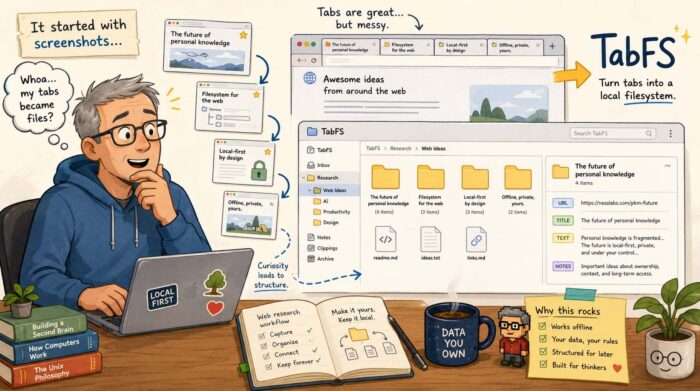
The idea is wonderfully strange: TabFS turns the tabs in your web browser into something that looks like an ordinary filesystem on your computer. Every open browser tab becomes a directory. Inside that directory are files representing things such as the URL, the title and the text of the page. Those aren’t simply exported copies. They reflect the current state of the browser tab. So suddenly your browser becomes accessible using all those boring old tools computers have been very good at for decades: files, directories, shell commands, scripts, text editors and file managers.

Your browser becomes scriptable

And that is where it becomes interesting. Suppose you have 40 tabs open while researching something. With TabFS, you can simply list the titles of those tabs as if you were reading files from a directory. You can also save the text of all your open tabs into one file. Or search those files. Or process them with Python. Or write a little shell script that selects certain tabs. Rizwan gives the example of closing every tab containing “Stack Overflow” in its title. Instead of building a special browser extension, you can essentially delete those tabs as if you were deleting files.

TabFS can go considerably further. It can expose images, JavaScript and other resources loaded by a page as actual files. You can evaluate JavaScript on a page through the filesystem, monitor values on a page and use scripts on your computer to interact with what is happening inside the browser.

It is experimental software, and some of the ideas Rizwan describes are explicitly still TODOs. But that almost makes it more interesting.

Browsing as information gathering

What particularly interests me is what this could mean for people who spend much of their day collecting information. That is basically what I do continuously. I open articles, reports, company websites, research papers, videos and all sorts of other sources. Some are immediately useful. Others might become useful several days or months later.

The browser is very good at finding and displaying all that information. It is much less good at turning it into something you can systematically work with afterwards. Bookmarks help, of course. So do read-later services and knowledge management tools. But they usually introduce yet another application and yet another database.

TabFS approaches the problem from an entirely different direction. It says: what if the browser simply became part of the filesystem?

Then you could write a script that periodically stores the text and URLs of your research tabs. You could sort them into project directories. You could use command-line tools to search through them. You could feed selected material into another processing workflow. You could create an archive containing the source URL, page title and extracted text. And because we are dealing with ordinary files, you could potentially combine this with almost anything else that understands files. That includes tools which haven’t even been designed to work with browsers.

I like this kind of software

TabFS probably isn’t something most computer users are going to install tomorrow. Its current setup requires a browser extension and a filesystem component, and Rizwan describes Chrome support as the main target, with more limited Firefox and Safari support. It currently runs on macOS and Linux.

But that isn’t really the point for me. What I like about projects like TabFS is that they question assumptions that have become so normal that we rarely notice them anymore. Why should information inside a browser be trapped inside a browser? Why shouldn’t my existing tools be able to access it? And why do we keep building separate applications for managing information when operating systems already have a perfectly good universal abstraction for storing and manipulating things?

I really like unpredictable journeys like that. I started out wondering why anyone would organise a conference about screenshots. A few clicks later, I found myself thinking about browsers as filesystems. Not a bad rabbit hole to fall into.

The Web Has a Memory Problem

I recently came across a post on Ctrl+Shift+3 from someone who had found an old backup of their del.icio.us bookmarks (https://ctrlshift3.com/post/cQHW0GSYNypR). The conclusion was concise and predictable: roughly 75 percent broken links and 80 percent obsolete technology. It made me sigh, because it reminded me of something I’ve been thinking about for quite a while: link rot.

Link rot is simply what happens when links that once worked stop taking you to the information they originally pointed to. A website disappears, an article is removed, a company changes its CMS, pages get reorganised or an entire domain simply vanishes. The result is the familiar 404 page, a redirect to somewhere irrelevant, or sometimes a completely different page at the same address.

And it happens a lot. A recent 20-year study of almost 2900 web citations found that accessibility dropped from 87 percent for citations less than five years old to only 38 percent for those more than ten years old. You can find the study here: https://www.sciencedirect.com/org/science/article/pii/S2050380626000220. That is quite a problem for something we tend to regard as permanent.

Why I don’t use URL shorteners

Link rot is also one reason why I prefer using the actual URL when I link to another website instead of putting a URL-shortening service in between. There is a very practical advantage: you can immediately see where you are going. A link beginning with w3.org, github.com or the website of a newspaper tells me considerably more than an address such as bit.ly/3Xf92Kd.

But there is another reason. A URL shortener adds an extra dependency. Instead of:

my website → source

you get:

my website → shortening service → source

That shortening service now controls all those redirects. If it disappears, changes the way it works, gets acquired, loses data or simply decides to discontinue the service, a potentially enormous collection of links can stop working overnight. It seems “slightly” strange to me to deliberately introduce another possible point of failure into something that is already rather fragile.

Of course, using the original URL doesn’t solve link rot either. If the original page disappears, the link still breaks. But at least there is one less organisation involved in keeping the link alive.

Keeping your own URLs boring

The Unattributed article “Digital Legacy: Link Rot Mitigation Issues” (https://unattributed.cc/2026/08/23/digital-legacy-link-rot-mitigation/) approaches the problem from the perspective of preserving a website over a long period. That is an interesting way of looking at it, because preventing link rot isn’t only about the sites we link to. It is also about the links other people create to us.

One of the most useful principles is actually very boring: don’t unnecessarily change URLs. If an article lives at a particular URL today, keeping it there for the next ten or twenty years is probably one of the best things you can do. The US Library of Congress makes the same recommendation: maintain stable URLs and, when a URL really has to change, redirect the old address to the new one. (https://www.loc.gov/programs/web-archiving/for-site-owners/creating-preservable-websites/)

That sounds obvious, but website redesigns have a remarkable ability to destroy perfectly good URL structures. A new CMS gets installed, /blog/interesting-article.html suddenly becomes /posts/2026/interesting-article, nobody bothers to create redirects, and thousands of old bookmarks and incoming links instantly become useless overnight.

Archive what matters

Another important defence against link rot is archiving. If I refer to something that is particularly important to an article, I can save the page in the Internet Archive’s Wayback Machine (https://web.archive.org/) or use a service such as Perma.cc (https://perma.cc/). That gives readers another route to the information if the original disappears.

This is especially useful for pages that are likely to change while keeping the same URL. Think of government policy pages, documentation, company announcements or so-called living documents. In those cases you can have something slightly different from link rot: content drift. The URL still works, but the information behind it is no longer what you originally referred to.

For sources like these, preservation guidance increasingly recommends keeping both the live URL and an archived snapshot. Have a look here for an interesting article about this topic: https://casrai.org/guides/link-rot-in-citations-and-how-to-prevent-it

For academic papers, reports and datasets, there is another option: use a persistent identifier such as a DOI whenever one exists (https://en.wikipedia.org/wiki/Persistent_identifier). The entire idea behind these identifiers is that the identifier remains the same even when the actual location of the document changes.

Give readers enough information to recover a link

There is also a wonderfully low-tech solution: don’t make the URL the only information you provide. When referring to an interesting article, mention its title, author and website. If the link dies in five years, someone can still search for it. If all I write is “read this” behind a hyperlink, the reader has almost nothing to work with once that link disappears.

The same applies to my own bookmarks. Saving only a URL isn’t particularly useful if that URL later breaks. A title, short note and perhaps publication date make the bookmark much more valuable as a record of what was actually there. Perhaps that old del.icio.us backup illustrates this perfectly. A dead URL on its own is almost meaningless. A dead URL combined with a title and description can still tell you what you once found interesting.

Check your old links

There is one final, rather mundane solution: occasionally check links. There are plenty of tools that can crawl a website and report broken external and internal links. Examples are LinkChecker (https://github.com/linkchecker/linkchecker) or Broken Link Checker (https://github.com/stevenvachon/broken-link-checker). For a small personal website you could run such a check every now and then and repair the links that matter. Sometimes the article simply moved. Sometimes there is an archived version. Sometimes another reliable source covers the same information.

But I wouldn’t turn this into an endless maintenance project either. Because ultimately link rot cannot be solved completely. Someone else’s website can disappear tomorrow. A company can close. A domain registration can expire. An organisation can deliberately remove twenty years of old material. Even archives cannot preserve everything, particularly today’s highly dynamic websites.

Perhaps the goal therefore shouldn’t be to create a Web in which no link ever dies. It should be to make links less disposable. Use stable URLs. Avoid unnecessary intermediaries. Redirect old pages when you move them. Archive important sources. Use persistent identifiers when they exist. And leave enough context around a link so somebody has a chance of finding the information again. Because the Web may look permanent when we use it every day. That old del.icio.us backup suggests otherwise.

China is Doing what Europe keeps Talking about — But Moving Much Faster

I recently went looking for a story I remembered reading about China replacing Windows with Linux. I could not find it at first, probably because I was searching for the wrong thing.

There is no single Chinese order saying that everybody has to throw Windows out. What China has been doing is much more interesting: step by step, it has been reducing its dependence on foreign technology, particularly within government organisations, state-owned companies and strategically important sectors.

The name that keeps coming up is Xinchuang, China’s programme to replace foreign technology with domestic alternatives (https://www.mof.gov.cn/jrttts/202312/t20231226_3924138.htm). That includes processors, databases, applications and operating systems. Chinese government procurement rules introduced in recent years increasingly require systems to meet domestic “safe and reliable” requirements. In practice, that has created much more room for operating systems such as Kylin and UnionTech UOS, both based on Linux.

And China has just taken another step. In August 2026, reports emerged (for example https://www.tomshardware.com/software/operating-systems/china-reportedly-orders-state-agencies-to-uninstall-its-government-only-edition-of-windows-10) that China’s Ministry of State Security had instructed some state-linked organisations to remove Windows 10 China Government Edition earlier than originally planned. This is important nuance: China has not banned Windows everywhere. The order concerns a special government version and a limited part of the Chinese market. Windows is still widely used by consumers and businesses.

Perhaps we should pay more attention to China

Still, I think the direction is interesting. Not because Europe should copy China’s political system or its approach to technology. Obviously not. But there is one thing China seems to understand very well: becoming extremely dependent on a handful of foreign technology companies is a strategic risk.

That is something Europe has been talking about for years. Digital sovereignty, strategic autonomy, European clouds, open source, sovereign AI. Plenty of conferences, reports and policy documents. But meanwhile we keep buying. And buying. And buying.

The numbers are rather impressive. A European Commission document published this year cites research estimating that European companies’ purchases of cloud software add around €264 billion annually to the US economy (https://eur-lex.europa.eu/legal-content/EN/TXT/?qid=1745691400115&uri=CELEX%3A52026SC0502&)

Then there is the price issue. Research commissioned by French CIO association Cigref found that European organisations saw cloud and software costs increase by an average 8.7 percent per year during the past three years. Some organisations experienced much larger increases when contracts were renewed. The same research expects average annual increases of around 12 percent during the coming five years. (https://www.cio-platform.nl/en/weblog/nieuws-extern-detailpagina/2026/07/02/rapidly-rising-cloud-and-software-costs-weigh-on-the-european-economy?)

That 8.7 percent figure is not specifically an “American cloud inflation rate”, so we should be careful with that. But combine rapidly increasing software and cloud prices with Europe’s enormous spending on predominantly American technology and it becomes clear that we are talking about very serious amounts of money. Digital sovereignty is therefore not just about geopolitics. It is also about economics.

I decided to start with myself

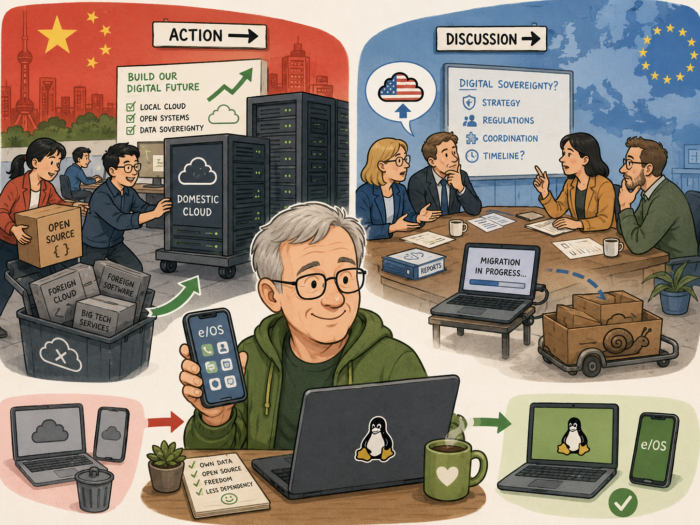
I have been gradually trying to reduce my own dependence on Big Tech. My laptop comes from a European company (Slimbook), although calling a computer completely European is almost impossible: the CPU and GPU in mine are from AMD. I use Linux as my operating system. Nearly all the software and cloud services I use are now European, open source, or both.

I came from a MacBook and an iPhone and switched to Linux Mint and Murena /e/OS, a de-Googled version of the open-source version of Android. And to be honest, it works differently in some ways, but certainly not worse.

So personally, I made the switch, and I’m perfectly happy with the result. The difficult part is often not my own technology. It is other people’s technology. Clients still invite me into SharePoint environments. People create WhatsApp groups and simply assume everybody uses WhatsApp. Publishing workflows are still often built around Adobe software. In those situations, digital independence suddenly becomes less of an individual decision. You are part of an ecosystem, and ecosystems are difficult to leave.

But migration costs money…

This is probably one of the biggest obstacles Europe faces as well. One argument I often hear is that replacing existing technology is expensive and risky. Of course it is. If an organisation has spent ten or twenty years building processes around Microsoft 365, Azure, AWS, Google Cloud or Adobe, you cannot simply switch everything off on Friday afternoon and start again with European alternatives on Monday morning. People have to be trained. Applications have to be migrated. Interfaces have to be rebuilt. Data needs to move. Some functionality may not have an equivalent. And some projects will undoubtedly go wrong.

So yes, reducing dependency costs money. But keeping the dependency has a cost too. And that part of the calculation seems to receive much less attention – even by business managers who consider themselves financially savvy. What happens if prices continue to rise by almost 9 percent every year? What happens if a supplier changes its licensing model? What happens if political relations deteriorate badly? And, perhaps the uncomfortable question: what happens if access itself becomes part of a geopolitical conflict?

Canada suddenly makes that question less theoretical

This is why I am watching the current trade conflict between Canada and the United States with some interest. See for example here: https://www.reuters.com/business/trump-time-teach-canada-you-cant-do-this-anymore-2026-08-26/?. Relations between two countries that have been extremely close economic partners for decades have deteriorated remarkably quickly. In August, the US imposed 50 percent tariffs on roughly $20 billion worth of Canadian goods, after which Canada announced matching retaliatory measures.

So far, this is a trade conflict involving physical goods and tariffs. I have seen no evidence that the US government intends to restrict Canadian access to Microsoft 365, Azure, AWS, Google Cloud or other American digital services. But it does raise an interesting question.

Could digital services eventually become economic or political leverage as well?

I don’t know. And that is precisely the problem.

For years we have treated cloud platforms, office software and other digital services almost as utilities. They are just there. We log in every morning and assume they will still be there tomorrow. China clearly doesn’t want to make that assumption. Europe shouldn’t either.

We don’t have to replace everything tomorrow. That would be unrealistic and probably counterproductive. But we could start doing exactly what China has been doing for years: identify dependencies, develop alternatives, change procurement policies and gradually move critical systems to technology over which we have more control. We do not need yet another conference about digital sovereignty. Not another declaration.

What we do need: start migrating. Because the best moment to reduce a dependency is probably while everything is still working.

AI and Art: Maybe the Interesting Part Is Somewhere in the Middle

Every now and then I watch a presentation about AI that actually adds something to the discussion. Jack Conte’s recent talk at SXSW is definitely one of those. Conte is not only the CEO and co-founder of Patreon, but also a musician and filmmaker himself, which probably explains why his presentation feels so personal. And passionate. Very passionate.

His SXSW session took place in Austin in March 2026, and the video has since been published as The future of creativity on the internet in a world with AI. Conte clearly struggles with AI himself. He is excited about what the technology could make possible, but at the same time angry about what is happening to artists and their work. That conflict is exactly what makes his presentation so interesting.

We have been here before

Conte spends quite a bit of time looking back at previous technological changes. Film initially copied theatre. Recorded music disrupted musicians playing live in cinemas. Synthesizers created fears that orchestras and musicians would become unnecessary. New technology repeatedly destroys existing business models, after which artists start figuring out what they can do with the new technology that simply wasn’t possible before.

He believes generative AI is currently going through a similar phase. Much of what we now see is what he describes as AI “slop”: technology being used mainly to imitate things we already know. Generate another picture. Another song. Another video. Another piece of text. Faster, cheaper and in almost unlimited quantities.

I think that distinction is important.

The debate about AI and creativity has become incredibly black and white. On one side are people who want nothing to do with AI-generated music, images or text because a human didn’t make it in the traditional sense. On the other side are people who seem determined to use AI for virtually everything.

I don’t find either position particularly useful.

Making more isn’t necessarily creating more

I use AI myself, including when writing. So obviously I don’t believe that using AI automatically makes something worthless. But there is a big difference between using AI as a creative tool and simply switching on some sort of content machine that produces hundreds of songs, articles or images because you hope to make money from the volume.

That doesn’t particularly interest me. What does interest me is someone taking these new tools and trying to do something genuinely new with them.

This is also where Conte makes an interesting point about creativity. Today’s AI models have learned from enormous amounts of existing human work. They are extraordinarily good at recognising patterns and recombining what already exists. That can produce impressive results, but it is fundamentally different from a human artist deliberately taking a creative risk, developing an unusual idea or deciding to make something nobody asked for.

Conte puts a lot of emphasis on precisely that human element. Art, in his view, is connected to difficulty, scarcity, risk and the person behind the work. We don’t just listen to music because certain sounds have been arranged correctly. We are also interested in the person who made it and what that person was trying to express.

Use AI to make your ideas possible

That is a much more useful way to look at AI and creativity. Don’t ask AI to come up with as much stuff as possible. Come up with ideas yourself and see whether AI can help you realise ideas that previously would have been too difficult, expensive or perhaps even impossible.

That applies to music, photography and video, but just as much to writing. AI can help me research, experiment, restructure, translate, challenge an argument or try a completely different approach. But there still has to be an idea. A reason for creating something.

That is why I like the double feeling in Conte’s presentation so much. He doesn’t pretend everything about AI is wonderful. Far from it. He is highly critical of how creators have been treated, including the use of their work for AI training without permission, attribution or compensation. At the same time, he refuses to conclude that the technology itself can therefore bring nothing worthwhile to art.

That middle ground is where this discussion becomes much more interesting to me. AI can produce more. Much, much more. But producing more isn’t the same thing as having a new idea. And perhaps the artists, musicians and writers who understand that difference will eventually do the most interesting things with AI.

The Smartphone Features We Should Have Had Years Ago

Smartphones are astonishingly capable devices. They have cameras that would have seemed impossible twenty years ago, processors powerful enough to run serious software, satellite connectivity, increasingly sophisticated AI and enough sensors to know roughly what we are doing most of the day. And yet I regularly find myself wondering: why can’t my phone do this?

Not because I am waiting for some spectacular new technology. Quite the opposite. Many of the features I would like to see seem surprisingly simple. I recently came across a post on Curvise about phone features that really should exist by now, and that got me thinking about a much broader question. Smartphones have evolved enormously, but the way we interact with them has remained remarkably conventional. We still open apps. We still move information manually from one app to another. We still hunt through settings menus. And when we want privacy, we often need to disable several different things separately. Surely we can do better.

Why is my smartphone still a collection of apps?

This is probably the biggest one for me. Suppose someone sends me a message asking whether we can meet next Wednesday at 11:00 at a certain café. What do I do? I open my calendar to check whether I am available. Then I open Maps to see where the café is and perhaps check how long it takes to get there. After that I return to the messaging app, confirm the appointment and finally go back to the calendar to create an event.

None of this is difficult, of course. But why am I doing all those individual steps? My phone already has access to the relevant information. It knows what is in my calendar, it knows where the café is, it can calculate travel time and it knows who sent the message. I should simply be able to say: “Yes, that works. Put it in my calendar and send the details back.” The phone should handle the rest.

This is where AI on smartphones could actually become useful. Not by generating funny pictures or summarising emails I could read myself, but by acting as a layer across the operating system. At the moment, smartphone software is still built largely around applications. Every app is its own little island, and we are the ones moving between those islands and performing a sequence of actions.

A smarter operating system could understand the intention behind what you are doing. You could say: “Send the photos I took yesterday to Anna,” or “Find the PDF Peter sent me last month and attach it to this email.” You might also ask: “During my holiday, silence all work notifications except messages from these three people”, or “Whenever I arrive at the office, switch my phone to silent mode and start my work timer.”

Some of this can already be achieved through automation tools, shortcuts or individual AI assistants, but that misses the point. It should not require programming your phone. The operating system itself should understand these kinds of instructions.

Small features can make a big difference

There is another category of missing smartphone features that is far less ambitious. These are the things where you discover an idea and immediately think: of course a phone should be able to do that. Curvise has collected several examples of this type, and I think this is an interesting reminder that innovation does not always have to mean adding another camera, making a screen slightly brighter or putting a faster processor inside a phone.

Sometimes innovation is simply about removing small irritations. Take notifications. Smartphones have become much better at managing them, but notification controls are still often strangely primitive. You can allow an app to send notifications or block them. Sometimes there are categories, and sometimes you can silence them temporarily. But I would like much more contextual control.

For example, I might want to tell my phone not to show me any news notifications while I am working, to mute a certain app until tomorrow morning, or to notify me only when a message in a group contains my name. I would also like to be able to say: “Never show promotional notifications from this app, but keep service notifications.” None of this sounds futuristic to me. It simply sounds useful.

The same applies to sound. Why isn’t there a proper mixer on every smartphone? My laptop lets me control the volume of individual applications, while on phones sound control is often still surprisingly basic. Perhaps I want Spotify playing quietly while a language-learning app is louder. Perhaps I want navigation instructions at one volume and music at another. Or perhaps I want one game permanently muted without disabling sound for everything else.

These are tiny improvements, but they can dramatically change how pleasant a device is to use. And that is something smartphone manufacturers sometimes seem to forget. A phone does not necessarily become better because it gains another headline feature. It becomes better when it gets out of your way.

Give me one big privacy switch

Then there is privacy. Modern smartphones contain microphones, cameras, GPS receivers, Bluetooth, Wi-Fi, motion sensors and plenty of other ways to collect information about us. Both Android and iOS now provide reasonably good permission controls, allowing you to decide which applications can use your microphone, camera or location.

But the controls are still fragmented. What I would really like is a huge, obvious privacy switch. One tap and camera access is off, microphone access is off, location access is off, Bluetooth scanning is off and background sensor access is disabled. Perhaps it could even temporarily disable network access for applications. Basically: a leave-me-alone-mode.

Android has experimented with sensor controls that come close to this idea, and individual privacy settings already exist on most phones. But there should be a simple universal control that temporarily shuts everything down. Imagine walking into a confidential meeting. Instead of checking five different settings, you tap one button and privacy mode is enabled. When the meeting is finished, you switch it off again.

Or perhaps you are visiting somewhere and simply do not want apps collecting location information for a few hours. Again: one tap, done. Of course there would need to be exceptions. Emergency calling, for example, should continue to work, and you might also want to allow certain devices or apps. But technically this does not seem particularly difficult.

More importantly, it would make privacy visible. At the moment privacy settings tend to be buried inside menus. That makes them something you configure once and then forget. A privacy switch would turn privacy into something you actively control.

Maybe we don’t need another AI button

What I find interesting about all these examples is that none of them require a radically different smartphone. The hardware is already there, the sensors are already there, the processing power is certainly there and even much of the software already exists in one form or another.

What is missing is integration. Smartphones have become enormously sophisticated devices, but we still interact with them in ways that often feel surprisingly manual. We open an app, tap something, copy information, switch apps, paste it somewhere else, change a setting and then switch it back later.

Perhaps the next big improvement in smartphones should therefore not be another camera lens or another AI button. Perhaps smartphones simply need to become better at understanding what we are actually trying to achieve.

Give me an operating system that can perform tasks across applications, give me much smarter contextual controls and please give me one enormous privacy switch. None of these ideas sound revolutionary, which is exactly why I find it so strange that we still don’t have them.

Here are two links to interesting blogs and ideas about this topic:

in Tech | 1,332 Words

Green Claims Are Easy. Proving Them Is the Hard Part

A friend of mine, Marco Verzijl, has been fighting for more transparency around data center sustainability and energy consumption for years. Whenever we talk about data centers, energy efficiency or sustainability, Marco usually comes back to the same basic point: claims are easy. Measurements are much more interesting. That is also the central idea behind a recent article he wrote for DCpedia.net (text in Dutch). Marco argues that a sustainable data center should not simply say it is sustainable. It should be able to prove it with reliable, traceable and independently verifiable data. I think that distinction is becoming increasingly important.

AI changes the discussion

Data centers have always consumed substantial amounts of electricity, but AI is rapidly changing the scale of the discussion. Powerful GPUs increase power densities, cooling becomes more demanding and access to sufficient grid capacity is turning into an important economic issue. At the same time, we increasingly depend on data centers. Hospitals, banks, government services, industrial systems, cloud platforms and, of course, AI applications all rely on physical digital infrastructure.

So the useful discussion is probably not whether we should have data centers at all. As Marco puts it, the real question is: which data centers do we need, for which applications, in which locations and with what demonstrable energy and societal performance? Answering that requires data.

PUE is only part of the story

One thing I particularly like about Marco’s argument is his criticism of looking at isolated sustainability indicators. Take PUE, or Power Usage Effectiveness. It is an important metric because it tells us something about how efficiently a data center uses energy for cooling, power distribution and other supporting infrastructure. But it does not tell us whether the servers themselves are doing anything useful.

Marco uses a nice analogy: an extremely fuel-efficient truck that drives around almost empty is still being used inefficiently. The same applies to a data center. A facility may have an excellent PUE while large amounts of IT capacity are hardly being used.

That becomes especially interesting with AI. Two models performing roughly the same task can require very different amounts of computing power and therefore energy. Eventually, we need to look beyond energy consumed per building and start asking how much useful digital output we receive per kilowatt-hour.

Green electricity is not enough

The same applies to renewable energy claims. Saying that a data center uses “100 percent green electricity” sounds convincing, but it does not necessarily mean renewable electricity physically powers that facility every hour of every day. Certificates and annual contractual arrangements can make the reality considerably more complicated. Water consumption, backup generators, heat reuse, hardware utilisation and even the lifetime and recycling of servers should also be part of the picture.

Which brings us back to transparency. Marco writes that sustainability data should be based on actual measurements, connected to known measuring points, traceable to source data and independently verifiable. Otherwise, sustainability risks becoming primarily a communications exercise. That seems like a useful principle far beyond the data center industry. Because in the end, as Marco concludes, a sustainable data center is not one that calls itself sustainable. It is one that can prove it.

You can read his article here: https://dcpedia.net/een-duurzaam-datacenter-begint-niet-bij-een-belofte-maar-bij-controleerbaar-bewijs/.

Open or Open (AI) Washing?

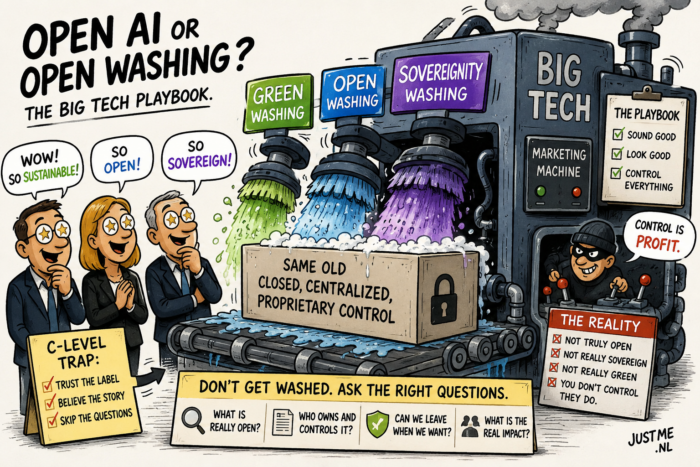
The technology industry has a long history of using attractive words to create a positive image. “Green”, “sustainable”, “responsible”, “sovereign” and now “open” are all terms that sound reassuring. But increasingly, these words are also becoming part of a familiar marketing strategy: make a product or service appear more independent, transparent or responsible than it really is.

We have seen this before with greenwashing. Companies present themselves as environmentally friendly while the reality behind their operations is often much more complex. A few sustainability initiatives or carefully chosen words can create the impression that a company is leading the way, even when the underlying business model has barely changed.

The same pattern is now appearing in other areas of technology. Open washing and sovereignty washing have become part of the same playbook.

Recently, I read an interesting article on Tech Policy Press titled “Open washing is everywhere in AI. Four criteria cut through it.” The author is J.J. Jasser, a professor and director of data analytics at Rollins College in Winter Park, Florida. His research examines artificial intelligence, open-source development, and digital literacy. He also contributes commentary on technology and digital literacy to the Orlando Sentinel.

Jasser explains how the word “open” is increasingly being used in artificial intelligence as a marketing term rather than as a clear technical description. The problem is that “open” can mean many different things. A company may release parts of an AI model, publish limited documentation or offer access through an interface, and then present the technology as open. But true openness requires much more: transparency about development, access to relevant information, the ability to inspect and adapt the technology, and meaningful freedom for users. As the author points out, companies often highlight the elements that support the “open” label while keeping important limitations less visible.

This is exactly why open washing deserves attention. The term creates a sense of trust and independence, while the actual level of openness may be far more limited. The same applies to digital sovereignty. In Europe, concerns about dependence on large technology providers have grown significantly. Organisations want more control over their data, infrastructure and AI capabilities. Big Tech companies have responded by introducing so-called sovereign cloud offerings and European cloud regions.

At first glance, this sounds like the solution Europe has been looking for. Data is stored in Europe, services are operated locally and the word “sovereign” appears prominently in the marketing material. But sovereignty is about much more than location. Who owns the technology? Who controls the software? Which laws apply? Where is the company based? Can customers realistically move away if circumstances change? These are the questions that matter.

Using a European data center does not automatically create digital sovereignty. Just as adding a green label does not automatically make a company sustainable, adding the word sovereign does not automatically create independence.

Unfortunately, many C-level executives still fall for these messages. Under pressure to make decisions about cloud, AI and digital transformation, it is tempting to rely on vendor promises and attractive terminology. But technology leaders need to look beyond the marketing language and examine the real level of control they have.

The lesson from the discussion around open AI is therefore much broader. Whether it is greenwashing, open washing or sovereignty washing, the mechanism is the same: take a concept with a strong positive meaning and use it to improve perception.

The answer is not to reject everything Big Tech offers. Many of these technologies are valuable and play an important role in modern organisations. But companies need to ask harder questions and demand more transparency. Because in the end, words like “open”, “green” and “sovereign” only matter when they are backed by reality. A label is easy to create. Genuine openness, sustainability and independence are much harder to achieve.


The Space Economy Is Taking Off

I have always been fascinated by space. Not only because of the spectacular images from distant galaxies, the engineering challenge of launching rockets, or the incredible scientific discoveries made by missions exploring our solar system. What fascinates me even more is the fact that space technology is increasingly becoming part of our everyday lives.

For many years, space was something that belonged mainly to governments, research institutes and a handful of large aerospace companies. Satellites were expensive, rockets were rare, and space exploration felt like something far removed from our daily reality. That is changing rapidly.

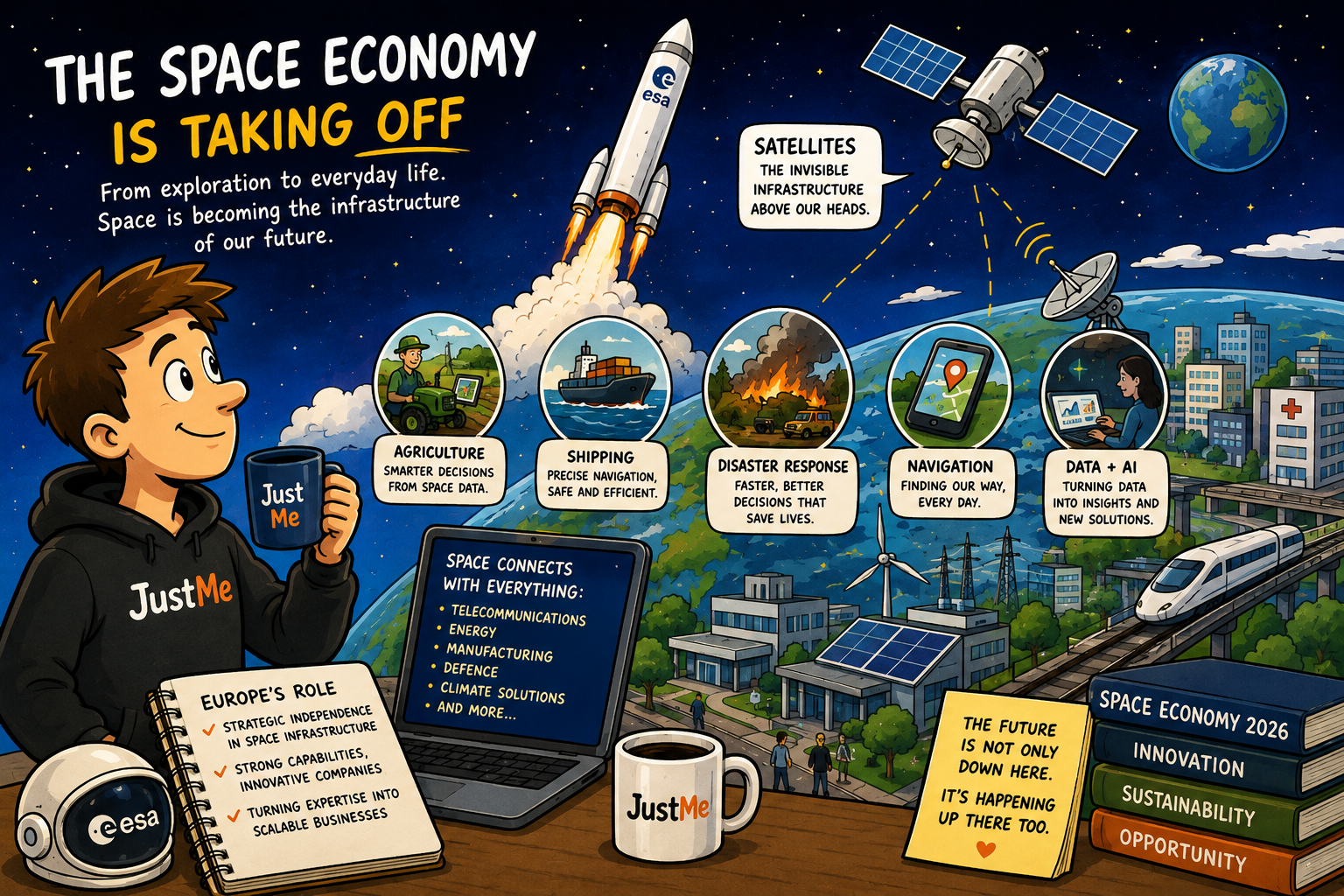
The latest Space Economy Report from the European Space Agency (ESA) shows how quickly space is developing into a mature economic sector. Space is no longer only about exploration and scientific missions. It has become an essential infrastructure layer for modern society — supporting communication, navigation, climate monitoring, agriculture, logistics, security and many other industries. And this is only the beginning.

From government projects to a global commercial ecosystem

One of the most interesting developments of recent years is the shift from a government-driven space sector towards a much broader commercial ecosystem. Companies are building satellites, developing launch services, analysing Earth observation data and creating completely new services based on information collected from orbit. The cost of entering space is decreasing, partly because of reusable launch technology, smaller satellites and more efficient manufacturing processes.

This has created opportunities for thousands of companies that would never have been considered “space companies” in the past. A farmer using satellite images to optimise irrigation is benefiting from space technology. A logistics company using precise positioning data relies on satellites. A telecommunications provider offering connectivity in remote areas depends on orbital infrastructure. And thanks to satellite data, governments can respond much more effectively to natural disasters such as wildfires, floods and earthquakes. In many ways, satellites are becoming the “cloud infrastructure in space”.

Europe’s role in the new space economy

As someone who follows technology, digital sovereignty and autonomy, and European innovation closely, I find the European perspective particularly interesting. The space economy is not only about economic growth. It is also about strategic independence. Just as Europe is discussing digital autonomy in areas such as cloud computing, artificial intelligence and semiconductor technology, space infrastructure is becoming a strategic asset as well.

Reliable access to satellite data, navigation systems and communication capabilities is increasingly important for governments, companies and society as a whole. Europe has strong capabilities in space technology. Organisations such as ESA, national space agencies, research institutes and a growing number of innovative companies are contributing to a competitive European space ecosystem. The challenge therefore is not whether Europe has the knowledge or the technology. The challenge is turning that expertise into scalable businesses and ensuring that Europe remains an important player in a rapidly growing global market.

The connection between space and artificial intelligence

Another reason why the space economy is becoming increasingly interesting is the connection with artificial intelligence. Satellites generate enormous amounts of data. Every day, they collect information about our planet, weather systems, oceans, cities and industrial activities. But collecting data is only the first step. The real value comes from analysing it.

AI will play a crucial role in turning satellite data into information we can actually use in daily (business) life. At the same time, space itself creates new challenges for AI. Processing data closer to where it is generated — potentially directly in orbit — could become increasingly important as the amount of information from satellites continues to grow.

One of the reasons I enjoy following developments in space technology is that they show how innovation often crosses traditional boundaries. Space is no longer an isolated industry. It connects with telecommunications, energy, manufacturing, defence, agriculture, logistics, climate technology and artificial intelligence. The same technologies that help us explore distant planets are also helping us solve problems here on Earth. This is perhaps the most exciting aspect of the new space economy: it is not about escaping from our planet. It is about understanding, protecting and improving it. And that makes this report a very interesting read.