Nextcloud on the Beach

A new episode of my “De Overstap” series has just been published on Computable.nl. In this series, I write about my own attempts to move away from the usual Big Tech ecosystem and see how far you can get with European, open source and more independent alternatives.

Episode 9 became something of a holiday edition. This summer I travelled with my family to the south of France with a tech setup that was almost completely free of the platforms I used to depend on. My laptop was my Slimbook Evo running Linux Mint, while my phone was a Fairphone 6 with Murena’s /e/OS. And yes, for the most part it worked remarkably well.

There was one small adventure on the way. As soon as I crossed the border, my phone suddenly had no mobile internet. Everything seemed to be configured correctly, but eventually I discovered (thank you Mistral Vibefor helping me) that the correct KPN APN setting was simply missing. Once I added it manually, everything worked again.

That experience actually illustrates one of the main points of this new episode. Alternatives to Big Tech increasingly work perfectly well from a technical point of view. But if we really want ordinary users to adopt them, the learning curve still needs to come down. People should not have to know what an APN is just because they choose a different mobile operating system.

And then there was Nextcloud. I happened to wear an old Nextcloud T-shirt on the beach in France. To my surprise, several French people recognised the logo and started talking to me about Nextcloud, digital autonomy and European alternatives. Hardly scientific market research, of course, but still interesting. Open source alternatives such as Nextcloud seem to be slowly moving beyond their traditional technical audience.

The article also includes my latest experiences with Capacities.io for personal knowledge management, plus a few other interesting alternatives I recently came across, including littleFedi, soev.ai and the Dutch Matrix service mtux.nl.

You can read De Overstap 9: Nextcloud op het strand on Computable.nl: https://www.computable.nl/2026/08/17/de-overstap-9-nextcloud-op-het-strand/.

AI Can Write The Code, But Do We Understand It?

There is something slightly strange happening in software development. For decades, one of the main challenges was writing the code. You had an idea, figured out how to translate it into software, wrote the code, discovered that it didn’t work, stared at it for half an hour, changed three characters and suddenly it did work.

AI changes that process dramatically. Today you can describe what you want and watch an AI coding agent produce hundreds or even thousands of lines of code. And it is only getting better at it. That sounds wonderful, but it also creates a problem that I find increasingly interesting: what happens when AI can write code faster than we can understand it?

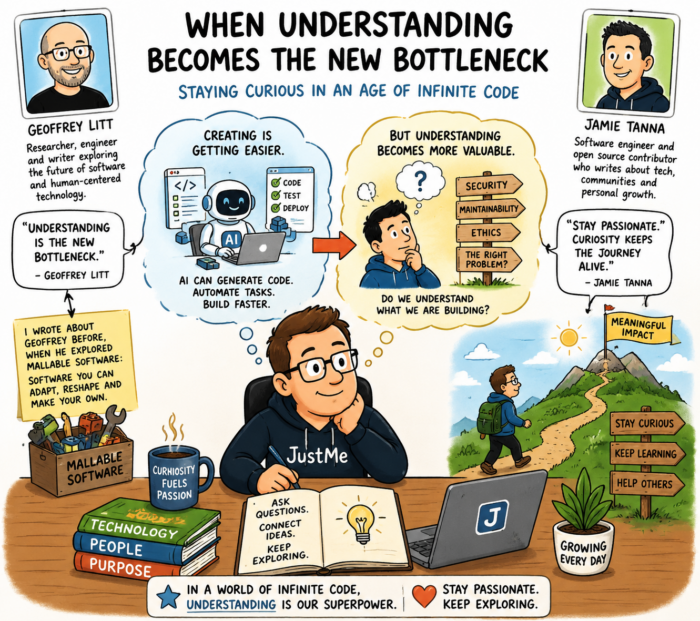
That is exactly the question Geoffrey Litt explores in his excellent article Understanding is the New Bottleneck. You can reda it here: https://www.geoffreylitt.com/2026/07/02/understanding-is-the-new-bottleneck. Geoffrey is a design engineer at Notion who writes and experiments extensively with new ways for humans to interact with software and AI. I have written about him before, especially when he was exploring the concept of malleable software: software that users can adapt, reshape and truly make their own instead of simply consuming it as a finished product. But also software you create when you need it and simply throw away when you don’t need it anymore.

In his new article, Geoffrey takes that thinking in an interesting direction. “It’s still important to understand the code that our agents write,” he argues. That sounds almost ridiculously obvious. Of course we should understand our software. But think about what happens when you actually start using AI coding tools seriously. You ask for a feature. The AI changes twelve files. It adds a library, modifies an API, creates some tests and changes part of the data model. Everything compiles. The tests pass. You run the application and it seems to work. Nice! On to the next prompt. And that is precisely where the danger begins.

The code works, so what?

Geoffrey Litt makes an important distinction between understanding code to verify it and understanding code so you can participate in developing it. Verification is basically asking whether the AI did its job correctly. Does the code compile? Do the tests pass? Does it match the specification? Is the architecture reasonable? AI is becoming increasingly capable of doing some of that verification itself.

But understanding has another purpose. If we really understand how a system works, We can think about what it should do next. We can see alternatives. We can recognise that a particular architectural choice will become a problem later. We can connect one part of the system with another. As Litt puts it, understanding allows us “to participate.”

I think that is an extremely useful way of looking at AI-assisted programming. If an AI agent has created half my application and all I can say about the result is, “Well, it seems to work,” I am no longer really developing that application. I am supervising its development.

Every time we accept code we do not understand, we also accumulate what Litt describes as cognitive debt. It resembles technical debt. You can ignore it for a while, particularly when everything is working. But sooner or later you need to change something and suddenly discover that you have lost your mental model of your own software.

So how do we prevent that? This is where Litt’s article becomes particularly useful, because he doesn’t just identify the problem. He experiments with practical ways of solving it.

Use a literate diff

One of the most obvious ways to review AI-generated code is to look at the diff. But imagine an AI agent has changed twenty files. Reading hundreds of changed lines from top to bottom is technically reviewing the work, but it isn’t necessarily a very good way of learning what happened.

Litt suggests turning the process around. Before looking at individual lines of code, ask the AI to explain the change. And not simply: What did you change? Ask it to teach you. What did the system look like before? What problem were we trying to solve? Which concepts do we need to understand? What architectural decision did you make? Which components interact with each other? What alternative approaches were possible? Why did you choose this one? Only then move towards the actual code.

Litt calls one version of this a literate diff. Instead of presenting changed files in whatever order Git happens to show them, the changes are presented as a story: first the background, then the idea, followed by the relevant pieces of code in an order that makes conceptual sense. That is an interesting idea. The AI wrote the code, so why not also make the AI write the manual that teaches us what it just built?

Ask for intuition

There is another subtle but important point in Litt’s approach: intuition before details. Suppose an AI has implemented a caching system. Before studying the implementation, we could ask: What exactly are we caching? Why will that make the application faster? When is the cache invalidated? What happens if it contains stale information? Where does the cache live? What happens after a restart?

Only once we understand those concepts does it make sense to study the classes, functions and data structures implementing them. The same applies to almost anything an AI creates. If it adds authentication, first understand the authentication flow. If it creates a database abstraction, first understand how data travels through the application. If it introduces asynchronous processing, first understand which things now happen in which order. If it creates an API, understand the contract before studying its implementation.

That sounds like basic software engineering. And I guess it is. The difference is that AI makes it extremely easy to skip these steps because the implementation can appear almost instantly.

Make the AI test you

This is perhaps my favourite suggestion from Litt. After the AI has explained the code, ask it questions about the system. Or even better: ask the AI to quiz you.

Litt actually does this. His code explainers contain five questions about the change, and he has a simple rule: he doesn’t send the code to other people until he can pass the quiz. That may sound a little like going back to school, but it solves an interesting problem. Reading something is not the same as understanding it. We can read a beautiful AI-generated explanation and think: yes, perfectly clear. Then somebody asks us five minutes later how the data actually gets from A to B and wemight very well discover that we don’t know.

So after an AI has generated something substantial, ask it: What are the five things I really need to understand about this implementation? Then close the explanation and try answering them yourself. Or ask the AI to give you scenarios. What happens if this API call fails? What happens when two users update this record simultaneously? Which component owns this data? What breaks if I remove this function? Where would I make a change if I wanted to add feature X?

If you cannot answer those questions, you probably don’t understand the software yet. says Litt. He describes these quizzes as a kind of speed regulator. AI can move much faster than human understanding, so occasionally we need to deliberately slow the loop down.

Tools for understanding AI code

Then comes an idea I hadn’t really considered before reading Litt. AI doesn’t only have to generate the application. It can also generate temporary software that helps you understand the application. Litt calls these micro-worlds. For example, while working on a Prolog interpreter, he had an agent create a debugger that allowed him to step through execution and see what was happening internally. In another project, an AI-generated interface let him migrate his website step by step while watching the old and new versions side by side.

That opens up all sorts of possibilities. Ask an AI to create a visualisation showing how data flows through the application. Ask it to build a tiny dashboard displaying internal state. Ask it for a stripped-down version of a complicated algorithm with sample data. Ask it to create a sequence diagram. Ask it to instrument the software so you can see which functions are being called. Or ask it to create a small playground where changing one variable immediately shows the consequences.

The important difference is that you do the exploring. As Litt notes, there is a big difference between asking an agent to debug something for you and using a tool created by the agent to investigate the problem yourself. In the second situation, AI hasn’t removed you from the process. It has given you better instruments.

Explain the code back to the AI

We could also add another simple technique: reverse the conversation. Don’t always ask the AI to explain things to you. Explain the software to the AI. Write down your understanding: As I understand it, request A enters here, is validated by B, stored through C and eventually triggers D. Component E is only used when… Then ask the AI: What have I misunderstood or missed?

This forces you to construct your own mental model instead of merely consuming the model’s explanation. You can do something similar by drawing the architecture yourself and asking the AI to check it against the codebase.

That distinction is important. The goal isn’t to have an AI that understands your software perfectly. The goal is for you to understand it.

Sometimes just write the code yourself

Which brings me to Jamie Tanna. Jamie is a software engineer and open-source maintainer who writes extensively about Go, open source, software engineering and his experiences with AI-assisted development. In his writing around GopherCon UK 2026, another question appears that fits remarkably well with Litt’s argument: how do you stay passionate about programming when increasingly powerful tools can do so much of the programming for you? You can read his report here: https://www.jvt.me/posts/2026/08/14/gophercon-uk-2026/.

That is a highly relevant question, because there is another risk here. You can understand perfectly well what an AI agent has built and still find the whole experience rather boring. For many developers, programming isn’t merely a mechanism for producing software. Solving the puzzle is part of the attraction. You try something. It fails. You discover why. You try something else. And somewhere during that process you learn something you didn’t know when you started.

If our interaction with software development becomes prompt, wait, accept, prompt, wait, accept, we may become extremely productive while slowly removing the thing that made programming interesting in the first place. That is why I think understanding and passion are closely connected.

Do not outsource all the interesting bits

There is no rule saying that because AI can do something, we have to let it. Let AI generate boilerplate, write repetitive tests, search through unfamiliar APIs and suggest solutions. But occasionally keep the interesting problem for yourself. Use AI as a teacher rather than a replacement. Ask it to give you hints instead of complete solutions. Ask it to explain an unfamiliar concept and then implement it yourself. Ask it to create an experimental environment where you can play with an algorithm. Or simply turn it off for an hour.

Efficiency isn’t always the objective. Sometimes learning is. Sometimes curiosity is. And sometimes spending an evening solving something that an AI could probably generate in thirty seconds is still worthwhile because we want to know how it works.

That is what I take away from these two authors. Litt’s argument isn’t really that we need to carefully inspect every line an AI generates. That would quickly become impossible. Instead, we need better ways of building and maintaining mental models of increasingly AI-generated systems. Explanations, literate diffs, quizzes, visualisations and micro-worlds can all help.

And Tanna’s thoughts about staying passionate add another line of thought. We shouldn’t only ask how AI can make us faster at programming. We should also ask how AI can make us better at understanding programming. That is a very different objective.

Perhaps the most interesting sentence in Litt’s article comes near the end: “The point was always to augment, not just automate.” I think that captures it perfectly. AI can write the code. It can test the code. It can explain the code. It can even write little tools that help us explore the code. But we still want to understand what is happening. Because the moment we stop understanding our, we also lose much of our ability to decide where it should go next.

AI Is Learning From Books by Destroying Them?

I use AI a lot. I find the technology fascinating and useful. But every now and then I come across a story that makes me wonder whether we have completely lost sight of what we are doing. This is one of those stories.

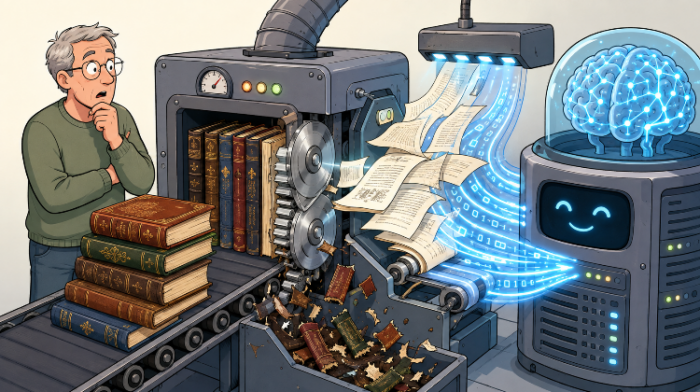
404 Media reports that Amazon is buying large quantities of physical books, scanning them to create AI training data and destroying the books in the process. The journalists even placed a tracker inside a shipment of rare books and followed it to an Amazon facility in Las Vegas where, according to employees, books are cut apart so they can be scanned more efficiently. Amazon itself confirmed that it purchases books through commercial channels to help develop and improve its products and services.

If this report is accurate — and there are now quite a few similar stories appearing elsewhere — I find this astonishing.

The basic process is brutally simple. Cut off the spine, separate the pages, scan them at high speed and turn the text into training data. The physical book is effectively gone afterwards. And apparently this does not only involve cheap mass-market paperbacks. 404 Media says the shipment it followed contained books that were rare in the sense that relatively few copies were in circulation.

This is not an isolated story either. Court documents previously revealed that Anthropic bought and destructively scanned millions of books for AI training. The Washington Post reported on the project, while Ars Technica described how bindings were removed, pages scanned and the original books discarded. Booksellers in Europe and Australia have meanwhile reported unusual bulk purchases of obscure and sometimes rare titles, although in many of those cases they cannot prove who the ultimate buyer is or what happens to the books afterwards.

I understand why AI companies want books. Compared with much of the web, books contain carefully edited, structured, human-written information. Older books also have another attractive property: they predate the current explosion of AI-generated text. For companies desperately looking for clean training data, that makes them extremely valuable. 404 Media previously reported that printed books are actively being marketed to AI companies for exactly this reason.

But surely there has to be a better way. A book is not simply a convenient container for a sequence of tokens. Especially with older or uncommon books, the physical copy can itself be part of our cultural and intellectual history. Once a scarce edition has been cut apart and recycled, having its text somewhere inside a gigantic training dataset is not quite the same thing.

What makes this even stranger is the contradiction. We are destroying human-made objects containing carefully collected human knowledge so machines can learn from that human knowledge.

Maybe all these reports will eventually turn out to be less dramatic than they currently appear. I hope so. But if AI really needs books this badly, I would much rather see us invest in ways of digitising and preserving them at the same time. Teaching machines should not require destroying the things from which they learn.

in Tech | 504 Words

The Curiosity That Makes a Great Tech Journalist

Recently, I was standing beside a hockey field, watching one of my daughters play a match. Like so often happens at these events, conversations with other parents started. At some point, someone asked me: “What do you actually do for work?” I explained that I am a technology journalist. That naturally led to a conversation about technology, innovation and the way the world is changing.

After a while, he asked me a interesting question: “Do you have a kind of role model? Someone you consider to be a really great technology journalist?” I did not have to think for even a second. “I guess that would be Jerry Pournelle,” I said.

For many people today, that name probably does not immediately ring a bell. But for me, Jerry Pournelle represents something that has always been at the heart of technology journalism: curiosity.

Pournelle was not just a journalist. He was also a science fiction author, a computer enthusiast and someone who had a deep connection with the world of space exploration. For many years, he wrote the famous “Chaos Manor” column for Byte magazine, one of the most influential computer magazines of its time. His writing was different from many traditional technology articles. He did not simply describe products or repeat announcements from vendors. He experimented. He built things. He tested technology himself and shared his experiences, including the problems and frustrations he encountered along the way.

That was what made him special. He approached technology as something you had to understand by using it. He was not only interested in what a computer could do according to a specification sheet. He wanted to know what happened when a real person worked with it. Learning by building and experimenting.

I became a technology journalist in a time when technology magazines were still big and influential. I remember waiting for those international technology publications to arrive. Computerworld, PC World, NetworkWorld, Byte. When the latest issues came in, I immediately wanted to take them home. I loved those magazines. In the evenings I used to read them back to front.

At the publishing company where I worked, we had a library with many international business publications. Magazines like BusinessWeek and Fortune were primarily there for the management team. They were considered important reading for directors and executives. But I was fascinated by them too. Whenever I had the chance, I would “steal” those magazines from the library and read them at home. I wanted to understand what was happening beyond the world of IT. What were companies thinking about? Which technologies were changing industries? How were leaders looking at the future?

Looking back, I realize that those moments shaped the journalist I became. Technology journalism is not only about knowing the latest processor, ERP-solution, 4GL tool, cloud platform or software release. It is about understanding the bigger picture. It is about being curious about people, businesses, society and the impact of technology.

That is exactly what I admired about Jerry Pournelle. Even at an age when many people would have slowed down, he remained incredibly active and curious. He continued writing, experimenting and exploring new developments. Technology kept changing around him, but his curiosity never disappeared.

I am younger than Jerry Pournelle was when he was still actively writing, but I recognize that same curiosity. I still enjoy discovering new technologies, reading about unexpected developments and diving into subjects I know little about. Whether it is artificial intelligence, space exploration, digital autonomy or completely new ideas that appear out of nowhere, there is always something new to learn.

And that might very well be the most important lesson from people like Jerry Pournelle. Technology changes constantly. The tools we use today will eventually become outdated. The platforms we consider revolutionary will one day be replaced. But curiosity remains. Or maybe I should say: curiosity needs to remain.

Because that is what makes a great technology journalist like Jerry Pournelle. Not the ability to predict the future perfectly. Not knowing every technical detail. But having the desire to keep asking questions, keep experimenting and keep learning.

I see that Jerry’s website is still available at https://www.jerrypournelle.com/.

in Tech | 697 Words

The Unexpected Comeback of Flash Games

The internet has a memory problem. Every year, countless websites, games, animations and creative projects disappear because the technology they were built on becomes outdated. One obvious example is the world of Flash games: a huge part of early internet culture that almost vanished when Adobe Flash reached the end of its life. That is why projects focused on preservation are so interesting. They are not only about technology, but also about keeping digital history alive.

Recently I read an interview by Gardiner Bryant with NaviVani about Swiff, a project that aims to bring Flash games back to modern Android devices. You can read the original interview here: https://gardinerbryant.com/inside-swiff-an-interview-with-navivani/

I know Gardiner personally: I met him last year during the Nextcloud Community Conference in Berlin. Besides his work around Linux, open source and digital freedom, he has a talent for finding people and projects that represent the creative side of technology.

Swiff is a great example of that creativity. The project focuses on making classic Flash experiences accessible again on modern hardware. For many people, Flash games were their first introduction to interactive entertainment on the web. They were often small, experimental and sometimes wonderfully strange. Unlike today’s highly polished games, many Flash creations had a very personal character because almost anyone could build and publish something.

In the interview, NaviVani – a young Mexican developer – explains her own connection with Flash games and why preserving this part of internet history matters. The challenge is not simply running old software. Flash was designed for a completely different technological environment, and modern platforms require new approaches. Swiff is therefore not just about running old games; it is about creating a bridge between the creative internet of the past and today’s mobile devices.

Another interesting aspect of the conversation is the role of retro hardware. The project connects with the growing community around handheld gaming devices, where people are rediscovering older games and experimenting with new ways to play them. It shows how modern hardware can become a window into digital history. NaviVani herself is particularly charmed by the Anbernic RG Rotate.

The project itself is openly available through GitHub, where users can find the latest releases of Swiff and explore its development: https://github.com/NaviVani-dev/Swiff/releases

What I find especially interesting about projects like Swiff is that they challenge the idea that technology should always move forward and leave everything behind. Innovation is not only about creating something new; sometimes it is about preserving what already exists. The digital world has produced an enormous cultural heritage, but much of it is fragile because it depends on specific software, formats and platforms. Swiff represents a broader movement: people taking responsibility for preserving parts of the internet that would otherwise disappear. It is a reminder that open technology, experimentation and communities can play an important role in protecting our digital memories.

For anyone interested in open source, retro gaming or the history of the web, Gardiner’s interview with NaviVani is a fascinating read.

Why DeepL Shows That Europe Can Build World-Class Technology

I recently read an interview with one of DeepL’s founders. It offered an interesting and rather different perspective on how AI is developing in Europe. When people talk about artificial intelligence, the conversation often quickly moves to Silicon Valley. The names are familiar: OpenAI, Google, Microsoft, Anthropic or Meta. Europe is frequently described as a continent that regulates technology rather than creates it.

I have always found that narrative too simplistic. Europe may not produce dozens of giant consumer technology platforms, but it does have companies that build highly advanced technology with a very different approach. A good example is DeepL, the Cologne-based AI company that started with machine translation and has grown into one of Europe’s most successful artificial intelligence companies.

In an interview with Bechtle, DeepL founder and CEO Jarek Kutylowski explains why the company has taken a different path from many AI competitors. His message is interesting because it is not about creating the loudest AI story. It is about building technology that people can trust and actually use.

Quality before hype

One of the most striking points from Kutylowski is his focus on quality. DeepL did not become successful by trying to be everywhere at once. Instead, the company concentrated on one very specific problem: making translations better. That sounds simple, but it is exactly where many AI projects struggle. The current AI landscape is full of impressive demonstrations, prototypes and experiments. However, moving from an exciting demo to reliable business use is a completely different challenge.

Kutylowski argues that companies need AI systems that deliver consistent results, especially when they are used in professional environments. A translation error in a casual conversation may be annoying. A wrong translation in a legal document, medical communication or international business process can have much bigger consequences. This focus on reliability is one of the reasons why DeepL has built such a strong reputation.

An opportunity in AI

The success of DeepL also challenges the idea that Europe cannot compete in artificial intelligence. Europe has a different technology culture. Issues such as privacy, security, transparency and control are often considered important from the start. For many organisations, especially in sectors like healthcare, government, finance and manufacturing, these are not secondary concerns. They are fundamental requirements.

In the interview Kutylowski highlights that AI adoption is not only about having the biggest models. It is about solving real problems for users and organisations. That is an important lesson. The future of AI will probably not belong only to companies that create the largest models. It will also belong to companies that understand specific industries, workflows and customer needs.

AI becomes part of everyday work

Another interesting point Kutylowski makes in the interview is the shift from AI experiments towards practical applications. Many organisations are currently exploring AI, but the real challenge is integration. How do you connect AI with existing processes? How do you make sure employees can use it effectively? How do you protect sensitive information?

This is where enterprise AI becomes very different from consumer AI. Businesses need control, security and predictable outcomes. DeepL’s move beyond translation into broader AI-powered communication tools reflects this change. AI is becoming less of a separate technology and more of an invisible layer within everyday business activities.

A more balanced view of artificial intelligence

The interview with Jarek Kutylowski offers a refreshing perspective in a time where AI discussions are often dominated by extremes. Some predict that AI will transform everything overnight. Others focus mainly on the risks. The reality is probably somewhere in between.

AI will change the way organisations work, but success will depend on thoughtful implementation. Companies need technology partners that understand not only algorithms, but also business processes, security requirements and human behaviour. DeepL is an interesting example because it shows another possible path for European technology: focused, specialised and built around trust.

The AI race is not only about who builds the biggest model. It is also about who builds technology that people are willing to use every day. And that is an area where Europe may have more strengths than many people realise.

Europe Doesn’t Need Its Own Big Tech. It Needs a More Diverse Internet

For quite some time now, Europe’s debate about digital sovereignty has largely revolved around one question: how do we reduce our dependence on American Big Tech?

It is an understandable concern. European governments, businesses and public institutions depend heavily on a relatively small group of US companies for cloud infrastructure, workplace software, search, social media, advertising, mobile ecosystems and increasingly artificial intelligence. That concentration creates questions around control, jurisdiction, data, resilience and economic power.

But there is a danger in defining digital sovereignty too narrowly. If Europe simply replaces American Big Tech with European Big Tech, we may change the nationality of the companies involved without solving the underlying problem. What Europe needs is not merely European technology. It needs technological diversity.

Monoculture is the real vulnerability

Hamish Campbell, who writes extensively about the open web and the Open Media Network, makes an important distinction. The problem with today’s internet is not simply that companies such as Google, Meta or Amazon have become extremely powerful. It is that digital infrastructure has developed into something resembling a monoculture.

When a small number of platforms dominate communications, infrastructure and online identity, dependency follows. Dependency gives those platforms control, while concentration makes the wider ecosystem vulnerable. Campbell therefore argues that the answer cannot be another monoculture carrying different branding.

That observation is particularly relevant to the European sovereignty debate. Imagine Europe successfully creates one major European cloud provider, one dominant European social network, one European AI platform and one European office-software ecosystem. European institutions might become less dependent on US companies, but customers could still face exactly the same structural problems: vendor lock-in, difficult migrations, concentrated market power and enormous dependence on individual suppliers. Sovereignty without diversity can simply create a different dependency.

We need an ecosystem, not a champion

Europe therefore needs to look beyond the traditional idea that every technology market requires a handful of very large “champions”.

The open web offers a different model. Instead of searching for one platform capable of replacing Facebook, X, Microsoft or Google, the objective can be to create an ecosystem in which many different services coexist and communicate through open standards.

Campbell describes the open web as something that should deliberately be messy: different technologies, organisations, communities and approaches existing alongside each other rather than converging on one supposedly perfect solution.

That messiness may actually be an advantage. A healthy digital ecosystem could include commercial companies, open-source projects, cooperatives, universities, public infrastructure providers and thousands of smaller hosting and software businesses. Some might operate locally, others internationally. They would not necessarily use identical technology, provided that open standards and interoperability allow users and information to move between them.

The comparison with biodiversity is obvious. An ecosystem containing many different species is generally more capable of adapting when circumstances change than one dominated by a single organism. Digital infrastructure deserves the same thinking.

Federation alone is not enough

The Fediverse demonstrates some of these possibilities. Instead of one company owning the entire social network, independent servers can communicate through common protocols such as ActivityPub. But decentralisation at the technical level does not automatically guarantee decentralisation in practice.

Campbell warns that federated systems can decentralise servers while gradually recentralising culture, governance and influence. The challenge is therefore not simply scaling the infrastructure. Communities, governance structures and shared social infrastructure must scale with it.

That lesson should be taken seriously in Europe. Building alternatives to hyperscalers is not enough if those alternatives eventually follow precisely the same path: consolidation, acquisition, platform concentration and lock-in.

Dependency is remarkably difficult to escape

There is another reason diversity matters. Once a platform becomes deeply embedded in everyday economic and social activity, leaving becomes increasingly difficult.

A small business may depend on Instagram to reach customers. A community organisation might coordinate activities through Facebook. Friends and families may communicate through WhatsApp. Companies can build entire business processes around one cloud provider. Campbell describes this as an infrastructure problem rather than simply an individual choice. People cannot easily leave dominant platforms when everyone and everything they need remains there.

Twenty years of platform dominance have therefore created something much deeper than market share. They have created habits, dependencies, technical architectures and network effects that reinforce one another.

Sovereignty should mean having choices

This changes the meaning of digital sovereignty. True digital autonomy should not mean that every server, application or cloud service must carry a European flag. Nor should it mean creating European equivalents of every American hyperscaler.

It should mean that organisations retain meaningful choices. They should be able to change providers without rebuilding their entire IT environment. Data should be portable. Standards should be open. Different platforms should interoperate. Open-source alternatives should remain viable. Smaller providers should be able to participate without first becoming hyperscalers themselves.

The strategic objective should therefore be bigger than replacing Big Tech. Europe needs an internet and technology industry where no single company becomes indispensable in the first place. Because the strongest form of digital sovereignty is not owning the next hyperscaler. It is not needing one.

De Overstap: My Search for a More Sovereign Digital Life

Over the past few months, I have been writing a regular blog for Dutch IT publication Computable.nl called De Overstap (text is in Dutch)— which roughly translates as Making the Switch.

The subject is digital sovereignty. But rather than approaching it primarily as a policy discussion, I am trying to look at a much more practical question: what actually happens when individuals and organisations try to reduce their dependence on Big Tech?

There is no shortage of discussion in Europe about digital sovereignty, technological autonomy and the dominance of mainly American hyperscalers. What interests me is what happens after that discussion. Which alternatives already exist? Are they good enough? What makes migration difficult? And are European and open-source solutions genuinely usable in everyday working environments?

Computable describes the series as a guide for IT professionals and decision-makers looking for alternative business solutions. So far, seven editions have been published.

It started with my MacBook

The first edition, “How do I get rid of my MacBook?”, was deliberately personal. After years inside Apple’s ecosystem, I moved much of my daily work to Linux, LibreOffice, Thunderbird, Nextcloud and other predominantly European or open-source tools.

The interesting discovery was that the move itself was considerably easier than expected. But it also revealed something important: you never operate completely independently. Customers, colleagues and other organisations may still expect Microsoft Teams, Adobe software or proprietary file formats. Digital sovereignty is therefore not simply a matter of choosing another laptop.

Half a million French students show what is possible

The second edition moved from my desk to the French education system. In Île-de-France, almost 550,000 students, teachers and staff use an environment based partly on Nextcloud and hosted using European infrastructure.

It is an interesting example because it demonstrates that open-source and European alternatives are not limited to enthusiasts or small experiments. They can operate at substantial scale. The article also looked at NLnet Labs moving projects from GitHub to Codeberg and at emerging European office platforms.

Open source needs an enterprise model too

Edition three examined an often overlooked problem. Having technically capable open-source software is not enough for large organisations. Enterprises also want contracts, support, accountability and somebody to call when something goes wrong.

One possible answer comes from organisations such as the Dutch Opensource Business Alliance, where specialist companies can work together in consortia and present customers with something resembling the service model they are accustomed to receiving from large proprietary vendors. The edition also explored European attitudes towards replacing US technology and alternatives to platforms such as GitHub and Notion.

Where does the money for migration come from?

Digital sovereignty sounds attractive until somebody asks who is going to pay for it.

The fourth De Overstap therefore looked at the economics of migration. One potentially useful approach is to examine existing IT contracts first. Organisations may be able to free up part of the necessary migration budget by benchmarking and renegotiating existing software and services agreements.

The broader point is that sovereignty cannot be treated purely as an architectural issue. Technology, procurement, contracts and financial planning are closely connected. This edition also examined the Dutch government’s decision to operate its own environment for hosting open-source code.

Sometimes you have to switch twice

My own migration did not proceed in a perfectly straight line either.

I originally switched from macOS to openSUSE on a Lenovo ThinkPad. It worked, but there were enough small issues — particularly involving hardware and some everyday applications — to interfere with my work. So I started again, this time with a Spanish Slimbook EVO running Linux Mint.

That experience became edition five. For me, Linux Mint turned out to be much closer to what mainstream users need: an operating environment that does not make the operating system itself a daily project. The article also looked at the contradictions that can arise when supposedly European services still depend on American cloud infrastructure.

The laptop was easy. Now for the smartphone

Edition six moved to perhaps the more difficult part of leaving Big Tech behind: the mobile phone.

My Linux laptop had by then become an ordinary piece of working equipment. My phone remained more complicated. Moving from an iPhone to a conventional Android device simply means moving from one dominant US ecosystem to another.

So I looked at European and more open alternatives, including France’s /e/OS and Murena and Finland’s Sailfish OS and Jolla. The article also explored developments around sovereign cloud infrastructure and European AI.

Convenience still beats principles surprisingly often

The seventh and, at the moment, most recent edition asks how much progress Europe is really making.

There are certainly more sovereign-cloud projects, open-source migrations and proofs of concept than there were only a short time ago. But there is also a striking contradiction. Organisations may discuss sovereignty, NIS2 and strategic dependence in one meeting, while adopting another service from Microsoft or another hyperscaler in the next.

That does not necessarily mean they do not understand the problem. Often the forces pulling in the opposite direction are very practical: existing platforms, perceived migration risks, pressure to introduce AI quickly and management’s desire to demonstrate immediate productivity improvements. Convenience, in other words, still frequently wins over principles.

A journey rather than a destination

That is probably why I enjoy writing De Overstap. It is not really a blog about replacing Microsoft, Apple, Google or AWS with a predetermined list of European products.

It is about discovering what genuine digital autonomy looks like in practice — including the compromises, failed experiments, unexpected alternatives and very ordinary usability issues that are easily forgotten in high-level debates about sovereignty.

And there is plenty more to explore.

All editions of De Overstap can be found here.

Europe Is Better at Tech Than We Like to Admit

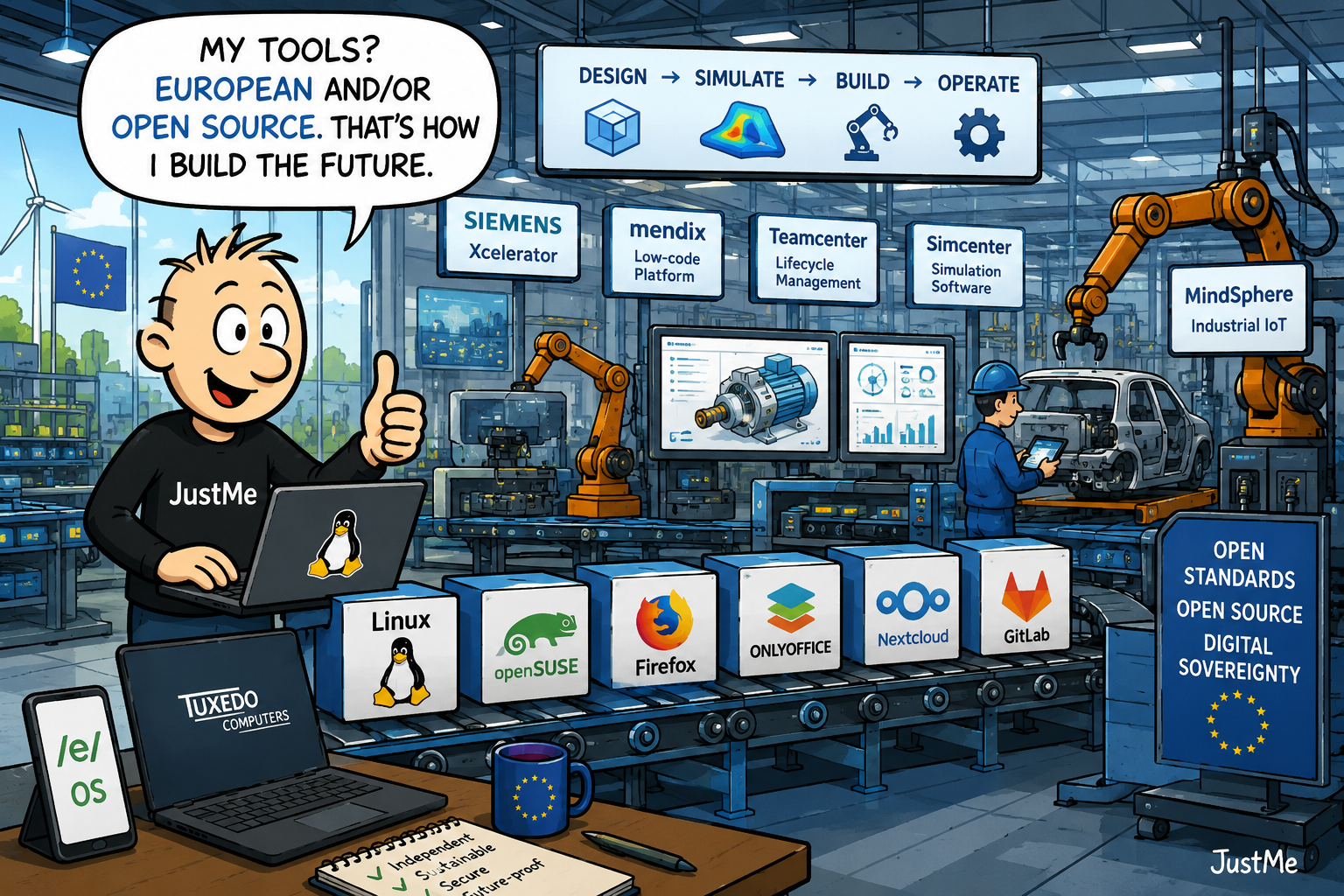
I am personally very interested in digital sovereignty, digital autonomy, European technology and open-source software. Partly because I believe Europe needs more control over the technology on which our companies, governments and societies increasingly depend. The tools I use myself — from my laptop and phone to software applications — are almost exclusively European and/or open source.

At the same time, I sometimes — perhaps even often — get frustrated by the way this discussion is conducted, especially in the Netherlands. There is a persistent assumption that European technology does not amount to very much, that the United States has already won the technology race, and that open source is mostly something complicated for technically minded enthusiasts. I think that picture is far too simplistic.

There is certainly a technology gap in some areas. American hyperscalers dominate cloud computing, many of the most visible AI companies are American, and China has built formidable capabilities in areas such as manufacturing, batteries and robotics. Pretending otherwise would be pointless.

But there is another side to the story. Sometimes I also think CIOs and IT managers make things unnecessarily easy for themselves. If Microsoft, AWS or another established supplier already provides almost everything you need, it is tempting simply to buy whatever your preferred vendor puts in front of you. That is convenient. It reduces the number of suppliers, contracts and technologies that need to be evaluated. But convenience can easily turn into dependency.

European and open-source alternatives are therefore sometimes dismissed as being too difficult before they have even been seriously investigated. And in the Netherlands in particular, I sometimes feel there is too much pessimism surrounding European technology. We talk extensively about everything Europe cannot do, while paying considerably less attention to the areas in which European companies are genuinely world-class.

That was one of the reasons I was particularly interested in visiting Siemens Realize Live Europe in Amsterdam. I knew beforehand that Siemens would offer a rather different perspective on the global technology race.

Europe is not absent from the technology race

I recently wrote about the event for Computable.nl in an article titled “Siemens: Europa is ijzersterk op het gebied van industriële tech” (text is in Dutch). The central message is worth repeating: Europe may not always dominate the headlines surrounding artificial intelligence, cloud platforms or consumer technology, but in industrial technology its position is considerably stronger than the popular narrative sometimes suggests.

One of the most striking examples during the event involved UBTech, a well-known Chinese manufacturer of humanoid robots. At first sight, it appears to be another illustration of Europe’s supposed technological weakness. China builds advanced humanoid robots while Europe watches from the sidelines. Except that this is not what is actually happening.

Siemens demonstrated how UBTech uses technology from the Siemens Xcelerator portfolio to design, simulate, test, manufacture and manage its robots throughout their lifecycle. In other words, some highly advanced Chinese technology is being created with European industrial software and engineering technology.

That changes the picture considerably. Yes, the most visible product may be Chinese, while much of the engineering infrastructure behind it comes from Europe.

Industrial technology deserves more attention

This is perhaps one of the problems with the broader technology debate. We tend to judge technological strength by looking at the companies that are most visible to consumers. Google, Microsoft, Amazon, Apple, OpenAI, Meta and Nvidia naturally receive enormous amounts of media attention. Industrial technology is much less visible. Yet behind virtually every physical product is an enormously complex digital environment. Aircraft, cars, chips, machines, factories, energy systems and robots must be designed, simulated, tested, manufactured and maintained. And Europe has exceptionally strong companies in precisely those areas.

At Realize Live Europe, Siemens repeatedly emphasised this complete industrial digital chain. Its strategy increasingly revolves around what the company calls the digital thread: connecting information from chip and electronics design through mechanical engineering, simulation and manufacturing all the way to factory automation and maintenance.

That includes technologies from companies Siemens has acquired over the years, including Mentor Graphics, Altair and the originally Dutch low-code company Mendix. Instead of presenting these as separate software products, Siemens increasingly positions them as parts of a connected industrial technology platform.

AI, but not AI for AI’s sake

Artificial intelligence naturally played a major role at the event. What I found interesting, however, was that Siemens did not primarily present AI as yet another chatbot. The focus was much more practical. AI is being incorporated into engineering tools, simulation software, manufacturing systems and product lifecycle management. According to Siemens, AI already reduces the time required to create certain technical 2D drawings by around fifty percent, while parts can be classified in Teamcenter roughly ten times faster.

The company is also introducing AI agents capable of carrying out parts of engineering workflows. But engineers remain responsible for supervision and final decisions. This is an important distinction. In industrial environments, AI cannot simply generate something that looks plausible. Engineering information needs to be accurate, traceable and connected to the correct version of a product or production process. That is why Siemens places so much emphasis on data.

Intelligence Center X

One of the major announcements during Realize Live Europe was Intelligence Center X, which Siemens positions as an intelligent layer across its software portfolio. The idea is that AI agents can analyse information, initiate processes and support engineers while remaining connected to the underlying industrial data. Instead of copying enormous quantities of information into separate AI environments, the agents work with data stored in systems such as Teamcenter.

That is significant because industrial data changes continuously. A product configuration may change. A component may be replaced. A new engineering version may become available. Manufacturing parameters may be adjusted. AI systems therefore need more than access to data. They need access to the right and current data, including the context in which that information exists.

Traceability is equally important. Companies need to understand where information came from and why an AI system reached a particular conclusion. These requirements are rather different from those of consumer-oriented generative AI.

Simulation becomes part of design

Another fascinating development is happening in simulation. Traditionally, engineers often designed something first and then used simulation to determine whether the design would actually work. That process is changing. According to Siemens, the combination of GPU acceleration and what it calls Physics AI can make some simulations hundreds or even thousands of times faster.

Examples presented at the event illustrated the impact. Continental has reportedly reduced a complex airbag simulation from around two hours to less than thirty seconds. Magna reduced another simulation from fourteen hours to approximately ten seconds. Rolls-Royce is using Simcenter Simsolid to analyse engine designs much more quickly.

When simulations take seconds rather than hours, they become something very different. An engineer can test many different design options during the design process rather than using simulation mainly as a final verification step. That can potentially change the way products are developed.

AI enters the factory

The same development is happening inside factories. Siemens demonstrated how AI can analyse abnormalities in manufacturing processes and combine information from engineering systems, ERP software and production environments. Instead of requiring engineers to manually investigate every possible relationship between datasets, AI can identify correlations and suggest possible improvements. (Computable)

Again, this does not mean removing humans from the process. It means automating parts of the investigative work while leaving engineers in control. That appears to be an important theme in Siemens’ approach to industrial AI: moving from systems that simply answer questions towards software that can help execute complete processes.

And then there is digital sovereignty

For me, one of the most interesting elements of the Siemens story was its connection with digital sovereignty. Mendix plays an important role here. The Dutch low-code platform, acquired by Siemens in 2018, is becoming part of the company’s broader AI architecture. It can be used to create applications and agentic workflows in which humans and AI agents work together.

But there is also an infrastructure dimension. Siemens is working with German cloud provider STACKIT to allow certain Mendix environments to run on European cloud infrastructure. According to Siemens, this currently primarily concerns projects involving Dutch government organisations, but the approach is expected to expand. Siemens has also been talking with European cloud provider OVHcloud about hosting additional Siemens solutions on European infrastructure.

That is exactly the kind of development I believe deserves considerably more attention. Digital sovereignty should not simply mean complaining about Microsoft, AWS or Google. Nor should it mean replacing American Big Tech with European Big Tech. It should mean creating genuine technological choice. That requires European cloud infrastructure, open standards, open-source technologies, interoperable software and strong European technology companies.

Perhaps we should stop underestimating ourselves

The visit to Siemens Realize Live Europe reinforced something I have thought for some time. Europe certainly has technological weaknesses. We need more investment, more scale, stronger capital markets and probably much more ambition in several areas of digital technology.

But constantly repeating that Europe has already lost the technology race is not particularly helpful either. Because it is not entirely true.

Europe has deep expertise in industrial automation, engineering software, semiconductor technology, manufacturing systems, digital twins, telecommunications, embedded systems, machine building and many other technologies that rarely generate the headlines enjoyed by ChatGPT or the latest American cloud service.

And these technologies matter enormously. Sometimes they are even the technologies being used to create the highly visible American and Chinese innovations that we subsequently point to as evidence that Europe is falling behind. The Siemens event was a useful reminder that technological power is not always found where the headlines are.

You can read my original Dutch article for Computable, “Siemens: Europa is ijzersterk op het gebied van industriële tech” here.

Perhaps the discussion about European digital sovereignty would become more productive if we spent a little less time explaining why things cannot be done — and a little more time looking at the technology that Europe already has.