Pebble’s Index 01 Is Exactly the Kind of Smart Device I Want

One of the nicer surprises waiting for me when we returned from our summer holiday at the Mediterranean was a small package from Pebble. Inside was the Index 01 (https://repebble.com/index).

I have been using it for a few weeks now and, although calling it a smart ring is technically correct, it is probably not what most people imagine when they hear that term. There is no screen. No heart-rate sensor. No sleep score. No attempt to tell me whether I am stressed, healthy or sufficiently recovered from yesterday. It is basically a ring with a button and a microphone. And I really like it.

Press, speak, forget about it

You wear the Index 01 on a finger — Pebble suggests the index finger, although other fingers can work as well — and use your thumb to press the small button. Then you bring the ring close to your mouth and say whatever you want to remember. “Buy buttermilk.” “Order new sports shoes for my daughter.” “Look up that article about industrial robots.” That sort of thing. The recording is transferred over Bluetooth to the Pebble app on your phone. There it is converted to text and an LLM works out what you meant. A request to buy buttermilk can end up on a shopping list, while the sports shoes become something to remember or do. If the software puts something in the wrong place, you can simply move or correct it in the Pebble app. But in my experience that hardly ever happens.

Dutch works just fine

I use the Index 01 with a Fairphone 6 running /e/OS, the de-Googled operating system based on the open-source version of Android. The same Pebble app connects both my Pebble smartwatch and the Index 01. So far the combination has worked remarkably well. The Bluetooth connection is reliable, activating the microphone is simple and I speak all my messages in Dutch. The speech recognition and LLM have no problem with that. In practice, my little spoken notes almost always end up where I expect them to.

There is something slightly magical about thinking I must remember this, pressing a button, saying five words and then carrying on with whatever I was doing. No phone to unlock. No app to find. No keyboard. That small reduction in friction makes a surprisingly big difference.

No charging

There is another unusual design choice. You cannot charge the Index 01. Pebble put a non-rechargeable battery inside and designed the device for extremely low power consumption. Depending on usage, Pebble says it should last for years. Founder Eric Migicovsky has described his own usage pattern as potentially giving around two years of operation.

Once the battery is empty, it is empty. That sounds strange in a world where seemingly everything needs to be charged every evening. But it also fits the product. The Index 01 isn’t trying to be a tiny computer on your finger. The ring records your voice and sends it to your phone. Most of the clever processing happens there.

I paid roughly €70 plus shipping for mine, although I may have had an early-adopter price. The current listed price is $75, with Pebble indicating a higher regular price later.

Now I want it in Capacities

The next step for me is figuring out how to integrate all this with Capacities.io (https://capacities.io/), which I use as my personal knowledge management system. Capacities has quite a steep learning curve. At least it did for me. Once you begin to understand how it allows you to organise information, however, it becomes very useful. At the same time, I am the first to admit that I am probably still using only a small percentage of what Capacities can actually do.

So perhaps the Index 01 can become part of that workflow as well. Pebble already supports external integrations through webhooks and MCP, the Model Context Protocol. The company explicitly designed the system so people can route notes and actions into their own tools. That sounds promising. I have no idea yet exactly how I will connect it to Capacities. But finding that out seems like a good subject for another blog post.

Technology that mostly leaves me alone

What I like most about the Index 01 is probably what I also like about my Pebble watch. Showing me the time aside, my Pebble watch is mainly there for notifications. That means I don’t have to pick up my phone every time something happens. I decide which notifications are important enough to reach my wrist and largely ignore the rest.

Don’t get me wrong, Pebble does have a huge collection of watch apps and watchfaces — thousands of them — but I have barely explored them. I don’t really need to. For me, the combination of the Pebble watch and Index 01 already does something much more valuable. It creates a relatively quiet technological environment. No constant demands for attention. No device desperately trying to become the center of my life. Just the notifications I have decided I want — plus a small ring that lets me capture a thought before I forget it. That is about as much “smart” as I need from a ring.

Here is the original video in which Pebble founder Eric Migicovsky introduced the Index 01:

Europe Just Opened a New Door to Space

I have written several times on Just Me about the space economy. About how satellites, launch services and new space companies are changing the way we think about access to orbit. For a long time, however, one question remained: could Europe really build its own commercial path into space?

This week, we got a very convincing answer. A German company called Isar Aerospace (https://isaraerospace.com/) has achieved something that feels like a turning point: its Spectrum rocket successfully reached orbit and deployed payloads during its second flight. The mission, called “Onward and Upward”, lifted off from Andøya Space in Norway (https://andoyaspace.no/) and made Isar Aerospace the first European commercial space company to successfully deliver satellites into orbit.

Not just another rocket launch

Of course, rockets reaching space is nothing new. Humanity has been doing that for decades. But this is different. For Europe, access to space has traditionally depended heavily on large institutional programmes. Rockets like Ariane have played a crucial role, but the world of space is changing quickly. Thousands of smaller satellites are being launched, companies want more flexible access to orbit, and commercial players are becoming increasingly important.

This is exactly the market where companies like Isar Aerospace are trying to make a difference. The idea is simple: make launching satellites more flexible, more scalable and more accessible. And that requires something more than just building a rocket. It requires building an entire industrial ecosystem.

The machine behind the machine

One thing I find particularly interesting about Isar Aerospace is that the company is not only developing the Spectrum launch vehicle. It is also building the manufacturing capabilities needed to produce rockets at scale. The company follows a highly integrated approach: designing, manufacturing and testing large parts of the rocket itself instead of relying completely on external suppliers. The next Spectrum vehicles are already in production, and Isar Aerospace is working towards a production facility capable of manufacturing dozens of rockets per year.

This reminds me of something I wrote earlier about European industrial ambitions (see here: https://justme.website/digital-autonomy/building-robots-is-not-enough/). The future is not only about making the final product. It is also about owning the knowledge, machines and processes behind that product. Whether we are talking about semiconductors, humanoid robots or rockets, the same principle appears again and again: the real strategic advantage often sits in the manufacturing capability.

Learning from failure

Another reason this story is interesting is that it shows how innovation actually works. The first Spectrum flight in 2025 was not a complete success. The rocket lifted off and cleared the launch pad, but the mission ended after a short flight. Instead of treating this as a failure, Isar Aerospace used the data to improve the next vehicle. That is how innovation always works. Test. Learn. Improve. Try again.

Space is probably one of the clearest examples of an industry where you cannot simply design everything perfectly on paper. Real-world testing is unavoidable.The second flight showed that this approach worked. Spectrum completed key flight milestones, reached orbital velocity and successfully separated its payloads.

Why Europe needs this

There is also a broader strategic dimension. Space has become critical infrastructure. Satellites support communication, navigation, climate monitoring, agriculture, defence and countless other services. Having independent access to orbit is increasingly seen as part of technological sovereignty. This does not mean Europe should build everything alone. International cooperation remains essential. But having European companies that can provide launch services from European soil gives Europe more options. So this is about technological and digital autonomy as well.

The global space industry is becoming more competitive every year. Companies in the United States, China and other regions are investing heavily. Europe needs companies that can move quickly, experiment and build new capabilities. Isar Aerospace is one example of this new generation of European space companies. Fortunately there are more.

The space economy is becoming real

What I like about this story is that it connects technology, industry and imagination. Space is no longer only about astronauts, giant government programmes and spectacular missions. It is also about factories, software, automation, supply chains and entrepreneurship. A small company from Germany launching a rocket from a small launch site in Norway may sound like science fiction. But this is exactly what the emerging space economy looks like.

How Did I Miss Radio Browser?

I am a big fan of internet radio. There is something wonderful about finding a station you have never heard before and suddenly discovering music that is completely new to you. And unlike many streaming services, internet radio still has that element of surprise. You don’t really know what is coming next.

Most of the stations I listen to were discovered more or less by accident. SomaFM (https://somafm.com), for example, was one of those discoveries. It is an independent, listener-supported internet radio network with more than 30 channels, many of them focused on music that sits comfortably outside the mainstream.

My favourite station, however, came to me in an even more traditional way: I first heard it on FM radio while in France. It is Radio Pays de Gueret, a local community station broadcasting from the relatively small city of Guéret on 96.5 FM. Its music programming is wonderfully unpredictable. You might hear some old jazz, followed by metal, then a French chanson, some hip-hop and perhaps Caribbean music. On paper, that sounds like a recipe for complete musical chaos. Yet somehow it works. There is a certain logic to the lack of logic, which is probably one of the reasons I keep listening. You can them here: https://www.radiopaysdegueret.fr.

Given how much I like internet radio, I was therefore slightly surprised to discover that I had never heard of Radio Browser (https://www.radio-browser.info/). Radio Browser is basically a community-driven directory of internet radio stations. It is free and provides an open API that is used by all kinds of radio apps, websites and other projects. You can simply search for stations on the website itself, but there is also a list of applications and services that use its database.

And that is where it becomes dangerous. At least if, like me, you enjoy disappearing down little internet rabbit holes. I have already spent quite a bit of time browsing through the stations, apps and projects listed there, and every time I look I seem to find something new and interesting. A new player, an unusual station from somewhere on the other side of the world, or simply another way of exploring radio.

That, for me, is still one of the nicest things about internet radio. It is not necessarily about finding exactly the music you already know you like. It is about hearing something you didn’t know existed.

Space Data Is Starting to Feel Like Software

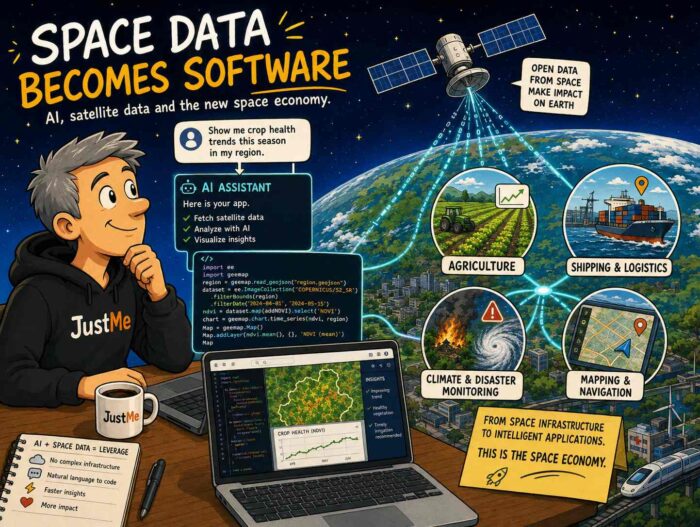
A little while ago, I wrote about how the space economy is taking off. You can find it here: https://justme.website/tech/the-space-economy-is-taking-off/. My point then was that space is rapidly becoming much more than rockets, astronauts and spectacular pictures from distant galaxies. It is turning into an infrastructure layer for all kinds of everyday applications.

I recently came across another example that makes that development much more tangible. The video Apparently, Satellite Apps Are Vibe-Codeable Now (https://youtu.be/49EMkFgFzgY?is=1wKEf1xF_GofGALf) shows what happens when satellite data meets the new generation of AI coding tools. At the centre of the story is Tilebox (https://tilebox.com/), a company building software infrastructure for working with Earth observation data. And it is a good illustration of where the space economy may be heading.

The difficult part is increasingly down here

Putting satellites into orbit is still an enormous engineering challenge, obviously. But once they are there, they generate huge amounts of data. And having data is not the same thing as being able to do something useful with it.

Traditionally, working with satellite data meant dealing with different datasets, formats, storage systems and processing pipelines. Tilebox tries to put an abstraction layer around all of that. Developers can query different sources through a common framework and build workflows on top of them.

That in itself is interesting. But AI changes the picture again.

Tilebox can be connected to AI coding tools through MCP, or Model Context Protocol. MCP is an open standard and open-source framework introduced by Anthropic in November 2024. Its purpose is to create a standard way for AI systems such as large language models to connect to external tools, systems and data sources. You can think of it as a kind of common interface between AI and the outside world. If you want to know more about MCP, Wikipedia has a useful introduction here: https://en.wikipedia.org/wiki/Model_Context_Protocol.

Back to Tilebox. Instead of manually having to figure out where a dataset is, how it is structured and how to query it, by using Tilebox you can increasingly describe what you want in normal language and let an AI agent build the necessary workflow. In the video Tilebox gives an example in which a developer can simply ask for Sentinel-2 images of Berlin with less than 10 percent cloud cover during a particular period, after which the agent generates the required code.

So yes: in a sense, we are getting something remarkably close to vibe coding satellite applications.

A much bigger developer community

This is exactly why I find the space economy so interesting. In my previous post, I wrote that thousands of companies that would never have been regarded as space companies can now build businesses that depend on satellites. Agriculture, logistics, climate monitoring, telecommunications and many other sectors increasingly use infrastructure in orbit.

Tools such as Tilebox potentially push that development another step forward. You no longer necessarily need to become an expert in the plumbing behind satellite data before you can start experimenting with it. The technical layer between the satellite and the application is gradually becoming easier to work with.

That is something we have seen before in computing. Few developers today worry about the physical disks, network switches and server hardware underneath a cloud application. Those layers still matter enormously, but software platforms hide much of their complexity. Something similar appears to be happening with space data.

Space becomes a platform

There is another interesting connection with AI here. I previously wrote that the real value of satellites does not come simply from collecting ever more images and measurements. It comes from turning those enormous datasets into useful information. AI is particularly good at helping with exactly that problem. Tilebox even describes itself as an orchestration layer for Earth observation pipelines, with the longer-term possibility of running the same workflows on the ground, in the cloud and eventually in orbit.

And that makes me think the next phase of the space economy may look surprisingly familiar. Satellites provide the infrastructure. Platforms provide access to the data. AI helps us work with it. Developers build applications on top.

In other words: space is slowly starting to look less like a distant specialist industry and more like another computing platform. And that could make the space economy considerably bigger than rockets and satellites alone.

Maybe Screenshots Are the Simplest Personal Knowledge Management Tool We Already Have

Via my recent post, I Went Looking at a Conference About Screenshots (About What?) and Found a Filesystem for Browser Tabs (see here: https://justme.website/content-creation/i-went-looking-at-a-conference-about-screenshots-about-what-and-found-a-filesystem-for-browser-tabs/), I seem to have stumbled into a new world. Or perhaps I should say that I have returned to an old one. Plain text files, bitmap images and other simple file formats have been around for as long as I can remember. They are boring in the best possible way: simple, understandable and usually not tied to a particular service or vendor. But after years of apps, platforms, cloud services and increasingly complicated workflows, I had more or less stopped thinking about them.

Then I discovered Screenshot Conf. And that made me look at screenshots differently.

A screenshot isn’t necessarily just an illustration

I take screenshots all the time. But I mostly use them as illustrations. Something interesting happens on my screen, I capture it, crop it and use it somewhere. That is about it. But screenshots can obviously be much more than that. They can be artistic objects. They can become part of collages. They can document software, interfaces and moments in digital history.

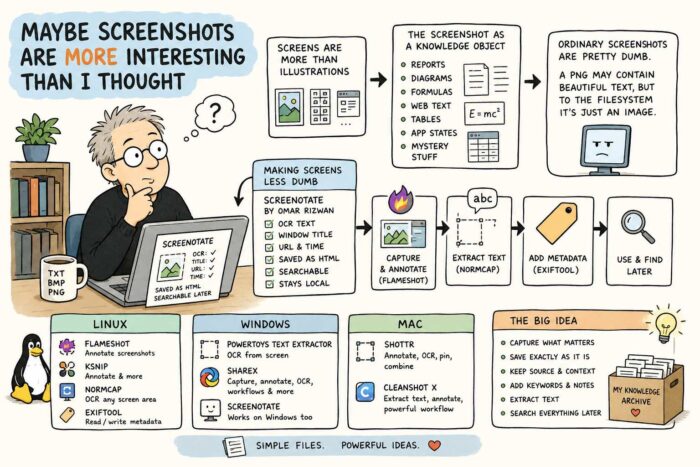
Even more interesting to me, however, is the idea of the screenshot as a knowledge object. You can capture part of a technical report. A diagram. A complicated mathematical formula. A paragraph from a website. A table from a PDF. A particular state of an application. Or simply something you don’t yet know what to do with, but suspect might become useful later.

The screenshot preserves exactly what you saw. The problem is that ordinary screenshots are fairly dumb. There may be a beautifully readable paragraph inside a PNG file, but as far as the filesystem is concerned, it is still just an image.

Making screenshots less dumb

This is where things become more interesting. Omar Rizwan, one of the people behind Screenshot Conf (https://screenshot.arquipelago.org/) and also the creator of TabFS (https://omar.website/tabfs/), made a tool called Screenotate for macOS and Windows (https://screenotate.com/). Screenotate doesn’t merely save the image. It uses OCR to recognise the text inside the screenshot and can also store information such as the window title, URL and time of capture. The result is searchable. Rizwan designed it so that screenshots remain on your own computer, with each capture stored as a self-contained HTML file.

That changes the nature of a screenshot quite dramatically. Imagine capturing one interesting equation from a 120-page research report. Normally you would later have to remember which report was that again? With a tool that also stores the source and recognises the text, the screenshot becomes part of a searchable personal archive.

That started me looking for other tools that do similar things. And there are quite a few.

Linux: Flameshot, NormCap and metadata

On Linux, Flameshot (https://flameshot.org/) is probably one of the better-known screenshot tools. It lets you annotate a screenshot immediately with arrows, text, highlights, shapes, blur and other elements. It also has a command-line interface, which means it can become part of scripts and more elaborate workflows.

Ksnip (https://ksnip.com/) takes a similar approach and combines screenshots with annotation tools.

For OCR, I particularly like the idea behind NormCap (https://dynobo.github.io/normcap/). Instead of capturing an image, you select a piece of the screen and NormCap tries to recognise the information inside it and copies the result as text. It is available for Linux, Windows and macOS and uses Tesseract OCR.

And if you really want to treat screenshots as proper information objects, there is ExifTool (https://exiftool.org/). It can read and write metadata, including XMP metadata in PNG files. That means you could add things such as descriptions, tags or other information to screenshots and potentially automate that process with scripts.

So a Linux workflow could be surprisingly simple: Take the screenshot with Flameshot. Annotate it. Extract useful text with NormCap. Add metadata with ExifTool. Suddenly a PNG is becoming something rather more useful.

Windows has some very good options too

Windows users have PowerToys Text Extractor (https://github.com/microsoft/PowerToys/blob/main/doc/devdocs/modules/textextractor.md), Microsoft’s open-source OCR utility. Press a keyboard shortcut, draw a rectangle around something on screen and the recognised text is copied to your clipboard. It even works on text displayed inside images or videos.

There is also ShareX (https://getsharex.com/), which has developed into much more than a screenshot utility, with capture, editing and workflow features. And, of course, Screenotate itself works on Windows too.

And on the Mac

macOS already does quite a lot with screenshots and text recognition itself, but there are some interesting specialised tools.

Shottr (https)://shottr.cc/, for example, combines screenshots, annotation and OCR. You can select text that normally isn’t selectable, recognise it and copy it directly to the clipboard. It can also combine screenshots, pin them on screen and add annotations.

CleanShot X (https://cleanshot.com/) takes a similarly broad approach. It can extract text from screenshots and open existing screenshots directly in its annotation environment.

Screenshots as a personal knowledge layer

What interests me most is not really which screenshot application has the longest feature list. It is the underlying idea. We usually think about screenshots as disposable images. Take one, send it to someone, use it in a blog post and forget about it.

But what if screenshots become part of a personal knowledge system? You could capture an important paragraph without copying an entire document. Save a formula exactly as it was typeset. Preserve a table together with its source URL. Add keywords. Extract the text. Annotate why you thought it was interesting. Search everything later.

When I was still using an iPhone, I deliberately set the system language to English. One of the reasons was Apple Notes. Set to English, it gave me access to OCR features that were surprisingly useful for collecting information. I could be reading a magazine, come across a paragraph or even a complete article that I wanted to keep, photograph it directly from Notes and have the app turn the image into editable text inside the note. In a way, it was exactly the same idea: capture something visually first, then use OCR to turn the interesting part back into text that you can search, store and work with later.

Screenshots are fundamentally just files. That means you are not necessarily dependent on one enormous knowledge-management application to do all this. The screenshot itself can become the basic object. That feels strangely old-fashioned. And perhaps that is exactly why I like it.

Building Robots Is Not Enough

I keep coming back to the same question when writing about European technology: what exactly do we want to keep in Europe? The usual answer is something like: semiconductor production, cloud infrastructure, AI models and perhaps a few strategically important factories. But after reading about French robotics company Wandercraft (https://en.wandercraft.eu/) and its cooperation with Renault, I think there is another part of the story that deserves much more attention. Europe should not only build products. It should also build the machines that build those products.

That may sound slightly old-fashioned in a world where almost every discussion about technology quickly turns into a discussion about software and AI. But there is a very practical reason for it. If you build your own production machines, you learn from them. You discover that a certain component is unnecessarily expensive. That another part could be lighter. That a production step takes too long. That a tolerance does not need to be quite so precise. Or that changing some software, mechanics or electronics could make the entire production process better.

In other words, a factory is not simply a place where products come off a production line. It is also a rather large laboratory.

Robots building European industrial knowledge

Wandercraft is an interesting example. The French company originally developed robotic exoskeletons for people who have difficulty walking. More than ten years of developing balance systems, actuators, mechanics and control software eventually resulted in something else: Calvin, a humanoid robot designed for industrial work.

And importantly, this isn’t primarily a robot designed to dance on a stage or generate spectacular YouTube videos. It is designed to work in a factory. Renault is already testing Calvin in its factory in Douai, where the robot moves things such as car tyres. Renault plans to have around 350 humanoid robots working in its French and Spanish factories by the end of 2027.

But the really interesting part is the relationship between the two companies. Renault is not simply buying robots from Wandercraft. It is also helping the company figure out how to manufacture those robots at scale. Wandercraft brings robotics and AI knowledge. Renault brings decades of experience in mass production, supply chains, quality control and designing products that can actually be manufactured at an acceptable cost. That combination makes a lot of sense.

Keep the feedback loop close

There is another detail I particularly like. Wandercraft says the components in its current robot all come from Europe. That matters. Because if the robot is designed in Europe, manufactured using European components, deployed in European factories and improved based on what happens in those factories, you create a very useful feedback loop: engineers see what breaks, factories discover what works, production specialists improve how the robot itself is manufactured and developers adjust the software and control systems. And then you do it all over again. That is industrial knowledge being created continuously. Move too many parts of that chain elsewhere and eventually part of that knowledge moves with it.

Europe already has an enormous high-quality manufacturing base, many specialised machine builders and companies that know how to manufacture complicated products at scale. We sometimes seem strangely eager to underestimate how valuable that is.

Perhaps technological sovereignty is not only about owning an AI model or running a European cloud. Sometimes it is also about knowing how to build the machine that builds the machine.

Here is a video of Andreas Klinger from the European investment fund PROTOTYPE (https://www.prototypecap.com/) visiting Wandercraft.

School Directors Are Making the Wrong Choice Between Tech and Privacy

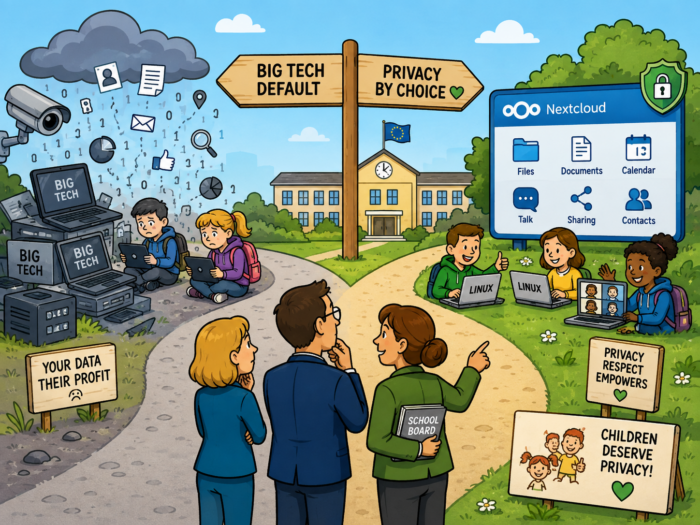
I came across an article by Privacy First about the digital student, and it touches on something that continues to bother me about the way we discuss technology in European education. The discussion is often framed as a choice: we can embrace digital technology in schools, or we can protect the privacy of our children.That is the wrong choice.

You can find the article here: https://privacyfirst.nl/artikelen/de-digitale-leerling/ (text in Dutch). Privacy First rightly points out that schools process enormous amounts of information about pupils, ranging from names and contact details to school results, behaviour and sometimes information about a child’s development. Children are particularly vulnerable because they usually have little choice about the software their school tells them to use.

But the conclusion shouldn’t be that schools therefore need less technology. They need different technology: technology that respects privacy and complies with privacy laws.

Digital does not automatically mean Google

There is absolutely no law of nature saying that digital education requires Chromebooks, Google Workspace, Microsoft 365, Windows laptops or MacBooks. A school can give students Linux laptops. It can use Nextcloud or similar open source platforms for storing and sharing files, working together on documents, calendars, video calls and all the other things schools nowadays expect from a digital workplace.

And before somebody says that this sounds nice in theory but could never work for hundreds of thousands of users: it already does. The French region Île-de-France has deployed a sovereign collaboration environment based on Nextcloud for around 550,000 pupils, teachers and administrative staff. The system is part of the regional monlycée.net environment and was explicitly designed as an alternative to Microsoft solutions. It includes document collaboration through Collabora Online, file storage and integration with the region’s existing systems. The infrastructure is operated in France.

You read that right: half a million users. So perhaps we can finally stop pretending that European and open source alternatives are lovely little hobby projects that might work for three enthusiasts and a Raspberry Pi. See https://nextcloud.com/fr/blog/cloud-souverain-plateforme-collaborative-ile-de-france/ for more information.

We became lazy buyers of IT

There is another part of this discussion that I think we don’t talk about enough. A Belgian CIO recently said something to me that stuck: we have forgotten that we actually have to make conscious choices ourselves.

For many years it was incredibly easy not to choose. Microsoft was already there, so you bought some more Microsoft. Your organisation was using AWS, so the next workload went to AWS as well. Google offered a complete education package, so schools bought Chromebooks and Google services.

You could call that standardisation. I increasingly call it convenience. Or perhaps there is a better word for it: laziness. And that is dangerous, because over time, that convenience has turned into dependency.

That dependency matters much more today than it did ten or fifteen years ago. Europe has become deeply dependent on a relatively small number of American technology companies for cloud computing, productivity software, communication and increasingly AI. In their article, Privacy First has made essentially the same broader point about Europe’s dependence on foreign technology providers and the consequences for autonomy and control over data. With today’s geopolitical uncertainty, treating that dependency as merely a procurement detail is becoming increasingly difficult.

Of course you cannot migrate an entire organisation in a day. Nobody sensible is suggesting that. Île-de-France didn’t do that either. But that argument is rapidly becoming an excuse. If you are responsible for IT in a sizeable European organisation and you are still not investigating alternatives, testing them, identifying dependencies and developing a realistic migration path, I think you have a problem. Migration takes years. Which is precisely why you need to start before circumstances force you to.

And then there are the children

There is something particularly uncomfortable about teaching children about privacy, data protection and digital literacy while at the same time making them use platforms built by some of the world’s largest data-driven technology companies. Privacy First argues that privacy should not simply be another compliance box for schools to tick. It should be a basic design principle of the digital environment children grow up in.

I couldn’t agree more with that conclusion. We have GDPR. We have endless discussions about children’s online safety. We teach pupils to think carefully about what they share online. And then institutions themselves make the fundamental technology choices on their behalf.

Schools deserve support from governments and IT specialists to make better choices. But eventually somebody also has to take responsibility. The technology exists. The alternatives exist. Large-scale examples exist. Île-de-France is already showing that hundreds of thousands of pupils and teachers can work digitally without simply handing the entire environment to Microsoft or Google.

So this really isn’t a discussion about digital versus privacy. It is about whether school directors are willing to do the homework required to have both.

You’re Not Just Publishing Posts. You’re Building a Habit for Your Readers

I only discovered Blaugust when August was almost over. Which is slightly unfortunate, because I like the idea.

Blaugust is one of those wonderfully IndieWeb-ish initiatives where people encourage each other to blog more. See for more here: https://tagn.wordpress.com/2026/07/21/. It originally started as a challenge to publish every day during August, although over the years it has become somewhat less strict. The idea now seems to be at least as much about participating, meeting other bloggers and keeping personal blogging alive.

Sebastian Malloy participated this year and wrote an interesting post about what the experience taught him (https://sebastianmalloy.bearblog.dev/what-blaugust-has-taught-me-about-my-blogging/). He managed 30 posts in 31 days, but discovered that producing something simply because today’s post still had to be produced wasn’t really for him. Some posts felt as if they existed mainly because there was a quota to meet. What he did enjoy was reading what everybody else had written.

I didn’t participate in Blaugust. There are several reasons for that. The most obvious one is that I already publish something on Just Me almost every day. So adding a challenge to make me write regularly would be slightly odd. The other reason is much simpler: I discovered Blaugust too late. Maybe next time.

There is a whole world of these things

What surprised me is that Blaugust isn’t some isolated event. There appears to be an entire world of challenges built around the simple idea of committing yourself to making things.

There is 100 Days To Offload, for example, where the challenge is to publish 100 posts on your personal blog within 365 days (https://100daystooffload.com/). And the rules explicitly say those posts don’t have to be long, profound or particularly polished. The important part is to write.

Then there is the IndieWeb Carnival (https://indieweb.org/IndieWeb_Carnival). Every month another blogger chooses a subject and other bloggers write their own posts about it. At the end of the month, the host collects the contributions. The IndieWeb wiki actually describes one of its purposes as motivating people to publish more on their personal websites and giving them inspiration for things to write about.

And there are many more. The DS106 Daily Create (https://daily.ds106.us/) offers small daily creative assignments involving photography, drawing, audio, video and writing. There are similar initiatives for musicians, pixel artists, zine makers and people building websites. There is even a site that collects these challenges.

And, of course, there is NaNoWriMo or National Novel Writing Month (https://nanowrimo2.com/), probably the best-known variation on the general idea: commit to creating something, set yourself a target and do it together with other people.

In other languages we see the same (more or less). In Germany there are quite of few challenges as well. See for example here https://judithpeters.de/50-blogparaden-im-sommer-2026/. I found fewer direct French-language blogging equivalents. There are plenty of French community writing challenges, though. For example, Scribonautes (https://scribonautes.fr/a-propos/) runs ongoing “défis d’écriture” where participants respond to community-created prompts and read and vote on each other’s work. It is closer to creative writing than personal blogging, but the community/regular-creation principle is very similar.

I find all this fascinating. Not necessarily because I need somebody to tell me to write another blog post. At the moment, I have rather the opposite problem. There are far more things I want to write about than I have time for. But these challenges provide something else. They are a very nice way to discover people. You follow links to participants, encounter blogs you have never seen before and suddenly end up reading about someone’s record collection, Linux setup, garden, travels, books or strange little hobby you didn’t know existed. That might actually be the most interesting part.

But what if you have nothing to say?

There is another side to all this. Sebastian Malloy’s experience also points to an obvious problem with publishing challenges: what happens when you simply have nothing you consider interesting enough to publish? I recently came across this post, Why People Quit Blogging (see here: https://unattributed.cc/2026/08/27/why-people-quit-blogging/), which looks at some of the reasons people eventually stop.

It certainly isn’t an exhaustive list, but I think the question itself is interesting. Starting a blog is easy. Continuing one for years is something else entirely. Perhaps you run out of subjects. Perhaps life changes. Perhaps writing starts feeling like an obligation. Or perhaps you begin wondering whether anybody is actually interested in what you have to say.

Challenges such as Blaugust, 100 Days To Offload and the IndieWeb Carnival can probably help with that. They provide a reason to sit down again. A subject. A small deadline. And, importantly, other people who are doing exactly the same thing.

Your readers notice when you disappear

But I think there is another reason to keep going that bloggers themselves may underestimate. What bloggers perhaps don’t always realise is that readers aren’t only interested in subjects. Over time, they also become interested in you. They want to know what you have discovered. What you are doing. What you think about something. Which book you are reading. Which piece of software you are experimenting with. Or why something completely ordinary suddenly caught your attention.

That creates a small social connection. It is very different from following a professional publication where another author can simply take over. A personal blog has a person attached to it. That person is part of the reason people return. And once you establish some kind of rhythm, people get used to that rhythm too. If it suddenly changes, I suspect some regular readers really do notice. Not necessarily in a dramatic way. Nobody will organise a search party because you haven’t published anything for four days. But perhaps there is a tiny moment of disappointment when they check your blog or their RSS reader and there is nothing new. Oh. You’re not here today.

I think that is rather nice. And perhaps that small relationship between writer and reader is something worth remembering whenever blogging starts to feel like talking into an empty room.

This is Why I Love Hackers So Much

Years ago I read The Cuckoo’s Egg by Cliff Stoll. It is one of those technology books that somehow sticks in your memory, probably because it hardly feels like a technology book at all. It is more like a detective story, except that the detective is an astronomer turned system administrator, the clues are hidden inside Unix systems and telephone networks, and the whole thing starts with an accounting discrepancy of just 75 cents.

That tiny discrepancy eventually led Stoll into a year-long hunt for cyber criminals who were breaking into American computer systems and passing information to the East German Stasi and the Soviet KGB. This was 1986, long before cybersecurity became an industry filled with SOCs, SIEMs, threat intelligence platforms and impressive-looking dashboards.

I hadn’t thought about the book for a long time. Then I came across a recent video of Stoll speaking at DEF CON 34, forty years after that original 75-cent discovery. And yes, he is quite a remarkable presenter.

No cyber, just curiosity

Stoll describes how they had essentially none of the tools we now associate with cybersecurity. There was no budget, no roadmap and not even much of a vocabulary for what they were doing. Instead, they used soldering irons, shell scripts, printers, logbooks and lots of improvisation.

Watching him talk about it reminded me why I have always liked the world of developers and hackers so much. Not the criminal kind of hacker, obviously, but the original meaning of the word: people who are intensely curious about how things work. People who see something strange and immediately want to understand why. People who happily open things, connect things that were never supposed to be connected, write a little piece of software to solve a problem and then build something slightly ridiculous because it might just work. Stoll seems to embody that attitude almost perfectly.

Following the strange little clue

There is also something wonderfully old-fashioned about the whole story. Today, a 75-cent discrepancy would probably generate a ticket somewhere. It might be assigned a severity level, automatically enriched with telemetry and eventually end up on somebody’s dashboard. Stoll simply wanted to know why the numbers didn’t add up. And that curiosity turned a tiny accounting error into an investigation that crossed networks and international borders.

Technology has changed enormously since then. The internet has changed. Cybersecurity has become a huge professional industry. Attackers have changed too. But perhaps one thing hasn’t changed at all. Someone still has to look at something slightly unusual and think: That’s strange. I wonder why that happened. And then keep digging.

Maybe that is why I enjoyed watching Stoll’s presentation so much. It isn’t only an interesting piece of computing history. It is also a reminder that some of the most interesting things in technology still start with curiosity, experimentation and somebody refusing to ignore a tiny detail. That wonderfully stubborn, slightly (very?) eccentric hacker mentality.

I hope we never professionalise it out of existence.

I Went Looking at a Conference About Screenshots (About What?) and Found a Filesystem for Browser Tabs

Sometimes you find interesting software because you are looking for it. And sometimes you arrive there through a rather strange series of clicks. TabFS definitely belongs in the second category.

It started with a very short message I saw somewhere about something called Screenshot Conf (https://cristobal.arquipelago.org/writing/screenshot.html). My first reaction was more or less: a conference about screenshots?

Obviously, I had to know more. And yes, Screenshot Conf really was a conference entirely about screenshots. It was organised in New York by Cristóbal Sciutto and Omar Rizwan, with talks about things such as screenshot archives, information storage, image-based computing and the surprisingly important role screenshots play in the way we collect and share information. I will come back to Screenshot Conf in another post, because I have the slightly strange feeling that I have just discovered an entire world I didn’t know existed.

But Screenshot Conf also led me to the website of one of its organisers, Omar Rizwan (https://omar.website/). And that turned out to be another rabbit hole.

Turning browser tabs into files

Rizwan is interested in new computer interfaces and new ways of programming. His website contains a collection of experiments and projects that approach computers in ways that are often very different from the standard application-and-window model we are used to. One of those projects is TabFS (https://omar.website/tabfs/).

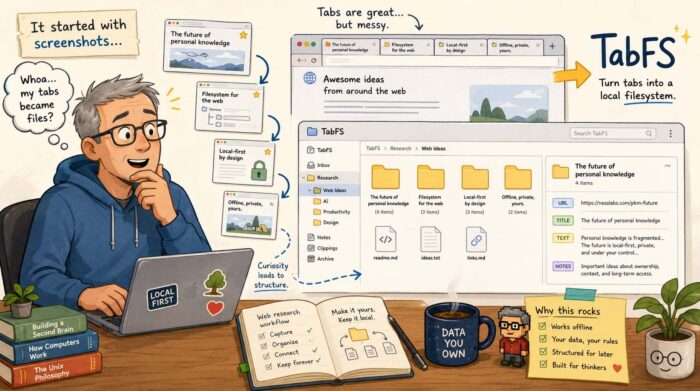
The idea is wonderfully strange: TabFS turns the tabs in your web browser into something that looks like an ordinary filesystem on your computer. Every open browser tab becomes a directory. Inside that directory are files representing things such as the URL, the title and the text of the page. Those aren’t simply exported copies. They reflect the current state of the browser tab. So suddenly your browser becomes accessible using all those boring old tools computers have been very good at for decades: files, directories, shell commands, scripts, text editors and file managers.

Your browser becomes scriptable

And that is where it becomes interesting. Suppose you have 40 tabs open while researching something. With TabFS, you can simply list the titles of those tabs as if you were reading files from a directory. You can also save the text of all your open tabs into one file. Or search those files. Or process them with Python. Or write a little shell script that selects certain tabs. Rizwan gives the example of closing every tab containing “Stack Overflow” in its title. Instead of building a special browser extension, you can essentially delete those tabs as if you were deleting files.

TabFS can go considerably further. It can expose images, JavaScript and other resources loaded by a page as actual files. You can evaluate JavaScript on a page through the filesystem, monitor values on a page and use scripts on your computer to interact with what is happening inside the browser.

It is experimental software, and some of the ideas Rizwan describes are explicitly still TODOs. But that almost makes it more interesting.

Browsing as information gathering

What particularly interests me is what this could mean for people who spend much of their day collecting information. That is basically what I do continuously. I open articles, reports, company websites, research papers, videos and all sorts of other sources. Some are immediately useful. Others might become useful several days or months later.

The browser is very good at finding and displaying all that information. It is much less good at turning it into something you can systematically work with afterwards. Bookmarks help, of course. So do read-later services and knowledge management tools. But they usually introduce yet another application and yet another database.

TabFS approaches the problem from an entirely different direction. It says: what if the browser simply became part of the filesystem?

Then you could write a script that periodically stores the text and URLs of your research tabs. You could sort them into project directories. You could use command-line tools to search through them. You could feed selected material into another processing workflow. You could create an archive containing the source URL, page title and extracted text. And because we are dealing with ordinary files, you could potentially combine this with almost anything else that understands files. That includes tools which haven’t even been designed to work with browsers.

I like this kind of software

TabFS probably isn’t something most computer users are going to install tomorrow. Its current setup requires a browser extension and a filesystem component, and Rizwan describes Chrome support as the main target, with more limited Firefox and Safari support. It currently runs on macOS and Linux.

But that isn’t really the point for me. What I like about projects like TabFS is that they question assumptions that have become so normal that we rarely notice them anymore. Why should information inside a browser be trapped inside a browser? Why shouldn’t my existing tools be able to access it? And why do we keep building separate applications for managing information when operating systems already have a perfectly good universal abstraction for storing and manipulating things?

I really like unpredictable journeys like that. I started out wondering why anyone would organise a conference about screenshots. A few clicks later, I found myself thinking about browsers as filesystems. Not a bad rabbit hole to fall into.