The Web Has a Memory Problem

I recently came across a post on Ctrl+Shift+3 from someone who had found an old backup of their del.icio.us bookmarks (https://ctrlshift3.com/post/cQHW0GSYNypR). The conclusion was concise and predictable: roughly 75 percent broken links and 80 percent obsolete technology. It made me sigh, because it reminded me of something I’ve been thinking about for quite a while: link rot.

Link rot is simply what happens when links that once worked stop taking you to the information they originally pointed to. A website disappears, an article is removed, a company changes its CMS, pages get reorganised or an entire domain simply vanishes. The result is the familiar 404 page, a redirect to somewhere irrelevant, or sometimes a completely different page at the same address.

And it happens a lot. A recent 20-year study of almost 2900 web citations found that accessibility dropped from 87 percent for citations less than five years old to only 38 percent for those more than ten years old. You can find the study here: https://www.sciencedirect.com/org/science/article/pii/S2050380626000220. That is quite a problem for something we tend to regard as permanent.

Why I don’t use URL shorteners

Link rot is also one reason why I prefer using the actual URL when I link to another website instead of putting a URL-shortening service in between. There is a very practical advantage: you can immediately see where you are going. A link beginning with w3.org, github.com or the website of a newspaper tells me considerably more than an address such as bit.ly/3Xf92Kd.

But there is another reason. A URL shortener adds an extra dependency. Instead of:

my website → source

you get:

my website → shortening service → source

That shortening service now controls all those redirects. If it disappears, changes the way it works, gets acquired, loses data or simply decides to discontinue the service, a potentially enormous collection of links can stop working overnight. It seems “slightly” strange to me to deliberately introduce another possible point of failure into something that is already rather fragile.

Of course, using the original URL doesn’t solve link rot either. If the original page disappears, the link still breaks. But at least there is one less organisation involved in keeping the link alive.

Keeping your own URLs boring

The Unattributed article “Digital Legacy: Link Rot Mitigation Issues” (https://unattributed.cc/2026/08/23/digital-legacy-link-rot-mitigation/) approaches the problem from the perspective of preserving a website over a long period. That is an interesting way of looking at it, because preventing link rot isn’t only about the sites we link to. It is also about the links other people create to us.

One of the most useful principles is actually very boring: don’t unnecessarily change URLs. If an article lives at a particular URL today, keeping it there for the next ten or twenty years is probably one of the best things you can do. The US Library of Congress makes the same recommendation: maintain stable URLs and, when a URL really has to change, redirect the old address to the new one. (https://www.loc.gov/programs/web-archiving/for-site-owners/creating-preservable-websites/)

That sounds obvious, but website redesigns have a remarkable ability to destroy perfectly good URL structures. A new CMS gets installed, /blog/interesting-article.html suddenly becomes /posts/2026/interesting-article, nobody bothers to create redirects, and thousands of old bookmarks and incoming links instantly become useless overnight.

Archive what matters

Another important defence against link rot is archiving. If I refer to something that is particularly important to an article, I can save the page in the Internet Archive’s Wayback Machine (https://web.archive.org/) or use a service such as Perma.cc (https://perma.cc/). That gives readers another route to the information if the original disappears.

This is especially useful for pages that are likely to change while keeping the same URL. Think of government policy pages, documentation, company announcements or so-called living documents. In those cases you can have something slightly different from link rot: content drift. The URL still works, but the information behind it is no longer what you originally referred to.

For sources like these, preservation guidance increasingly recommends keeping both the live URL and an archived snapshot. Have a look here for an interesting article about this topic: https://casrai.org/guides/link-rot-in-citations-and-how-to-prevent-it

For academic papers, reports and datasets, there is another option: use a persistent identifier such as a DOI whenever one exists (https://en.wikipedia.org/wiki/Persistent_identifier). The entire idea behind these identifiers is that the identifier remains the same even when the actual location of the document changes.

Give readers enough information to recover a link

There is also a wonderfully low-tech solution: don’t make the URL the only information you provide. When referring to an interesting article, mention its title, author and website. If the link dies in five years, someone can still search for it. If all I write is “read this” behind a hyperlink, the reader has almost nothing to work with once that link disappears.

The same applies to my own bookmarks. Saving only a URL isn’t particularly useful if that URL later breaks. A title, short note and perhaps publication date make the bookmark much more valuable as a record of what was actually there. Perhaps that old del.icio.us backup illustrates this perfectly. A dead URL on its own is almost meaningless. A dead URL combined with a title and description can still tell you what you once found interesting.

Check your old links

There is one final, rather mundane solution: occasionally check links. There are plenty of tools that can crawl a website and report broken external and internal links. Examples are LinkChecker (https://github.com/linkchecker/linkchecker) or Broken Link Checker (https://github.com/stevenvachon/broken-link-checker). For a small personal website you could run such a check every now and then and repair the links that matter. Sometimes the article simply moved. Sometimes there is an archived version. Sometimes another reliable source covers the same information.

But I wouldn’t turn this into an endless maintenance project either. Because ultimately link rot cannot be solved completely. Someone else’s website can disappear tomorrow. A company can close. A domain registration can expire. An organisation can deliberately remove twenty years of old material. Even archives cannot preserve everything, particularly today’s highly dynamic websites.

Perhaps the goal therefore shouldn’t be to create a Web in which no link ever dies. It should be to make links less disposable. Use stable URLs. Avoid unnecessary intermediaries. Redirect old pages when you move them. Archive important sources. Use persistent identifiers when they exist. And leave enough context around a link so somebody has a chance of finding the information again. Because the Web may look permanent when we use it every day. That old del.icio.us backup suggests otherwise.
Why Thomson Reuters’ Own AI Model Is More Interesting Than It First Seems

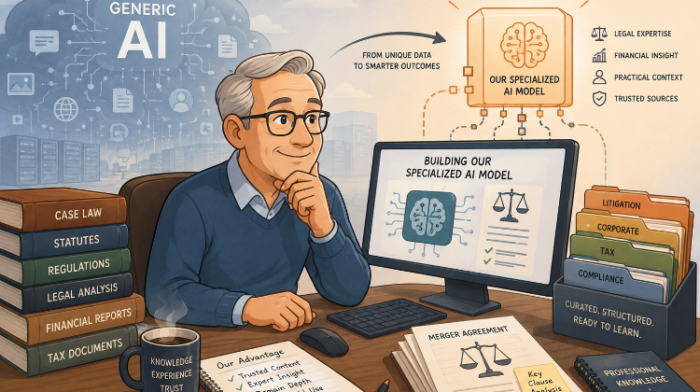
Thomson Reuters has launched its own AI model, called Thomson, and I think the most interesting part of the story is not that yet another company has built an AI model. It is how they did it.

You can read the original press release here: https://www.thomsonreuters.com/en/press-releases/2026/august/thomson-reuters-leverages-its-world-class-data-assets-to-launch-its-own-frontier-model. I wrote about it here (text in Dutch): https://ai-visie.net/thomson-reuters-bouwt-eigen-frontier-ai-model/.

Thomson Reuters is not trying to beat OpenAI, Google or Anthropic by training a gigantic general-purpose model from scratch. Instead, it started with an existing open model and then trained and specialised it using its own data and expertise. The company reportedly invested around $40 million in talent and compute. That is still a serious amount of money, of course. But compared with the billions now being spent on the largest frontier models, it is almost modest.

The real advantage may be the data

Thomson Reuters has something most companies simply do not have: decades of highly structured, professionally maintained legal, tax and financial information. That may turn out to be much more valuable than simply having access to more GPUs.

For certain legal tasks, Thomson Reuters says its model can compete with, and in some cases outperform, much larger general-purpose frontier models. That makes sense. A specialised model does not need to be brilliant at everything. It needs to be exceptionally good at the tasks for which it was designed.

And that raises an interesting question. If Thomson Reuters can do this, why don’t more large companies simply build their own frontier models?

Because having lots of data is not enough

Many large organisations have enormous amounts of data. Banks have transactions. Manufacturers have huge amounts of product(ion) data. Telecom companies have network data. Healthcare organisations have huge collections of medical information.

But having data and having usable AI training data are two very different things. Corporate information is often scattered across thousands of systems, poorly structured, duplicated, lacking useful meta data, outdated or difficult to use because of privacy, intellectual property and compliance restrictions.

Then there is the technology itself. Training and maintaining a serious model still requires specialised AI engineers, infrastructure, evaluation methods, security expertise and a lot of compute. And once the model exists, you have to keep operating, testing and improving it.

So perhaps the interesting lesson from Thomson Reuters is not that every large organisation should now build its own model. It is that some organisations may have a very valuable combination: unique data, deep domain knowledge and enough resources to turn an existing open model into something that is better than a general-purpose AI system for their particular field.

Maybe “frontier” is becoming more specialised

I find that a particularly interesting development. Until now, we have tended to think of frontier AI as a race to build ever larger models. More parameters, more compute, bigger clusters. But perhaps there will also be another kind of frontier: not a model that knows everything, but one that knows one domain exceptionally well.

For companies sitting on decades of carefully curated specialist knowledge, that could make owning at least part of their AI stack increasingly attractive. And it may also change the AI discussion inside companies. The question may no longer simply be: which frontier model should we buy? It could increasingly become: What knowledge do we have that nobody else has, and can we turn that into our own AI advantage?

China is Doing what Europe keeps Talking about — But Moving Much Faster

I recently went looking for a story I remembered reading about China replacing Windows with Linux. I could not find it at first, probably because I was searching for the wrong thing.

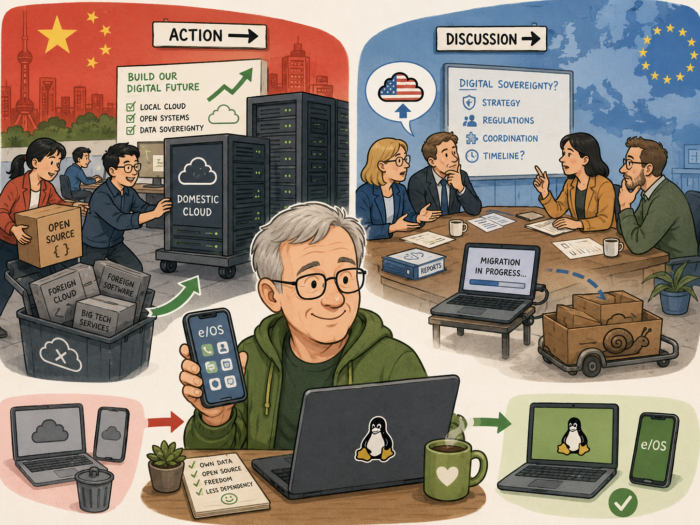
There is no single Chinese order saying that everybody has to throw Windows out. What China has been doing is much more interesting: step by step, it has been reducing its dependence on foreign technology, particularly within government organisations, state-owned companies and strategically important sectors.

The name that keeps coming up is Xinchuang, China’s programme to replace foreign technology with domestic alternatives (https://www.mof.gov.cn/jrttts/202312/t20231226_3924138.htm). That includes processors, databases, applications and operating systems. Chinese government procurement rules introduced in recent years increasingly require systems to meet domestic “safe and reliable” requirements. In practice, that has created much more room for operating systems such as Kylin and UnionTech UOS, both based on Linux.

And China has just taken another step. In August 2026, reports emerged (for example https://www.tomshardware.com/software/operating-systems/china-reportedly-orders-state-agencies-to-uninstall-its-government-only-edition-of-windows-10) that China’s Ministry of State Security had instructed some state-linked organisations to remove Windows 10 China Government Edition earlier than originally planned. This is important nuance: China has not banned Windows everywhere. The order concerns a special government version and a limited part of the Chinese market. Windows is still widely used by consumers and businesses.

Perhaps we should pay more attention to China

Still, I think the direction is interesting. Not because Europe should copy China’s political system or its approach to technology. Obviously not. But there is one thing China seems to understand very well: becoming extremely dependent on a handful of foreign technology companies is a strategic risk.

That is something Europe has been talking about for years. Digital sovereignty, strategic autonomy, European clouds, open source, sovereign AI. Plenty of conferences, reports and policy documents. But meanwhile we keep buying. And buying. And buying.

The numbers are rather impressive. A European Commission document published this year cites research estimating that European companies’ purchases of cloud software add around €264 billion annually to the US economy (https://eur-lex.europa.eu/legal-content/EN/TXT/?qid=1745691400115&uri=CELEX%3A52026SC0502&)

Then there is the price issue. Research commissioned by French CIO association Cigref found that European organisations saw cloud and software costs increase by an average 8.7 percent per year during the past three years. Some organisations experienced much larger increases when contracts were renewed. The same research expects average annual increases of around 12 percent during the coming five years. (https://www.cio-platform.nl/en/weblog/nieuws-extern-detailpagina/2026/07/02/rapidly-rising-cloud-and-software-costs-weigh-on-the-european-economy?)

That 8.7 percent figure is not specifically an “American cloud inflation rate”, so we should be careful with that. But combine rapidly increasing software and cloud prices with Europe’s enormous spending on predominantly American technology and it becomes clear that we are talking about very serious amounts of money. Digital sovereignty is therefore not just about geopolitics. It is also about economics.

I decided to start with myself

I have been gradually trying to reduce my own dependence on Big Tech. My laptop comes from a European company (Slimbook), although calling a computer completely European is almost impossible: the CPU and GPU in mine are from AMD. I use Linux as my operating system. Nearly all the software and cloud services I use are now European, open source, or both.

I came from a MacBook and an iPhone and switched to Linux Mint and Murena /e/OS, a de-Googled version of the open-source version of Android. And to be honest, it works differently in some ways, but certainly not worse.

So personally, I made the switch, and I’m perfectly happy with the result. The difficult part is often not my own technology. It is other people’s technology. Clients still invite me into SharePoint environments. People create WhatsApp groups and simply assume everybody uses WhatsApp. Publishing workflows are still often built around Adobe software. In those situations, digital independence suddenly becomes less of an individual decision. You are part of an ecosystem, and ecosystems are difficult to leave.

But migration costs money…

This is probably one of the biggest obstacles Europe faces as well. One argument I often hear is that replacing existing technology is expensive and risky. Of course it is. If an organisation has spent ten or twenty years building processes around Microsoft 365, Azure, AWS, Google Cloud or Adobe, you cannot simply switch everything off on Friday afternoon and start again with European alternatives on Monday morning. People have to be trained. Applications have to be migrated. Interfaces have to be rebuilt. Data needs to move. Some functionality may not have an equivalent. And some projects will undoubtedly go wrong.

So yes, reducing dependency costs money. But keeping the dependency has a cost too. And that part of the calculation seems to receive much less attention – even by business managers who consider themselves financially savvy. What happens if prices continue to rise by almost 9 percent every year? What happens if a supplier changes its licensing model? What happens if political relations deteriorate badly? And, perhaps the uncomfortable question: what happens if access itself becomes part of a geopolitical conflict?

Canada suddenly makes that question less theoretical

This is why I am watching the current trade conflict between Canada and the United States with some interest. See for example here: https://www.reuters.com/business/trump-time-teach-canada-you-cant-do-this-anymore-2026-08-26/?. Relations between two countries that have been extremely close economic partners for decades have deteriorated remarkably quickly. In August, the US imposed 50 percent tariffs on roughly $20 billion worth of Canadian goods, after which Canada announced matching retaliatory measures.

So far, this is a trade conflict involving physical goods and tariffs. I have seen no evidence that the US government intends to restrict Canadian access to Microsoft 365, Azure, AWS, Google Cloud or other American digital services. But it does raise an interesting question.

Could digital services eventually become economic or political leverage as well?

I don’t know. And that is precisely the problem.

For years we have treated cloud platforms, office software and other digital services almost as utilities. They are just there. We log in every morning and assume they will still be there tomorrow. China clearly doesn’t want to make that assumption. Europe shouldn’t either.

We don’t have to replace everything tomorrow. That would be unrealistic and probably counterproductive. But we could start doing exactly what China has been doing for years: identify dependencies, develop alternatives, change procurement policies and gradually move critical systems to technology over which we have more control. We do not need yet another conference about digital sovereignty. Not another declaration.

What we do need: start migrating. Because the best moment to reduce a dependency is probably while everything is still working.

AI and Art: Maybe the Interesting Part Is Somewhere in the Middle

Every now and then I watch a presentation about AI that actually adds something to the discussion. Jack Conte’s recent talk at SXSW is definitely one of those. Conte is not only the CEO and co-founder of Patreon, but also a musician and filmmaker himself, which probably explains why his presentation feels so personal. And passionate. Very passionate.

His SXSW session took place in Austin in March 2026, and the video has since been published as The future of creativity on the internet in a world with AI. Conte clearly struggles with AI himself. He is excited about what the technology could make possible, but at the same time angry about what is happening to artists and their work. That conflict is exactly what makes his presentation so interesting.

We have been here before

Conte spends quite a bit of time looking back at previous technological changes. Film initially copied theatre. Recorded music disrupted musicians playing live in cinemas. Synthesizers created fears that orchestras and musicians would become unnecessary. New technology repeatedly destroys existing business models, after which artists start figuring out what they can do with the new technology that simply wasn’t possible before.

He believes generative AI is currently going through a similar phase. Much of what we now see is what he describes as AI “slop”: technology being used mainly to imitate things we already know. Generate another picture. Another song. Another video. Another piece of text. Faster, cheaper and in almost unlimited quantities.

I think that distinction is important.

The debate about AI and creativity has become incredibly black and white. On one side are people who want nothing to do with AI-generated music, images or text because a human didn’t make it in the traditional sense. On the other side are people who seem determined to use AI for virtually everything.

I don’t find either position particularly useful.

Making more isn’t necessarily creating more

I use AI myself, including when writing. So obviously I don’t believe that using AI automatically makes something worthless. But there is a big difference between using AI as a creative tool and simply switching on some sort of content machine that produces hundreds of songs, articles or images because you hope to make money from the volume.

That doesn’t particularly interest me. What does interest me is someone taking these new tools and trying to do something genuinely new with them.

This is also where Conte makes an interesting point about creativity. Today’s AI models have learned from enormous amounts of existing human work. They are extraordinarily good at recognising patterns and recombining what already exists. That can produce impressive results, but it is fundamentally different from a human artist deliberately taking a creative risk, developing an unusual idea or deciding to make something nobody asked for.

Conte puts a lot of emphasis on precisely that human element. Art, in his view, is connected to difficulty, scarcity, risk and the person behind the work. We don’t just listen to music because certain sounds have been arranged correctly. We are also interested in the person who made it and what that person was trying to express.

Use AI to make your ideas possible

That is a much more useful way to look at AI and creativity. Don’t ask AI to come up with as much stuff as possible. Come up with ideas yourself and see whether AI can help you realise ideas that previously would have been too difficult, expensive or perhaps even impossible.

That applies to music, photography and video, but just as much to writing. AI can help me research, experiment, restructure, translate, challenge an argument or try a completely different approach. But there still has to be an idea. A reason for creating something.

That is why I like the double feeling in Conte’s presentation so much. He doesn’t pretend everything about AI is wonderful. Far from it. He is highly critical of how creators have been treated, including the use of their work for AI training without permission, attribution or compensation. At the same time, he refuses to conclude that the technology itself can therefore bring nothing worthwhile to art.

That middle ground is where this discussion becomes much more interesting to me. AI can produce more. Much, much more. But producing more isn’t the same thing as having a new idea. And perhaps the artists, musicians and writers who understand that difference will eventually do the most interesting things with AI.

Your AI Tool May Be Using More of Your Data Than You Think

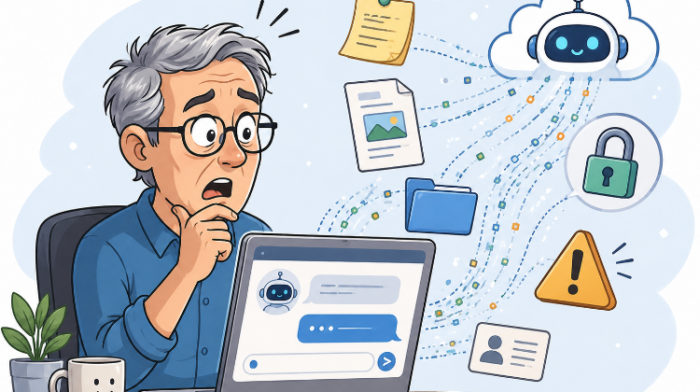
I use AI tools a lot. And like many people, I have gradually become accustomed to typing quite a lot of information into them: ideas, drafts, questions, pieces of text and sometimes work-related information. That makes a recent piece of research highlighted by Cybernews rather uncomfortable reading.

Here is the full article: https://cybernews.com/ai-news/ai-companies-lack-disclosures-on-data-training-and-retention/. The research comes from the Production AI Institute, which created an AI Data Use Index covering 63 AI products. It looked at what companies publicly disclose about the use of customer and user data: whether data can be reused for AI training, whether users can opt out, how long information is retained and whether humans may review it. Assuming the research has been carried out properly, I find the results pretty shocking.

So what exactly happens to our data?

The important point is not that all these AI companies are secretly feeding everything we type into their models. That is not what the research says. The problem is that in many cases it is surprisingly difficult for an ordinary user to determine exactly what happens to their data. According to the researchers, only a relatively small number of products clearly state that they use customer data for training, while others offer user-controlled settings or provide information that is spread across several privacy policies, help pages and product-specific terms.

That alone is worrying. With AI, we are no longer talking about entering a few search terms into a search engine. We increasingly paste complete documents, source code, meeting notes, business plans, customer information and personal questions into these systems. The more useful AI tools become, the more information we tend to give them.

One thing that becomes clear from the research is that there is no obvious industry standard for how AI companies deal with training data. Consumer ChatGPT, for example, can use conversations to improve models depending on the user’s Data Controls settings, while OpenAI says business workspace data is not used for model training by default. Perplexity has its own settings around AI data retention, while Cursor distinguishes between users who enable Privacy Mode and those who do not. Other services, including GitHub Copilot, Slack and Notion, again apply different policies.

Your data may still be stored

So the apparently simple question, does my AI tool train on my data?, often has no simple answer. It can depend on the product, the type of account you have, the subscription you pay for, your individual privacy settings and sometimes even the specific feature you are using.

That raises another question which I find even more interesting. In cases where an AI service has a setting that allows users to opt out of data being used for model training, what exactly does that opt-out mean? Does it apply immediately? Does it also cover previously stored conversations? What happens when you provide feedback on an answer? And does opting out of training also mean your information is no longer stored, reviewed for abuse prevention or shared with third-party service providers?

These are not the same things. The Production AI Institute’s research is primarily about transparency: it examines what companies publicly say about their data practices. It is not a technical audit that verifies what actually happens inside every company’s infrastructure. That means the research does not show that companies continue using data for AI training after users have opted out. But it also does not independently prove that every opt-out is implemented exactly as users might assume.

There is another distinction that deserves much more attention: not using your data for training is not the same as not storing your data. An AI provider may promise that prompts and responses are excluded from model training while still retaining them temporarily for security, abuse monitoring, troubleshooting or other operational purposes. Enterprise and API services often have separate rules again, with different retention periods and contractual protections.

For business users in particular, asking only whether an AI company trains on your data is therefore not enough. You also need to know what information is stored, for how long, where it is processed, who can access it, which third parties may receive it and whether deleting a conversation actually removes the underlying data. You should also know whether the privacy rules for a consumer account are different from those for a business or enterprise subscription.

For years, most of us have become used to clicking through privacy notices and terms of service without paying much attention. With AI, that habit is becoming considerably more risky. Both business users and private users probably need to become much more conscious about the services they use and the information they provide.

We need to pay more attention

Before using an AI tool for anything sensitive, it makes sense to check its privacy and data controls. Is model improvement enabled by default? Is there an opt-out? Does the opt-out apply to all data or only certain types of conversations? Are consumer and business accounts treated differently? And perhaps most importantly, what exactly does the company mean when it says it does not use your data for training?

I would like AI companies to make this much simpler. Every AI service should have one clearly visible page explaining in plain language what happens to everything you submit: whether it is used for training, whether that is opt-in or opt-out, how long data is retained, whether humans can review it, whether third parties receive it and whether you can permanently delete it.

That information should not require digging through five different policy documents. Because if this research is even broadly representative of the market, we have probably been paying far too little attention to a very basic question: What actually happens to our data after we press Enter?

The Smartphone Features We Should Have Had Years Ago

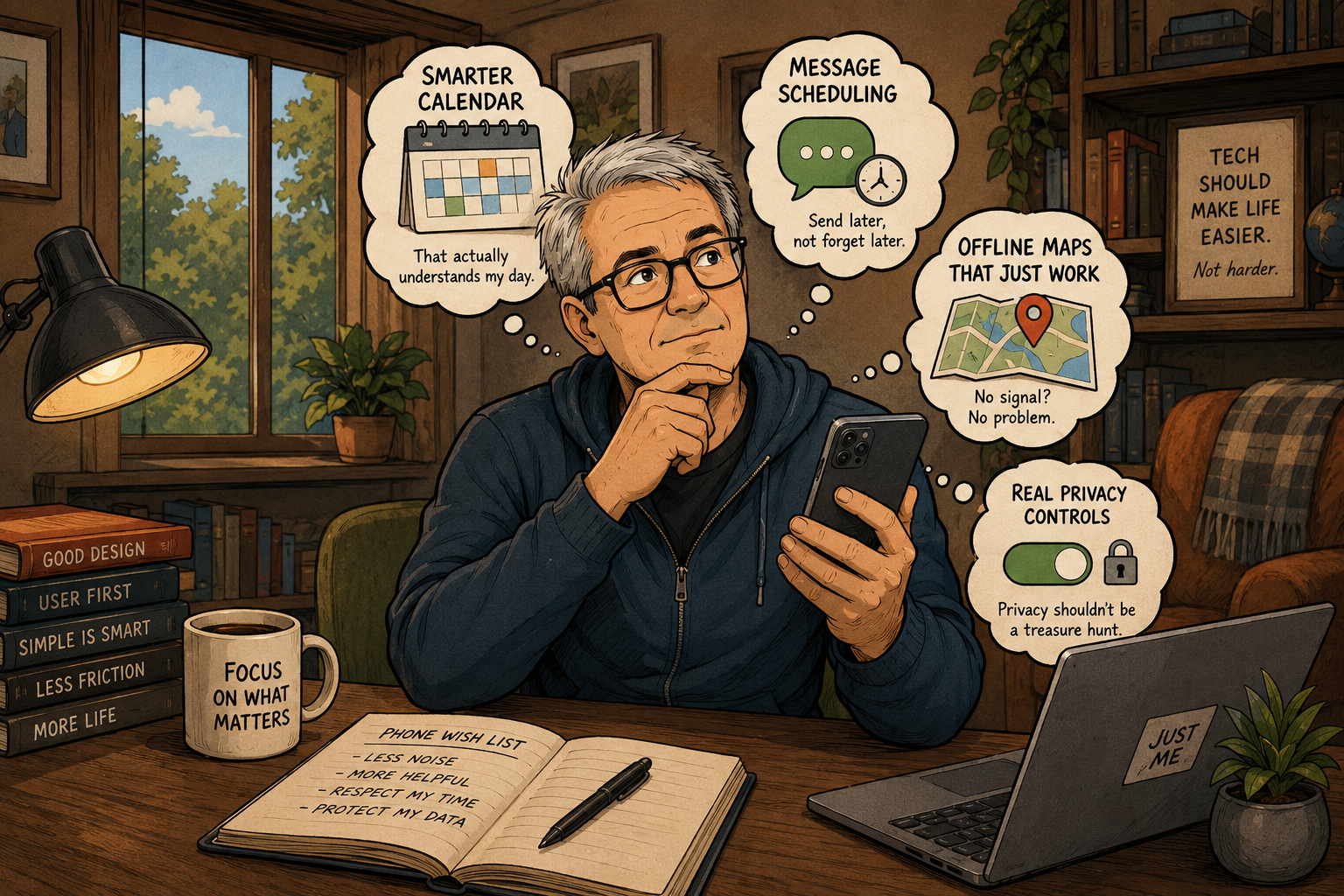
Smartphones are astonishingly capable devices. They have cameras that would have seemed impossible twenty years ago, processors powerful enough to run serious software, satellite connectivity, increasingly sophisticated AI and enough sensors to know roughly what we are doing most of the day. And yet I regularly find myself wondering: why can’t my phone do this?

Not because I am waiting for some spectacular new technology. Quite the opposite. Many of the features I would like to see seem surprisingly simple. I recently came across a post on Curvise about phone features that really should exist by now, and that got me thinking about a much broader question. Smartphones have evolved enormously, but the way we interact with them has remained remarkably conventional. We still open apps. We still move information manually from one app to another. We still hunt through settings menus. And when we want privacy, we often need to disable several different things separately. Surely we can do better.

Why is my smartphone still a collection of apps?

This is probably the biggest one for me. Suppose someone sends me a message asking whether we can meet next Wednesday at 11:00 at a certain café. What do I do? I open my calendar to check whether I am available. Then I open Maps to see where the café is and perhaps check how long it takes to get there. After that I return to the messaging app, confirm the appointment and finally go back to the calendar to create an event.

None of this is difficult, of course. But why am I doing all those individual steps? My phone already has access to the relevant information. It knows what is in my calendar, it knows where the café is, it can calculate travel time and it knows who sent the message. I should simply be able to say: “Yes, that works. Put it in my calendar and send the details back.” The phone should handle the rest.

This is where AI on smartphones could actually become useful. Not by generating funny pictures or summarising emails I could read myself, but by acting as a layer across the operating system. At the moment, smartphone software is still built largely around applications. Every app is its own little island, and we are the ones moving between those islands and performing a sequence of actions.

A smarter operating system could understand the intention behind what you are doing. You could say: “Send the photos I took yesterday to Anna,” or “Find the PDF Peter sent me last month and attach it to this email.” You might also ask: “During my holiday, silence all work notifications except messages from these three people”, or “Whenever I arrive at the office, switch my phone to silent mode and start my work timer.”

Some of this can already be achieved through automation tools, shortcuts or individual AI assistants, but that misses the point. It should not require programming your phone. The operating system itself should understand these kinds of instructions.

Small features can make a big difference

There is another category of missing smartphone features that is far less ambitious. These are the things where you discover an idea and immediately think: of course a phone should be able to do that. Curvise has collected several examples of this type, and I think this is an interesting reminder that innovation does not always have to mean adding another camera, making a screen slightly brighter or putting a faster processor inside a phone.

Sometimes innovation is simply about removing small irritations. Take notifications. Smartphones have become much better at managing them, but notification controls are still often strangely primitive. You can allow an app to send notifications or block them. Sometimes there are categories, and sometimes you can silence them temporarily. But I would like much more contextual control.

For example, I might want to tell my phone not to show me any news notifications while I am working, to mute a certain app until tomorrow morning, or to notify me only when a message in a group contains my name. I would also like to be able to say: “Never show promotional notifications from this app, but keep service notifications.” None of this sounds futuristic to me. It simply sounds useful.

The same applies to sound. Why isn’t there a proper mixer on every smartphone? My laptop lets me control the volume of individual applications, while on phones sound control is often still surprisingly basic. Perhaps I want Spotify playing quietly while a language-learning app is louder. Perhaps I want navigation instructions at one volume and music at another. Or perhaps I want one game permanently muted without disabling sound for everything else.

These are tiny improvements, but they can dramatically change how pleasant a device is to use. And that is something smartphone manufacturers sometimes seem to forget. A phone does not necessarily become better because it gains another headline feature. It becomes better when it gets out of your way.

Give me one big privacy switch

Then there is privacy. Modern smartphones contain microphones, cameras, GPS receivers, Bluetooth, Wi-Fi, motion sensors and plenty of other ways to collect information about us. Both Android and iOS now provide reasonably good permission controls, allowing you to decide which applications can use your microphone, camera or location.

But the controls are still fragmented. What I would really like is a huge, obvious privacy switch. One tap and camera access is off, microphone access is off, location access is off, Bluetooth scanning is off and background sensor access is disabled. Perhaps it could even temporarily disable network access for applications. Basically: a leave-me-alone-mode.

Android has experimented with sensor controls that come close to this idea, and individual privacy settings already exist on most phones. But there should be a simple universal control that temporarily shuts everything down. Imagine walking into a confidential meeting. Instead of checking five different settings, you tap one button and privacy mode is enabled. When the meeting is finished, you switch it off again.

Or perhaps you are visiting somewhere and simply do not want apps collecting location information for a few hours. Again: one tap, done. Of course there would need to be exceptions. Emergency calling, for example, should continue to work, and you might also want to allow certain devices or apps. But technically this does not seem particularly difficult.

More importantly, it would make privacy visible. At the moment privacy settings tend to be buried inside menus. That makes them something you configure once and then forget. A privacy switch would turn privacy into something you actively control.

Maybe we don’t need another AI button

What I find interesting about all these examples is that none of them require a radically different smartphone. The hardware is already there, the sensors are already there, the processing power is certainly there and even much of the software already exists in one form or another.

What is missing is integration. Smartphones have become enormously sophisticated devices, but we still interact with them in ways that often feel surprisingly manual. We open an app, tap something, copy information, switch apps, paste it somewhere else, change a setting and then switch it back later.

Perhaps the next big improvement in smartphones should therefore not be another camera lens or another AI button. Perhaps smartphones simply need to become better at understanding what we are actually trying to achieve.

Give me an operating system that can perform tasks across applications, give me much smarter contextual controls and please give me one enormous privacy switch. None of these ideas sound revolutionary, which is exactly why I find it so strange that we still don’t have them.

Here are two links to interesting blogs and ideas about this topic:

in Tech | 1,332 Words

How a Red Sony Walkman Brought My Cassette Collection Back to Life

There is something strangely magical about pressing play on a cassette player. It is not the easiest way to listen to music. The sound quality is not perfect, the tape can wear out, and sometimes you have to rewind before you can hear a favourite song again. Yet, for many music lovers, that is exactly the charm.

While the world has moved almost completely towards streaming, a growing number of people are rediscovering physical music formats. Vinyl has already made its impressive comeback, but another, more unexpected format is also attracting attention: the cassette tape.

Websites and blogs dedicated to cassette collections, such as Hails & Ales or in The Netherlands where I live Platomania, show that there is still a passionate community around this small plastic box with magnetic tape inside. These collectors are not simply looking for the best possible audio quality. They are looking for a connection with music.

And that connection is something I completely understand.

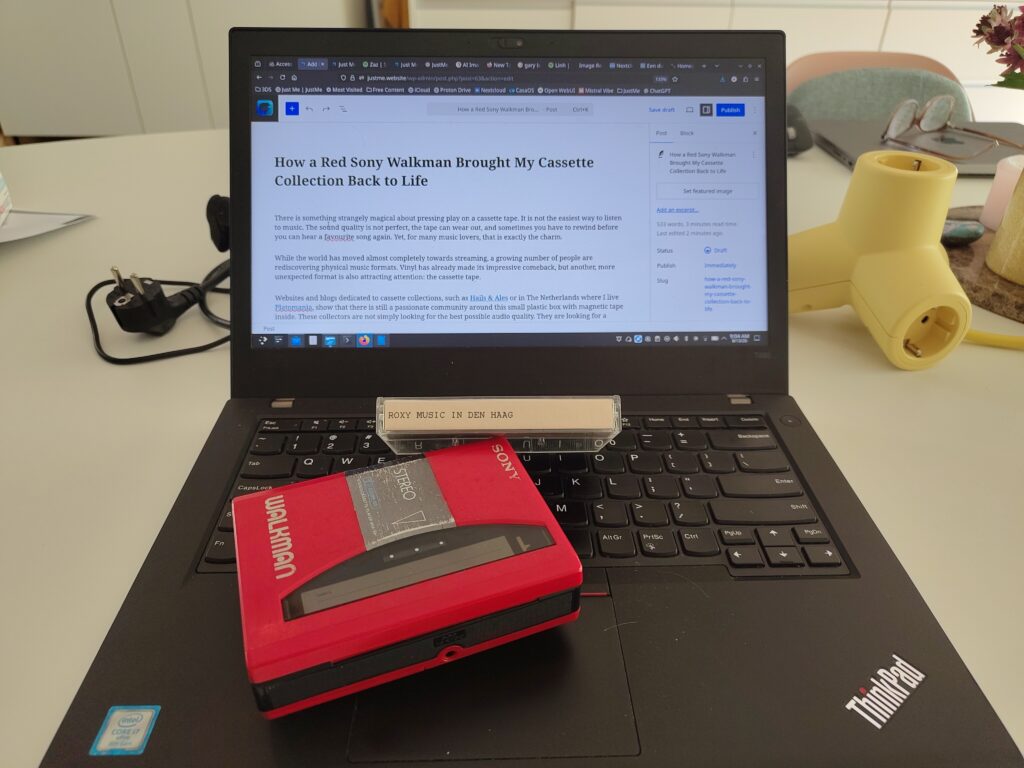
Earlier this year, I bought a bright red second-hand (third-hand or maybe even seventeenth-hand?) Sony Walkman. It was not a practical purchase. In fact, from a purely technical perspective, it makes little sense. I have access to millions of songs through streaming services. I have high-quality digital files at home. I can listen to music anywhere, anytime.

But I bought that Walkman for one specific reason: a cassette recording I have been keeping for years. It is a recording of a Roxy Music concert in The Hague. A fantastic performance by a band that was always about atmosphere, detail and musicianship. When I put that cassette into the Walkman and press play, something remarkable happens. The music itself is already special, but then there is the mechanical sound of the Walkman: the tiny motor running, the subtle noises from the tape mechanism, the feeling that the music is physically moving through the device. That combination creates a completely different atmosphere.

The little imperfections become part of the experience. The slight hiss, the mechanical sounds, the fact that this is not a perfectly clean digital stream — they all add something human. It feels less like playing a file and more like opening a small time capsule.

Of course, my new Walkman did not arrive quickly. Earlier this year, The Netherlands experienced a period with unusually heavy snowfall, and deliveries were delayed. For a while, I was wondering when my little red music machine would finally arrive. But when it finally appeared, the wait was completely worth it.

That is why I enjoy following websites and communities that focus on cassette music. They understand that listening to music is not only about convenience or technical perfection. It is also about memories, stories and rituals.

At home, I still have a small collection of cassettes. Some are old recordings that have been with me for decades. Others are newer releases that show that the format is not just a nostalgic curiosity. Among them are tapes from the Dutch band Alquin, a group that played an important role in the Dutch progressive rock scene. And I also have a much newer cassette release from Cigarettes After Sex, proving that even modern artists see value in this old-fashioned medium.

Green Claims Are Easy. Proving Them Is the Hard Part

A friend of mine, Marco Verzijl, has been fighting for more transparency around data center sustainability and energy consumption for years. Whenever we talk about data centers, energy efficiency or sustainability, Marco usually comes back to the same basic point: claims are easy. Measurements are much more interesting. That is also the central idea behind a recent article he wrote for DCpedia.net (text in Dutch). Marco argues that a sustainable data center should not simply say it is sustainable. It should be able to prove it with reliable, traceable and independently verifiable data. I think that distinction is becoming increasingly important.

AI changes the discussion

Data centers have always consumed substantial amounts of electricity, but AI is rapidly changing the scale of the discussion. Powerful GPUs increase power densities, cooling becomes more demanding and access to sufficient grid capacity is turning into an important economic issue. At the same time, we increasingly depend on data centers. Hospitals, banks, government services, industrial systems, cloud platforms and, of course, AI applications all rely on physical digital infrastructure.

So the useful discussion is probably not whether we should have data centers at all. As Marco puts it, the real question is: which data centers do we need, for which applications, in which locations and with what demonstrable energy and societal performance? Answering that requires data.

PUE is only part of the story

One thing I particularly like about Marco’s argument is his criticism of looking at isolated sustainability indicators. Take PUE, or Power Usage Effectiveness. It is an important metric because it tells us something about how efficiently a data center uses energy for cooling, power distribution and other supporting infrastructure. But it does not tell us whether the servers themselves are doing anything useful.

Marco uses a nice analogy: an extremely fuel-efficient truck that drives around almost empty is still being used inefficiently. The same applies to a data center. A facility may have an excellent PUE while large amounts of IT capacity are hardly being used.

That becomes especially interesting with AI. Two models performing roughly the same task can require very different amounts of computing power and therefore energy. Eventually, we need to look beyond energy consumed per building and start asking how much useful digital output we receive per kilowatt-hour.

Green electricity is not enough

The same applies to renewable energy claims. Saying that a data center uses “100 percent green electricity” sounds convincing, but it does not necessarily mean renewable electricity physically powers that facility every hour of every day. Certificates and annual contractual arrangements can make the reality considerably more complicated. Water consumption, backup generators, heat reuse, hardware utilisation and even the lifetime and recycling of servers should also be part of the picture.

Which brings us back to transparency. Marco writes that sustainability data should be based on actual measurements, connected to known measuring points, traceable to source data and independently verifiable. Otherwise, sustainability risks becoming primarily a communications exercise. That seems like a useful principle far beyond the data center industry. Because in the end, as Marco concludes, a sustainable data center is not one that calls itself sustainable. It is one that can prove it.

You can read his article here: https://dcpedia.net/een-duurzaam-datacenter-begint-niet-bij-een-belofte-maar-bij-controleerbaar-bewijs/.

How I Use AI to Give Just Me Its Own Illustration Style

When I started Just Me, I quickly realised that writing the articles was only part of the job. A blog also needs a visual identity. Not necessarily a complicated one, but something that makes the site feel consistent. For me, illustrations are an important part of that.

I could of course use stock photography. There is certainly enough of it available. But I find that stock images often look exactly like what they are: stock images. The same smiling people behind laptops, the same futuristic server rooms and the same glowing AI brains seem to appear everywhere. That is not really what I wanted for Just Me. So I started experimenting with AI-generated illustrations instead.

Finding a style instead of generating random images

The interesting part is that I don’t simply ask AI to create an image for every article. That would be easy, but it would also produce a fairly random collection of pictures. Instead, I use AI to create illustrations within a recognisable style.

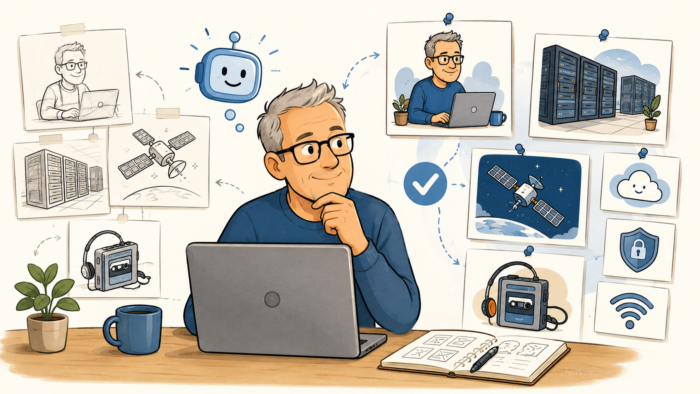
Most Just Me illustrations are deliberately cartoon-like. They are fairly simple, friendly and colourful without becoming childish. They should support the article, not compete with it. Sometimes there is a person working behind a laptop. Sometimes it is a data center, a satellite, a cassette player or somebody struggling with a piece of software. The subjects can be completely different, but I try to make the illustrations feel as if they all belong to the same website. That consistency is important.

AI gradually learns what I mean by “Just Me style”

This is also where working with AI becomes interesting. Over time, I have developed a kind of shorthand. I can ask for an illustration “in Just Me style”, while also describing the subject of the article and the scene I have in mind. That doesn’t mean the AI magically understands a formal design manual. There isn’t one.

The style has developed through repetition. I generate an illustration, look at the result and adjust it. Perhaps the image is too realistic. Perhaps the person looks too young. Maybe the background is too busy or the whole thing has that slightly overproduced AI look that I try to avoid. Then I refine the instruction.

After doing that repeatedly, certain elements start returning. The drawing style, the level of detail, the way people are depicted and the overall atmosphere gradually become more consistent. In other words, I am not asking AI to invent a new visual style every time. I am using it to keep working within a visual direction that has already been established.

Sometimes the character is me

There is another small detail. In some illustrations, the person is supposed to represent me. That means I don’t want the standard AI-generated young tech worker with perfect hair sitting behind an impossibly clean laptop. I am somewhat older. I have grey hair. And my desk is probably not quite as perfectly organised either.

Once that character had appeared in a few illustrations, it became another recurring element of the visual language of Just Me. That is something I rather like. The blog is called Just Me, after all.

The AI does the drawing, but I still make the decisions

Using AI for illustrations doesn’t mean pressing a button and accepting whatever comes out. I still decide what I want the illustration to communicate. Should it be serious or slightly humorous? Should the technology itself be visible? Does the illustration need a person at all? What should be happening in the image? There are often several iterations before I use one. In that sense, AI is less of an automatic illustration machine and more of a tool that makes it possible for someone who isn’t an illustrator to develop a reasonably consistent visual identity. And that, for me, is the useful part.

Consistency matters more than perfection

I don’t think every illustration needs to be perfect. In fact, I probably prefer them not to be. Just Me isn’t meant to look like a carefully polished corporate publication. It is a personal website where I write about technology, digital autonomy, sustainability, space, music, personal knowledge management and whatever else catches my attention.

The illustrations should have the same feeling. They make the site more recognisable, add a little personality and help connect articles about very different subjects. AI simply gives me a practical way to create them.

And after generating enough of them, something interesting happens: what started as a few experiments gradually becomes a style of its own. Not because I designed an elaborate visual identity beforehand. Mostly because I kept saying: make it a little more like Just Me.

Open or Open (AI) Washing?

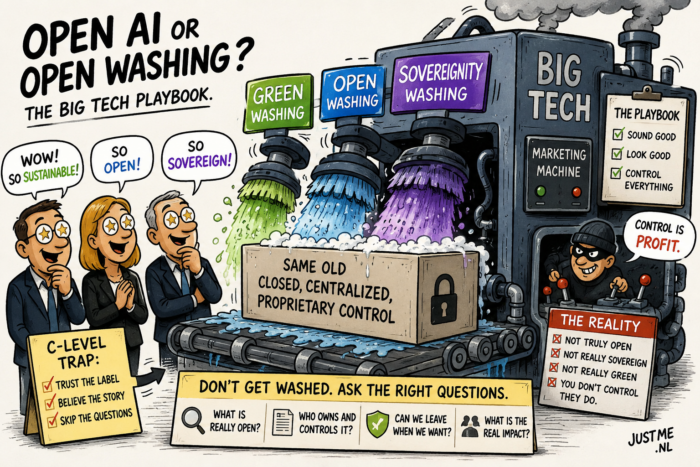
The technology industry has a long history of using attractive words to create a positive image. “Green”, “sustainable”, “responsible”, “sovereign” and now “open” are all terms that sound reassuring. But increasingly, these words are also becoming part of a familiar marketing strategy: make a product or service appear more independent, transparent or responsible than it really is.

We have seen this before with greenwashing. Companies present themselves as environmentally friendly while the reality behind their operations is often much more complex. A few sustainability initiatives or carefully chosen words can create the impression that a company is leading the way, even when the underlying business model has barely changed.

The same pattern is now appearing in other areas of technology. Open washing and sovereignty washing have become part of the same playbook.

Recently, I read an interesting article on Tech Policy Press titled “Open washing is everywhere in AI. Four criteria cut through it.” The author is J.J. Jasser, a professor and director of data analytics at Rollins College in Winter Park, Florida. His research examines artificial intelligence, open-source development, and digital literacy. He also contributes commentary on technology and digital literacy to the Orlando Sentinel.

Jasser explains how the word “open” is increasingly being used in artificial intelligence as a marketing term rather than as a clear technical description. The problem is that “open” can mean many different things. A company may release parts of an AI model, publish limited documentation or offer access through an interface, and then present the technology as open. But true openness requires much more: transparency about development, access to relevant information, the ability to inspect and adapt the technology, and meaningful freedom for users. As the author points out, companies often highlight the elements that support the “open” label while keeping important limitations less visible.

This is exactly why open washing deserves attention. The term creates a sense of trust and independence, while the actual level of openness may be far more limited. The same applies to digital sovereignty. In Europe, concerns about dependence on large technology providers have grown significantly. Organisations want more control over their data, infrastructure and AI capabilities. Big Tech companies have responded by introducing so-called sovereign cloud offerings and European cloud regions.

At first glance, this sounds like the solution Europe has been looking for. Data is stored in Europe, services are operated locally and the word “sovereign” appears prominently in the marketing material. But sovereignty is about much more than location. Who owns the technology? Who controls the software? Which laws apply? Where is the company based? Can customers realistically move away if circumstances change? These are the questions that matter.

Using a European data center does not automatically create digital sovereignty. Just as adding a green label does not automatically make a company sustainable, adding the word sovereign does not automatically create independence.

Unfortunately, many C-level executives still fall for these messages. Under pressure to make decisions about cloud, AI and digital transformation, it is tempting to rely on vendor promises and attractive terminology. But technology leaders need to look beyond the marketing language and examine the real level of control they have.

The lesson from the discussion around open AI is therefore much broader. Whether it is greenwashing, open washing or sovereignty washing, the mechanism is the same: take a concept with a strong positive meaning and use it to improve perception.

The answer is not to reject everything Big Tech offers. Many of these technologies are valuable and play an important role in modern organisations. But companies need to ask harder questions and demand more transparency. Because in the end, words like “open”, “green” and “sovereign” only matter when they are backed by reality. A label is easy to create. Genuine openness, sustainability and independence are much harder to achieve.